Original | Odaily Planet Daily (@OdailyChina)
Author|Azuma (@azuma_eth)
The stablecoin sector has welcomed a truly heavyweight new player.
On the evening of June 30, Beijing time, a new company named Open Standard announced the launch of a new dollar stablecoin called Open USD, which will officially launch later this year.
Who is Open Standard? Before today, probably no one had heard of them. The real key information is that, alongside the launch of Open USD, a collaboration list covering 140 companies was unveiled — including payment giants Visa, Mastercard, Stripe, Adyen, financial institutions BlackRock, BNY, DBS, Standard Chartered, Mizuho, and tech company representatives like Google, Shopify, IBM, as well as leading cryptocurrency industry institutions such as Coinbase, OKX, Bybit, Ripple, Fireblocks, MetaMask, covering multiple fields like payments, banking, internet, and digital assets.
Open Standard states that the goal of Open USD is to create a stablecoin "for global capital flow," providing businesses with a lower-cost and more open on-chain dollar infrastructure.
After the news was announced, the capital market reacted swiftly. The stock price of stablecoin issuer Circle (CRCL) plummeted by 17.55% in a single day, marking the largest drop in recent times. The market generally believes that the launch of Open USD signifies that the stablecoin industry has finally welcomed a true competitive new challenger.
What makes Open USD different?
At first glance, Open USD seems not much different from USDC and USDT, also being a stablecoin pegged to the value of the dollar and equally using an over-collateralization model. However, in terms of issuance and operational mechanisms, Open USD has made several distinctly different designs, and these design points seem somewhat aimed at challenging Circle...
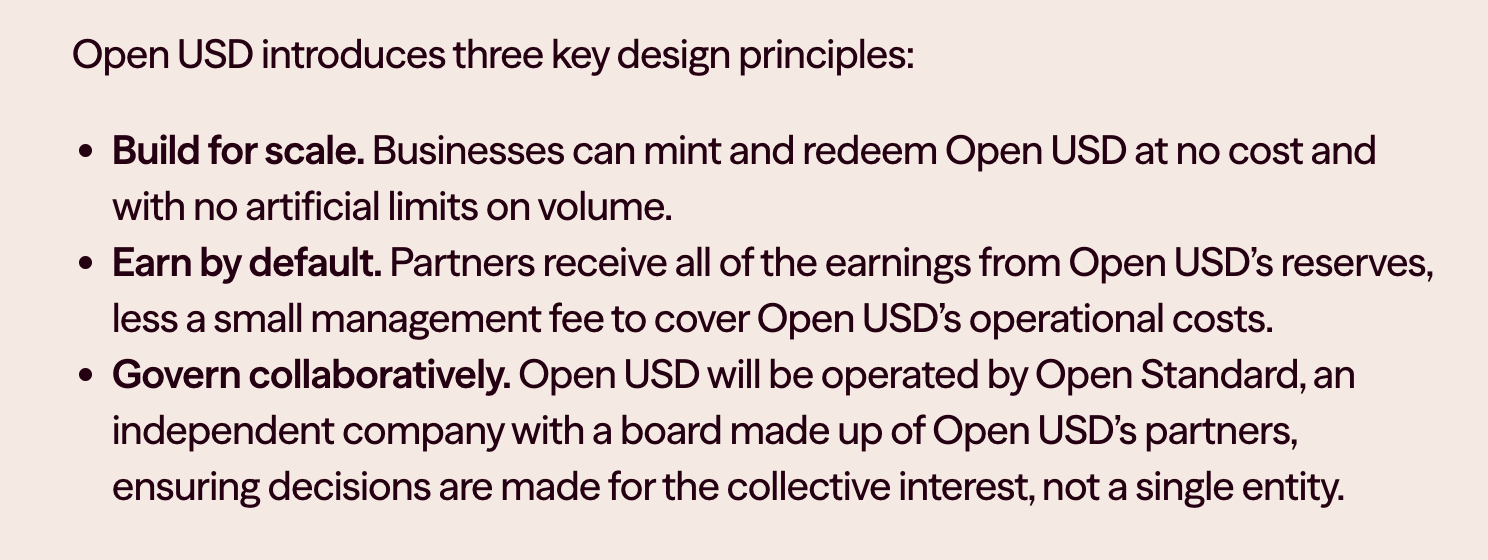
First, there is minting and redeeming at zero cost.
Open USD officials state that enterprise users can mint and redeem stablecoins without limit and at zero cost, without additional scale restrictions. For payment institutions and financial institutions that need to handle large capital flows, this means lower capital usage costs and lowers the access threshold for stablecoins as a payment infrastructure.
Secondly, and most crucially — the income generated from reserve assets will belong to the partners.
This is the biggest difference between Open USD and existing mainstream stablecoins. Currently, most stablecoins, including USDC, allocate the U.S. dollars deposited by users to low-risk assets like U.S. Treasury bonds, and the interest income generated primarily belongs to the issuers, which is also one of Circle's most important sources of profit.
In contrast, Open USD adopts a completely different model. Officials state that the income generated from the stablecoin reserves will default back to the partners, with Open Standard only charging a small management fee to cover daily operational costs. In other words, the reserve income that was previously enjoyed solely by the issuer will be redistributed to all participants in the ecosystem.
Lastly, there is a change in collaborative governance.
Open USD is not operated independently by any single company but is managed by Open Standard, with partners collectively forming a board that participates in future development directions and major decisions.
The officials refer to this model as "Neutral Governance," hoping to make Open USD an open industry infrastructure rather than a product belonging to any one company.
Circle faces a true formidable opponent
In recent years, there have been numerous stablecoins attempting to challenge USDC, but most have struggled to truly shake Circle's market position. The reason is simple; the biggest moat for stablecoins has never been technology but rather trust, compliance, and adoption rate.
In terms of compliance, Circle has long actively embraced regulation and is one of the most mature stablecoin issuers under the U.S. regulatory framework; in terms of adoption rate, USDC has been widely integrated by Coinbase, Visa, Stripe, Robinhood, as well as many exchanges, wallets, and payment institutions, forming a notable network effect. For newcomers, merely issuing a new stablecoin is not difficult; the real challenge is to get the entire industry to be willing to use it.
However, Open USD is different; unlike past stablecoins that relied on a single company and needed to promote from scratch, Open USD has had a luxurious partnership list covering payments, banking, the internet, and the crypto industry from its inception. Companies like Visa, Mastercard, Stripe, BlackRock, Coinbase, Google, Shopify are themselves the most important potential users and promoters of stablecoins.
More importantly, many of these companies were originally significant participants in the USDC ecosystem. For example, Coinbase has long maintained deep cooperation with Circle, jointly promoting the development of USDC; while payment giants like Stripe and Visa have been important drivers for the landing of stablecoin payments in recent years.
Now, with these companies collectively joining Open Standard, it undoubtedly means that Open USD stands at a much higher starting point in compliance, channels, and adoption rate than ordinary new projects. For Circle, this could be the real challenge.
One of the biggest advantages of USDC in the past has been that it was almost the default choice when institutions entered the on-chain dollar system. However, when a large number of heavyweight players choose to create a new open standard, the market will begin to reassess a question — if a company can achieve similar compliance capabilities, similar network coverage, and share the income generated from stablecoin reserves, why should it continue to help Circle build the USDC network?
CRCL plummets over 17%, should we hold?
After the official announcement of Open USD, Circle (CRCL) stock price dropped over 17% last night — in addition to the competitive pressure from Open USD, being kicked out of Russell was another key negative factor.
FTSE Russell, in its latest annual index restructuring, removed Circle (CRCL) from five major Russell growth index benchmarks. This is a direct blow to institutional holdings.
Given that Open USD will not be released until later this year, USDC's market share in the short term will not face a fierce blow, but the real concern in the market is whether USDC's moat built on first-mover advantage, compliance system, and liquidity network remains solid.
The emergence of Open USD has already prompted the market to begin reassessing Circle's business model — when companies can jointly issue stablecoins and share reserve income, can Circle continue to solely enjoy the dividends brought by stablecoin growth?
These questions may not yet have answers, but the significant drop in CRCL indicates that the capital market has started to reprice this possibility.
As a holder of CRCL, I will not choose to reduce my holdings during this current FUD sentiment, but I will definitely reassess my expectations for this operation after CRCL stabilizes.
免责声明:本文章仅代表作者个人观点,不代表本平台的立场和观点。本文章仅供信息分享,不构成对任何人的任何投资建议。用户与作者之间的任何争议,与本平台无关。如网页中刊载的文章或图片涉及侵权,请提供相关的权利证明和身份证明发送邮件到support@aicoin.com,本平台相关工作人员将会进行核查。


