Institutions and hedge funds are exiting, while retail investors are entering even more aggressively!
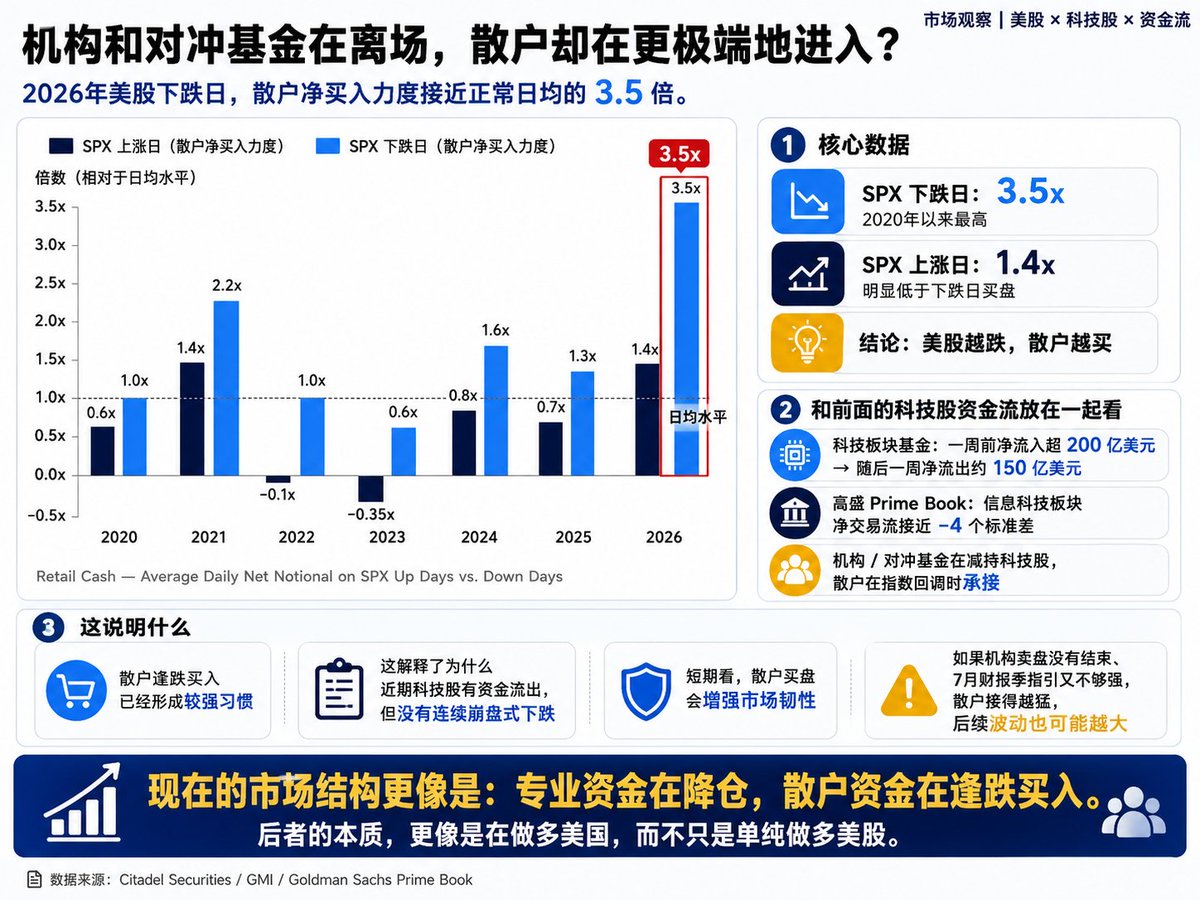
According to the latest data from Citadel Securities and GMI, when the S&P 500 declines in 2026, the average net buying intensity of retail investors in cash stocks is close to 3.5 times the normal daily average, marking the most extreme instance since 2020. In contrast, on days when the S&P increases, the net buying intensity of retail investors is only about 1.4 times.
In simpler terms, the more the U.S. stock market falls, the more retail investors buy, and they buy much more aggressively on down days than on up days.
When viewed together with the earlier data on capital outflow from tech stocks, the sense of conflict is strong. On one hand, funds in the tech sector went from a net inflow of over $20 billion to a sudden net outflow of $15 billion; on the other hand, Goldman Sachs' Prime Book indicates that hedge funds and institutional accounts are showing extreme net selling close to -4 standard deviations in the U.S. information technology sector.
It is clear that institutions and hedge funds are reducing their holdings in tech stocks, while retail investors are stepping in strongly when the index drops.
This also explains why, despite recent capital outflows from tech stocks, there hasn’t been a particularly sustained collapse. Because with each index pullback, retail investors are rushing in to buy. Over the past few years in the U.S. stock market, especially in AI and tech stocks, many retail investors have been trained into a "buying on dips" trading habit. In the past, declines easily triggered panic; now declines have turned into a buy signal.
Of course, this is also strongly related to the fact that the U.S. stock market has been on an upward trend in recent years, especially as it seems that after significant drops, the recovery tends to be even stronger—April 2025 is the best example.
However, I researched a bit and found that including the larger scale declines in April 2025 and March 2026 were either due to Trump stirring things up, or it was still Trump stirring things up, one being the tariff war where the U.S. and China raised tariffs to the ceiling, then there was the U.S. TACO, and the other was the war between the U.S. and Iran, which also feels like the U.S. TACO 🤣
So, this approach does carry some risks. While retail buying on dips can make the market more resilient in the short term and lead to quick recoveries from many pullbacks, if institutional selling hasn’t ended, and if tech funds continue to flow out, and the July earnings season does not provide sufficiently strong profits and guidance, then the more aggressively retail investors buy, the greater the volatility they may have to endure later.
Professional funds begin to reduce positions when the crowd is loud, while retail investors accelerate buying during each decline.
It’s hard to judge which approach is correct in today’s U.S. stock market. At least from the trading perspective, both the former and the latter have made money, only the latter needs to endure a little longer, and the essence of the latter is to go long on America, not just to go long on U.S. stocks.
#Bitget is here, and it’s VIP! Crypto, U.S. stocks, CFD, the global opportunity all in one place!
免责声明:本文章仅代表作者个人观点,不代表本平台的立场和观点。本文章仅供信息分享,不构成对任何人的任何投资建议。用户与作者之间的任何争议,与本平台无关。如网页中刊载的文章或图片涉及侵权,请提供相关的权利证明和身份证明发送邮件到support@aicoin.com,本平台相关工作人员将会进行核查。


