The characteristics of CRS in China — Taxes on joint accounts that cannot be paid!
Yesterday while having a meal with my friends, we talked about CRS, and it was more than just a mild annoyance, the situation is as follows.
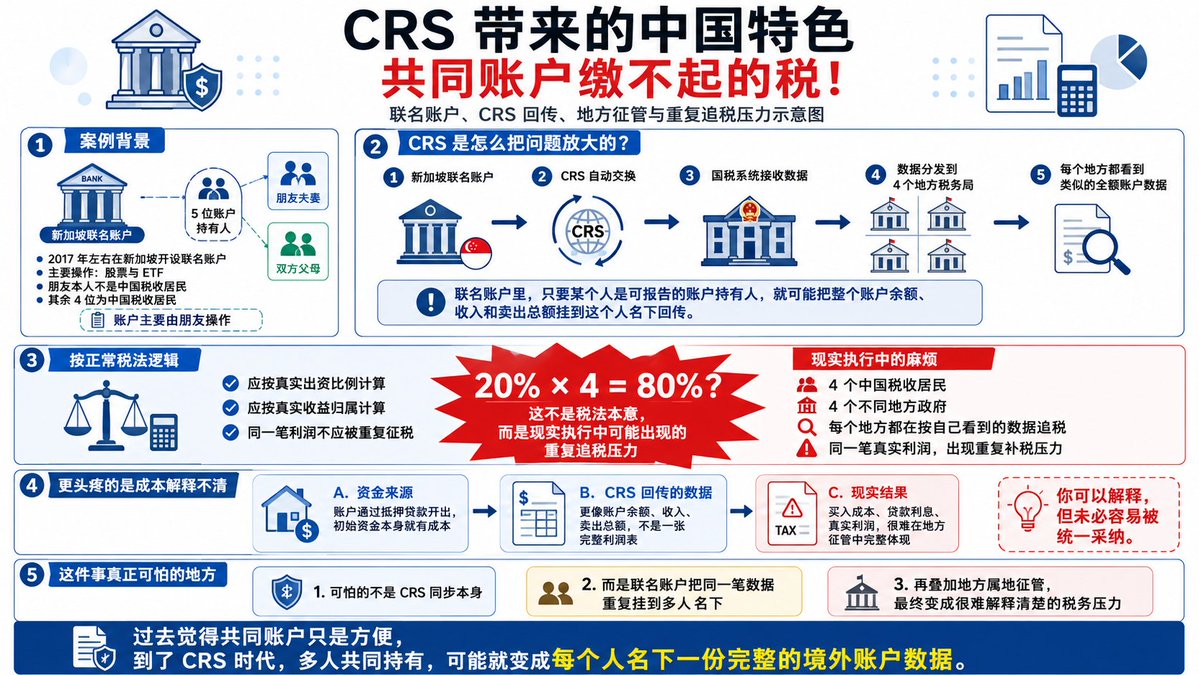
A friend is an entrepreneur in China, and around 2017 opened a joint account in Singapore. The account holders are a total of five people, including the friend and his spouse, as well as both parents. The money in the account is primarily managed by the friend, mainly invested in some stocks and ETFs, and indeed made some profits later on.
The friend himself is not a tax resident of China, but the three elderly individuals and his wife are still Chinese tax residents. As a result, about a month ago, Singapore exchanged account information prior to 2025 back to China through CRS, and the troubles began.
The friend and his wife are in Singapore, so they were hardly contacted by the local tax bureau. However, both sets of parents are in China, and the friend's mother-in-law was contacted, though not with high frequency. The most troublesome situation is for the friend’s father, who has been almost constantly called by the local tax bureau, primarily demanding back taxes.
Up to this point, it seems relatively normal; after all, the overseas account information was synchronized back through CRS, and profits need to be explained, tax issues need to be communicated, which can be understood. The real problem is the joint account.
Logically, for a joint account held by five people, the calculations should be based on the actual contribution proportions and actual profit proportions of the five individuals. However, the reporting logic of CRS is not that detailed. In a joint account, as long as one person is a reportable account holder, the entire account balance, income, and total sales amount may be reported under that person's name.
This becomes very problematic.
In one account held by four Chinese tax residents, four different local governments all see similar full data. According to normal tax law logic, the same profit should not be taxed separately by all four individuals. However, in actual execution, local tax bureaus see that this person has overseas account data in their jurisdiction, so each locality pursues tax based on the data they see.
The consequence becomes a very characteristic issue in China. Each local government's tax rate is 20%, which turns into a total tax on profits of 80%, rather than simply 20%.
This is not the end of the story.
The friend's account in Singapore was opened with a mortgage loan, meaning the initial funds came from loans against mortgaged assets, so this initial capital has a cost. However, the tax bureau receives only sales data from the CRS and cannot prove the costs of the initial funds. You might say, I can provide that, but they refuse.
You might say this money has interest to repay, not all profits should be counted as income, but they do not care. Regardless of how the money came in or whether there were costs, as long as it is actual transaction funds, taxes must be paid.
So the most troublesome part of this matter is that once CRS data enters local governments in China, it may lead to very blunt enforcement. After the overseas CRS sync, the national tax authority distributes the data to local tax bureaus, which then go to find individuals locally.
Additionally, the joint account causes the same data to be reported multiple times under several account holders' names. This leads each locality to believe that individuals in their jurisdiction should pay back taxes. From a legal standpoint, the same real profit should not be taxed multiple times. But in practical operations, it might result in everyone being pursued for repayment.
This is also why I say that once CRS arrives in China, the greatest concern is not the tax synchronization itself, but rather the difficulty in providing clear explanations.
Thus, many friends who opened joint accounts overseas never thought about this issue that could arise later. They believe it is all their family's money. However, after CRS syncs, multiple parties sharing a joint account turns into each person having a complete set of overseas account data under their names.
#Bitget arrives and you are a VIP! Crypto, US stocks, CFDs, a one-stop layout for global opportunities
免责声明:本文章仅代表作者个人观点,不代表本平台的立场和观点。本文章仅供信息分享,不构成对任何人的任何投资建议。用户与作者之间的任何争议,与本平台无关。如网页中刊载的文章或图片涉及侵权,请提供相关的权利证明和身份证明发送邮件到support@aicoin.com,本平台相关工作人员将会进行核查。


