Original source: Wall Street Journal
From April 28 to May 27, the Japanese Ministry of Finance spent 11.7 trillion yen to buy yen. This is the largest single-month scale in the history of Japanese foreign exchange intervention.
On June 30, the yen against the dollar fell to 162.62—the lowest since December 1986. On July 8, it reached this position again during trading. Today, it continues to trade above 162.
11.7 trillion, which lasted less than six weeks.
It is not that the Bank of Japan did not try. In June, the policy interest rate was raised to 1%, the highest in 31 years. Since the end of negative interest rates in March 2024, cumulative rate hikes have exceeded 100 basis points. Coupled with the intervention of 9.8 trillion yen in 2024, the Ministry of Finance has spent over 21 trillion in dollar reserves in these two years.
Goldman Sachs is not buying it. On July 6, strategist Karen Reichgott Fishman directly raised the one-year target for the dollar against the yen from 155 to 165—one of the most pessimistic forecasts on Wall Street. Market pricing shows that traders believe there is a 72% probability of reaching 165 before June 2027.
This is not about "raising by another 25 basis points." What the Bank of Japan is facing is a war it was destined to lose from the start.
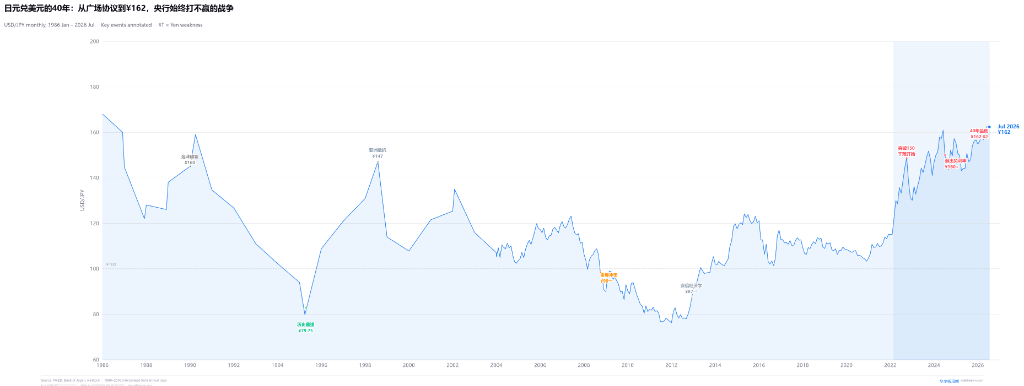
The Gravity of 275 Basis Points
The foreign exchange market does not trade absolute values; it trades differences.
The Federal Reserve's benchmark interest rate is 3.50-3.75%, while the Bank of Japan’s is 1%. A difference of 275 basis points. The latest CFTC data shows that hedge funds' net short positions in yen are at their most extreme level in recent years.
275 basis points mean a trade repeated countless times every day: borrowing yen—where the inflation rate exceeds 3%, a 1% interest rate translates to a real negative interest rate—exchanging it for dollars, purchasing U.S. bonds yielding over 4.5%. Not accounting for exchange rate fluctuations, annualized carry trade yields exceed 3%. For every point the yen depreciates, returns increase further.
This is not some sort of "market sentiment." This is mechanism. Carry trades do not care whether the Bank of Japan raises by 25 basis points or 50 basis points, they only care about the water level difference between the U.S. and Japan. As long as the Federal Reserve does not cut rates—while oil prices are soaring, the situation in Iran is escalating, and the shadows of inflation in the U.S. are far from dissipating—the yen is facing not the Bank of Japan, but the gravitational field of the entire dollar system.
The reason the 11.7 trillion yen intervention was digested by the market in less than six weeks is not because the amount was not large enough. It’s because the direction is wrong.
For Every 4 Yens Collected, 1 Yen Goes to Interest
More lethal than the U.S.-Japan interest rate differential is Japan's fiscal policy—a chain bound to the Bank of Japan's feet that tightens the more it struggles.
The total budget for Fiscal Year 2026 is 122.3 trillion yen, a historical record. Among this, "debt service"—the spending used to repay principal and interest on government bonds—amounts to 31.3 trillion yen, an increase of a whole 3 trillion from the previous year’s 28.2 trillion, consuming a quarter of the budget.
For every 4 yens in taxes collected by the Japanese government, 1 yen goes to creditors.
What’s more troubling is that this figure is accelerating.
The yield on 10-year Japanese government bonds has risen from 0.25% in 2022 to 2.88% today. The Japanese government is not repaying old debts; it is borrowing new debts to repay old debts—with government debt exceeding 250% of GDP, maturing debts rely on new bonds issued for payment, and the interest rates on new bonds are several times higher than those on old ones. Within the 31.3 trillion yen debt service, the growth rate of the interest portion far outpaces that of principal repayment. Interest on interest will cause a snowball effect.
If the yield on 10-year Japanese government bonds rises another 100 basis points—without being overly aggressive, the Bank of Japan continues to raise rates, or even just reduces bond purchases—the debt service will easily surpass 35 trillion yen and approach 40 trillion yen. By then, for every 3 yens in taxes collected, 1 yen will be paid in interest.
This is the ceiling for the Bank of Japan’s interest rate hikes. It’s not that inflation prevents hikes or that politics prevent hikes; it’s that the Ministry of Finance has done the math: if you raise rates by another 50 basis points, the yen may not appreciate by 100 points, but my interest bill will increase by several trillion. The market will also factor this calculation—thus, raising rates not only does not boost the yen, but rather makes the market more certain that the Bank of Japan will eventually be constrained by the Ministry of Finance.
Brakes and Accelerator
The attitude of the government under Prime Minister Kishida towards fiscal policy is exactly the opposite of that of the Bank of Japan.
In the fiscal year 2026 budget, defense spending exceeds 9 trillion yen, marking the 14th consecutive year of growth, with its proportion of GDP reaching 2% in fiscal year 2025. The ruling coalition is discussing a suspension of the food consumption tax, which, once implemented, will lead to a reduction of 4 to 5 trillion in revenue per year. Various economic stimulus measures and household subsidies continue to escalate. Nomura Securities had already warned at the beginning of the year that this "Kishida trading" model—where Japanese stocks rise, the yen falls, and long-term Japanese bonds come under pressure—mirrored the logic of market pricing seen in former British Prime Minister Truss's "mini-budget": the government spends without limits, and the market sets the price for you.
The only difference is this: Truss resigned in 45 days. Japan's fiscal expansion has lasted for thirty years.
Raising rates tightens monetary policy, while issuing bonds releases it. The central bank steps on the brakes, and the Ministry of Finance steps on the accelerator. Ironically, the Bank of Japan itself is the largest holder of Japanese government bonds—though its monthly bond purchase plan is being reduced, as long as it continues to buy, every 1 yen of government bonds purchased is releasing 1 yen into the market. While raising rates drains liquidity, purchasing bonds injects liquidity, and these two actions offset each other.
The market does not need to be composed of economists to understand: every card in the Bank of Japan's hand is canceled out by another card.
5346 Companies
The numbers behind this reflect real costs.
On July 8, the Tokyo Shoko Research Company announced: in the first half of 2026, 5346 companies in Japan with debts exceeding 10 million yen went bankrupt, an increase of 7.1% year-on-year, marking the fifth consecutive year of increase, and it was the first time in 12 years that the number surpassed 5000 in the first half.
Among those that went bankrupt directly due to yen depreciation were 45 companies, 32.3% more than the previous year, the highest since records began. The wholesale industry bore half of this—23 out of the 45 companies were from this sector, compared to only 14 at this time last year. In addition, bankruptcies due to staff shortages increased by 37.7%, while those due to rising prices rose by 27.6%.
These numbers illustrate a fact obscured by the "new highs in large enterprise profits": yen depreciation is not universally beneficial.
Toyota, Sony, and Hitachi enjoy the benefits of exports, with overseas profits magnifying automatically when converted back to yen. But the vast majority of Japanese companies are not Toyota—they rely on imported raw materials, cater to the domestic market, and are reluctant to raise prices. Three decades of zero interest rates and a cheap yen have fostered a massive ecosystem of small and medium-sized enterprises. Now, with rising interest rates, falling yen, and increasing prices, this ecosystem is collapsing.
Labor shortages are the other side of the same coin. Large businesses attract young people with high salaries, while small businesses do not lack orders but lack staff. Data from the Empire Database indicates that bankruptcies due to labor shortages have hit a historical high.
No Winning Possibilities
Three paths, three costs in different directions.
Not raising rates. The yen continues to depreciate, import costs keep rising, and small and medium-sized enterprises keep going bankrupt. Social discontent continues to accumulate.
Raising rates. Government bond interest skyrockets, fiscal sustainability collapses, and the market bets that the central bank will eventually be called off by the government—the yen continues to depreciate because what the market sees is "exit illusion," not determination to tighten.
Raising rates in combination with a reduction in asset purchases. Japanese bond yields soar, global carry trades reverse, and Japanese investors sell off overseas assets to repatriate funds—in the short term, the yen may indeed appreciate, but the script for August 2024 is already on the table: that unexpected rate hike from the Bank of Japan triggered not a steady rebound of the yen but a collective crash of global stock markets.
None of the three paths lead to success, because the issues cannot be resolved by monetary policy. Japan's 250% government debt, continuously shrinking labor force, and year-after-year expanding fiscal deficits—these are not matters that can be changed by increasing or decreasing interest rates by 25 basis points.
On the day Goldman raised its target to 165 on July 6, the market was not waiting for the Bank of Japan's next meeting. What it was doing was pricing a deeper matter: whether the Bank of Japan has any chance of winning.
The answer is becoming increasingly clear: it has been destined to lose from the very beginning.
162.62 is not the endpoint, and 165 is likely not either. Unless fiscal discipline returns miraculously or the Federal Reserve significantly cuts rates, this "impossible triangle" will only become more entrenched. The direction of the yen does not depend on Tokyo but on Washington, Riyadh, and deeper elements within global capital flows.
What the Bank of Japan can choose is only whether to lose more slowly or to lose more painfully in this war it is doomed to lose.
免责声明:本文章仅代表作者个人观点,不代表本平台的立场和观点。本文章仅供信息分享,不构成对任何人的任何投资建议。用户与作者之间的任何争议,与本平台无关。如网页中刊载的文章或图片涉及侵权,请提供相关的权利证明和身份证明发送邮件到support@aicoin.com,本平台相关工作人员将会进行核查。


