Wall Street is rushing to position itself in Bittensor ETF, hiding huge ecological imbalance hazards behind it.
Written by: Thejaswini M A
Translated by: Chopper, Foresight News
When focusing on refining high-quality, long-term feasible products, funds are often slow to arrive; but when only grand, hollow projects are pursued, capital comes rushing in. This is an unchanging rule of the market, from the tulip bubble, the internet bubble, canal stocks, to the NFT wave, cycling repeatedly.
Currently, artificial intelligence is viewed as the next giant bubble. A typical characteristic of bubbles is that market participants leverage heavily, and the entire business model is built on shaky foundations, ignoring underlying system vulnerabilities, eventually leading to collapse, with everyone blaming the failure on the "bubble market."
This article focuses on the Bittensor network, which incentivizes the public to develop AI through tokens, with a rather clever initial intention. The entire network is divided into hundreds of independent ecological units called subnets. Developers build AI-related services, and the system scores the results, allowing developers to instantly receive cryptocurrency tokens TAO as rewards.
Currently, Wall Street is competing to set up Bittensor ETF products, and Bitwise and Grayscale have submitted applications for Bittensor ETF to the SEC, with the hidden vulnerabilities of this system clearly laid out before everyone.
Bittensor builds a decentralized AI network based on the competitive incentive logic of Bitcoin: using tokens to motivate participants to compete with one another, relying on market dynamics to filter high-quality results from poor projects. The entire network is divided into about 128 subnets, each corresponding to a type of segmented AI business, such as model inference, large model training, data scraping collection, and more.
Miners are responsible for mining, and validators are responsible for scoring. TAO pays miners based on the quality assessed by validators. Validators’ rewards are determined by how well their scores match those of other validators, weighted by the stakes they hold. Therefore, a validator's earnings depend on how their scores align with those of other validators, rather than whether their scores are correct.
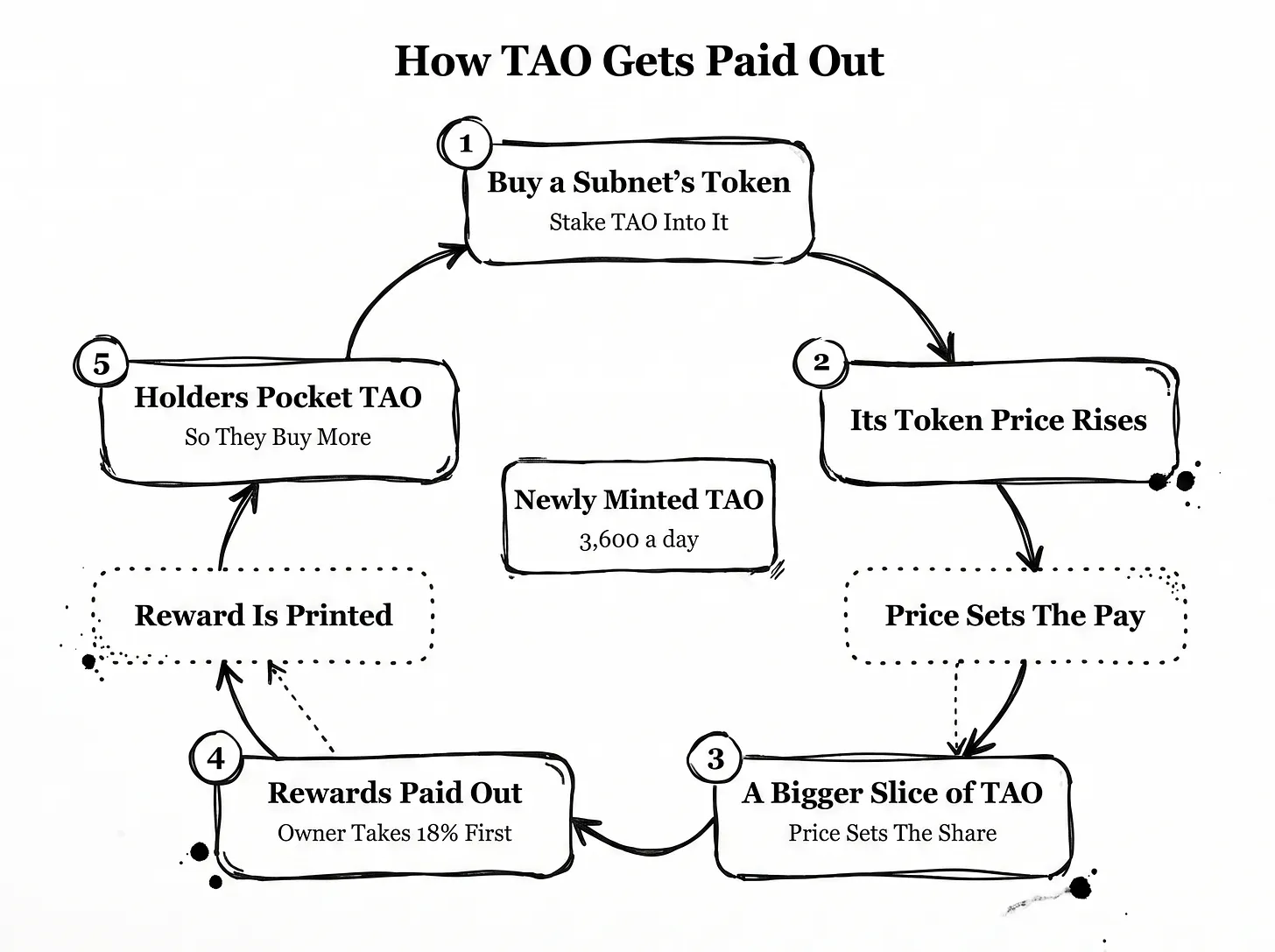
The amount of new TAO allocated to each subnet is determined solely by the native Alpha token price of that subnet, having no relation to the quality of AI results. Furthermore, the subnet operator will first take 18% of the profit share, and the remaining portion will be distributed to other participants.
TAO is a token valued at approximately $2 billion, with around $690 million staked in subnets, which determine which AI projects receive funding.
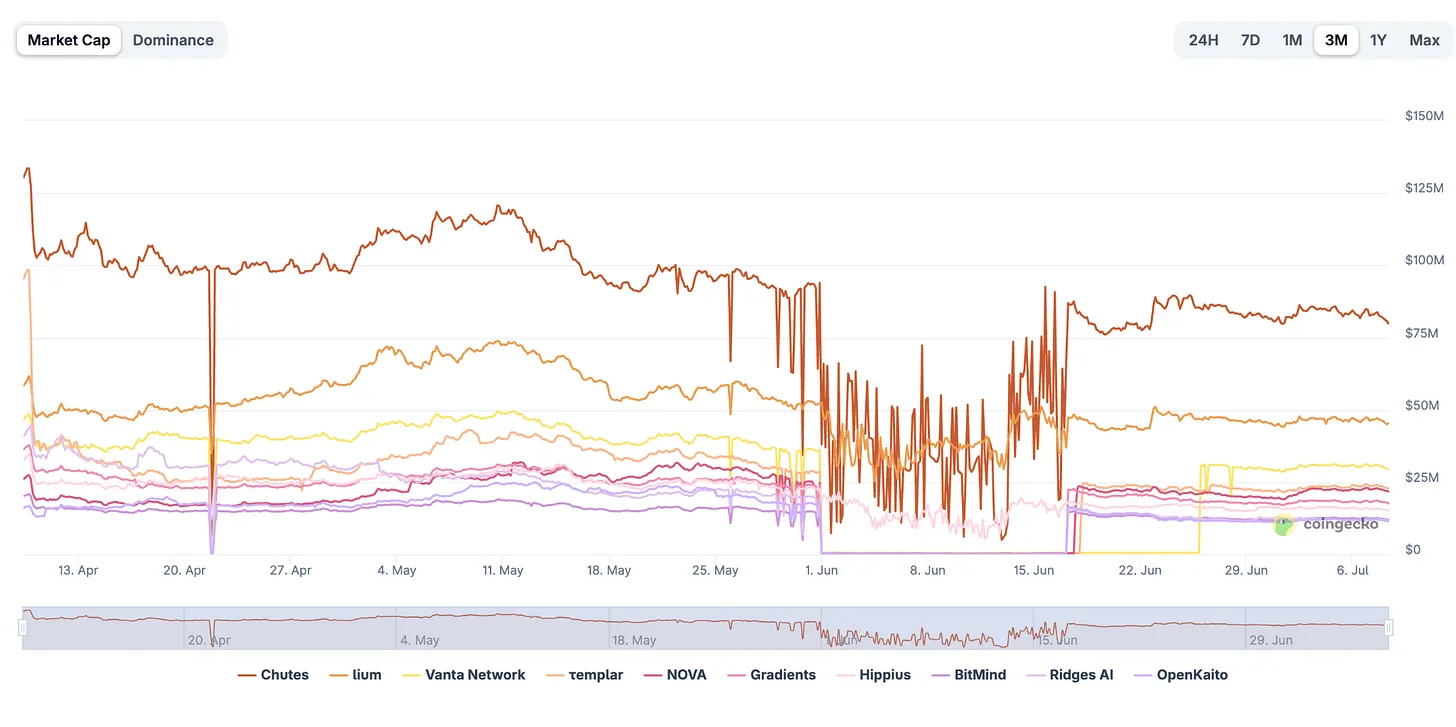
Bittensor subnet token market capitalization ranking, data source: coingecko.com
Each subnet issues an independent native token called Alpha. Users stake TAO in a certain subnet, essentially buying the subnet's Alpha token, which drives up its market price. The proportion of new TAO obtained by the subnet is determined by the average price of the Alpha token over a certain period.
Relying solely on short-term drives cannot sustain a long-term increase in reward shares; continuous purchasing of support coins is essential, forming a self-reinforcing cycle: Buy Alpha → Token price rises → Subnet receives more new TAO tokens → New tokens are directly distributed to Alpha token holders → Holders gain incremental funds to continue buying more. External incremental funds drive up the token price, and rising trends attract more capital to enter.
The only constraint of this cycle is the network's continuous issuance of Alpha tokens; miners and validators, in order to realize profits, can only keep selling, continually putting selling pressure on the token price. A subnet that wishes to continue receiving financial support must have a continuous flow of new buyers to absorb the selling pressure. This is precisely the operational logic that this mechanism is deliberately designed to have.
The advantage of this mechanism is that, relying on independent subnet tokens, investors can individually bet on segmented AI tracks. For example, one can focus solely on the inference subnet without participating in the model training track, and vice versa. Capital can precisely cut into a single link of the AI industrial chain, which is not achievable in traditional stock markets.
However, the on-chain system can only recognize token transfer behaviors and cannot account for the actual usage volume of AI products; there is no clear and traceable commercial income ledger. Token prices are entirely driven by fund flows, unconstrained by actual revenue. The price of traditional stocks has real revenue support, such as Nvidia’s stock price, which has verifiable product sales income behind it; whereas the price of subnet tokens is only supported by secondary market buy actions. When fund inflows become the sole measure, the price is entirely determined by capital excitement.
The design intention of this mechanism is to require validators to objectively and fairly score for miners; the underlying consensus protocol Yuma has also set up anti-cheating rules: if scores deviate too much from the group average, the corresponding score will be invalidated, preventing validators from profiting by deliberately inflating the scores of familiar projects. This design is very clever.
However, this anti-collusion mathematical model has a critical threshold; it is effective only when the amount of staked cheating parties is less than half of the total staked validation amount in the subnet. Once cheating nodes control more than half of the staked computing power, miners and validators can collude in private to inflate scores and split TAO rewards, and the network will automatically distribute profits.
Another significant vulnerability is "score copying": Some validators do not verify AI results but directly copy scores from other validators' public ledgers, receiving rewards without any effort. The project parties introduced a "submission - reveal" mechanism to patch this vulnerability: scores will be encrypted and stored for a period, preventing immediate copying behaviors. However, this solution applies only in scenarios where AI result quality fluctuates continuously; if the subnet's business stabilizes and produces homogenous outputs, copying scores still presents profit opportunities.
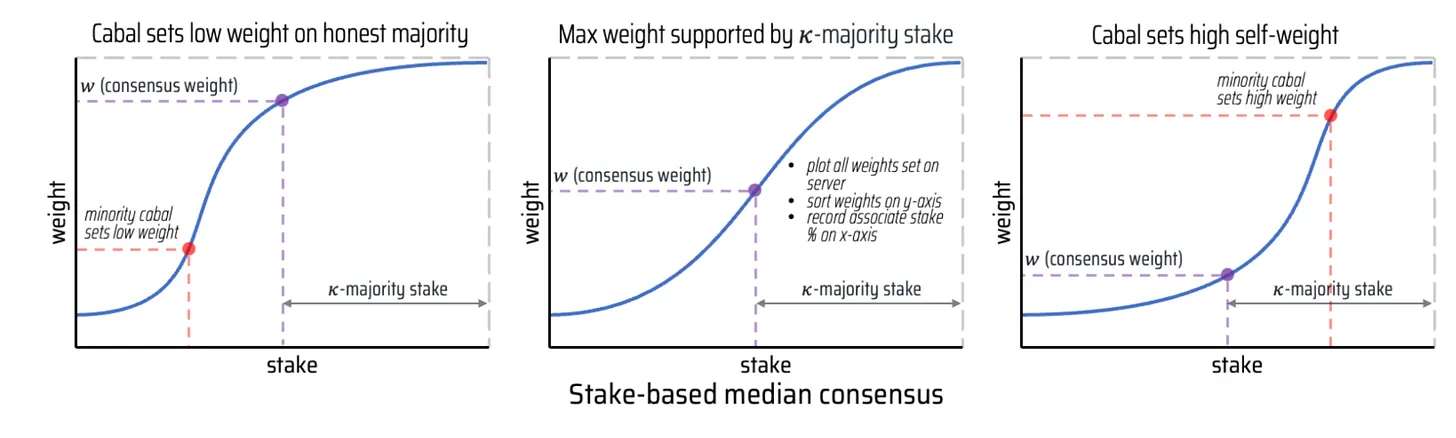
Data source: RaoFoundation subnet
Now, let’s look at the threshold for cheating and who holds the power. The Rayon Labs team operates three major subnets, collectively dividing a quarter of the total daily new TAO in the network; about two-thirds of the entire network's TAO is staked, with large quantities of chips concentrated in a few entities.
This situation elicits two completely opposing interpretations in the market: Perspective one: Bittensor is an efficient market mechanism. There is no need for a closed-door committee to determine the funding qualifications for AI projects; a massive number of market participants publicly bet on various AI tracks, and funds naturally flow toward the promising directions. Capital influx is often a leading sign that a track has potential. Perspective two: Token prices must be linked to real commercial demand to have practical meaning, such as paying customers or realizable sales revenue. The value anchor of Bittensor is extremely weak.
The subnet with the highest earnings in the entire network sees token issuance revenues far exceeding genuine customer payment revenues; the number of core operational entities that can control reward distribution rules is very small. This spring, the project team adjusted the token release rules and sold off a large amount of their token holdings, leading to internal conflicts, resulting in the largest operator in the network, Covenant AI, exiting directly from the network.
Although early mechanism vulnerabilities can be rapidly repaired, the network has already rectified major issues through hard forks. In contrast, the Optimism ecosystem, weary of unchecked pre-funding modes, launched a retroactive funding mechanism: funds are only issued to verified projects with actual value, rather than simply betting on future potential; reward distributions are established post-validation of verifiable outcomes, not through pre-subsidies before token issuance. Gitcoin and Filecoin have also implemented various forms of this kind of thinking.
The core issue of the Bittensor system lies in using circulating token revenue as the incentive measure instead of a more reliable verification standard based on real business realization.
The network changes subnet reward distribution rules twice a year. Initially based on beta token prices, it switched to net staked fund flows (inflow staked funds minus outflow funds) in November last year; this June, due to flaws exposed in the fund flow rules, it reverted to the token price mechanism. Both rules are merely alternative indicators that fail to measure the most critical data—whether there are real users paying for the corresponding AI services.
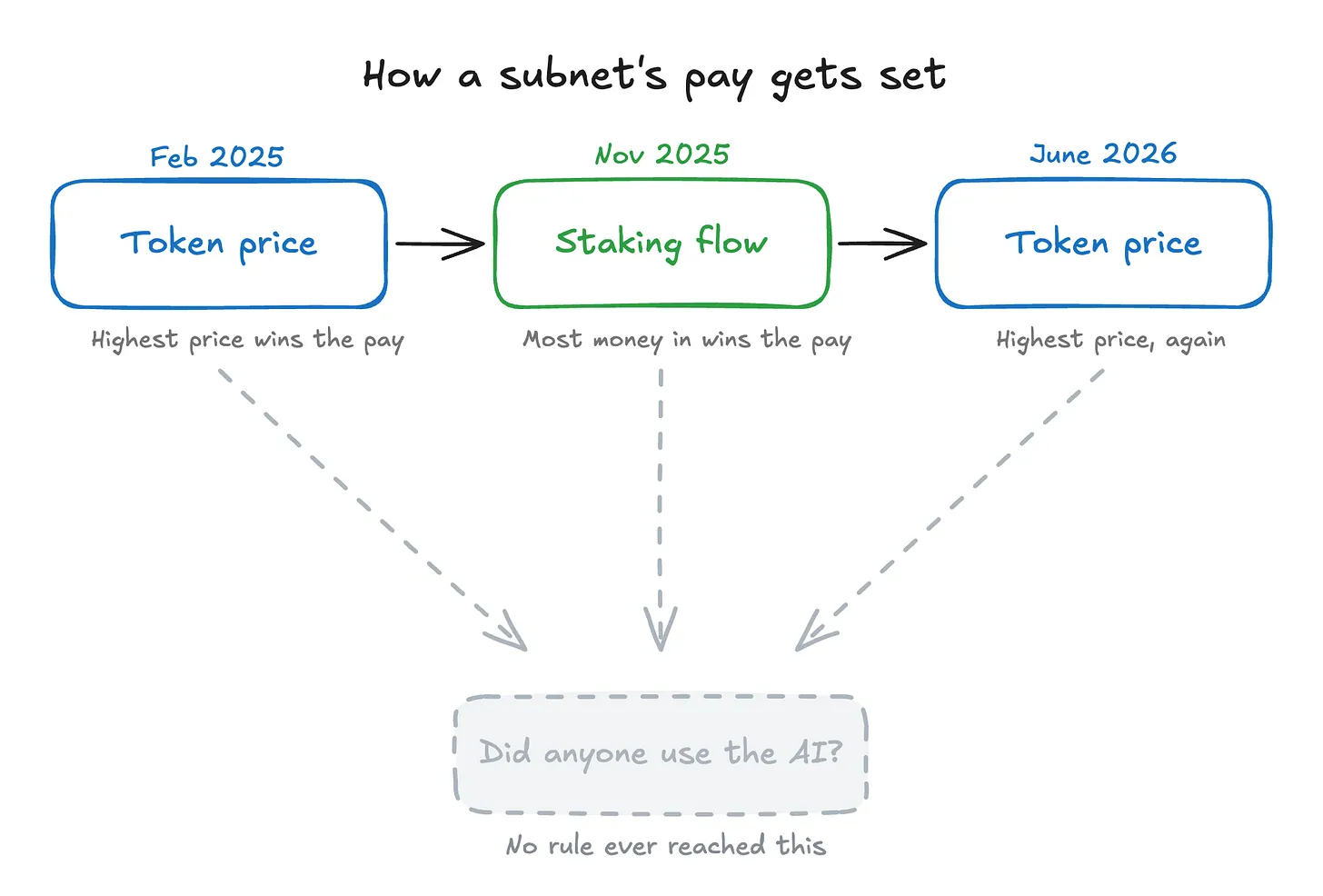
A network willing to overturn its fundamental rules twice in a short time, thus undermining its survival foundation, may have a formidable capability for transformation compared to most networks. However, a calm examination of the two hard forks and rule adjustments shows that all three sets of evaluation standards ignored the key indicator: the willingness of external real users to pay. All rules guide "money chasing money," rather than "value following market demand."
Even if this system suffers from significant idle fund waste, it is objectively building underlying infrastructure. Just as the internet bubble generated the global fiber optic backbone network, the Bittensor craze has produced computational hardware and AI training resources, which, even after the hype fades, still have long-term retention value.
The distributed AI track itself holds tremendous industry advantages; open-source solutions are the only path to breaking the chip giants' monopoly, just as Linux revolutionized the operating system landscape, and Wikipedia reconstructed the encyclopedic content ecosystem. This network is enacting a similar disruptive innovation: The Covexus team trains large models relying on 70 distributed devices, achieving performance surpassing Meta Llama 2, and even gaining public recognition from Nvidia CEO Jensen Huang, yet getting buried in the vast hype of token trading.
This is why this ETF is more than just a harbinger. Grayscale and Bitwise both expect that the U.S. Securities and Exchange Commission (SEC) will respond later this year, around August. Once approved, this inherently flawed system will directly connect to American retirees' investment portfolios. Blindly entering investors will face enormous risks, but the advent of the ETF also represents two positive shifts in the emerging ecology: a massive influx of traditional funds and the complete acceptance of public regulatory scrutiny across the industry. Regulatory endorsement and millions of new shareholders supervising profit distribution throughout represent the most effective way to compel the network to optimize its incentive mechanisms. The ensuing rigorous scrutiny will ultimately push the entire ecosystem towards maturity.
With this optimism, I want to say you should closely monitor what truly matters. Like all young systems with vulnerabilities, this system is still new, and the vulnerabilities need fixing. I want to emphasize the potential behind it: open, multi-party participating, non-proprietary AI, not the closed ecosystems built by large cloud service providers that own the largest server clusters worldwide.
I look forward to subnets being able to independently generate funds without relying on foundation subsidies, indicating that the most powerful technologies of our time do not need to be controlled by a few entities.
免责声明:本文章仅代表作者个人观点,不代表本平台的立场和观点。本文章仅供信息分享,不构成对任何人的任何投资建议。用户与作者之间的任何争议,与本平台无关。如网页中刊载的文章或图片涉及侵权,请提供相关的权利证明和身份证明发送邮件到support@aicoin.com,本平台相关工作人员将会进行核查。


