Key Takeaways
- Coinbase says CLARITY Act strengthens crypto oversight with tougher compliance and enforcement requirements.
- Senator Elizabeth Warren argues current bill language could create opportunities for sanctions evasion.
- Debate focuses on whether crypto regulation improves or weakens national security protections.
Crypto exchange Coinbase (Nasdaq: COIN) pushed back after U.S. Senator Elizabeth Warren (D-MA) warned that the CLARITY Act could pose national security risks, arguing her criticism mischaracterizes the legislation’s impact.
On July 11, Chief Policy Officer Faryar Shirzad said on X that the lack of clear crypto rules leaves financial systems vulnerable. He argued the bill would bring digital asset platforms under stronger oversight.
“The argument that the CLARITY Act compromises national security gets it exactly backward,” Shirzad wrote, adding:
“Right now, the lack of clear rules is what leaves our financial system vulnerable because bad actors thrive in the shadows of regulatory uncertainty. This bill drags them into the light.”
He argued that regulatory uncertainty creates vulnerabilities and that the legislation would require crypto platforms to follow stronger national security standards.
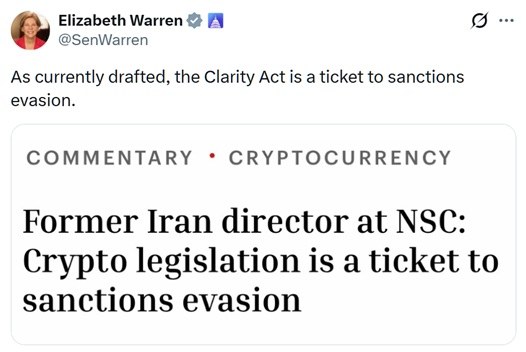
His comment responded to Senator Warren’s X post on July 8 stating: “As currently drafted, the Clarity Act is a ticket to sanctions evasion.” Her criticism focused on concerns that the legislation could weaken safeguards designed to prevent illicit financial activity. The disagreement placed sanctions enforcement at the center of the broader fight over crypto market structure rules.
Coinbase’s defense of the legislation highlights provisions Shirzad said would strengthen government oversight of digital assets. He pointed to Treasury Department tools for tracking and blocking foreign adversaries attempting to evade sanctions. He also cited increased FinCEN funding aimed at combating state-sponsored cybercrime networks.
Shirzad also said the bill would allow crypto platforms to freeze suspicious transactions when law enforcement requests action. Coinbase presented these measures as evidence that the legislation creates obligations for digital asset companies. He added:
“This isn’t a free pass for crypto—it is a strict national security mandate designed to protect the U.S. financial system.”
Warren’s concerns focus on whether the current draft could weaken sanctions enforcement, keeping national security at the center of the debate.
The CLARITY Act debate has gained urgency as lawmakers consider whether Congress can establish a digital asset regulatory framework before another prolonged gap in crypto oversight.
U.S. Senator Cynthia Lummis (R-WY) warned the legislation could be Congress’ last major opportunity to pass comprehensive digital asset rules before 2030.
She also pushed back against Warren’s sanctions concerns earlier this month, arguing the CLARITY Act includes 16 illicit finance safeguards designed to prevent abuse. She said the bill would strengthen oversight through compliance requirements and enforcement tools, rejecting claims that the legislation would weaken protections against illicit finance.
The senator from Wyoming cautioned that failing to pass the legislation could delay the creation of a clear U.S. regulatory framework for digital assets for years. The concern centers on continued uncertainty for companies, regulators and enforcement agencies, while lawmakers remain divided over how the bill should balance crypto oversight with sanctions enforcement.
免责声明:本文章仅代表作者个人观点,不代表本平台的立场和观点。本文章仅供信息分享,不构成对任何人的任何投资建议。用户与作者之间的任何争议,与本平台无关。如网页中刊载的文章或图片涉及侵权,请提供相关的权利证明和身份证明发送邮件到support@aicoin.com,本平台相关工作人员将会进行核查。


