Key Takeaways
- Bitcoin’s short-term holder cost basis has crossed below the adjusted long-term holder level, triggering an “end of bear market” signal.
- The short-term holder cost basis has fallen from $112,500 to $69,000, consistent with recently acquired bitcoin changing hands at lower prices.
- The signal points to a late-stage bear market, not a confirmed bottom or new bull cycle.
Blockchain analytics platform Cryptoquant shared an analysis on July 18 suggesting bitcoin’s bear market may be approaching its final stage. The signal compares the average acquisition prices of short-term and long-term holders.
The analyst said:
“The end of the bear market is approaching.”
Cost basis refers to the average price at which investors acquired bitcoin. Short-term holders, or STHs, have held bitcoin for less than six months, while long-term holders, or LTHs, have held the crypto for more than six months.
The signal appeared when the STH cost basis fell below the adjusted LTH cost basis. The crossover indicates that the average cost basis of short-term holder supply has fallen below that of adjusted long-term holder supply.
The analyst explained:
“The end-of-bear-market signal has just flashed. This signal is defined by the downward crossover of the STH/LTH cost basis (with a 3-day confirmation window to validate the signal).”
The crossover marks a shift in holder positioning rather than an exact market bottom. Bitcoin could remain volatile or trade lower before a sustained recovery develops.
The chart included in the analysis plots bitcoin’s price alongside the short-term holder (STH) cost basis and the adjusted long-term holder (LTH) cost basis. It also marks “end of bear” signals and later upward crossovers that the analysis associates with confirmed bull-market phases.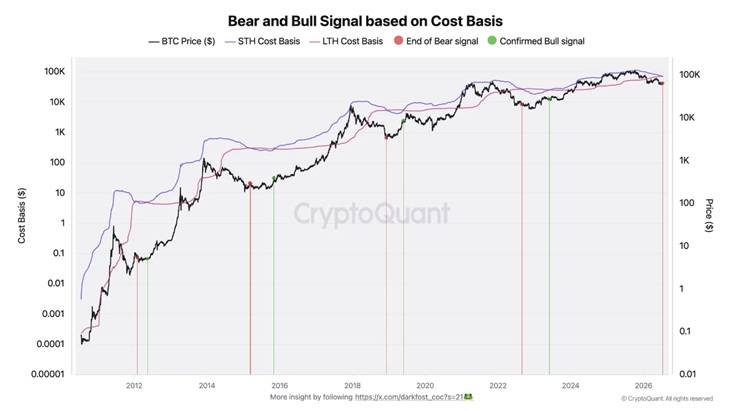
The newest “end of bear” marker appears where the STH cost basis falls below the adjusted LTH cost basis. Earlier cycles show the same sequence: a downward crossover, followed later by an upward crossover and bull-market confirmation.
The interval between the “end of bear” and bull-market confirmation markers shows that bitcoin can remain in a transitional phase after the initial signal. The first crossover points to the bear market’s final stage, while the later reversal suggests the average cost basis of newer buyers is rising progressively.
According to the analysis, the short-term holder cost basis has declined from $112,500 to $69,000. The drop is consistent with bitcoin acquired within the past six months changing hands at lower prices.
This activity reduced the average STH acquisition price. The LTH cost basis changes more gradually because it reflects bitcoin accumulated over a longer period. The adjusted LTH calculation excludes bitcoin held for more than seven years. The exclusion limits the influence of dormant supply and focuses the metric on long-term holdings considered economically active.
The analysis presents the crossover as a recurring feature of bitcoin cycles: short-term holders accumulate bitcoin during prolonged declines until their average cost basis falls below that of active long-term holders. It also argues institutional participation has not fundamentally changed this pattern.
The analysis describes the crossover as the start of a late-stage accumulation period rather than confirmation that prices will immediately recover.
The analyst noted:
“This doesn’t mean the bear market ends the moment the signal fires and the bottom is in, but it indicates we are entering its final phase, a period during which establishing a DCA makes sense.”
Dollar-cost averaging, or DCA, involves investing fixed amounts over time rather than committing all capital at one price. The strategy reduces reliance on identifying the exact market bottom.
Under the analyst’s framework, a bull market would require the short-term holder cost basis to rise back above the adjusted long-term holder level. That upward crossover would match the confirmation observed in earlier cycles and suggest that recently acquired bitcoin is changing hands at progressively higher average prices. Until then, the signal suggests bitcoin’s bear market may be nearing its end without confirming that a new bull cycle has begun.
免责声明:本文章仅代表作者个人观点,不代表本平台的立场和观点。本文章仅供信息分享,不构成对任何人的任何投资建议。用户与作者之间的任何争议,与本平台无关。如网页中刊载的文章或图片涉及侵权,请提供相关的权利证明和身份证明发送邮件到support@aicoin.com,本平台相关工作人员将会进行核查。


