Original Author: Li Jia
Original Source: Wall Street Insight
On July 22, after the U.S. stock market closes, Google's parent company Alphabet will release its second-quarter financial report for 2026. The current market trading logic is highly focused on one core proposition: whether the capital expenditure (Capex) that continues to expand in the AI era is a heavy burden that erodes profits or a forward-looking realization of future growth.
In a report released by Deutsche Bank on July 20, it pointed out that despite recent market concerns about the slowing growth of the search business, the delay in the release of the new Gemini model, and the ongoing increase in AI investments, the truly noteworthy variable is not the capital expenditure itself, but rather the possibility that Google Cloud revenue growth may significantly exceed current expectations. If cloud business demand is released as expected, the incremental profits generated in the coming years will be sufficient to cover the increased intensity of AI investments, and the company's overall profitability still has room for further upward revisions.
For investors, the key focus of this financial report is not whether Capex continues to rise, but rather how management characterizes the state of cloud service demand, changes in order backlog, and the pace of future revenue realization. These signals may determine whether the market will reprice Alphabet's valuation logic in the AI investment cycle.
Google Cloud is the true variable determining valuation
Deutsche Bank's most optimistic assessment is centered on Google Cloud.
Analysts have raised their revenue growth forecast for Google Cloud in the second quarter from 65% to 70%, and expect it to accelerate further to 75% in the second half of 2026.
This forecast is based on three judgments. First, the demand for AI computing power remains in short supply, and Google has recently even leased some computing resources from SpaceX. Second, as of the end of the first quarter of 2026, Google Cloud's backlog had reached $462 billion, a year-on-year increase of 400%. Additionally, some major cloud vendors, including Amazon, have begun to raise prices for certain cloud services.
More importantly, Deutsche Bank believes the market has significantly underestimated the future revenue scale of Google Cloud. It anticipates that Google Cloud revenue could reach $190 billion to $195 billion by 2027, while the market consensus expects only about $142 billion. Based on a profit margin of 30%, this additional revenue alone could contribute about $15 billion in GAAP operating profit, equivalent to an increase of about $1 in earnings per share.
Capex will continue to increase, but financing capabilities are also strengthening
Surrounding AI infrastructure construction, Deutsche Bank has significantly raised its future capital expenditure forecast for Alphabet. The company previously estimated that capital expenditure in 2026 would be $180 billion to $190 billion and indicated that it would "significantly increase" in 2027 compared to this year.
Considering the order backlog, Deutsche Bank estimates that to meet current demand, Google needs approximately 11.5 GW of computing power capacity; an additional approximately 10 GW will be needed under the baseline scenario for 2027. With construction costs of about $30 billion to $35 billion per GW, Deutsche Bank projects that capital expenditure in 2027 will be approximately $325 billion, higher than the previous forecast of $250 billion; it will further rise to $365 billion to $370 billion in 2028.
However, analysts also pointed out that due to Google's use of a hybrid deployment of TPUs and NVIDIA GPUs, its unit construction costs are expected to be lower than market concerns.
At the same time, the company's financing capabilities remain ample. This quarter, Alphabet has completed approximately $65 billion to $70 billion in financing, including a $10 billion investment from Berkshire Hathaway, two equity financings of about $36 billion, up to $40 billion in ATM issuance capacity, and multi-currency senior debt issuance.
As of the end of the first quarter of 2026, the company held approximately $127 billion in cash and investments, along with about $107 billion in non-listed securities; Deutsche Bank expects that by the end of 2027, the company's cumulative operating cash flow will be approximately $420 billion.
Deutsche Bank believes that what Alphabet currently faces is not the issue of "Capex being too high," but rather the market's excessive focus on investment while underestimating the speed at which Google Cloud revenue is realized.
Search growth has not stalled, advertising budgets are starting to flow towards AI
Surrounding Google's search business, the biggest market concern comes from the possibility that AI Overview could change traditional search traffic.
However, Deutsche Bank's channel research shows that advertisers' behaviors are undergoing new changes. Some advertisers have maintained existing search budgets, but an increasing number of brands are starting to try directing their advertising budgets towards AI Overview, while also increasing Google Search and ChatGPT-related AI advertising spending.
Meanwhile, SimilarWeb data shows that Google's website visits and page views in the second quarter of 2026 improved compared to the first quarter. Based on this data, Deutsche Bank maintains its forecast of a 16.5% year-on-year increase in Google Search for the second quarter when calculated at fixed exchange rates, with a projected year-on-year increase of 14% for the third quarter.
Analysts believe that even if the release date of the Gemini new model has been slightly delayed, the current AI model is already capable of continuously improving advertising placement efficiency, and the fundamentals of the advertising business have not undergone substantial changes. 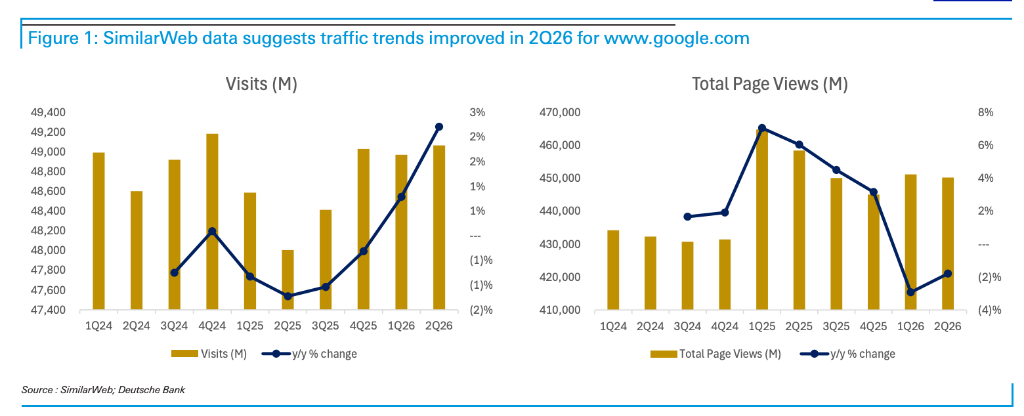
Gemini delay is not critical, users are still continuously growing
The delay in Gemini's release has become another focus of market attention. Google previously stated at the I/O 2026 conference that Gemini 3.5 Pro would be released shortly, but as of now, the new model has not yet been officially launched.
However, Deutsche Bank believes that the timing of the model's release has not changed the trend of user growth. SimilarWeb data shows that the website access volume and page views for Gemini continued to grow in the second quarter, though the growth rate slightly slowed. Sensor Tower data indicates that Gemini App downloads have decreased from their peak in 2025, but the total number of sessions continues to grow.
In comparison, ChatGPT remains in the lead, but the conversation volume has generally stabilized over the past 12 months; Meta AI has seen significant growth since launching Muse Spark; Grok has experienced declines in both download and session volume this year.
Therefore, Deutsche Bank believes that the adjustment of Gemini's release date is a short-term event and will not change Alphabet's long-term competitiveness in AI. 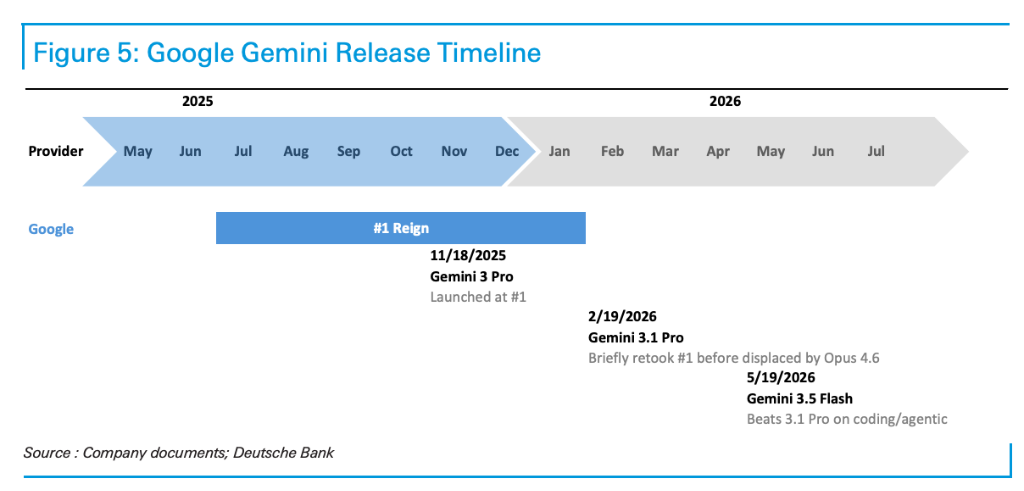
免责声明:本文章仅代表作者个人观点,不代表本平台的立场和观点。本文章仅供信息分享,不构成对任何人的任何投资建议。用户与作者之间的任何争议,与本平台无关。如网页中刊载的文章或图片涉及侵权,请提供相关的权利证明和身份证明发送邮件到support@aicoin.com,本平台相关工作人员将会进行核查。


