An investment institution that pioneered the industry is no longer just focused on the cryptocurrency track.
Written by: Vaidik Mandloi
Translated by: Luffy, Foresight News
Paradigm, one of the world's leading pure cryptocurrency-focused funds, recently completed the raising of a new fund worth $1.2 billion, which will be invested in startups in artificial intelligence, robotics, aerospace, and other sectors. This institution has even completely removed all references to "cryptocurrency" from its official website. Its core investment logic is: cryptocurrency is just the first cutting-edge track in their layout, and currently, other waves of cutting-edge technology also cannot be missed.
Framework Ventures also completed a $400 million fund raise in June, initiating investment across different tracks, and institutions making such adjustments are far from being just them. Over the past year, nearly all leading cryptocurrency-focused VC firms have been broadening their investment boundaries and adjusting their investment themes. In the first quarter of 2026, only eight new pure cryptocurrency venture funds were established across the market, setting the lowest value since 2020.
This article will delve into whether venture capital funds focused on cryptocurrency are really fading away. If the answer is yes, how will this industry reshuffle affect the lifecycle of various funds? For crypto startups, what will it mean for them to compete for resources within the portfolios of comprehensive funds in the future?
The Development Cycle of Cryptocurrency-focused Funds
The reason cryptocurrency-focused funds emerged primarily lies in their willingness to invest substantial time in building industry information barriers and being the only ones willing to bear the high risks of the track back then. In 2017, partners of comprehensive growth funds like Tiger Global could not comprehend the underlying logic of Solidity smart contracts, let alone establish deep collaborative relationships with anonymous developers in Discord communities.
To determine whether the cryptocurrency venture capital track is heading to its conclusion, we can refer to the rise and fall patterns of other specialized investment genres in history; similar industry iterations have played out repeatedly.
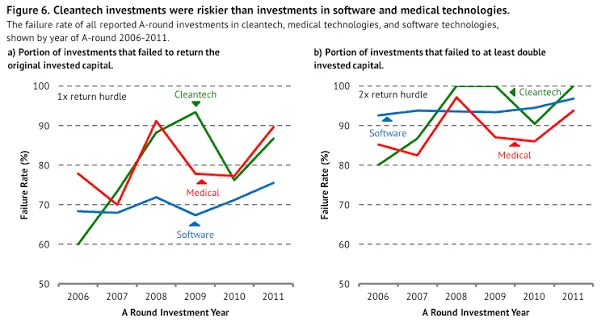
From 2006 to 2011, the clean energy track became a hot investment target, with numerous institutions establishing specialized new energy funds, paralleling the logic of the cryptocurrency venture capital at the time: investors believed they were capturing a transformative technological shift ahead of others and hoped to build an exclusive investment landscape around this track.
Capital accumulated over $25 billion in clean energy startups, but ultimately, more than half of the investments resulted in losses. Interestingly, the relevant technology itself proved feasible, and today the clean energy market is massive; during the same period, the cost of solar power generation fell by 85%. However, venture capitalists made a fundamental judgment error: they applied the software company investment model, extending $5 million seed round checks to startups, whereas these projects actually needed $200 million in project financing and required 15 years to achieve profitability.
The Massachusetts Institute of Technology's Energy Initiative concluded afterward that the traditional venture capital model fundamentally misaligns with the clean energy sector. Early specialized funds bore the risks of technological development, financing industry foundational research, building credibility in the track to attract significant industrial capital; however, once the technology matures, infrastructure loans and project financing funds enter the scene, the unique information barrier of specialized funds completely disappears.
Source: Massachusetts Institute of Technology
Special Purpose Acquisition Companies (SPACs) have also followed a similar rise and fall trajectory. SPACs are blank check companies that raise funds through an IPO, lacking physical operations, and then acquire private companies for quick public listing, a process more straightforward than traditional IPOs. In 2020-2021, many investors regarded them as a replicable capital tool, even establishing investment firms entirely around SPAC operations.
Chamath Palihapitiya raised a $1.6 billion SPAC fund. However, by 2022, two-thirds of the SPACs that went public in 2021 failed to complete acquisitions, resulting in Chamath ultimately having to return funds to investors. In just two years, the market reversed completely, demonstrating that once the information advantage of a specialized track disappears, the industry landscape can be quickly reconstructed.
Different industries repeatedly play out the same narrative, backed by a unified underlying logic. Carlota Perez reviewed 250 years of technological transformation history, proposing the theory of technological-economic paradigms: every significant technological revolution goes through an early niche stage, where only insiders understand the technology. Investors who delve into the track hold exclusive information and become the most valuable capital providers; as technology matures, it gradually integrates into the existing traditional industrial system.
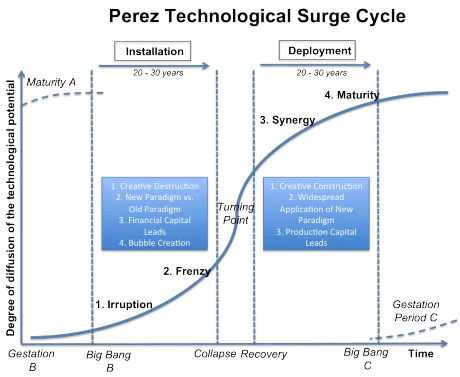
As the development reaches this stage, the information barriers supporting the survival of specialized funds cease to exist — comprehensive large institutions also come to understand that asset track. Fred Wilson predicted early on that cryptocurrency would reach this inflection point; he wrote in 2015 that the cryptocurrency industry would encounter a critical financial watershed, completing the leap from the "construction phase" to the "widespread application phase" in Perez's theory.
Today, this watershed has arrived; the features of the phase of cryptocurrency's widespread application are evident everywhere: payment giants like Stripe have acquired Bridge and launched their own stablecoin public chain; asset management institutions like BlackRock and Fidelity have issued tokenized money market funds; and traditional payment leaders such as Visa and Mastercard are also building settlement networks on the foundation of stablecoins.
These traditional giants do not require cryptocurrency-specific funds to explain MEV extraction or validator economics; such exclusive industry knowledge is meaningless to their business expansion. What they need are regulatory approvals, traffic channels, and banking partnership resources, which are identical to the resources required for scaling ordinary fintech companies. Today, investors of comprehensive funds like Sequoia and Founders Fund evaluate cryptocurrency projects with the same logic as they do fintech projects like Stripe and Plaid.
Polarization and Fund Track Expansion
Since the information barrier of specialized cryptocurrency funds has already collapsed, where will the funds established on this advantage go? Their ultimate fate is entirely determined by the capital logic of fund management scale.
Over the years, the venture capital industry has formed a "barbell differentiation" pattern: on one end are giant comprehensive investment platforms like a16z, Sequoia, and Founders Fund, capable of incorporating complete tracks into their vertical investment maps; on the other end are small boutique funds that rely on deep industry understanding to bet on niche cutting-edge projects, where a single blockbuster project can cover all returns for the entire fund; meanwhile, the survival space of medium-sized funds in between has been completely squeezed, and currently, the vast majority of cryptocurrency-focused specialized funds find themselves in this "death zone."
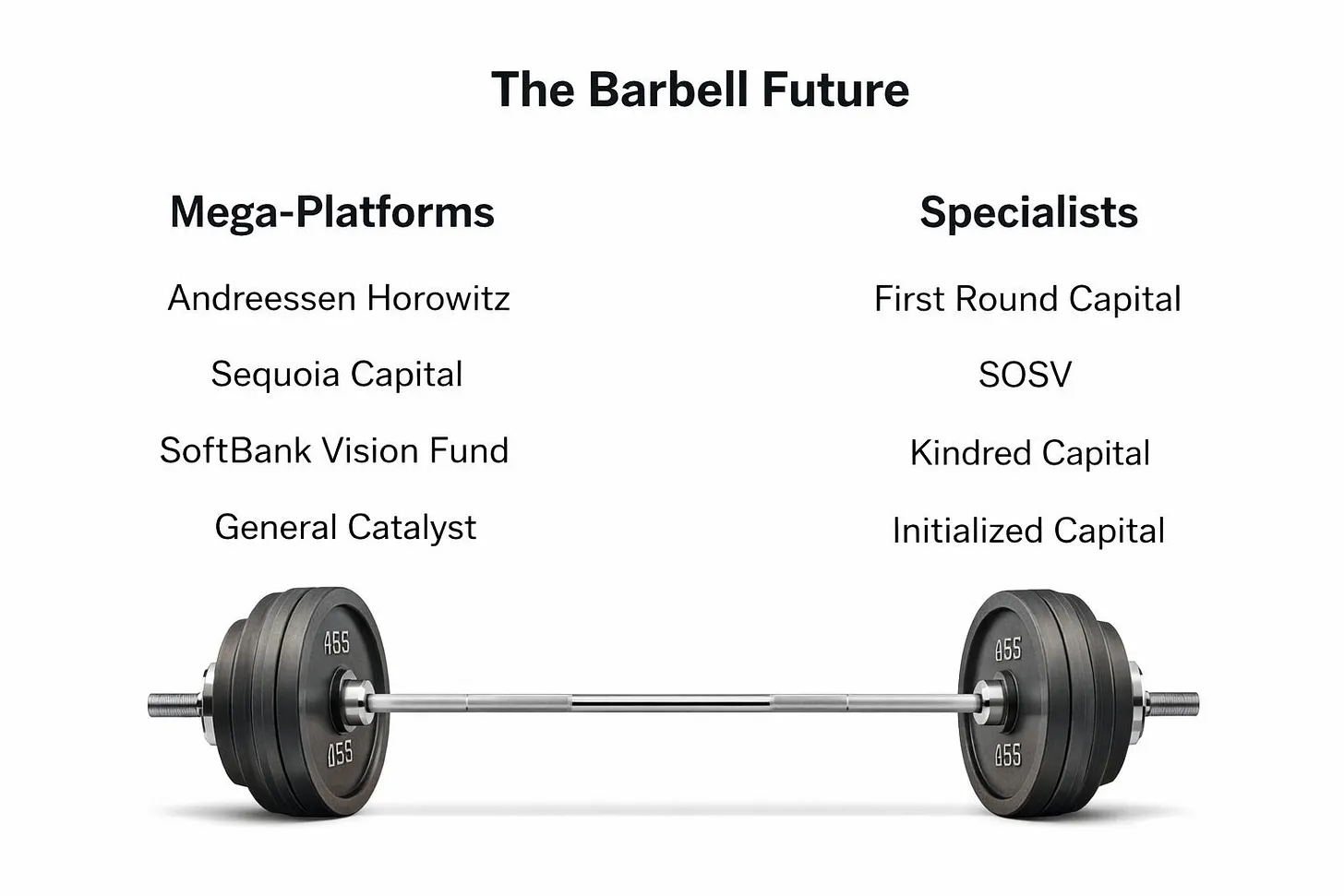
A fund with a size of $500 million requires a total project exit amount of $1.5 billion to provide the contributors with a three-fold net return. Relying solely on small seed investments is insufficient to achieve this goal; a single seed investment portfolio struggles to yield enough large-scale projects. Simultaneously, they are also unable to compete with giant funds of $50 billion in the growth round — the latter can easily extend investments of over $100 million. For instance, in the first half of 2025, the total amount raised by Founders Fund alone was 1.7 times the total raised by all emerging small funds during the same period. Capital continues to concentrate at the two ends of the industry.
Similarly, while broadening their investment tracks, Framework Ventures and Paradigm's underlying strategies differ fundamentally, stemming from scale differences. Framework manages a scale of $400 million, which is too small to rely on a few seed projects for recovery and insufficient to compete with giant funds for growth round projects. Relying solely on exit returns produced from the cryptocurrency track cannot meet fund return requirements, hence the need to broaden investment boundaries. In contrast, Paradigm manages a scale of $1.2 billion, a size sufficient to transform into a cross-industry comprehensive investment platform, marking a fundamental difference in their strategic choices. In short, the scale of the fund determines its positioning within the barbell structure and also dictates its available development pathways.
Even those venture capital firms claiming to stay committed to the cryptocurrency track have thoroughly redefined the connotation of "cryptocurrency investment." Dragonfly completed a fundraising of $650 million this February, exceeding their fundraising target threefold. However, the institution clearly stated that the cryptocurrency application track, disassociated from financial scenarios, has fully failed, with the fund only betting on two major directions: stablecoins and prediction markets. a16z completed fundraising for a $2.2 billion cryptocurrency fund in May 2026, only half of the $4.5 billion fund size in 2022. Moreover, partner Chris Dixon has also adjusted the core narrative: no longer defining cryptocurrency as a new computing paradigm, but instead positing finance as the foundational bedrock of the entire industry.

Today, the "pure cryptocurrency investment" referred to by these institutions essentially involves laying out financial infrastructure built on blockchain, which is also a key investment direction for comprehensive funds with substantial capital.
Another core force driving the industry's shift comes from the behavioral changes of fund contributors (LPs). The current venture capital industry universally faces a DPI (Distributions to Paid-In) crisis, with funds established in 2021 averaging a paid-in return of only 0.08 times. The 2022 cryptocurrency bear market caused significant losses for many contributors, while the artificial intelligence track has now become a new outlet, absorbing 70% of global first-tier market funding. Contributors are sitting on four years of idle funds that cannot be liquidated, witnessing AI projects delivering the high returns once promised by the cryptocurrency track, prompting fund managers to actively布局 AI tracks to meet LP demands.
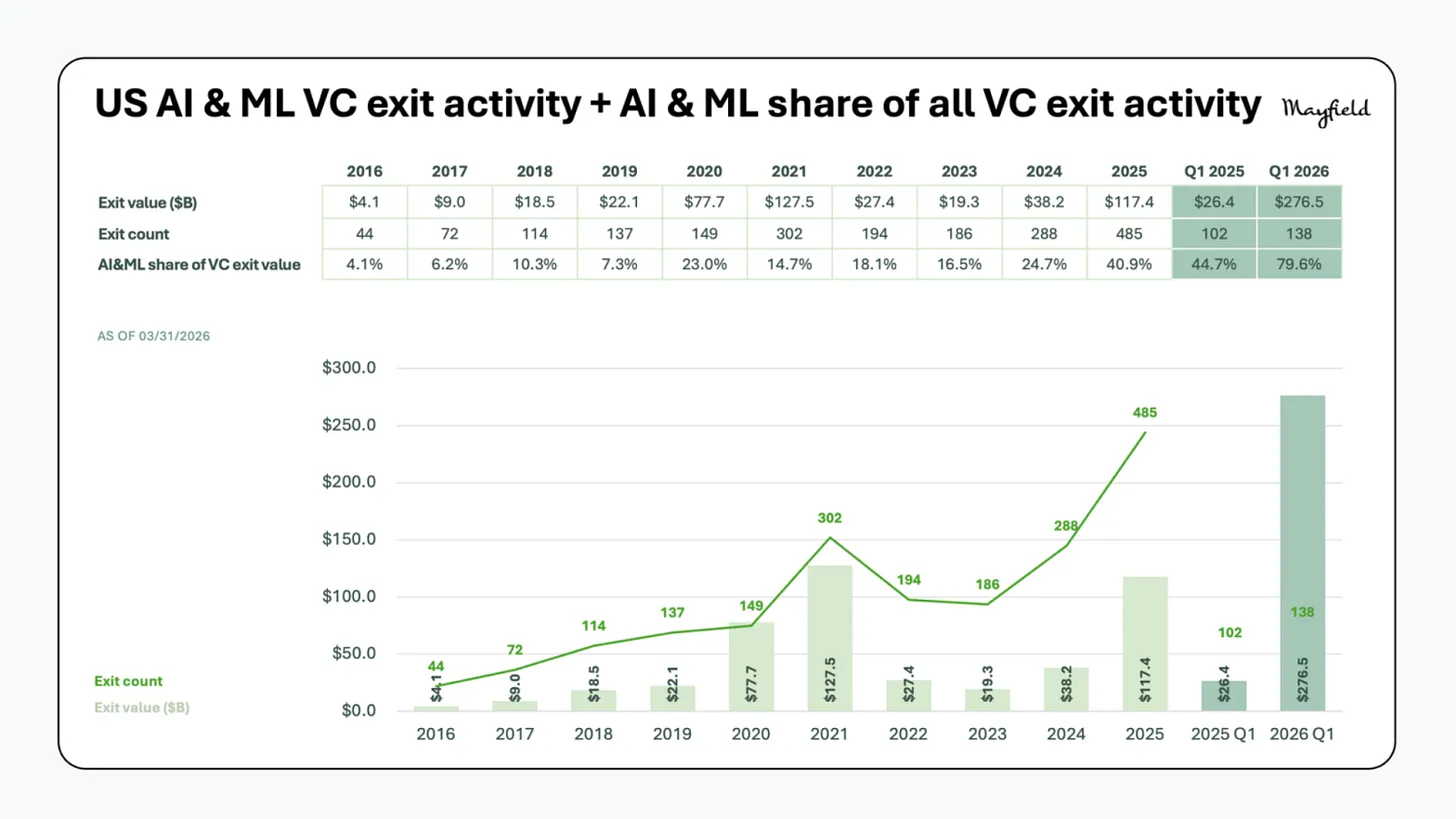
This trend is not favorable for entrepreneurs still focusing on cryptocurrency: the number of investment firms that truly understand cryptocurrency and are willing to continue investing is continually shrinking. Many may suggest that entrepreneurs can directly seek funding from comprehensive funds, which theoretically seems feasible — Sequoia and Founders Fund can issue larger checks and provide commercialization channels that native cryptocurrency funds cannot match.
However, reality has two major flaws. First, the current AI track is siphoning off most of the quality project resources, and cryptocurrency projects, within comprehensive funds, must compete for the attention of investment teams against a plethora of AI projects. Only extremely high-quality targets have a chance to enter the investment decision-making agenda, and the competition logic is completely different from presenting to specialized funds focused on cryptocurrency. Second, the development of the cryptocurrency ecosystem relies on specialized funds' long-term investments in foundational infrastructure. Paradigm sponsors academic research related to MEV, and Dragonfly supports cross-chain development tools; such investments may struggle to yield commercial returns when looked at individually, yet they build shared foundational public facilities for the entire industry. Comprehensive funds will never invest in such projects, as they only evaluate targets based on independent commercial returns.
I believe that in a few years, the title of "cryptocurrency investor" will become as outdated as "internet investor" is today. Cryptocurrency has already become foundational infrastructure, a fundamental channel supporting the operation of various financial products. No one will construct a complete investment logic solely around foundational pipelines; investment value arises from the application layer above the pipelines. If Perez's theory of technological cycles holds, the industry is currently at this transitional node: cryptocurrency is no longer an independent investment track but the foundational infrastructure for various investment targets.
However, this does not mean that specialized cryptocurrency funds will completely disappear. With new subcategories like tokenization and on-chain securities continually emerging, many niche cutting-edge tracks will arise that comprehensive funds are unwilling to venture into, and during each cycle, small specialized funds will form around specific fields. What is genuinely on the path to decline are the currently medium-sized, large pure cryptocurrency funds — which cannot sustain their fund recovery demands relying solely on niche cryptocurrency projects. The entire track will continue to be reconstructed according to the barbell structure: large growth round investments will be captured by comprehensive funds, while pioneering niche experimental projects will be handled by small specialized funds.
Early specialized funds established in 2017-2018 incubated core infrastructures such as Uniswap, the Ethereum ecosystem, and stablecoin support tools. But the era has changed; leading cryptocurrency projects that have emerged in recent years, such as Hyperliquid and MegaETH, have been entirely funded through community fundraising, without relying on venture capital. At that time, specialized funds provided a clear investment logic for the cryptocurrency track, attracting comprehensive capital to enter; now, more and more entrepreneurs realize that they can complete project cold starts without relying on venture capital.
免责声明:本文章仅代表作者个人观点,不代表本平台的立场和观点。本文章仅供信息分享,不构成对任何人的任何投资建议。用户与作者之间的任何争议,与本平台无关。如网页中刊载的文章或图片涉及侵权,请提供相关的权利证明和身份证明发送邮件到support@aicoin.com,本平台相关工作人员将会进行核查。


