The just-passed week saw the pressured AI hardware sector waiting for a shot in the arm strong enough to reverse the mood.
ASML and TSMC subsequently delivered earnings reports that were fundamentally strong, yet could not fully meet high expectations: The former significantly raised its full-year revenue and gross margin guidance and began to increase lithography machine production capacity for 2027-2028; the latter maintained historical highs in revenue, gross margin, and operating profit margin while simultaneously raising its full-year capital expenditure guidance to a staggering $60 billion to $64 billion.
Logically, this should be the most ideal combination for AI semiconductors—equipment companies proving that customers are still placing orders, while the leading wafer foundry proves that orders are being converted into revenue and is willing to continue investing huge sums into capacity expansion.
However, the feedback from the market did not fully align with the strength of the performance.
The reason is not that the fundamentals of the two companies have deteriorated, but rather that the expectations for the AI supply chain have been pushed to an unusually high position. The market is no longer satisfied with "demand remains strong," but hopes that each earnings report continues to be upgraded, every profit margin breaks limits, and all huge capital expenditures can immediately translate into higher profits.
This has also made the earnings reports from ASML and TSMC relay two seemingly contradictory but simultaneously valid signals, namely that the expansion cycle of AI semiconductors is still ongoing, with some key aspects even accelerating; but the capital market's pricing of this cycle has shifted from validating demand to validating returns.
1. ASML and TSMC Both Intensify: The Expansion Cycle Is Far from Over
ASML was the first to reveal the answer for this round of earnings season.
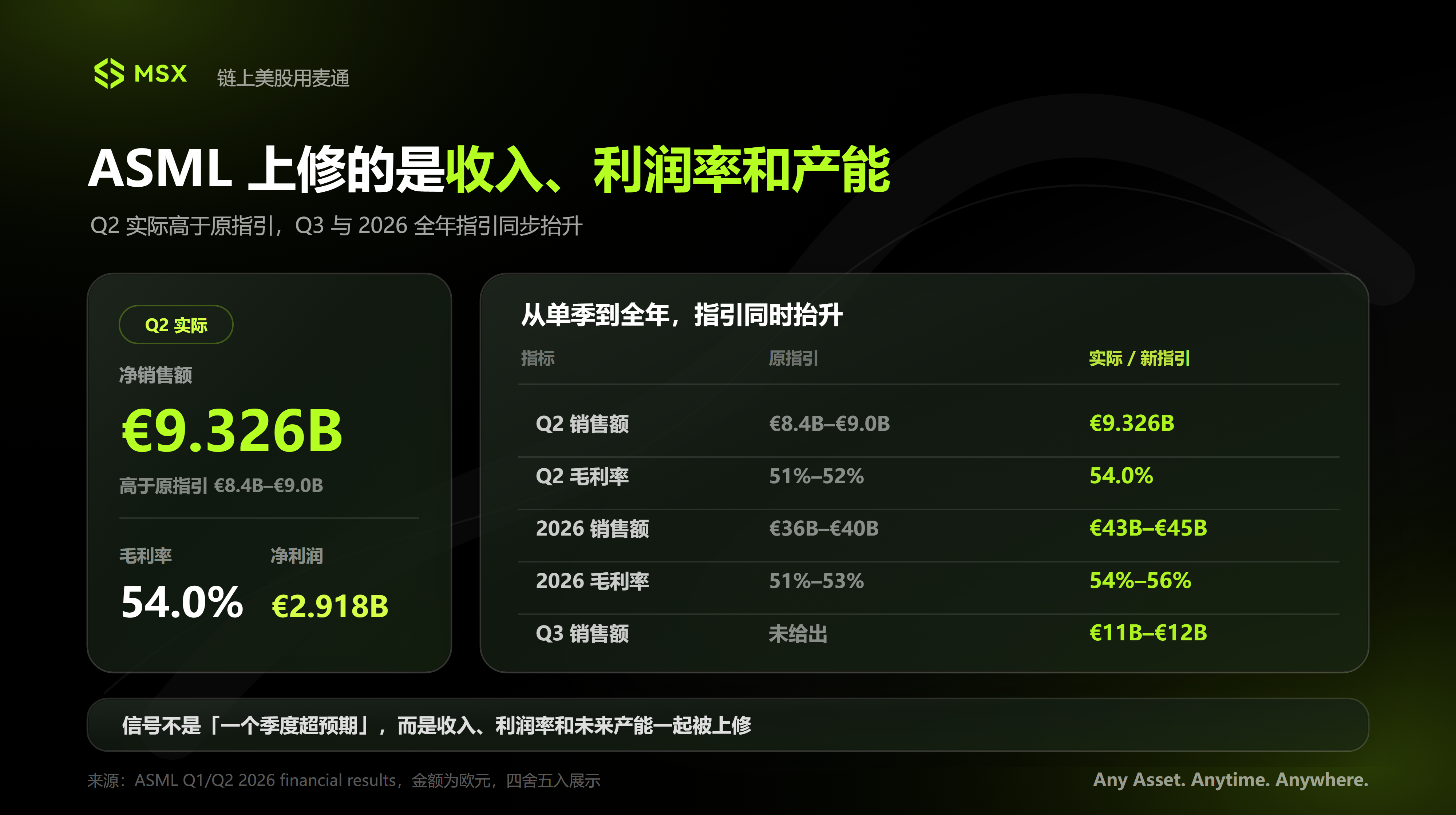
The company reported net sales of €9.326 billion in the second quarter, exceeding previous guidance of €8.4 billion to €9 billion; the gross margin reached 54%, and net profit was €2.918 billion. The company subsequently raised its third-quarter sales guidance to €11 billion to €12 billion and significantly revised its full-year 2026 sales expectation from €36 billion to €40 billion up to €43 billion to €45 billion.
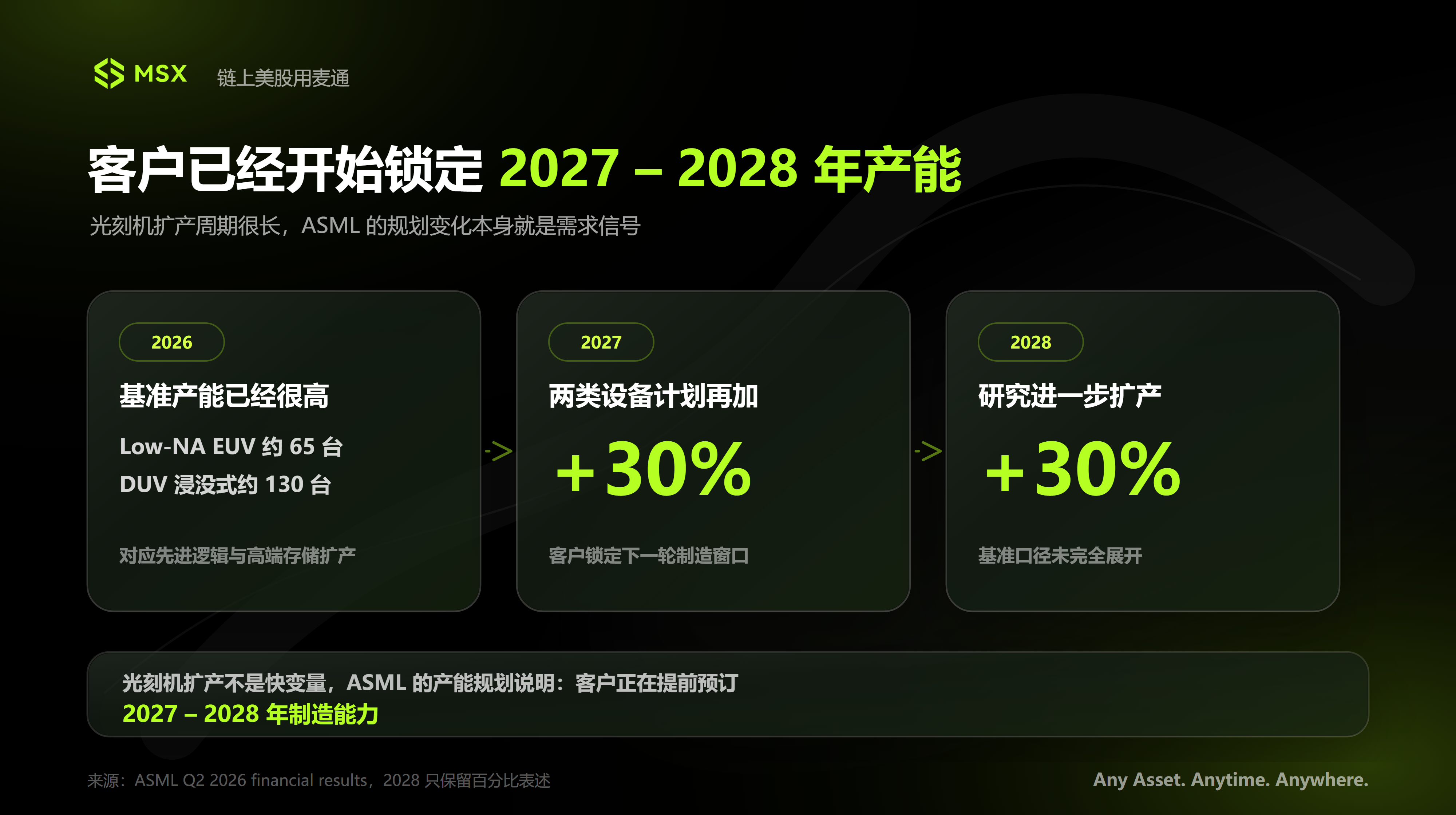
More important than the quarterly data is ASML's adjustment of equipment capacity for the next two years. The company plans to increase low numerical aperture EUV production capacity by 30% from around 65 units in 2026; DUV immersion equipment will also see a 30% increase from approximately 130 units. Meanwhile, ASML is also researching the possibility of further expanding production in 2028.
The lithography machine supply chain is complex, with long delivery cycles, so ASML will not recklessly increase production capacity two years out based on the fluctuations of one or two quarters' orders. Such plans for expansion mean that foundry customers are locking in advanced process and high-end memory capacity for 2027-2028 in advance.
A day later, TSMC provided corresponding validation from the wafer manufacturing side.
The company achieved revenue of $40.2 billion in the second quarter, a 12% quarter-over-quarter growth, landing at the upper limit of the previous guidance range of $39 billion to $40.2 billion; the gross margin reached 67.7%, slightly above the guidance upper limit, and the operating profit margin reached 60.3% for the first time. Net profit was NT$706.56 billion, a year-on-year increase of 77.4%, with earnings per share of NT$27.25.
The revenue structure continues to tilt towards AI and advanced processes. In the second quarter, revenue from high-performance computing business grew 20% quarter-over-quarter, accounting for 66% of the company's total revenue; 7nm and below advanced processes made up 77% of wafer revenue, where 3nm and 5nm respectively contributed 30% and 33%, and the 2nm process, which is entering the ramp-up phase, first contributed 3% of wafer revenue.
Even more indicative is the capital expenditure. TSMC has significantly raised its capital expenditure plan for 2026 from the original $52 billion to $56 billion up to $60 billion to $64 billion. About 70% to 80% of it will be used for advanced processes, and about 10% to 20% will be allocated to advanced packaging, testing, photomask manufacturing, and other stages.
The company also raised its full-year dollar revenue growth expectation from over 30% to slightly above 40%. Management stated that AI-related demand remains extremely strong, with positive signals still coming from cloud service providers and downstream customer demand.
ASML is preparing to increase lithography equipment capacity, while TSMC is expanding wafer manufacturing and advanced packaging capabilities through higher capital expenditures.
Thus, when the equipment leader and the world's largest foundry both raise future investments, at least one thing is confirmed: AI semiconductor capital expenditures have not entered a contraction phase, and the supply chain is still accelerating capacity preparation for the demand of the coming years.
2. With Such Strong Results, Why Does the Market Still Feel It Isn't Enough?
The issue is that the market is waiting for more than just a "goal achieved" earnings report.
Since TSMC publishes its revenue data every month, the second-quarter revenue of $40.2 billion had already been largely digested by the market; therefore, what truly had an expectation gap before the earnings report were the gross margin, the third-quarter guidance, and how much capital expenditure could be increased.
From this perspective, TSMC's second-quarter gross margin of 67.7%, while exceeding the company’s previous guidance of 65.5% to 67.5% upper limit, was only roughly in line with the market's revised mainstream expectations and did not satisfy some investors' aggressive judgments approaching 69% or even higher.
For the third quarter, the company expected revenue of $44.6 billion to $45.8 billion, indicating a quarter-over-quarter growth of about 12% based on the midpoint; however, the gross margin guidance decreased to 65% to 67%, with the midpoint at around 66%.
The decline in gross margin does not mean that demand has weakened.
TSMC anticipates that the rapid ramp-up of the 2nm process will dilute the gross margin by about 3 to 4 percentage points in the second half of the year; expansion of overseas foundries will also continue to increase depreciation and manufacturing costs. Strong demand for advanced processes, high capacity utilization, and improvements in manufacturing efficiency will only partially offset these pressures.
In other words, TSMC is facing a typical high-boom expansion paradox— the stronger the demand, the more the company needs to procure equipment and build fabs and introduce new processes in advance; yet, the higher the capital expenditure, the earlier depreciation, overseas production costs, and new node ramp-up pressures will reflect in the profit margins.
This is also the most important aspect of understanding this earnings report.
From the management's statements regarding pricing strategy during the earnings call, TSMC is not pursuing pushing short-term gross margins to their limits during the tightest supply periods. The company emphasizes that it is a long-term partner to its customers and will not suddenly increase prices drastically to squeeze customers; rather, it wishes to maintain profits at levels sufficient to support long-term expansion.
This means that TSMC currently prefers to strike a balance between pricing power, customer relationships, and ongoing expansion, rather than cashing in all scarcity premiums at once. From an industrial perspective, this is undoubtedly a positive signal, but from a short-term trading perspective, it means that investors must accept a reality: namely, that AI demand remains strong, but it does not imply that every dollar of new revenue can instantly translate into higher profit margins.
Therefore, the market's cool reaction to TSMC's earnings report cannot simply be understood as AI demand peaking; a more accurate interpretation is that in an environment where expectations have already surged, strong performance is becoming a necessary condition for valuation but is no longer an automatic catalyst for new upward momentum.
After the earnings report was released, strong performance did not immediately translate into continuous gains for the sector, reflecting that investors are digesting pressures on margins and overly high expectations.
3. To See TSMC and ASML Together Is to See the "Second Wave" of AI Chips
When viewing the earnings reports of ASML and TSMC together, the outline of the so-called "second wave" of AI chips has become clearer than before.
It is not a return to an overall shortage of "all chips are not enough", nor is it a simple replication of the past two years dominated by Nvidia GPUs; instead, the supply bottlenecks continue to spread to the entire AI system.
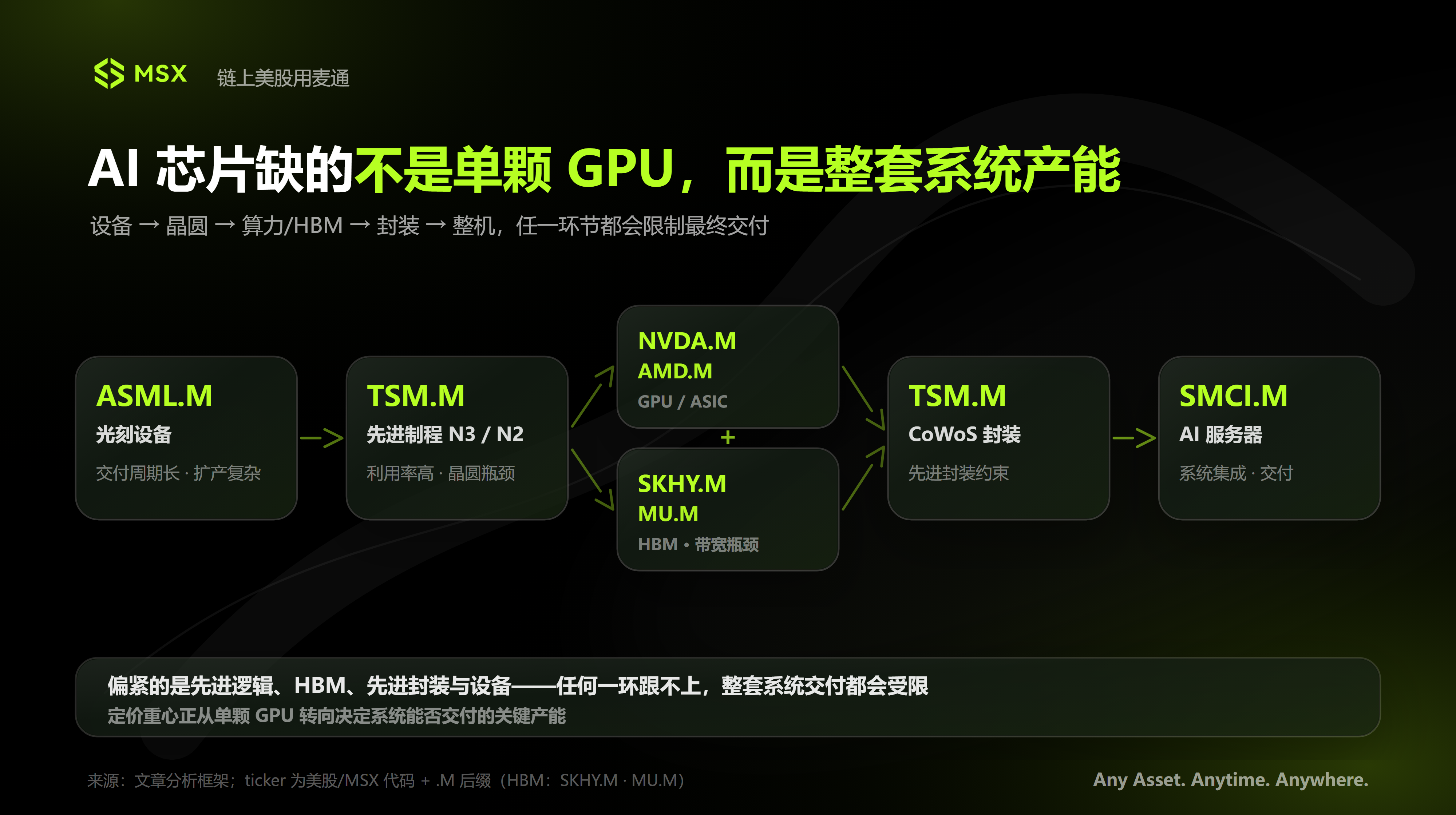
ASML’s EUV and DUV equipment determine how quickly advanced processes can expand; TSMC's 3nm and 2nm determine how much wafer capacity GPUs, CPUs, and custom ASICs can acquire; HBM determines memory bandwidth; advanced packaging such as CoWoS determines whether computing chips, memory, and high-speed interconnects can ultimately combine into deliverable data center products.
If any one of these links fails to expand sufficiently, it will slow down the entire AI system's shipment.
TSMC’s management even stated that current advanced packaging capacity is already tight enough to limit customer growth, and the company is working hard to bridge the gap between demand and capacity, while welcoming other packaging solutions to provide additional options for customers.
At the same time, AI demand is also spreading from single accelerators to a broader range of chip types.
TSMC believes that the development of Agentic AI is reinstating the importance of CPUs in data centers. Regardless of whether customers use x86, Arm, or RISC-V architectures, the advanced chips behind them mostly still need to be manufactured by TSMC. This means that future AI capital expenditures will not only flow towards GPUs but will also continue to drive demand for CPUs, network chips, memory, and advanced packaging.
The management's expressions regarding long-term demand are equally positive. TSMC believes that AI-related trends will remain strong through 2029-2030, and while occasional fluctuations may occur, the long-term direction remains unchanged. For the previously provided judgment of a high 50% compound growth rate in AI-related business, management did not provide new specific figures, only stating that demand trends are stronger than previously expected.
However, this does not mean that all semiconductor companies will benefit equally.
- ASML (ASML.M) directly benefits from demand for lithography equipment and advanced process expansion;
- Applied Materials (AMAT.M), Lam Research (LRCX.M), and KLA (KLAC.M) benefit respectively from demand for deposition, etching, and inspection equipment, but the cadence of order fulfillment may vary;
- TSMC (TSM.M) controls advanced wafer manufacturing and packaging capabilities and is the core beneficiary of AI chip capacity expansion;
- SK Hynix (SKHY.M), Micron (MU.M), and Samsung Electronics handle HBM and high-end memory supply;
- Nvidia (NVDA.M), AMD (AMD.M), Broadcom (AVGO.M), alongside cloud service providers with in-house chip capabilities like Amazon (AMZN.M), Alphabet (GOOGL.M), Microsoft (MSFT.M), and Meta (META.M) together determine how fast end demand can grow.
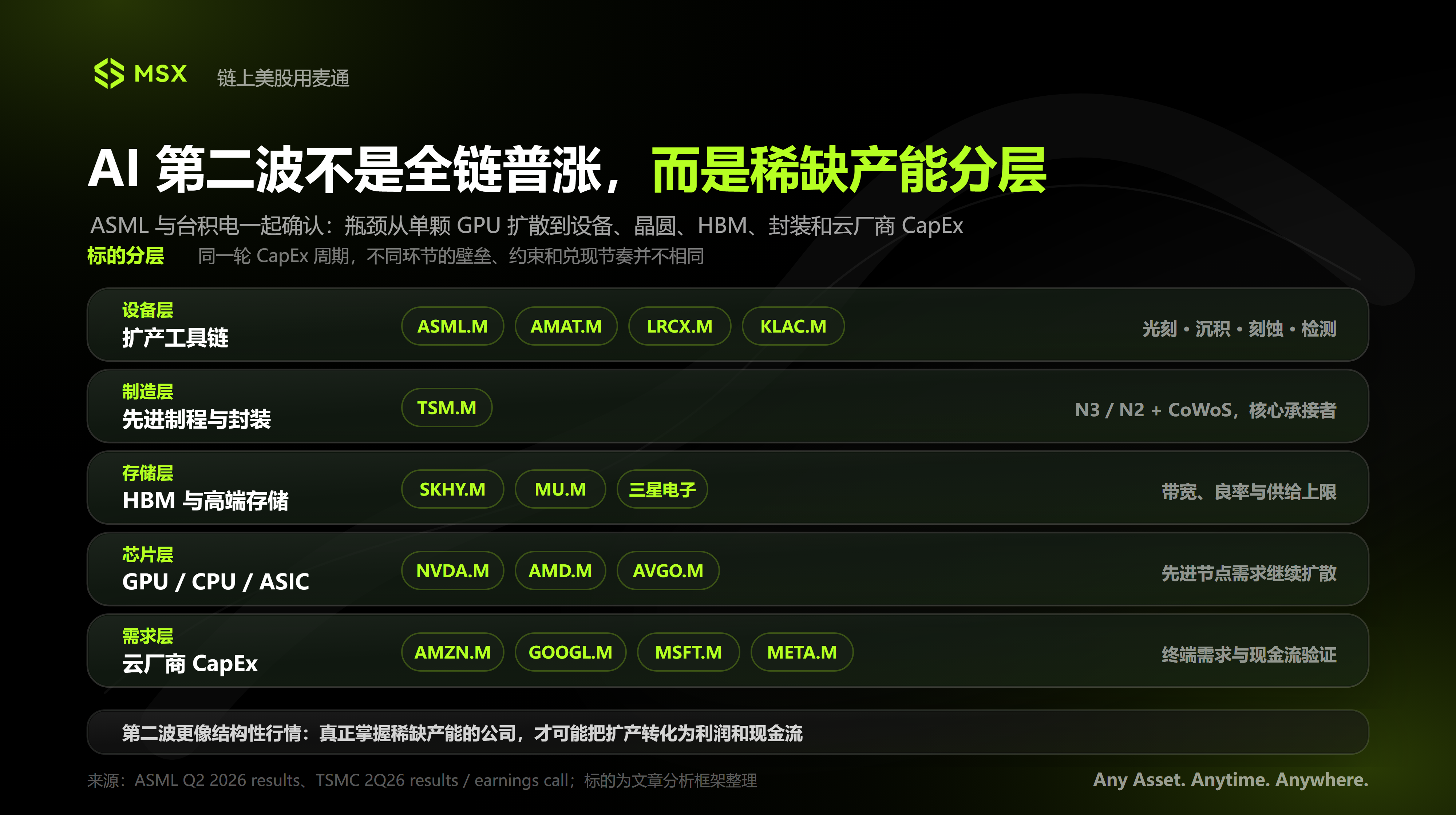
They are in the same capital expenditure cycle yet have entirely different technological barriers, capacity constraints, profit structures, and valuation levels. Therefore, the "second wave" of AI chips is more likely a structural market rather than a synchronized rise across the entire hardware supply chain.
In the next phase, the market will pay closer attention to which companies actually possess irreplaceable scarce capacity, which companies are merely following clients in increasing capital expenditures, and which companies can maintain pricing power, profit margins, and capital returns after expansion.
After ASML and TSMC, the next key validation will also fall upon cloud service providers like Microsoft, Amazon, Google, and Meta; ultimately, the willingness of equipment companies to expand and the willingness of foundries to invest need to be matched by cloud providers continuing to increase capital expenditures and proving that the ever-growing AI infrastructure can generate real model calls, corporate revenue, and cash flow returns.
Final Thoughts
Objectively speaking, ASML has answered whether foundries are still willing to purchase equipment, while TSMC further proves that customer orders are sufficient to drive the company to continue increasing wafer and advanced packaging capacity.
From this angle, the industry cycle of AI semiconductors has not peaked.
After all, equipment capacity is expanding, advanced packaging remains tight, and TSMC has even raised its full-year capital expenditure to a peak of $64 billion—none of these are signals that suggest an industry preparing for contraction.
However, the reason the market still feels it isn't enough is that the questions for the next phase have changed. In the past, investors needed to confirm whether AI demand genuinely existed; now, demand has become hard to deny, and the market wants to know how much capital is required to meet these demands and how much profit and cash flow this capital can ultimately convert into.
Thus, the "second wave" of AI chips may have already begun, but it will not simply be a rehash of the first round of market movements.
What is truly scarce is not merely the companies capable of providing more chips, but those that can control key capacity while continuing to maintain pricing power, profit margins, and capital returns following significant expansions.
免责声明:本文章仅代表作者个人观点,不代表本平台的立场和观点。本文章仅供信息分享,不构成对任何人的任何投资建议。用户与作者之间的任何争议,与本平台无关。如网页中刊载的文章或图片涉及侵权,请提供相关的权利证明和身份证明发送邮件到support@aicoin.com,本平台相关工作人员将会进行核查。


