Written by: Rita
Trends Guide
On July 20, 2026, J.P. Morgan's strategy team published a report indicating a noticeable divergence in the U.S. stock AI sector recently, with hardware stocks such as Nvidia and Broadcom experiencing increased volatility, fluctuating in gains and losses. Microsoft, Google, Meta, and Amazon have shown steadier trends.
The market is concerned about whether the AI market has peaked. J.P. Morgan's latest U.S. stock strategy report provides a clear judgment: the AI supercycle is not over, but the capital is changing hands. The investment logic has shifted from "competing on capital expenditure" to "competing on commercial realization." The annual AI capital expenditure of $870 billion continues to accelerate, but the market is no longer satisfied with "investment scale" and is starting to question "profit realization." J.P. Morgan believes that large-scale companies with cloud platforms, data centers, and AI application ecosystems have a better risk-reward ratio than AI hardware.
Capital Expenditure is Still Accelerating
The core highlights of Q2 earnings reports this year lie not in profits, but in AI capital expenditure.
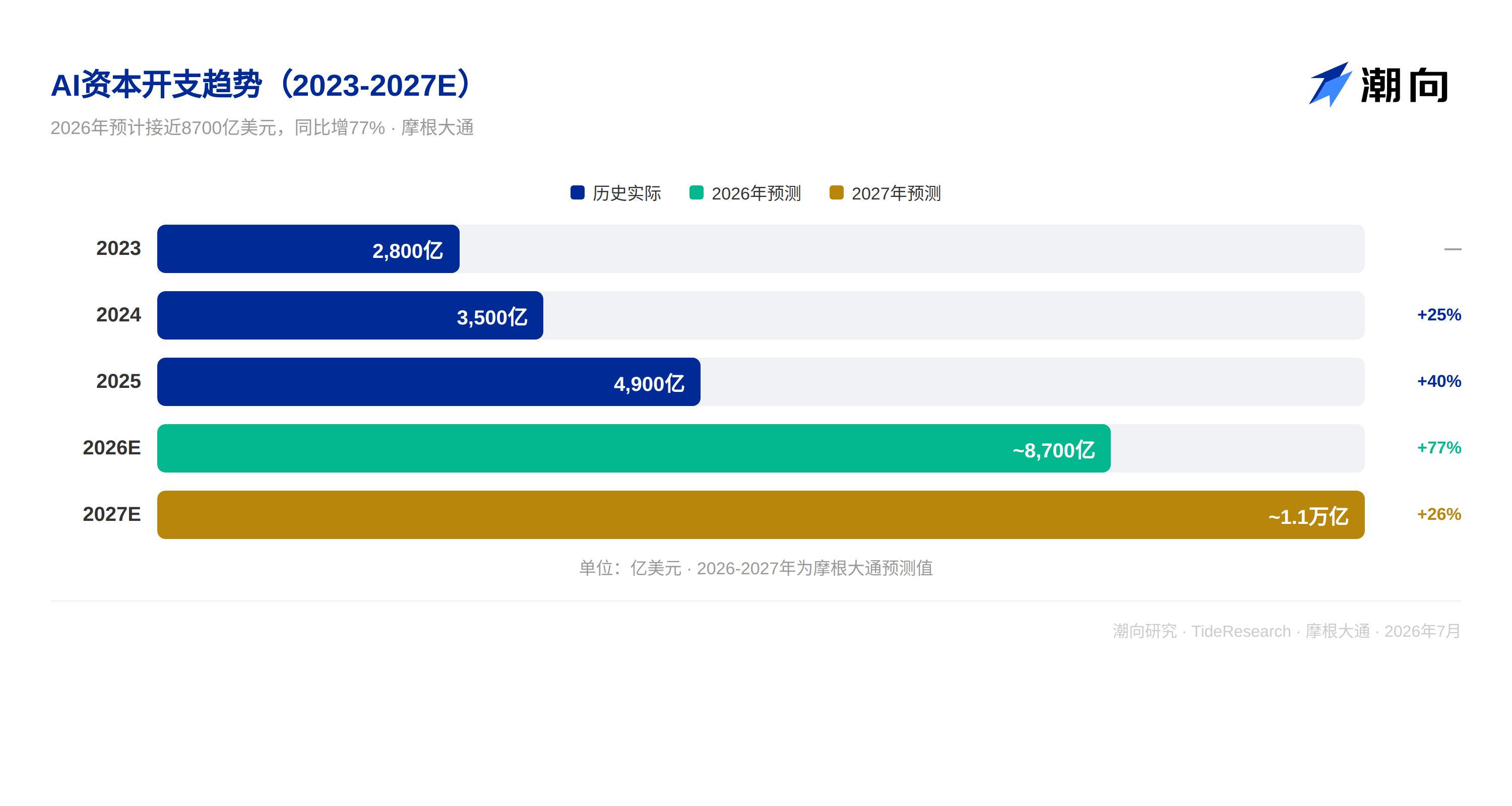
The development of the AI industry chain heavily relies on continuous investments from tech giants in data center construction. The market expects that by the end of 2026, global AI-related capital expenditures will approach $870 billion, a year-on-year increase of 77%, with large-scale companies contributing about $750 billion.
J.P. Morgan's internet analysts believe that market expectations for 2027 remain conservative. Google's capital expenditure for 2027 is expected to grow by 54%, approaching $300 billion. Amazon is expected to grow by 42%, around $300 billion. Meta is expected to grow by 42%, about $200 billion.
The construction of AI infrastructure has not slowed down, and is continuing to accelerate. In the coming weeks, the earnings reports of the four major large-scale companies will be the market's core weather vane.
The Market Begins to Ask: When Will We Make Money?
For the past two years, the market has only focused on investment scale. Current investors are beginning to focus on the core issue: when can large-scale investments yield returns?
J.P. Morgan believes that this will become the core mainline of AI investment in the coming years. Positive signals have started to emerge. Meta is selling idle AI computing power externally to directly realize data center resource monetization. Anthropic's progress in safety research suggests that safety concerns may accelerate the transfer of government and enterprise workloads to the cloud, replacing local model deployments.
This means that demand for cloud services such as Azure, Google Cloud, and AWS will continue to grow. AI business models are gradually being validated, covering multiple paths including model sales, computing power output, cloud services, and software licensing. J.P. Morgan believes that if management releases more signals of AI commercialization in their earnings report, profit forecasts and free cash flow are likely to be revised upward.
Money is Flowing from Hardware to Cloud Giants
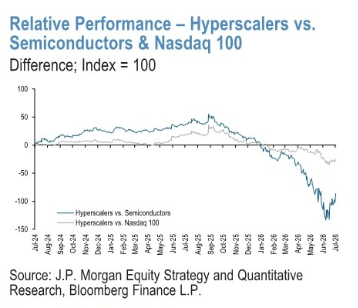
In the past two years, the biggest winners in the AI market have been upstream. Sectors such as GPU, HBM, high-speed networks, switches, and optical modules have all risen sharply. However, J.P. Morgan believes that a sector rotation is occurring.
AI hardware is a typical momentum trade: positions are highly concentrated, and trading is extremely crowded. Once expectations change, volatility will be significantly amplified. The semiconductor sector has recently corrected by about 15%, and although the crowding level has eased, it is far from being cleared. Market concerns are focused on four points: the continuity of capital expenditure, the diversion of funds from AI company IPOs, the supply-demand landscape for infrastructure, and whether the return on invested capital can cover costs.
In contrast, Microsoft, Google, Meta, and Amazon have a better risk-reward ratio. These companies have control over computing power, cloud platforms, and end users. The ones truly realizing profits may not be the "pick and shovel sellers," but rather the "gold mine operators."
Where's the Money Coming From?
The source of funds has become a new concern in the market: with annual investments in the thousands of billions of dollars, can the financial reserves of tech giants support this?
J.P. Morgan specifically responds to this. The bond financing scale of the five major tech giants has increased from $40-50 billion in 2022 to about $190 billion by 2026. Google has completed $85 billion in equity financing this year, and Meta is also evaluating similar plans.
However, J.P. Morgan believes this is merely a restructuring of financing and does not indicate worsening business conditions. It is expected that by 2027, the operating cash flow of tech giants will still exceed $900 billion. Revenue is expected to grow at an average annual rate of about 17% over the next few years, and profit margins will remain high. The market is willing to provide financing support for AI construction, based on the core logic that it expects long-term profit returns.
Regarding the free cash flow inflection point, J.P. Morgan predicts it will appear as early as 2027. If the pace of AI commercialization slows, significant improvements may require waiting until after 2028.
The Semiconductor Logic Has Not Changed
J.P. Morgan does not have a bearish outlook on AI hardware.
Demand from large-scale companies remains strong, AI laboratory computing power still has gaps, demand for intelligent agent inference is rapidly growing, and data center investments continue to increase. New platforms like Blackwell and Rubin further enhance visibility of demand in the coming years. The market's discussion focus has shifted: previously, the market was concerned about "the authenticity of AI demand," and is now turning to "whether the supply chain and power supply can match."
Apart from GPUs, AI demand has spread to customized chips, HBM storage, high-speed networks, semiconductor equipment, EDA, and other fields. This year, global semiconductor (excluding memory) industry revenue growth is still expected to exceed 30%. J.P. Morgan remains optimistic about the AI industry chain, believing only that the pace of investment is undergoing rotation.
Q2 Profits Remain Strong
J.P. Morgan is generally optimistic about the U.S. stock Q2 earnings season. The S&P 500's Q2 profits are expected to grow by 23% year-on-year, with growth of 19% after excluding energy, and revenue growth of 12%. Almost all sectors have achieved revenue growth, with most sectors, except healthcare, also seeing profit increases.
However, the growth structure is highly concentrated. Just Nvidia and Micron alone contribute about 37% of the S&P 500's profit growth. Current profit growth in U.S. stocks is still mainly driven by AI.
The energy sector is expected to see a profit growth of 122%, driven by rising oil prices, making it another important highlight of the season. Healthcare is the only sector expected to see a profit decline, but J.P. Morgan remains optimistic about its long-term allocation value, especially in the context of AI empowering drug development and improving healthcare efficiency.
Trends Perspective
This report juxtaposes two core variables of the AI investment chain: the slope of capital expenditure and the latency of realization. The $870 billion annual expenditure corresponds with the financing curve of the five major large-scale companies, rising from $40 billion to $190 billion, with the steepening of the curve itself accumulating risks.
J.P. Morgan assesses that the inflection point of free cash flow may appear as early as 2027, but acknowledges that a more distinct recovery will need to be awaited until 2028 or even later. This time window hides a core bet: if progress on realization in 2027 does not meet expectations, the market's patience for a recovery in 2028 may run out early.
The impact of changes in the fair value of private investments on EPS can easily be overlooked. The approximately $4 EPS of the S&P 500 in Q1 came from non-cash revaluations, and the scale may further expand in Q2. A considerable portion of the profit revisions is driven by accounting effects, and the actual extent of business improvement should be evaluated with caution.
Disclaimer
This article is an organization and interpretation of the third-party brokerage report (J.P. Morgan, July 20, 2026) by Trends Research. The ratings, target prices, profit forecasts, and related judgments quoted in this text are the views of that brokerage's analysts, representing only the positions of their respective institutions and do not represent Trends Research's views, nor do they constitute any investment advice. The market has risks, and decisions must be independent. This article should not be used as a basis for buying or selling any securities.
免责声明:本文章仅代表作者个人观点,不代表本平台的立场和观点。本文章仅供信息分享,不构成对任何人的任何投资建议。用户与作者之间的任何争议,与本平台无关。如网页中刊载的文章或图片涉及侵权,请提供相关的权利证明和身份证明发送邮件到support@aicoin.com,本平台相关工作人员将会进行核查。


