Original | Odaily Planet Daily (@OdailyChina)
Author | Wenser (@wenser2010)

Last night, a report about the “Movement developer Movement Labs applies for bankruptcy protection” caused a stir in the community. No one expected that this “star L2 project,” which had once sought $100 million in financing at a valuation of $3 billion, had reached this point of bankruptcy.
However, with more details released, the truth finally came to light: only the former developer company Movement Labs declared bankruptcy, which has no impact on the Movement network; the Movement network has been operated by Move Industries since May 2025 and has shifted to cross-border payment and stablecoin settlement as an L1 network. Movement Industries CEO Torab also confirmed this news.
Just when we thought this was nothing more than an old discussion about “issues left behind due to a developer team rotation,” a post revealing the true bankruptcy process of Movement Labs provided a different answer: this is not a simple bankruptcy application, but a carefully prepared escape act.
Detailing the Mystery of Movement Labs' Bankruptcy: Former Developer Transforms into a Bankruptcy Shell
According to a tweet from Thomas Braziel, a partner at the corporate bankruptcy handling firm 117Partner, the bankruptcy application of Movement Labs resembles a premeditated “shell trick”: before declaring bankruptcy, all operational businesses, intellectual property, contracts, token rights, and employees were transferred out; the original company was left with only $60,000 in cash and litigation claims.
In other words, this was not a standard application for bankruptcy protection but a maneuver to cut risks and protect Movement Industries and the Movement Foundation from litigation disputes as a means of survival. Because the latter two are precisely the recipients of related assets from the original developer Movement Labs.
In the bankruptcy protection application documents submitted by Movement Labs, we can find further evidence supporting this viewpoint:
- In mid-July 2026, the company submitted a Chapter 11 (Subchapter V, streamlined process for small businesses) application in the bankruptcy court of the United States District of Delaware. The company's assets are between $100,000 and $500,000, liabilities up to $10 million, and creditors ≤ 299.
- According to the previous “Fenix Project Agreement,” Movement Labs transferred its remaining intellectual property and key contracts to the Movement Foundation, waived the rights to issue MOVE tokens, and agreed to terminate its business operating qualifications.
- Movement Labs transferred its main team to Move Industries (the current developer of the Movement network) for a price of $1.2 million.
- As of the bankruptcy protection application date, Movement Labs had no operating assets, no actual business operations, and no full-time employees; it only had about $60,000 in cash; the company was still involved in litigation claims and residual rights issues in contracts.
- The Cayman Islands subsidiary MNF DIP SPV Limited of the Movement Foundation is providing up to $5.7 million in financing to Movement Labs for debt repayment and exit plans; however, this requires meeting a series of stringent conditions, including but not limited to approval by the bankruptcy court and compliance with the “Fenix Project Agreement,” the bankruptcy trustee handling the case must be recognized by the company, and prohibition against investigation or lawsuit against the Movement Foundation, Movement Limited, DIP loan institutions, and numerous affiliated institutions. It is worth mentioning that former co-founder Cooper Scanlon, Polychain Capital's Chief Legal Officer Ruby Sekhon, and all executives, directors, and employees who moved over from Move Industries (including CEO Torab Arya/Torab Torabi) are also included. In contrast, the previously dismissed co-founder Rushi Manche, who was involved in the market manipulation and token insider trading scandal, and market-making institutions are not within the scope of this protective clause.
Thus, Movement Labs became the “scapegoat,” while the Movement Foundation and Cayman Islands subsidiary, along with Movement Industries, essentially became “financial backers” for the litigation, vying for priority in processing compensation and approving the trustee's bankruptcy plan. Meanwhile, former co-founder Rushi Manche, who plays the role of creditor during the bankruptcy protection, must also look to the Movement Foundation's subsidiary for whether he can get compensation for the $1.6 million in legal and litigation costs incurred from the lawsuit. Currently, that subsidiary has temporarily approved $750,000 for this bankruptcy protection.
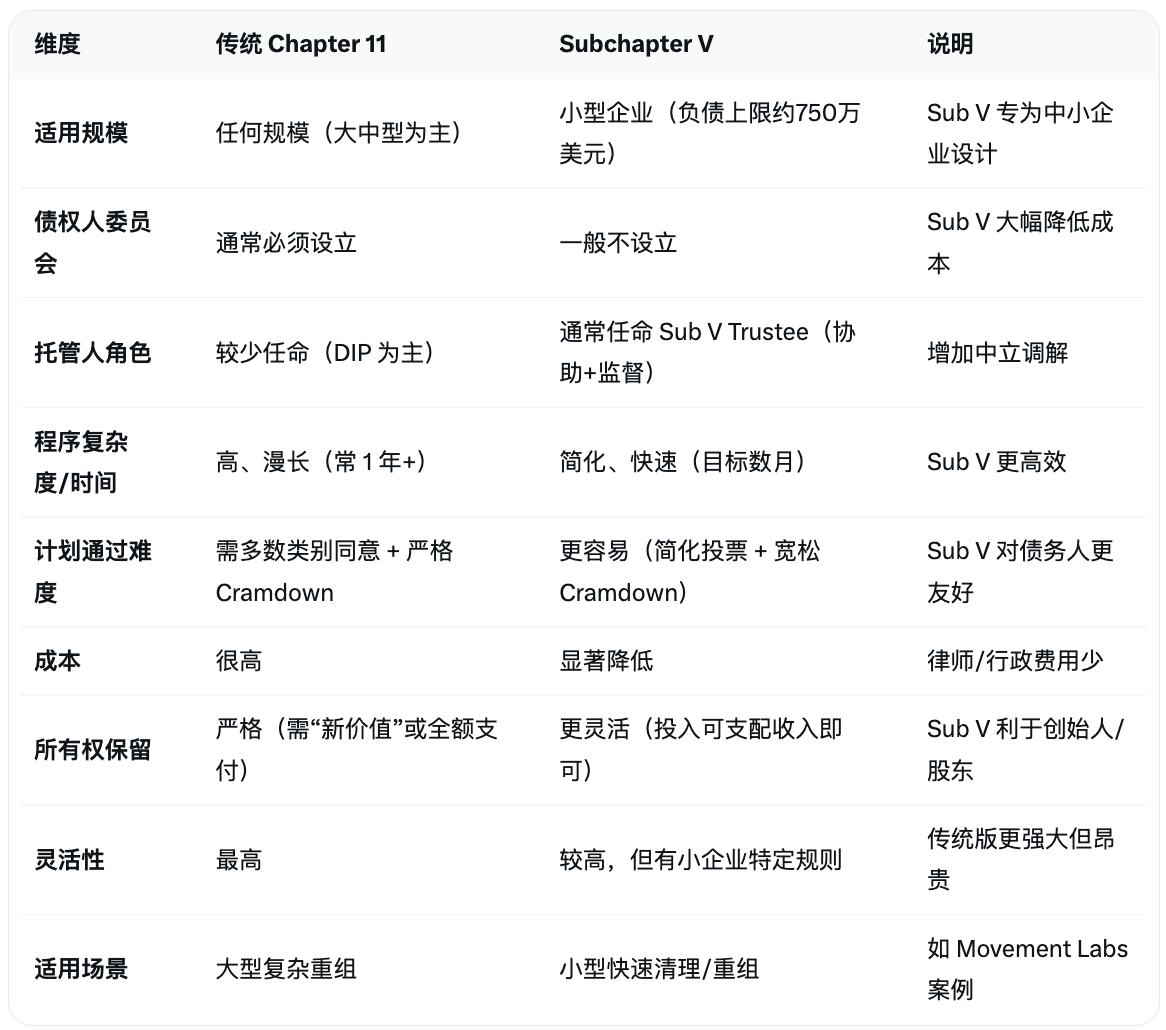
This inevitably leads us to mention the differences between Chapter 11 of the U.S. bankruptcy protection law and Subchapter 5.
According to public information, Chapter 11 bankruptcy protection applies to medium and large enterprises, requiring a creditors' committee and involving complex, lengthy processes, along with higher associated costs; whereas the Subchapter 5 of Chapter 11, which Movement Labs employed in this bankruptcy protection application, primarily applies to small businesses (like Movement Labs, which has no full-time employees), streamlining the bankruptcy processing procedures to be as quick and efficient as possible to avoid potential scrutiny from a creditors' committee.
According to document information, the deadline for objections to the final DIP financing order is 4 PM ET on August 20, and the final bankruptcy review hearing will be presided over by Judge Thomas M. Horan at 11 AM ET on August 27.
Behind the Bankruptcy of Movement Labs: MOVE Token Deep in DOJ Investigation, Two Co-Founders Part Ways
Last April, Movement faced the “66 million MOVE tokens sell-off incident.” At that time, this $38 million sell-off event was exposed by an insider contract, drawing numerous criticisms towards the market maker Rentech and its parent company Web3Port.
Ultimately, the incident concluded with Binance banning the involved market maker accounts and freezing profits, Coinbase halting MOVE trading, the Movement Foundation using reclaimed funds for a $38 million token buyback, and co-founder Rushi Manche being fired from the team. However, the U.S. Department of Justice is still conducting a grand jury investigation into this matter and the MOVE token issuance event, with Rushi as one of the parties involved.
As of now, Rushi Manche still holds a 34.25% stake in Movement Labs and retains the title of co-founder but has no decision-making authority in business operations. This token sell-off incident, along with the “Movement Labs had secretly promised two advisors up to 10% of the token share,” are direct reasons that led Movement Labs to file for bankruptcy protection.
Additionally, it is worth mentioning that another co-founder, Cooper, is also not blameless.
Previously, MOVE token airdrop participant Thapaliya revealed that Cooper insisted on allowing specific 75,000 wallets to receive the highest proportion of MOVE token shares per wallet. He also pointed out via an on-chain heatmap that these wallets were almost the only ones that claimed and were able to bundle and sell over 60 million MOVE tokens during the Move token airdrop on December 9, 2024. Currently, Cooper has exited the decision-making level of the Movement ecosystem and previously handed leadership to Movement Industries CEO Torab, indicating a tendency to retire from the scene.
Looking at the current situation, aside from the DOJ investigation and litigation, Rushi's development in the crypto industry has not been significantly affected.
Last December, Rushi announced the establishment of Nyx Group, planning to invest up to $100 million to support crypto token projects, aiming to provide liquidity and comprehensive operational support for projects preparing for token launches, including community building, financial management, and compliance guidance. It seems he is pursuing his own “second spring” in business.
As for whether Movement Labs can successfully escape compliance scrutiny and the impacts of token sell-offs and market-making turmoil through this escape act, the upcoming bankruptcy hearing may provide the final answer.
免责声明:本文章仅代表作者个人观点,不代表本平台的立场和观点。本文章仅供信息分享,不构成对任何人的任何投资建议。用户与作者之间的任何争议,与本平台无关。如网页中刊载的文章或图片涉及侵权,请提供相关的权利证明和身份证明发送邮件到support@aicoin.com,本平台相关工作人员将会进行核查。


