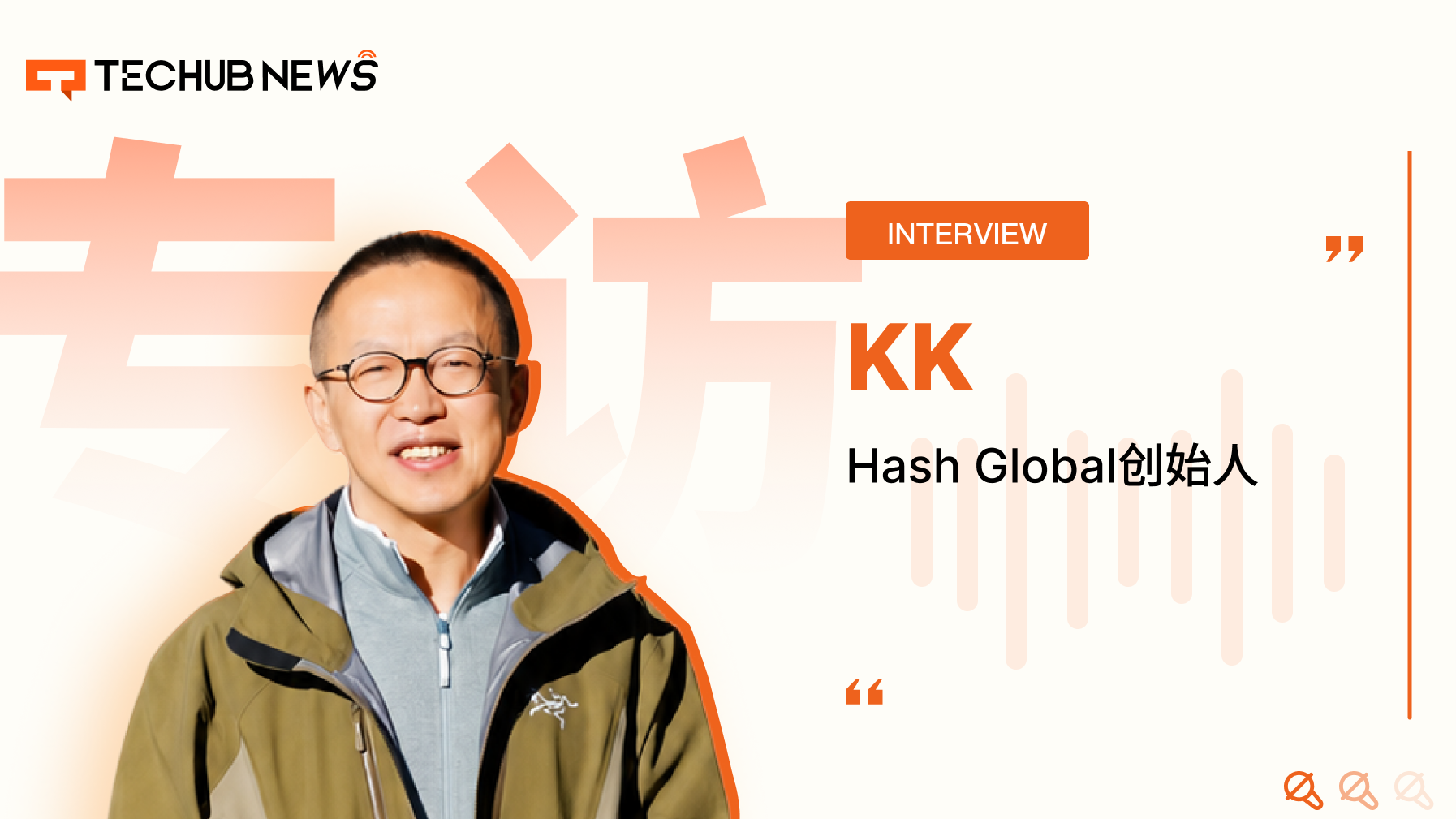
Introduction: KK (the founder of Hash Global) is a seasoned investor transitioning from traditional finance to Web3. Since entering the industry in 2018, he has led his team through multiple market cycles, consistently adhering to a value investment logic when considering digital assets. In the current context of talent and capital outflow facing the Web3 industry, along with the impact of the AI wave, KK accepted an exclusive interview to deeply analyze his thoughts on the industry's current state and his firm confidence in Hong Kong as a global RWA hub.
Core Summary:
- Cycle Judgment: Currently, it is the coldest moment in the industry since 2018, and the trough is expected to last for another year until the AI boom returns to rationality and the industry values are reshaped.
- Investment Logic: The core dimension is "people," especially the background of the founders, product thinking, ability to cope with difficulties, and familiarity among team members.
- AI and Web3 Fusion: Approach infrastructure projects with caution, optimistic about the combination of Agentic Commerce (intelligent agent commerce) with Web3 payments, and the localization of personal behavioral data (such as the Data Dance project).
- Hong Kong Role: Hong Kong is the first choice for Chinese entrepreneurs and is expected to become the global RWA (Real World Asset) hub for connecting Chinese and Asian assets with global liquidity in the future.
1. Traditional Finance Background and Entry Opportunity
Maggie: Today, I am honored to invite KK, the founder of Hash Global. KK, you had experience in traditional finance before; did you work in the primary or secondary market? What prompted you to notice Web3?
KK: I entered the Web3 digital asset industry in 2018. Before that, I was working in traditional finance and the asset management industry. Most of my focus was on the secondary market, where I worked at US bond management companies and domestic stock firms. After leaving my original platform in 2015, I began investing in the primary market.
My entry into Web3 was mainly influenced by my former leader, Hashkey Chairman Xiao Feng. He entered this industry early and was one of the earliest and most important investors in Ethereum. I have always admired him and felt that the industries he recognizes must be reliable, and that the track would be long enough.
2. Investment Logic Through Cycles: Adhering to Value Judgment
Maggie: What was the market feeling like when you first entered the industry in 2018?
KK: It was very lively, with all sorts of ideas and aspirations. At that time, the lines between the primary and secondary markets of Web3 were not clear, with many funds buying in the secondary market while also investing in early-stage projects. We were not Web3 natives; we came from traditional finance, and there weren't many institutions like us at that time.
Maggie: What different qualities does your traditional finance background bring to Hash Global?
KK: We have been in the industry for 8 years and have gone through about two to three cycles. Our characteristic is that we insist on thinking from the perspective of value investment: does this matter have value? Can it solve real problems? This makes us relatively conservative and rational. Although we have made mistakes and lost money due to excessive optimism, we have still persevered to this day.
Maggie: What do you consider your most successful investment case?
KK: In April 2019, we tried to assess the value of BNB using traditional asset management logic and the "currency equation" instead of traditional PE or DCF methods. We began to accumulate at about 16 dollars for BNB and became one of the first ecological nodes. Although we later invested in many less-than-ideal projects, we believe our investments in BNB and Bitcoin were relatively correct.
3. Core Dimensions for Project Assessment: People Come First
Maggie: How do you rank the importance of factors when assessing projects?
KK: After years of ups and downs, we believe "people" are the most important factor. We look at the founders' backgrounds, product thinking, ability to cope with difficulties, and their character and qualities. Additionally, the familiarity among team members is crucial; a team formed from college classmates is completely different from a temporary team.
4. Cautious Optimism Towards AI
Maggie: Are you currently looking at AI projects?
KK: Our team is extensively using AI tools and is paying attention to this industry. However, I am very cautious about directly investing in AI projects because there is a huge gap between understanding them and being able to invest in them. We prefer to invest in two types: first, projects where Web3 teams transition to empower through AI technology, and second, projects that deeply integrate AI with Web3 that we can understand.
5. Industry Judgment: Currently in the "Coldest" Trough Period
Maggie: Where do you think the market stands in the cycle now?
KK: I believe we are at the coldest time since entering the industry and this coldness may last another year. The current problem in Web3 is that AI has siphoned off nearly all outstanding talents and capital. In 2019, half of the talented young people went to AI and half to Web3, and everyone was very enthusiastic. But now, Web3 lacks people, money, and no one is willing to talk to you; it's at its lowest point.
Maggie: When will it get better?
KK: It is expected to improve in a year. The prerequisite is that the AI industry cools down and some resources return. More importantly, the Web3 industry may also need a "blood transfusion." Products too close to the casino mentality, only wanting to issue tokens to attract "sheep," need a change. Issuing tokens is not a panacea; it is actually a form of debt. When people start to thoughtfully consider using technology to solve business problems, the industry will improve.
6. Why Choose Hong Kong?
Maggie: Between Hong Kong, Dubai, and Singapore, why do you choose Hong Kong?
KK: Singapore has good living standards and education, but the entrepreneurial culture is relatively weak and quite comfortable. Hash Global's positioning is to only invest in Chinese teams, so we want to be closer to entrepreneurs. Dubai is highly internationalized and vibrant, but due to geopolitical issues, we have temporarily shelved related plans. For Chinese entrepreneurs, Hong Kong is still the best choice.
Maggie: How do you view Hong Kong's role in this wave?
KK: Hong Kong is steadily advancing. In the past, Hong Kong was the hub for selling Chinese assets to the world. Now, with stablecoins and RWA, under legal guidance (such as Document 43), Hong Kong has the opportunity to become a global RWA hub. Through the public chain ecosystem, Hong Kong can undoubtedly become the core for connecting Asian assets with global liquidity.
7. Business Landing and Future Directions
Maggie: Which Web3 business landing directions do you find promising?
KK: Besides the financial sector, we are particularly optimistic about the creator economy and cultural entertainment. For example, we invested in IPDEX, which empowers copyright and allows fans to co-create and benefit from IP assets. There’s also the card project Renaiss Protocol, which utilizes Hong Kong’s tax advantages while effectively resolving the offline business logic of RWA assets and leveraging the on-chain infrastructure of BNB Chain to serve global clients. We believe the future is "Everything on Chain," and Web3 has a natural advantage in payment settlement, asset formation, issuance, and distribution. Web3, as a financial infrastructure with generational technical advantages, can empower all industries, not just finance, but also cultural and entertainment sectors.
Maggie: Can you talk about specific opportunities for the integration of AI and Web3?
KK: I am very focused on Agentic Commerce. I even created a dashboard to track the development of various elements in this direction. We invested in a project called Data Dance, which combines Web3 and AI, allowing personal data to be stored locally and authorized for use after encryption. In the Web2 era, data was owned and used by platforms, and individuals received the right to use internet services for free; however, the cost of this "free" access is actually quite high. It seems quite difficult to break user habits solely relying on Web3 technology. But AI and Agentic Commerce are changing internet search and business models. Having local data means AI can offer more accurate and fair services. This new type of internet business, combining Web3 payments with encrypted-protected local data tools, encompasses a huge opportunity.
8. About Jiu Ming Commune
Maggie: What kind of organization is "Jiu Ming Commune"?
KK: Jiu Ming Commune, originally named Maodao, is an NFT community that initially had many Thai design elements, but now the core operation is in Hong Kong. Due to the industry's downturn in the past two years, making entrepreneurship challenging, we renamed it "Jiu Ming Commune" to inspire entrepreneurs to have a resilient perseverance, having nine lives to take on projects. We hope it can serve as a platform for Web3 entrepreneurs and practitioners to make friends, share high-quality information, connect resources, and learn and grow.
Maggie: Thank you for sharing today, KK.
KK: Thank you.
免责声明:本文章仅代表作者个人观点,不代表本平台的立场和观点。本文章仅供信息分享,不构成对任何人的任何投资建议。用户与作者之间的任何争议,与本平台无关。如网页中刊载的文章或图片涉及侵权,请提供相关的权利证明和身份证明发送邮件到support@aicoin.com,本平台相关工作人员将会进行核查。


