Original author: Zhang Yaqi
Original source: Wall Street views
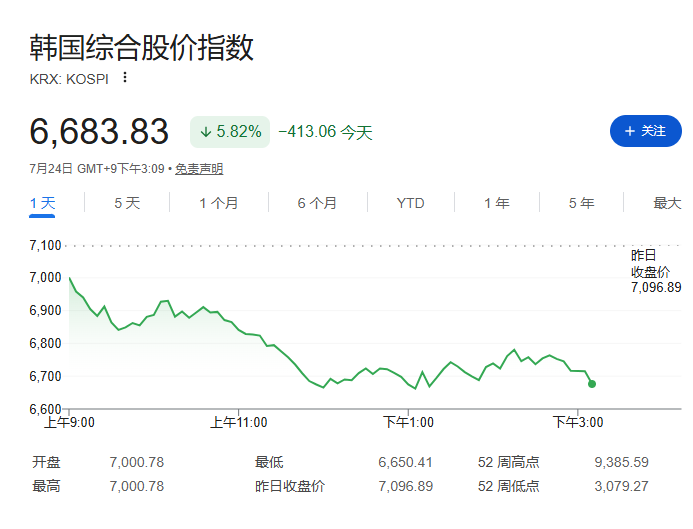
Today, the South Korean stock market has again fallen into the "ICU".
SK Hynix and Samsung Electronics both dropped over 7% during trading, and the Seoul Composite Index at one point fell over 6%, triggering a circuit breaker. Media reports indicate that the trigger for the decline is related to Morgan Stanley's Asia technology research head Shawn Kim, nicknamed "the Grim Reaper of South Korean semiconductors".
In a report released on July 21, he warned that the AI-driven semiconductor memory industry frenzy is approaching a turning point, with memory contract prices expected to peak in the fourth quarter, and the ratio of net profit revisions has fallen from a peak of 92% to 77%. Although some analysts claim that Shawn Kim's report was used to incite panic and might not be the cause of the significant drop.
But this time, Shawn Kim's report not only stirred the market but also put Morgan Stanley itself in a more awkward situation.
This leading Wall Street investment bank has long issued bearish reports on South Korean semiconductors, and is now facing setbacks in the South Korean market — from being excluded from the list of lead underwriters for SK Hynix's U.S. listing, to several major deals falling through one after another, its business in South Korea is under increasing reputational and commercial pressure.
The most iconic event was SK Hynix's approximately $26.5 billion U.S. depositary receipt (ADR) listing project. Bank of America, Citigroup, Goldman Sachs, and JPMorgan were selected as co-lead underwriters, with Morgan Stanley being the only top investment bank not selected. Calculated at a 0.5% underwriting fee, the total commission for this listing is approximately $130 million. For an institution that prides itself on big IPOs like SpaceX and Anthropic and is viewed as a top candidate underwriter for OpenAI's listing, this exclusion is not only a financial loss but also a significant blow.
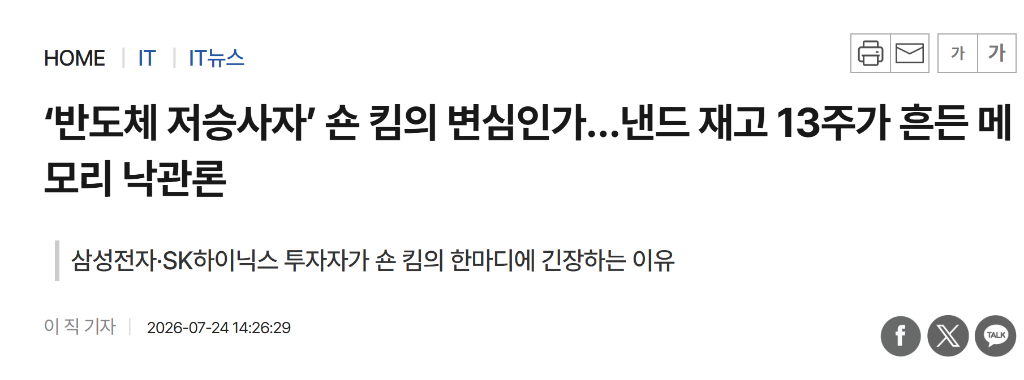
Repeatedly bearish, dubbed “the Grim Reaper of South Korean semiconductors”
In the South Korean investment circle, when mentioning Morgan Stanley's research department, one cannot avoid the name Shawn Kim. This Korean-American managing director joined Morgan Stanley in 2002 and is currently in charge of technology research for Europe and Asia. He has previously been stationed in Seoul and Hong Kong, and now resides in London. In the South Korean market, he has established significant influence with a series of sharply worded semiconductor reports, and has also earned the nickname "the Grim Reaper of South Korean semiconductors".
Over the past decade, he has repeatedly issued warnings near the peaks of South Korea's semiconductor economic cycles: in 2017, he released a bearish report on NAND prices and memory supply surplus; in August 2021, he launched the report "Memory, Winter is Coming", which accurately coincided with a subsequent two-year downturn in the semiconductor market; in September 2024, his report on the possibility of an oversupply of HBM was regarded as one of the triggers for the sharp drop in Samsung Electronics and SK Hynix’s stock prices — Morgan Stanley later also admitted to errors in the short-term performance forecast for SK Hynix.
On July 6, Morgan Stanley's chief investment officer Michael Wilson led the stock strategy team to once again recommend reducing holdings in memory semiconductor-related stocks such as Samsung Electronics, SK Hynix, and Micron, at a time when the market was already under downward adjustment pressure. This move was described by the South Korean industry as "rubbing salt in the wound".
Shawn Kim's latest report was even more systematic: NAND module manufacturers' inventories have risen to about 13 weeks, approaching the peak level of about 15 weeks during the pandemic; spot prices are weakening; some cloud service providers have indicated ample inventories, including Tencent, which has stockpiled approximately 90% of its needed quantity (the source and accuracy of this data have not been officially confirmed). He also presented the trading logic of "when NAND goes down, sell DRAM", linking the two segments into the same cyclical narrative.
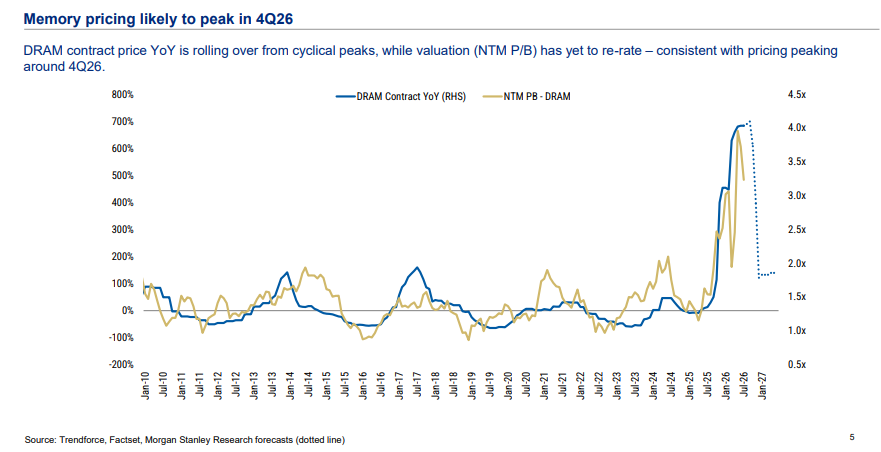
Nevertheless, Joseph Moore, an American semiconductor analyst at Morgan Stanley, holds a more optimistic view — he believes that AI data center investments will make DRAM the core bottleneck, and supply shortages may extend until 2028. The root of their disagreement lies in differing observational perspectives: Joseph Moore focuses on the capital expenditure of large U.S. cloud providers, while Shawn Kim pays more attention to early warning signals appearing in Asian distribution channels.
After being kicked out by SK Hynix, Morgan Stanley begins to reflect: South Korean semiconductors are not to be trifled with
SK Hynix's ADR listing is the largest IPO in U.S. history for a foreign company. Morgan Stanley's absence has triggered a direct chain reaction internally.
According to several investment banking personnel (including former executives of Morgan Stanley), a sentiment has spread within the Seoul office:
"Is it because of negative reports from Shawn Kim and others that we lost the SK Hynix deal, we need to be cautious in the future."
This sentiment has also spread to the line of business within Morgan Stanley responsible for fundraising from South Korean institutional clients. According to South Korean media reports, there have been complaints emerging in related departments:
"How can we do business this way?"
This division reflects a structural dilemma faced by international investment banks: the tension between the independence of research departments and the business interests of investment banking. If research reports are interpreted by the market as being manipulated for business purposes, it will damage credibility; but if self-censorship is employed out of consideration for client relationships, it will lose research value.
A head of a domestic large investment institution stated, "Morgan Stanley’s transactions in South Korea have encountered repeated setbacks, and it seems to have entered a mode of self-reflection lately. This exclusive exclusion from the SK Hynix listing project has hit them hard."
More troubles: multiple large deals falling through
The SK Hynix project is not an isolated case. Recently, several transactions that Morgan Stanley participated in or led in South Korea have not ended well.
The most noteworthy controversy is related to the SpaceX IPO. According to Korea's leading brokerage Mirae Asset Securities, during the period from June 5 to 10, it applied for $1.14 billion through Morgan Stanley's lead underwriting system and received a "confirmation" receipt, but ultimately did not receive any allocation. Mirae Asset suspects that Morgan Stanley overlooked this application when transferring work to co-lead underwriter Goldman Sachs. Since the allocation rights of the IPO fully belong to the discretion of the underwriter, Mirae Asset cannot formally hold anyone accountable. According to Bloomberg's report on June 30, it was stated that the allocation failure was due to an operational error on the part of Mirae Asset. On July 14, Mirae Asset filed a civil lawsuit against Bloomberg over this matter, escalating the incident into a legal confrontation between a large domestic brokerage and an international media outlet. The South Korean Financial Supervisory Service has completed on-site inspections, with results expected to be published in several months.
Another equally embarrassing case is the project for the sale of IGIS Asset Management, led jointly by Morgan Stanley and Goldman Sachs. IGIS is South Korea's largest real estate asset management company, managing 73 trillion won, including 20 trillion won of entrusted funds from the national pension. In December last year, the two investment banks listed Singapore's Hillhouse Capital as a preferred purchaser, but the latter ultimately withdrew due to financing issues. Competing buyers subsequently reported to the police, claiming that during negotiations, there were instances of price information being unilaterally leaked to Hillhouse, involving a total of five people from IGIS's controlling party and Morgan Stanley. There are also reports that the details of the national pension's entrusted investment were leaked during due diligence, attracting regulatory attention.
An earlier case dates back to 2017-2018, when Morgan Stanley issued a report predicting that the stock price of biopharmaceutical company Celltrion would be halved, causing a market uproar. Celltrion questioned the credibility of the report, and there were speculations linking it to short-selling behavior.
A deeper predicament: research independence vs business interests
This incident reflects a structural dilemma faced by international investment banks:
There is a natural tension between the independence of research departments and the commercial interests of investment banking.
If research reports are seen by the market as being manipulated for business purposes, it will undermine credibility; but if self-censorship is practiced out of consideration for client relationships, the research value is lost.
For Morgan Stanley, the controversy surrounding Shawn Kim's report is not simply equivalent to "bearishness leading to retaliation". Looking back, the bearish judgments made in 2017 and 2021 were both later proven to have some foresight; the prediction regarding HBM in 2024 has shown deviations. The source of its influence lies in the fact that semiconductors are a typical cyclical industry, and when optimistic sentiments accumulate to a peak, reverse warnings often prompt foreign institutions to adjust their allocations, thereby creating real impacts on the South Korean stock market.
From a valuation perspective, Samsung and SK Hynix's price-to-book ratios have now fallen to about 1.7 times and 2.5 times, respectively, significantly lower than recent peaks, yet still higher than their respective long-term historical averages. This valuation range reflects the market's neutral pricing logic, considering that "the storage industry is not purely a cyclical stock, and the AI narrative has not yet fully materialized."
The latest report on July 21 is methodologically more refined than before: it constructs a judgment framework for price peaking in the fourth quarter through cross-verification of multi-dimensional signals such as NAND module inventory weeks, profit revision ratios, and contract price growth rates. Morgan Stanley estimates the upper limit of HBM's supply growth rate to be about 40%, while also incorporating a long-term addressable market size of approximately $25 billion into the storage innovation track, covering various technological paths such as capacity, bandwidth, and power consumption.
An investment banking professional summed it up directly: "For investment banks, successful transaction records are core performance indicators, and the accumulation of failed cases will inevitably bring burdens."
The predicament Morgan Stanley currently faces in South Korea may just be the most realistic footnote to this logic.
免责声明:本文章仅代表作者个人观点,不代表本平台的立场和观点。本文章仅供信息分享,不构成对任何人的任何投资建议。用户与作者之间的任何争议,与本平台无关。如网页中刊载的文章或图片涉及侵权,请提供相关的权利证明和身份证明发送邮件到support@aicoin.com,本平台相关工作人员将会进行核查。


