From the Asia-Pacific and emerging markets to global corporate demand, compliant digital dollars have quietly entered the era of "distribution as king" in collaborative alliances.
Written by: Farmer Frank
Regarding corporate stablecoins, there has been a consistent discussion in the market over the past few years about a "happening" story.
This story has many versions, but the core narrative is roughly the same: traditional financial institutions are entering the space, compliant stablecoins will become the underlying infrastructure for cross-border payments, and corporate treasury management will undergo a paradigm shift, all supported by a new generation of stablecoins co-developed by banks, payment institutions, and technology platforms.
Few question this narrative.
In fact, precisely because it is so reasonable, the market has given it significant attention and expectations. After all, institutions and enterprises do indeed need a digital dollar that can enjoy blockchain efficiency while being accepted by finance, compliance, and risk departments. However, past discussions have mostly remained in the future tense: which institutions are ready to enter, what products are about to launch, and what payment and settlement scenarios are expected to move on-chain.
Until recently, the market has seen two lines of clues that are worth observing together:
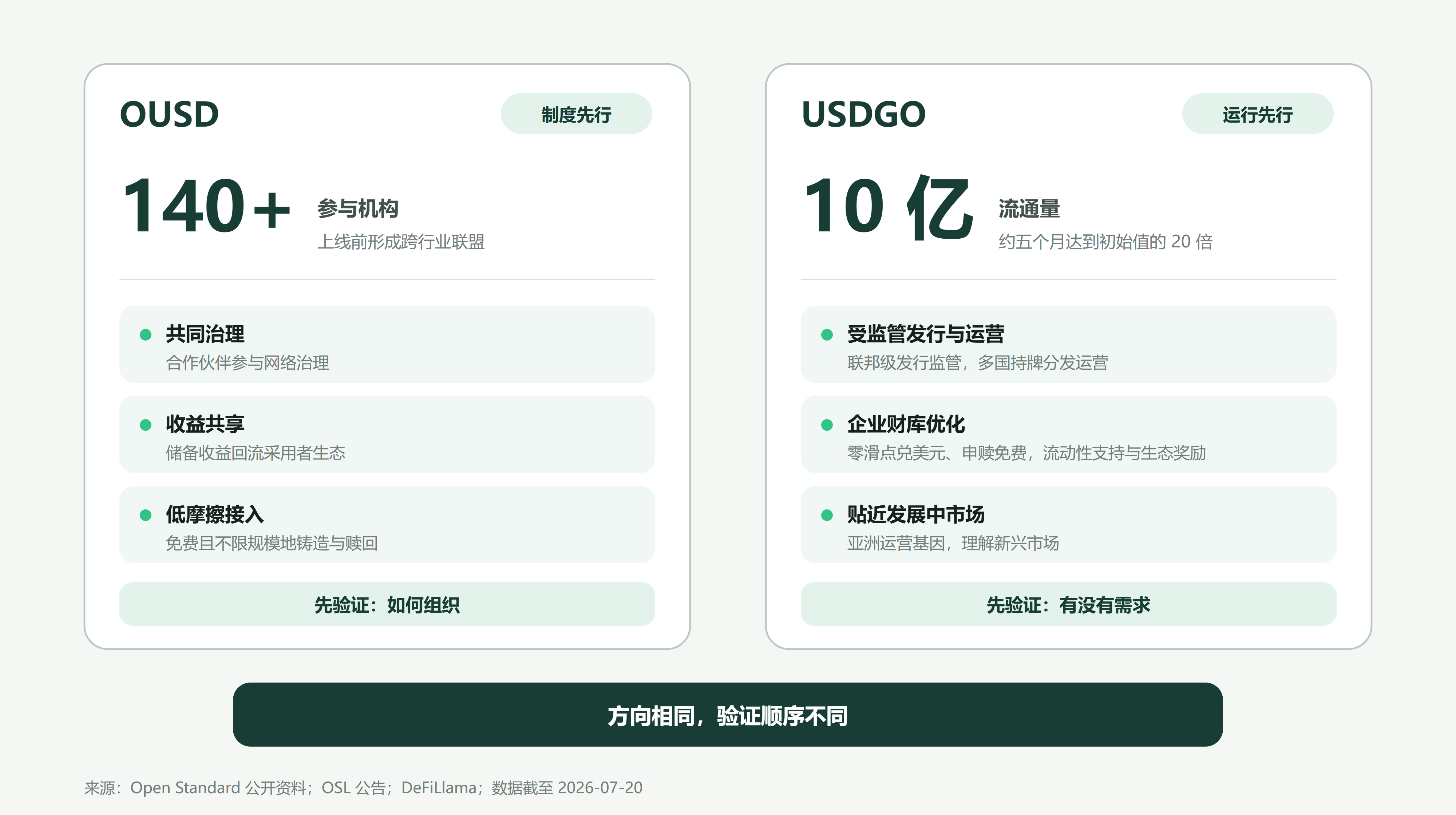
On June 30, Open Standard officially announced Open USD (OUSD), gathering over 140 financial, payment, technology, and cryptocurrency companies including Visa, Mastercard, Stripe, BlackRock, BNY, Google, and Coinbase, with plans for a formal launch in late 2026;
On July 20, according to DefiLlama's statistics, another enterprise-level stablecoin USDGO surpassed a circulation of $1 billion, entering the top six in global compliant stablecoin circulation, and became the largest dollar-compliant stablecoin operated by Asian stablecoin operators;
In a sense, OUSD intentionally aims to elevate the demand for corporate stablecoins to a global industry consensus, while the $1 billion of USDGO provides a highly valuable practical example for this consensus.
Corporate stablecoins seem to have entered a new phase of "distribution as king."
1. With USDT and USDC already in place, why do we need "OUSDs"?
Given the vast liquidity networks established by USDT and USDC, why does the market still need another dollar stablecoin?
This is an age-old topic and the first threshold that all corporate stablecoins must face. Many past discussions have summarized the opportunity for corporate stablecoins as stemming from two structural pain points in traditional payment systems:
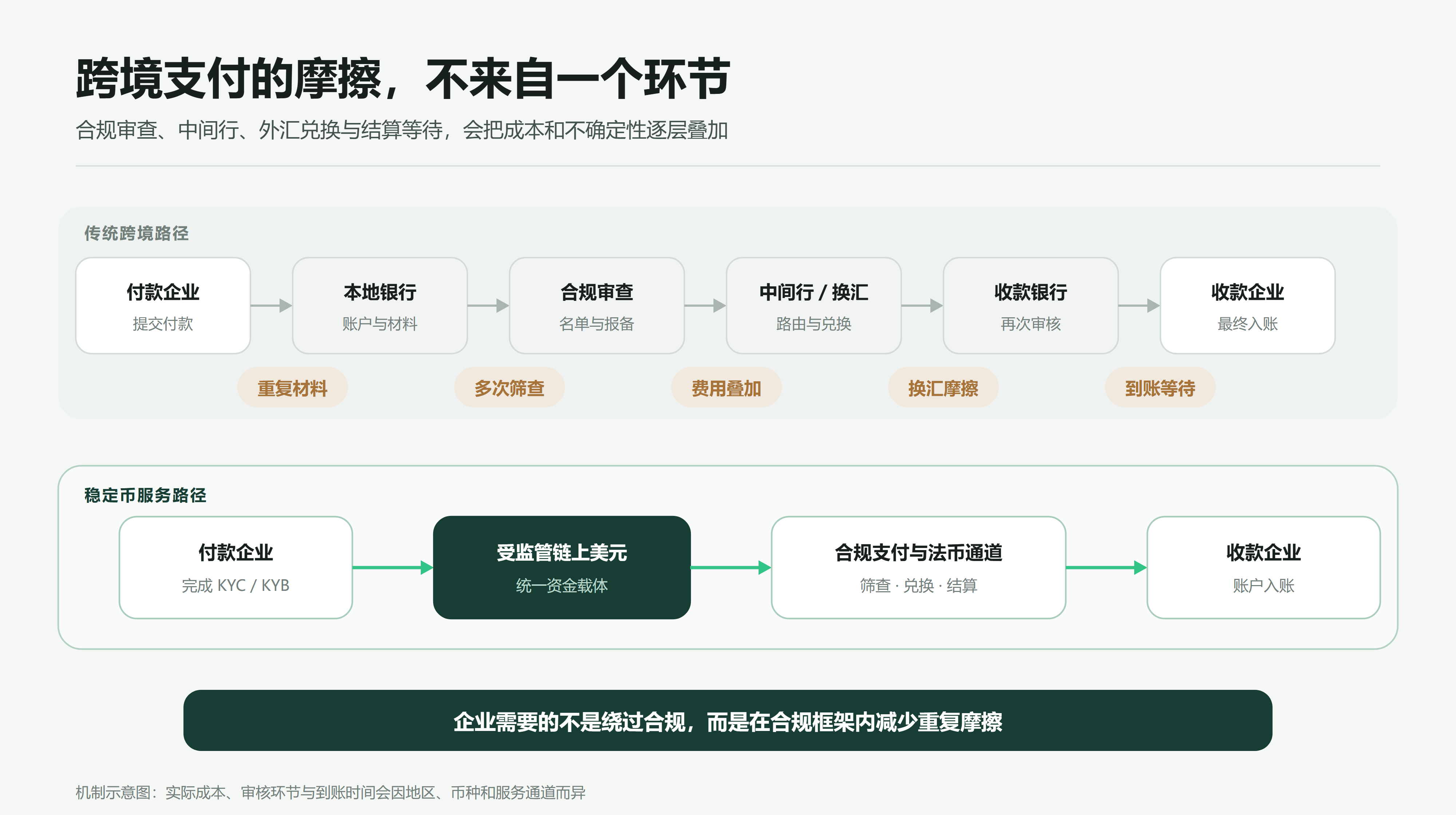
First is compliance costs. Compliance review of cross-border capital flows is not a one-time event but is embedded in every transaction. Anti-money laundering reviews, screening against sanction lists, cross-border reporting, and rules alignment among different jurisdictions means that every additional step introduces more uncertainty;
Secondly, there's settlement efficiency. A cross-border B2B payment of several hundred thousand dollars often needs to go through multiple steps, including message transmission, intermediary banks, foreign exchange conversion, and final accounting, resulting in cumulative fees, foreign exchange spreads, and capital occupation costs, with settlement cycles usually requiring several working days;
However, in reality, the opportunity for corporate stablecoins has never solely arisen from existing stablecoins being "not compliant enough" or traditional payment systems being "not fast enough". A deeper reason lies in the fundamental differences between how enterprises utilize funds compared to how crypto users engage with stablecoins.
It's important to note that in the crypto market, stablecoins primarily serve as liquid assets.
Exchanges are responsible for offering trading entry, wallets and blockchains facilitate transfers, and DeFi protocols provide lending, market making, and yield scenarios, which implies that as long as a stablecoin has deep trading pairs and on-chain liquidity, users will naturally choose it.
But a multinational enterprise wouldn't simply migrate supplier payments, merchant settlements, and treasury management on-chain just because a certain stablecoin offers faster transfers; it still needs to address issuer risk, subscription and redemption processes, fiat currency conversion, technical integration, accounting treatment, liquidity management, and different market regulatory requirements.
In simple terms, enterprises genuinely care about a complete set of issues, such as who is the legal issuer? Who manages the reserve assets? Can large subscriptions and redemptions be completed smoothly? How is the exchange between fiat and stablecoins managed? Can financial costs be optimized? How do we integrate with existing financial systems? How do we handle customer identification, anti-money laundering, sanction screening, and accounting treatment?
Beyond that, from an economic benefit perspective, the traditional stablecoin model formed for the crypto trading market may not necessarily be copied intact into the corporate payment field.
In the past model, issuers like Tether/Circle only needed to issue stablecoins and manage reserves, capturing most of the profits generated by reserve assets; exchanges, wallets, and various on-chain protocols were responsible for trading access, product integration, liquidity building, and user engagement.
This model operated well in the crypto market because stablecoins themselves are indispensable liquidity tools for exchanges and on-chain protocols; even if channels cannot directly share reserve profits, they can still obtain returns through transactions, custody, lending, and other services.
However, in the corporate market, the costs associated with distributing a stablecoin are evidently much higher. Payment companies, banks, and fintech platforms not only need to complete technical integration and compliance reviews but also must persuade enterprises to change their settlement tools, adjust their funding processes, and continuously provide fiat currency inflows and outflows, liquidity management, accounting reconciliation, and customer services.
If the economic benefits generated from the growth of stablecoin scales are still mainly monopolized by the issuer, those truly responsible for finding customers, building payment channels, and driving enterprise adoption may lack sufficient motivation for long-term investment.
OUSD and USDGO also seek to change this relationship:
According to the design published by Open Standard, aside from maintaining a small management fee necessary for daily operations, the profits generated from reserve assets will be distributed to partners like banks, payment platforms, e-commerce enterprises, and technology service providers. In other words, OUSD is a stablecoin network co-built, co-governed, and sharing economic benefits among its adopters;
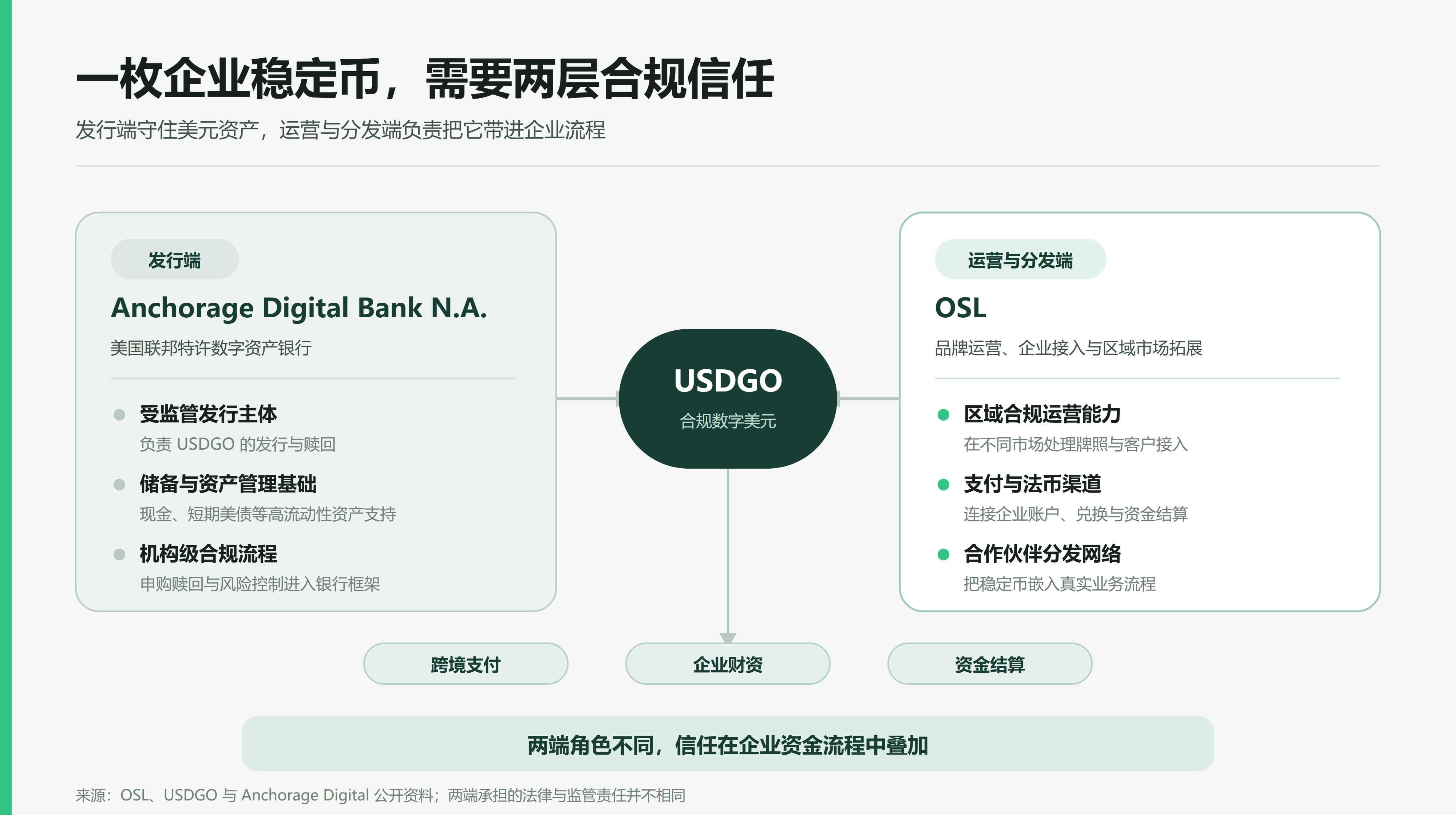
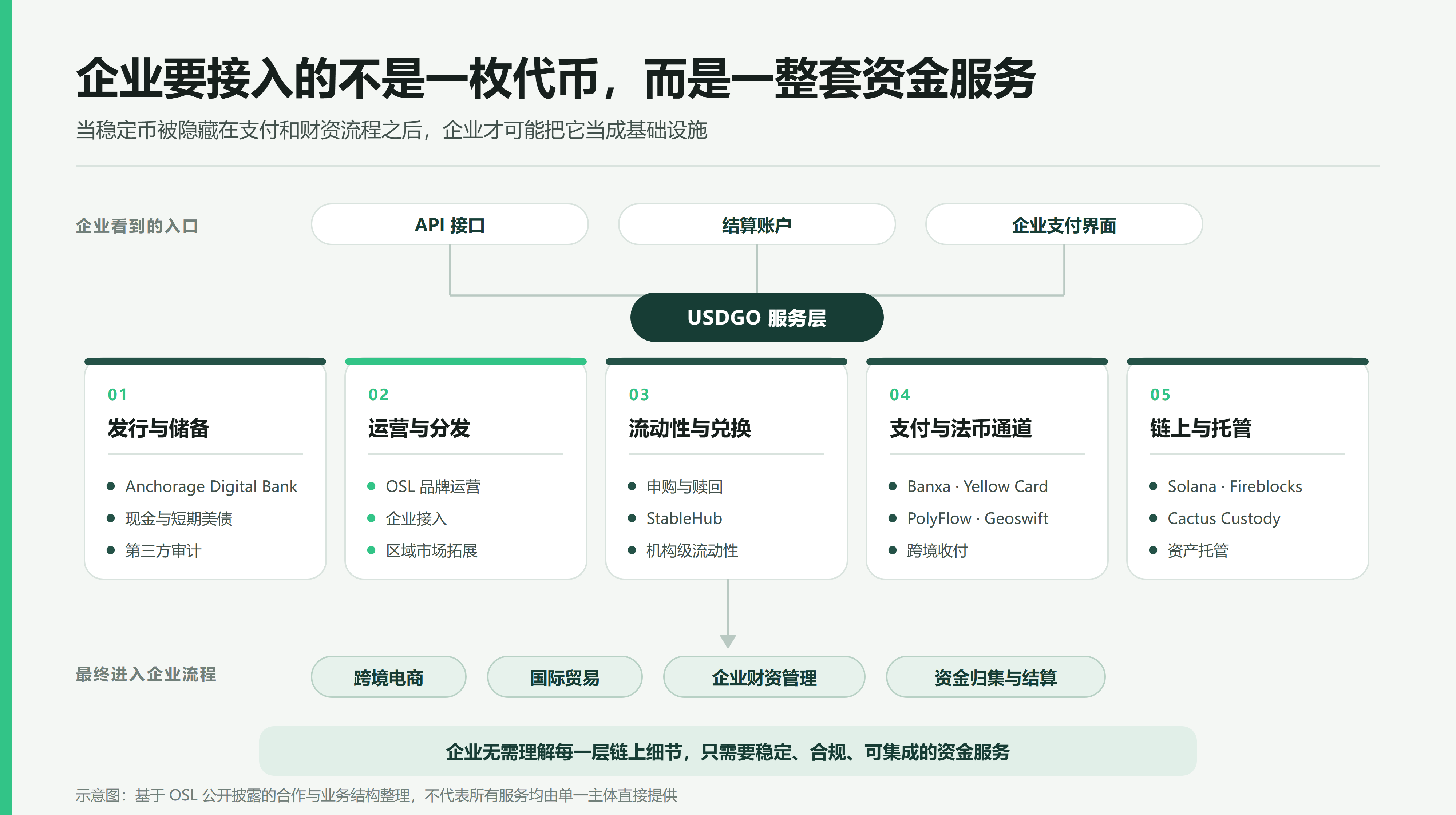
USDGO, on the other hand, has taken a more pragmatically executable path, entering through regulated issuance, regional distribution, and specific enterprise scenarios, with Anchorage Digital Bank providing the issuance and reserve foundation, while OSL is responsible for brand operations, market distribution, and enterprise onboarding. It gradually connects payment, custody, fiat currency inflows and outflows, and liquidity service providers, aiming to lower the barrier for enterprises to access and use stablecoins through the specialization among issuers, regional operators, and service partners, with USDGO ecosystem clients also receiving participation incentives;
Although the two paths differ slightly, they point to the same industry judgment: enterprises need more than just a token that can transfer on-chain; they need a funding network capable of connecting different markets, accounts, fiat systems, and commercial platforms.
For banks, it can be used for digital asset settlement and corporate fund management; for payment companies, it may facilitate merchant clearing and cross-border payments; for internet platforms, it may become a foundational tool for payments to merchants, creators, and gig workers; for crypto enterprises, it can continue to fulfill functions of on-chain transactions and liquidity.
From this perspective, corporate stablecoins are indeed entering a "distribution as king" stage, and the launch of OUSD also shows that traditional large payment institutions are trying to demonstrate that global financial, payment, technology, and crypto enterprises are willing to sit at the same table to discuss a new organization model for stablecoins.
However, whether it can truly transform into a genuinely efficient operational payment and distribution network remains unknown—after all, the scale of the distribution network and the actual business scale generated by the network remain two different matters.
2. What are the significant signals from USDGO's pioneering validation?
To assess how far OUSD may go in the future, USDGO, which has been in operation for nearly half a year, serves as a valuable case study.
It officially launched on February 10, 2026, with an initial issuance scale of $50 million on Solana. Subsequently, its circulation surpassed $68 million within a month, exceeded $100 million in April, reached over $500 million in June, and further climbed to $1 billion in July.
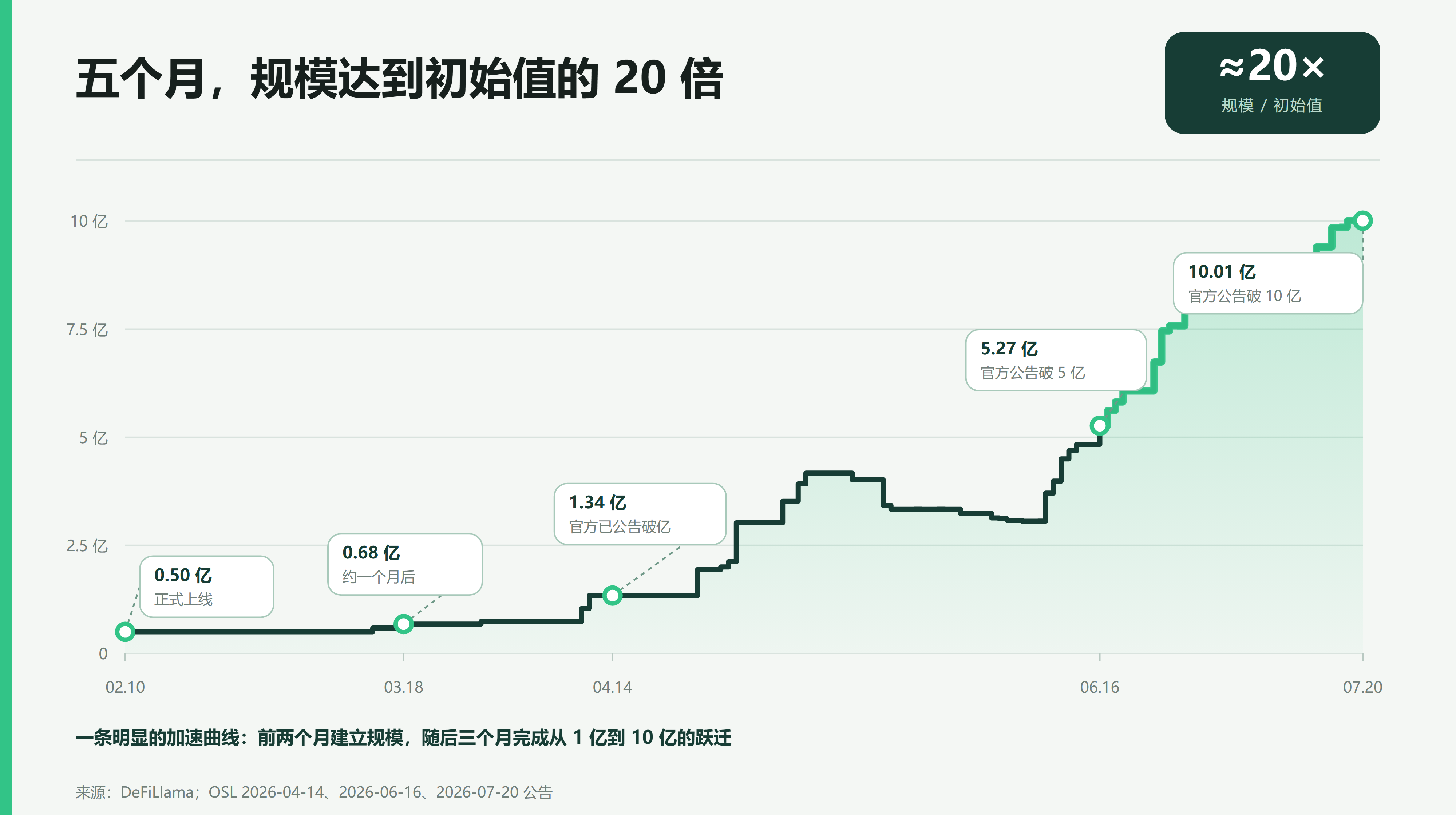
In less than half a year, growing from $50 million to $1 billion indicates at least that even though USDT and USDC already occupy a major share of the stablecoin market, the enterprise-level demand for compliant digital dollars remains a massive blue ocean waiting to be tapped, capable of converting into significant real financial scales that users are willing to hold and use.
However, the noteworthy aspect of this $1 billion is not just its growth rate.
For enterprises, the appeal of USDGO is not solely based on which blockchain it operates on or merely because on-chain transfers are faster—just as mentioned before, the premise for enterprises to use stablecoins is that issuance, reserves, subscription, redemption, regional distribution, fiat currency channels, and compliance services can form a complete chain.
The issuer of USDGO, Anchorage Digital Bank N.A., is the first federally regulated crypto bank in the U.S. The prominent names involved in issuing the stablecoin alongside Anchorage include major players like Western Union, a global cross-border payment giant, and Tether, the leading player in global stablecoins (yes, the compliant dollar stablecoin in the U.S. is issued by Tether through Anchorage).
In other words, the issuer of USDGO is not just any offshore foundation or a Web3 project or crypto community organization found in the digital world, but a licensed institution regulated by the Office of the Comptroller of the Currency (OCC) and holding a federal banking license.
Meanwhile, OSL Group, which acts as the operational and distribution partner for USDGO, is also no stranger to users who have been following the Hong Kong crypto market. As the first licensed public virtual asset platform in Hong Kong, it has been one of the representative banners of the development of the Hong Kong virtual asset market, and in recent years has also heavily invested in areas focused on stablecoins for payments and transactions, obtaining dozens of compliance licenses and registrations globally.
This means that at least in terms of the visible compliance chain, USDGO offers a "double assurance" framework that is closer to traditional finance's understanding—where the compliance attributes of dollar assets are backed by a federal-level bank and the implementation and distribution in Asian markets are managed by a licensed public institution.
Of course, mere compliance is not enough to get enterprises to use stablecoins genuinely. Traditional enterprises use bank accounts and do not need to separately search for custodians, foreign exchange platforms, clearing networks, and transaction validation tools. Therefore, if a stablecoin requires enterprises to piece together a whole set of on-chain infrastructure by themselves, it will be challenging to become a truly widespread commercial tool.
Thus, from the beginning, USDGO is not just built around token issuance but attempts to integrate payments, transactions, custody, fiat currency inflows and outflows, and liquidity management while providing robust infrastructure and offering cost-reducing and efficiency-enhancing ecosystem support for participating enterprise clients. According to information disclosed by OSL, USDGO has partnered with payment and trading service providers such as Banxa, Yellow Card, GoldStack, PolyFlow, Geoswift, and Vantage to cover scenarios like cross-border e-commerce, international trade, on-chain fund transfers, enterprise fund management, and digital asset trading; regarding on-chain infrastructure and institutional custody, it has also integrated with Solana, Fireblocks, Cactus Custody, and Amber Group.
The key to this path is not teaching every enterprise to manage wallets and operate blockchains but hiding stablecoins behind payment and fund management processes. What enterprises see is an API, a settlement account, or a corporate payment interface, while the underlying funds are transferred, converted, and settled across borders using stablecoins.
This aligns with the direction repeatedly emphasized by OUSD participating organizations—stablecoins should ultimately not become products that Terminus users need to comprehend but should serve as infrastructure hidden behind actual business operations, much like internet protocols.
On another level, USDGO's choice to enter through the cross-border operations of Asian enterprises and emerging markets is also not coincidental.
Compared to the more unified financial markets in Europe and the U.S., cross-border capital flows in Asia, Africa, and Latin America face more friction, such as local currency exchange rate fluctuations, insufficient bank coverage, inconsistencies in clearing times across regions, complexities in foreign exchange conversion, and costs and delays stemming from intermediary banks.
OSL designating Southeast Asia, Africa, and Latin America as key application markets and emphasizing that USDGO is being used for cross-border fund transfers, trade financing, corporate treasury management, e-commerce, and interactive entertainment scenarios is precisely because of the clear demand for dollar assets in these regions, where the costs for enterprises to obtain dollar liquidity, complete cross-border payments, and manage in-transit funds are often higher than in mature financial markets.
From this perspective, the value offered by stablecoins here is not just faster transfer speeds but also unifying funds from different regions into a type of on-chain dollar asset that can flow around the clock. For example, the zero-spread dollar foreign exchange, free subscriptions and redemptions, and 24/7 support offered by USDGO, along with additional participation incentives for ecosystem partners, aim to help participating enterprises further reduce financial friction and opportunity costs, achieving true cost reduction and efficiency enhancement.
3. Transitioning from $1 billion to $10 billion, what should corporate stablecoins truly compare against?
On the surface, OUSD seems more like a globally unified stablecoin alliance built by large institutions, while USDGO resembles a service already operating in regional markets providing enterprise digital dollar functions.
The current validations of the two vary.
OUSD has made attempts to re-establish discussions on stablecoin governance and economic models among large financial institutions, payment companies, and technology platforms but has yet to prove whether over 140 participants can truly form a unified, efficient, and continuously functioning distribution network; USDGO, on the other hand, has already proven that a newly issued corporate stablecoin can accumulate a circulation of $1 billion within a short timeframe while actively expanding into different markets and scenarios, but it still needs to further prove that these funds can continuously and stably flow into payment, settlement, and corporate financial cycles.
Overall, transitioning from $1 billion to $10 billion is not as simple as merely issuing nine times more; what truly needs to be accomplished are the layers of transformation from funds entering the system to funds continuously flowing, and then to enterprises forming usage dependencies.
Therefore, the next phase of competition for corporate stablecoins should not only focus on circulation market value but also observe several dimensions.
First, beyond circulation scale, the quality of funds is even more critical.
After all, for instance, how many enterprises contribute to the $1 billion? Is the capital concentrated in a few institutions or platforms? Are the funds held by enterprises long-term operational funds or short-term allocations and ecosystem incentive funds? Only when the sources of funds gradually diversify and form stable corporate balances can the circulation scale truly be sustainable.
Next is actual usage efficiency.
Once funds are minted, they must truly flow; a stablecoin with a circulation of $1 billion but where most of the funds remain idle long-term differs entirely in commercial value from a stablecoin that also has a circulation of $1 billion and is continuously used for supplier payments, merchant settlements, cross-border collections, and corporate fund aggregation.
Then there's liquidity and redemption capabilities.
Corporate-level stablecoins often need to handle not small transactions of hundreds of dollars but rather movements of hundreds of thousands or even millions of dollars. Whether large subscriptions and redemptions can proceed smoothly and whether the price differences between different stablecoins and fiat currencies are stable ultimately determine whether enterprises are willing to use them as routine tools.
If an enterprise needs to prepare multiple redemption and exchange schemes in advance for a payment, then stablecoins have not genuinely simplified the complexity of capital management; instead, they merely shift that complexity from the banking system onto the blockchain. Consequently, for corporate stablecoins to become routine tools, there must be sufficiently deep liquidity, stable fiat channels, and a robust system that can accommodate large inflows and outflows for subscriptions and redemptions.
Finally, there's the sustainability of the business model and the ability for global expansion.
Whether concerning OUSD's shared reserve profits or USDGO's incentives and service systems built around ecosystem partners, they both need to navigate changes in interest rate cycles and manage differences in regulations, data, KYC, anti-money laundering, sanction screenings, and fiat channels across various regions.
This means that the competition for corporate stablecoins will not simply replicate the market share struggle between USDT and USDC but will resemble a competitive environment based on comprehensive capabilities, where issuance and reserves are merely the starting point. Payment networks, bank channels, customer relationships, liquidity, technical integrations, and regional compliance will all need to be integrated into one system.
Final Thoughts
Every industry revolution has actually gone through similar stages.
The market is still fervently discussing "who will do what," but genuine changes have quietly crossed the initial threshold:
The emergence of OUSD is undoubtedly an important sign of the maturation of corporate stablecoins, indicating that the "corporate stablecoin" sector has genuinely entered the mainstream view of global financial institutions;
At the same time, USDGO has also demonstrated through a circulation of $1 billion within six months that corporate stablecoins can be issued, held, and possess the foundational liquidity required for large payments;
However, $1 billion is still just a new starting point.
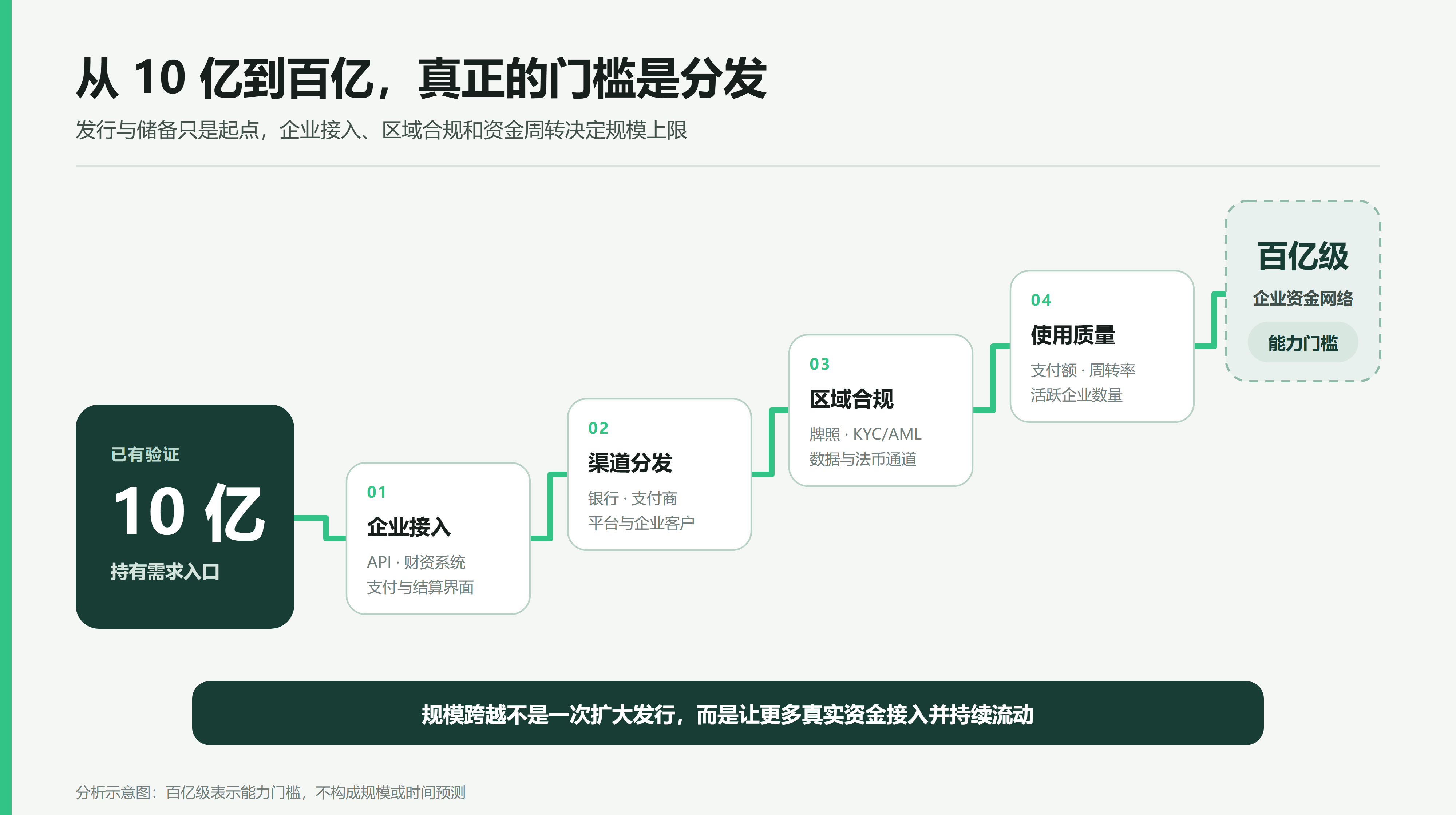
Transitioning from $1 billion to $10 billion truly necessitates crossing the entire chain from "being issued" to "being held," and then from "being held" to "being continuously used," allowing OUSD or USDGO to persist in trade, payment, and corporate financial cycles.
Perhaps in the future, digital dollars will become so naturally integrated, akin to bank interfaces, that enterprises will no longer need to know which specific stablecoin is used at the underlying level, and it will truly evolve from a type of crypto asset into foundational infrastructure for global commerce.
免责声明:本文章仅代表作者个人观点,不代表本平台的立场和观点。本文章仅供信息分享,不构成对任何人的任何投资建议。用户与作者之间的任何争议,与本平台无关。如网页中刊载的文章或图片涉及侵权,请提供相关的权利证明和身份证明发送邮件到support@aicoin.com,本平台相关工作人员将会进行核查。