Original Author: Zhang Yaqi
Original Source: Wall Street Insights
A political and business marriage once called the "Century Wedding" is concluding with the most expensive divorce in Korean history.
On July 24, the Seoul High Court ruled: SK Group Chairman Choi Tae-won must pay his ex-wife Oh Soo-young a property settlement of 944 billion won, approximately 643 million dollars. This marks the most expensive divorce ruling in South Korean judicial history.
The case has been ongoing for nearly ten years. From the first trial ruling of 50 million dollars in 2022, to the appellate court's ruling of nearly 1 billion dollars in 2024, and then sent back for retrial by the Supreme Court, it ultimately settled on this figure.
The issue was not just "how much" but also included whether Choi Tae-won would pay the amount in cash, stock, loans, or asset disposals, and whether this would affect the stability of his control over SK Group. Analysts indicate that to raise the settlement money, Choi Tae-won may face the options of borrowing or selling assets, but his core control over SK Group is likely to remain stable in the short term.
The Wall Street Journal called it a "Century Divorce," while Bloomberg questioned on the day of the ruling whether the payment would be made in cash or stock. Foreign media headlines were even more direct—"Real-life K-drama: Money, Romance, Corruption, and Betrayal Intertwined."
However, back in 1988, no one would have thought this.
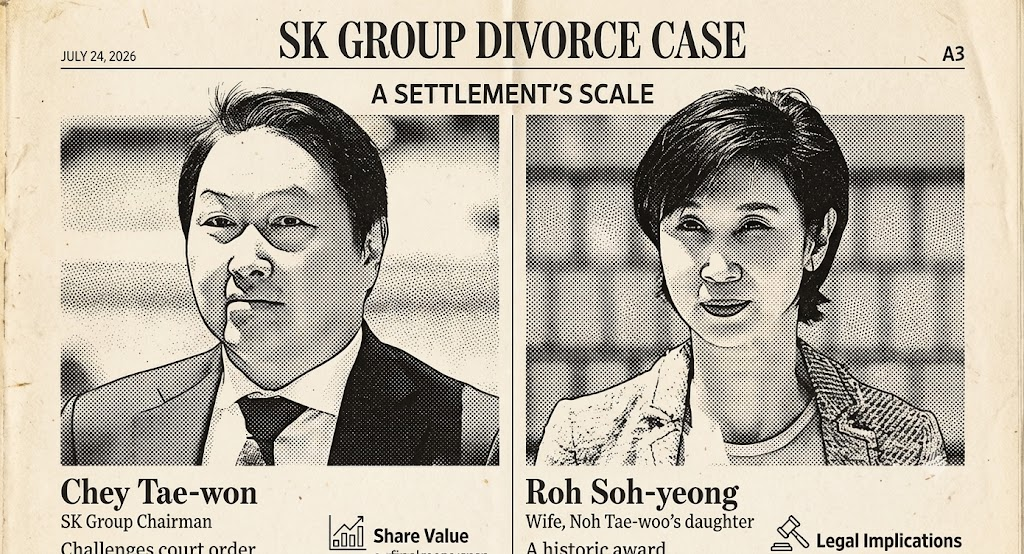
The Wedding at Cheong Wa Dae Defined the Beginning of This Marriage
In 1988, shortly after the Seoul Olympics concluded, South Korea transitioned to a democratic government. Oh Soo-young, the daughter of President Roh Tae-woo, got married at the Cheong Wa Dae presidential residence. The groom was Choi Tae-won, the nephew of the founder of SK Group. The then Prime Minister Lee Hae-chan officiated, and it was labeled a "Century Wedding" by South Korean media.
The couple met while studying at the University of Chicago. This marriage tied political power and a business empire together—such unions were a signal in Korea during that era.
They have three children, all of whom worked at SK subsidiaries after adulthood.
Everything began to unravel in 2015.
The Public Letter in 2015 Was More than an Adultery Statement
In December 2015, Choi Tae-won published a three-page open letter in a South Korean newspaper, admitting to an affair with another woman and that they had a son.
He quoted the opening line of Tolstoy's "Anna Karenina":
"All happy families are alike; each unhappy family is unhappy in its own way."
He stated that his 27-year marriage with Oh Soo-young was irretrievable, expressing a wish to "end things cleanly."
Four months before this letter was sent—in August 2015—he had just received a presidential pardon and was released from prison. This was his second pardon.
Oh Soo-young's reaction at the time was widely reported in South Korean media. She told those around her that she wondered if she was too selfish and not understanding enough of her husband. She later stated to the media:
"I will not divorce."
She ultimately agreed to the divorce in 2019.
Two Prison Sentences, Two Pardons: The Other Side of Choi Tae-won
Before the divorce case became the center of attention, Choi Tae-won had two earlier legal records.
In 2003, he was sentenced to three years in prison for illegal stock trading and accounting fraud, released on bail months later, had the sentence converted to probation, and was then pardoned by the president, with the record expunged. In 2013, he was sentenced to four years for misappropriating approximately 42 million dollars of company funds (to cover personal investment losses). The judge criticized him in court for "lacking sincere consciousness of his responsibilities."
Choi Tae-won denied the charges in court, claiming that the related transactions were legitimate corporate investments. "I don't know what else I haven't clarified, but I can honestly say I did not commit this crime."
During his imprisonment, he accomplished two things: he strengthened his control over SK Holdings through the merger of two subsidiaries; and published a 229-page book titled "New Exploration: Social Enterprises," discussing how the government can incentivize businesses to engage in solving social issues.
In August 2015, he received a presidential pardon for the second time. Four months later, he announced his divorce in the newspaper.
In 2018, Choi Tae-won and his current partner Kim Hee-young (English name Chloe, 50 years old) co-founded the T&C Foundation to engage in youth scholarships and education projects. In 2019, they made their first public appearance together. At the event, Choi Tae-won stated, "I reflected on my past and realized I lived it wrong."
SK Hynix's AI Boom Changed the Divorce Settlement Amount
If SK Hynix hadn't boarded the AI train, the amount in this case could have been at a different level.
SK Hynix is a major global supplier of HBM, key hardware for training large models. Since early 2025, SK Hynix's stock price has increased nearly tenfold. By the end of May, the company's market capitalization surpassed 1 trillion dollars. On July 10, Choi Tae-won rang the bell at NASDAQ, marking SK Hynix's completion of its US listing, raising approximately 26 billion dollars.
According to the Bloomberg Billionaires Index, Choi Tae-won's personal net worth is approximately 5.6 billion dollars, more than doubling in one year. Last month, he was seen drinking whiskey with Nvidia CEO Jensen Huang at a fried chicken restaurant in Seoul, where he voluntarily offered to pay for the entire party. He had previously met Trump on a golf course, and Biden publicly referred to him as an "old friend" during his visit to South Korea in 2022.
The rapid increase in these numbers directly altered the directions of the divorce case. Oh Soo-young's side claimed that SK Hynix's surge occurred during a phase when the foundation for the marriage was laid, and that dividing the settlement according to the market value at the time of divorce was unfair, thus calling for the use of updated evaluations.
The first-instance ruling in 2022 granted approximately 50 million dollars, prompting Oh Soo-young to appeal, arguing that this "negated the contributions of women to the family." In 2024, the appellate court revised the ruling to 35% of assets, then equivalent to nearly 1 billion dollars. Choi Tae-won's side argued that Oh Soo-young contributed nothing to SK's recent success, advocating for valuation based on conditions before the AI boom.
After the Supreme Court sent it back for retrial, on July 24, 2026, the Seoul High Court ruled 944 billion won.
What Form Will This Money Take?
The core question raised by Bloomberg on the day of the ruling was whether the payment would be made in cash or stock—this is directly related to Choi Tae-won's control over SK Group.
Choi Tae-won directly holds 17.9% of SK Corporation's shares. SK Corporation is the holding company of SK Group. Bloomberg quoted analysts suggesting that if the ruling amount is executed in cash, Choi Tae-won may need to borrow large amounts or sell part of his assets; however, the control structure of SK Group is unlikely to be shaken in the short term.
The Overlooked Other Side: Oh Soo-young Is More Than Just a "Ex-Wife"
Oh Soo-young's identity goes far beyond being just a party in the divorce case.
She operates Art Center Nabi, the first media art museum in South Korea. The center was initially located within the SK headquarters building. In June 2023, an SK subsidiary accused the museum of "illegal occupation," citing the expiration of its lease. This year, she moved the museum near the old royal palace in Seoul, with an opening exhibition titled "A Pregnant Pause."
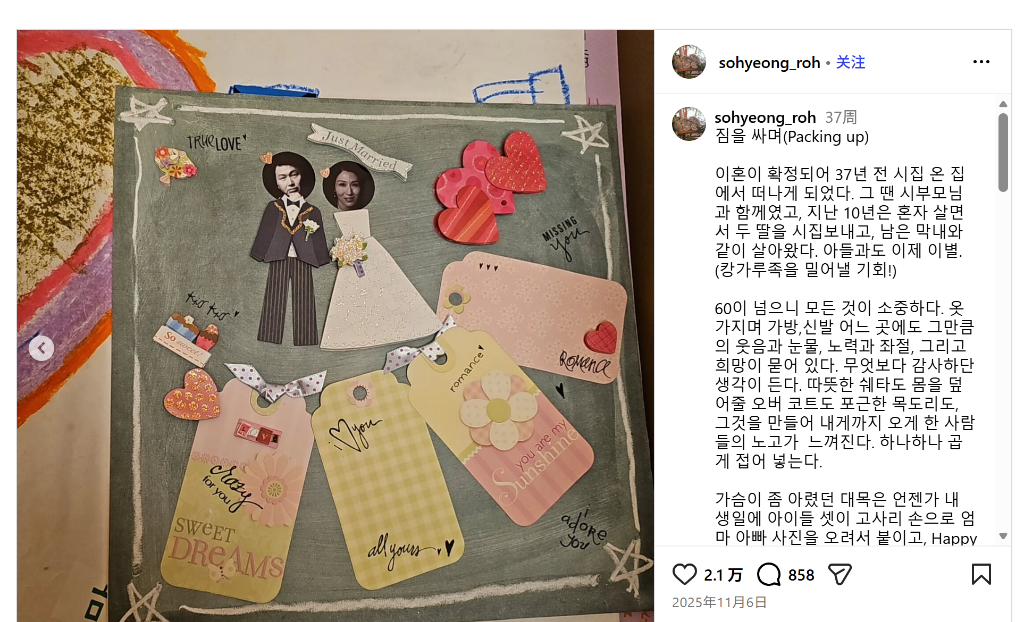
She has held lectures at Cambridge University. Last year, when she moved away from her home of 37 years, she shared items on social media, including her wedding dress, handbags, and a wedding poster made by her three children during their childhood—where the children cut out photos of their parents and pasted them onto paper wedding gowns and tuxedos, surrounding them with hearts and stars, and writing "True Love Above All."
In October 2024, Choi Tae-won and Oh Soo-young attended their youngest daughter's wedding together. The daughter walked down the aisle alone. Among their three children, only one remains employed at an SK subsidiary.
This Case Touches Three Sensitive Nerves in South Korean Society
The logic of the divorce ruling reflects several deep-seated issues within South Korean society.
The relationship between chaebols and the judiciary is the first sensitive point. Choi Tae-won has served two prison sentences and received two presidential pardons. Whether it was the illegal trading case in 2003 or the misappropriation of funds case in 2013, both ultimately resulted in records being cleared through pardons. This cycle has been repeatedly mentioned during the ongoing divorce case.
How to price contributions during marriage is the second point of contention. The evidence submitted by Oh Soo-young's legal team included whether the Roh Tae-woo government provided special conveniences during the period when SK obtained Korea's second mobile communication license in 1992. At that time, the opposition leader Kim Dae-jung publicly criticized this as "an outrageous act of presidential favoritism," and there were dissenting voices within the ruling party. SK subsequently returned the license.
Oh Soo-young's side also submitted a handwritten note indicating that the Roh Tae-woo government had transferred 30 billion won (about 23 million dollars) to SK. SK has denied receiving the amount. However, the appellate court accepted the evidence, determining that Oh Soo-young had made "substantial contributions" to the development of SK Group—this finding directly influenced the division ratio in each ruling.
The situation of women in elite marriages is the third perspective for observation. Oh Soo-young's first reaction in 2015, after her husband publicly cheated, was introspection rather than retaliation—"Am I too selfish?"—this statement ignited a discussion in South Korea regarding women's roles in marriage.
What Variables Remain After the Ruling?
The ruling of 944 billion won is still subject to appeal. However, larger variables exist outside the court.
There are no signs that SK Hynix's AI boom is ending. The company recently announced an additional investment of over 250 billion dollars in expansion, with President Lee Jae-myung calling Choi Tae-won and the Samsung head "heroes of the nation and the people."
If the stock price of SK Hynix continues to rise, will Oh Soo-young's side demand a recalculation of the division amount based on the updated market value? If Choi Tae-won is forced to sell shares to raise cash, what changes will occur in the ownership structure of SK Group?
The Wall Street Journal cited Oh Soo-young's social media post from last November at the end of its report. When she was moving out of her old home, she wrote: "Now that I am over 60, everything has become precious."
免责声明:本文章仅代表作者个人观点,不代表本平台的立场和观点。本文章仅供信息分享,不构成对任何人的任何投资建议。用户与作者之间的任何争议,与本平台无关。如网页中刊载的文章或图片涉及侵权,请提供相关的权利证明和身份证明发送邮件到support@aicoin.com,本平台相关工作人员将会进行核查。


