Key Takeaways
- The 382,000-member Fraternal Order of Police now supports the revised CLARITY Act.
- Other law enforcement organizations have endorsed, opposed, or softened their positions.
- Seven Democratic senators said the latest Republican draft still falls short.
The National Fraternal Order of Police (FOP) has endorsed the latest version of the Digital Asset Market Clarity Act after lawmakers revised provisions that had raised concerns about cryptocurrency-related prosecutions.
Founded in 1915, the FOP describes itself as the largest law enforcement labor organization in the United States, representing more than 382,000 active and retired officers. Its size gives the group a prominent voice in federal debates affecting policing, criminal investigations, and officer resources.
In a July 24 letter to Senate Banking Committee Chairman Tim Scott and ranking member Elizabeth Warren, FOP National President Patrick Yoes said the organization’s concerns had been “satisfactorily addressed.”
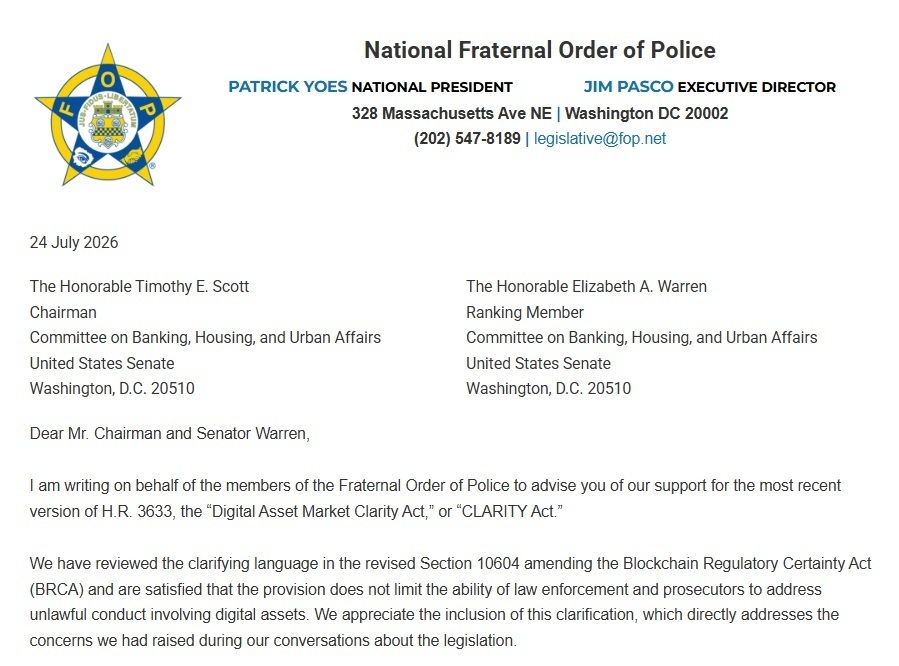
The endorsement reverses the FOP’s earlier position. In its April opposition letter, the organization warned that language involving noncontrolling blockchain developers could restrict prosecutors pursuing financial crimes involving cryptocurrency.
Revisions clarified that protections for certain noncontrolling software developers and decentralized technologies would not curtail investigations, prosecutions, or the application of established criminal statutes.
The FOP joins the National Organization of Black Law Enforcement Executives (NOBLE), which became the first major police organization to endorse the legislation. NOBLE said the bill would expand investigative capabilities while preserving established criminal authorities, marking an early law enforcement endorsement for the proposal.
Major County Sheriffs of America stopped short of endorsing the bill but withdrew its opposition after further discussions. The group’s move to a neutral position suggested that revisions had eased some concerns.
Opposition has not disappeared. A coalition representing more than 70,000 prosecutors, sheriffs, police chiefs, and other professionals previously called for changes to the CLARITY Act, arguing that broad exemptions could weaken oversight and investigative tools.
The revised bill would protect digital asset companies and stablecoin issuers from liability when they voluntarily delay suspicious transactions or act at law enforcement’s request. Temporary holds could give investigators time to prevent losses, trace stolen assets, and disrupt illicit transfers.
The legislation also addresses crypto ATM fraud and applies Bank Secrecy Act obligations to covered digital commodity exchanges, brokers and dealers. An official section-by-section summary says those businesses would face anti-money laundering, customer identification, and due diligence requirements.
Title IX would establish a grant program to strengthen state and local digital asset enforcement capabilities, create a law enforcement and national security training program, establish a digital asset cyber innovation center, and fund research into emerging technologies used in cryptocurrency-related crime. The provisions also include initiatives aimed at protecting older Americans from fraud and improving coordination among federal, state, and local agencies.
U.S. Senator Cynthia Lummis (R-WY) released an updated CLARITY Act draft July 22 after Senate banking and agriculture lawmakers combined their market-structure proposals. The measure addresses securities oversight, commodities regulation, decentralized finance, illicit-finance controls, and federal ethics requirements involving digital assets.
Seven Democratic senators rejected the Republican text, contending that the proposal still falls short of an acceptable bipartisan agreement. Their joint statement opposing the current draft identified unresolved concerns involving elected officials’ ethics, consumer protections, illicit finance, conflicts of interest, and market integrity.
Although the seven lawmakers pledged to continue negotiations, Republicans are expected to need Democratic votes to reach the 60-vote threshold typically required to invoke cloture if the legislation faces a filibuster. The timing of a floor vote will depend on whether negotiators can resolve the remaining political and regulatory disputes.
免责声明:本文章仅代表作者个人观点,不代表本平台的立场和观点。本文章仅供信息分享,不构成对任何人的任何投资建议。用户与作者之间的任何争议,与本平台无关。如网页中刊载的文章或图片涉及侵权,请提供相关的权利证明和身份证明发送邮件到support@aicoin.com,本平台相关工作人员将会进行核查。


