
Source: Tiger Research
Translation and Compilation: BitpushNews
Headlines continuously report about AI Agents conducting autonomous trading and processing payments. However, the cryptocurrency wallet industry has long been paving the way for this. Currently, more than ten companies are specifically creating custom wallets for AI Agents. What exactly are they pursuing? What is the potential ultimate return?
Core Points
- When AI Agents browse the internet and purchase goods or information on behalf of humans, they will ultimately generate thousands of micro-payments, each worth only a few cents. Existing bank card payment networks cannot support such small payment scales, so wallets that can automatically split and send funds based on preset conditions become crucial.
- Despite the current lack of short-term profitability, companies like Coinbase and Binance are actively building AI wallet infrastructure. This can lock in future customer demographics before AI Agents begin large-scale trading. The key at this stage is to establish a user base before actual demand explodes.
- Calculations based on Coinbase's data show that the rise in AI Agent usage is expected to bring growth of up to seven times its current revenue.
- The accumulated payment records in wallets can demonstrate whether AI Agents are profitable, which opens the door for loans based on future earnings — similar to providing credit loans based on micro-enterprises' card sales history.
- This is still at the stage of "possibility" rather than "proven." AI Agents currently still make operational errors and execute incorrect payments, and related rules vary by country and company. The legal status of AI Agents is also not clearly defined. Therefore, the current competition is not about capturing current income but about securing favorable positions in a potentially emerging large market in advance.
1. The Rise of AI Agents
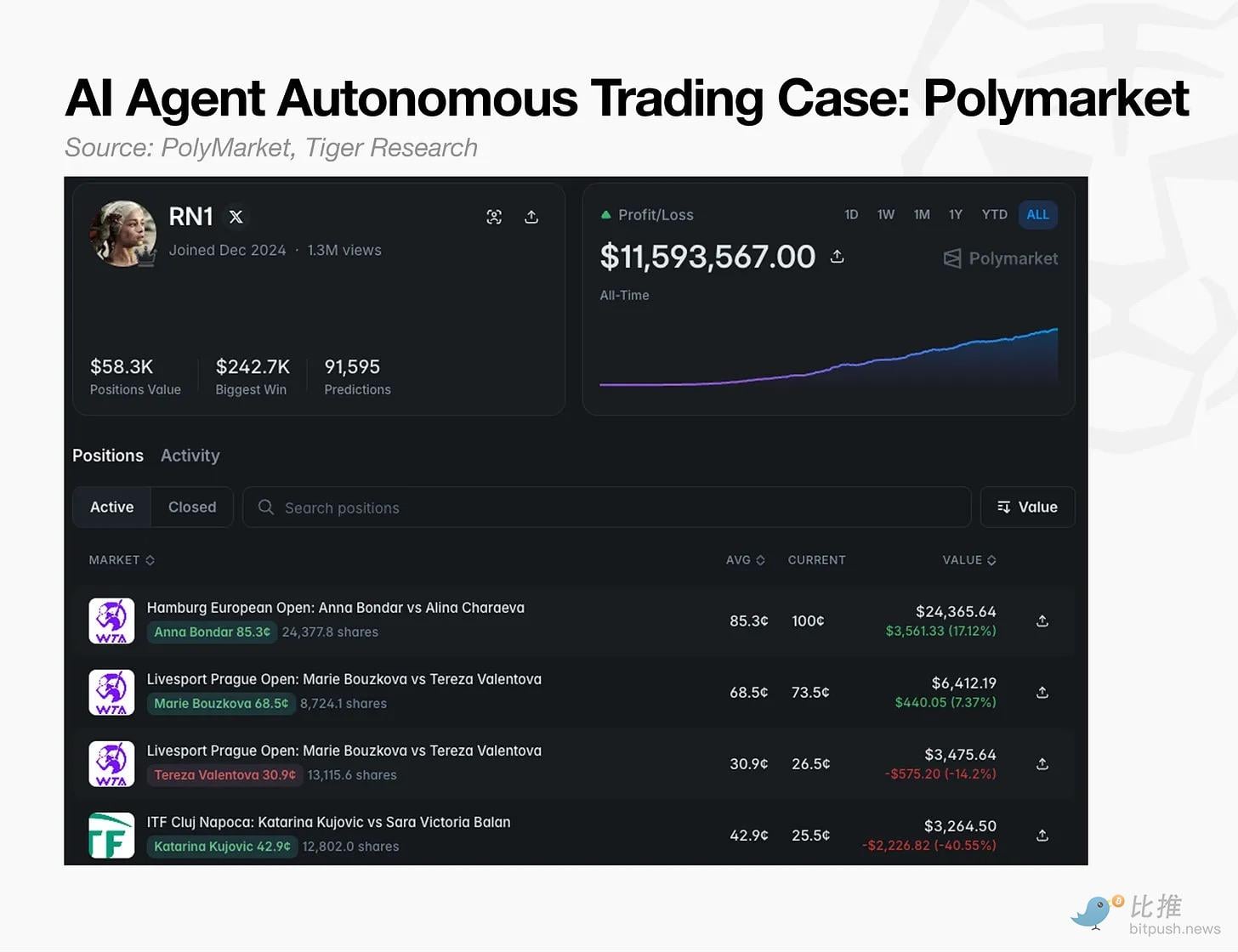
Earlier this year, an experiment on the prediction market Polymarket sparked widespread discussion by providing an AI Agent with $50 in startup capital and allowing it to trade autonomously. The experiment's condition was that if it could not generate profit to cover its API and server costs, it would cease to exist. The Agent subsequently succeeded in trading, and since then, a series of other Agents have also begun trading in a similar manner.
Although AI Agents have not yet fully integrated into everyday life, there is no doubt that they will be widely applied in the near future.
2. Every Transaction of an Agent Starts with a Wallet
AI Agents have not yet entered the realm of everyday payments. Their current most active applications are cryptocurrency trading bots operating within the cryptocurrency ecosystem. These bots operate independently of traditional payment networks and focus solely on cryptocurrency trading.
However, in the future, payments will expand into areas that are hard to imagine today. As indicated in previous reports, AI is changing the very nature of payments. Once Agents (rather than humans) directly interact and navigate on the internet, the amount of individual payments will sharply decline. The cost of a single API call or data query may be as low as $0.001, or even as low as $0.00001 in extreme cases.
To automatically split and send such tiny payments according to preset conditions, without any human intervention throughout the process, a Programmable Payment System is required. This is the backdrop for the emergence of the x402 payment network, with wallets being the foundation of this network's operation.
However, existing payment networks are designed with "humans" as the transactional entities.
Credit cards are issued to individual cardholders and operate on a "chargeback" structure — meaning that when a transaction has issues, humans initiate disputes and revoke transactions, with each transaction subject to fixed fees of up to several cents. When a person occasionally makes a $20 purchase, this is perfectly fine; but once an Agent starts sending payments at thousands per second — even if each API call only costs $0.001 or each data record only costs $0.00001 — this payment model becomes economically unviable.
The core issue is whether the funds themselves have "programmability."
Bank cards can facilitate the automatic entry of payment information, but they cannot be programmed to split the cash flow according to specific conditions, to stream payments, or to settle instantly. This capability is inherently possessed in the network where the wallet operates. Storing payment details on a card can at most only perform transactions at the human scale. Once the economic model transforms into direct transactions between machines, wallets become the only viable starting point.
3. Agents are a $50 Billion Business
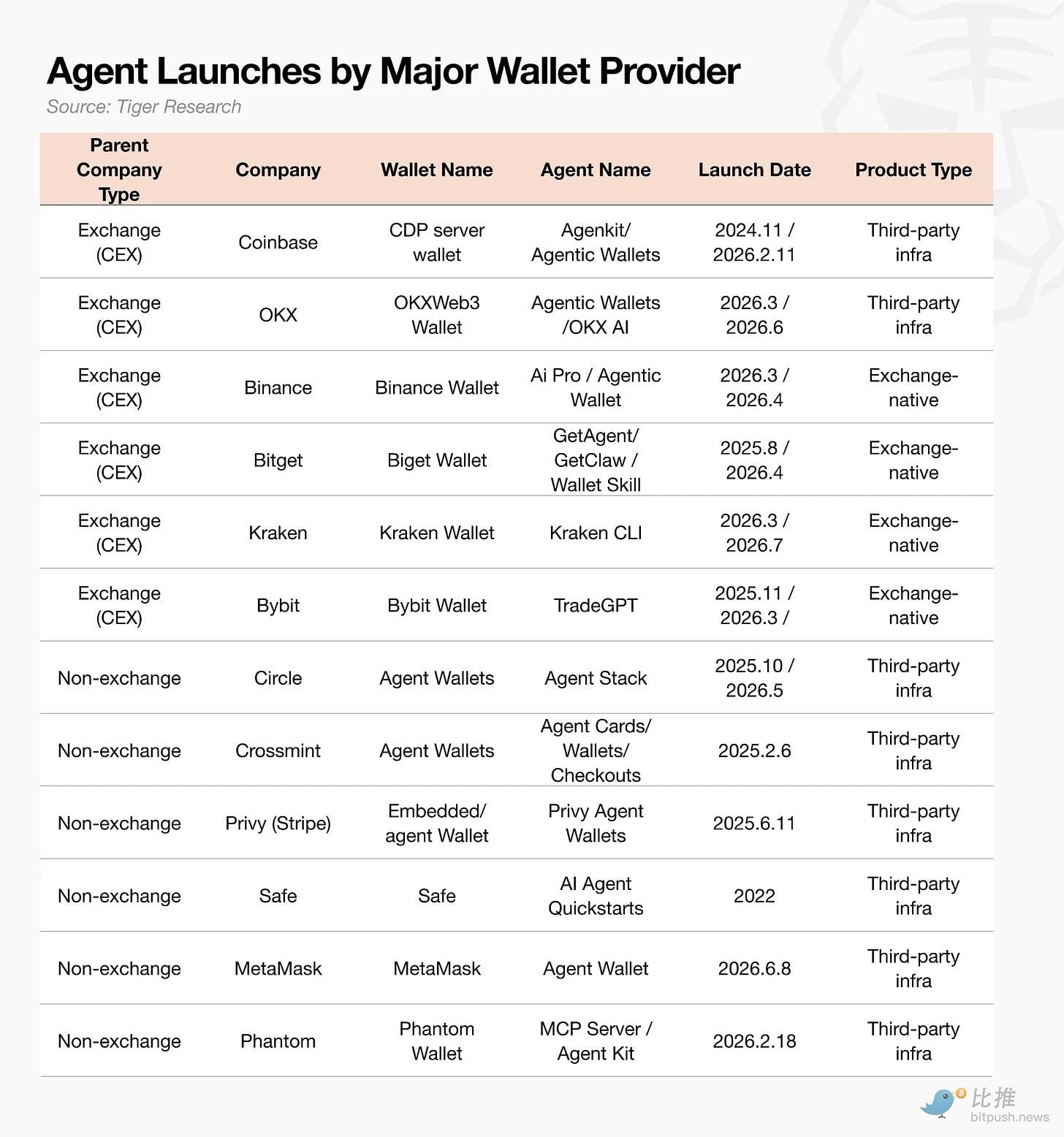
As shown in the image, the range of wallet providers is very broad, covering entities from exchanges to stablecoin issuers. So why are so many diverse participants entering the currently undefined short-term profitability of the Agent wallet infrastructure?
The answer is: these companies are positioning themselves for future income and business layouts, not for today.
Embedding Agent functionality in wallets right now is not an initiative that can yield immediate revenue. It builds a fundamental carrying capacity to absorb these transaction volumes once Agents begin to generate large-scale activities.
The key is that AI Agents will ultimately operate around the clock in a browserless environment without human intervention. Imagine a user asking an Agent to create a research report. As the Agent gathers information, every time it pulls data from different paid platforms, it executes a micro-payment. A simple instruction from the user could trigger 20 to 30 payments or even more in an instant.
A procedure that seems simple and singular to a human, once processed by an AI Agent, can result in an incredibly huge transaction volume.
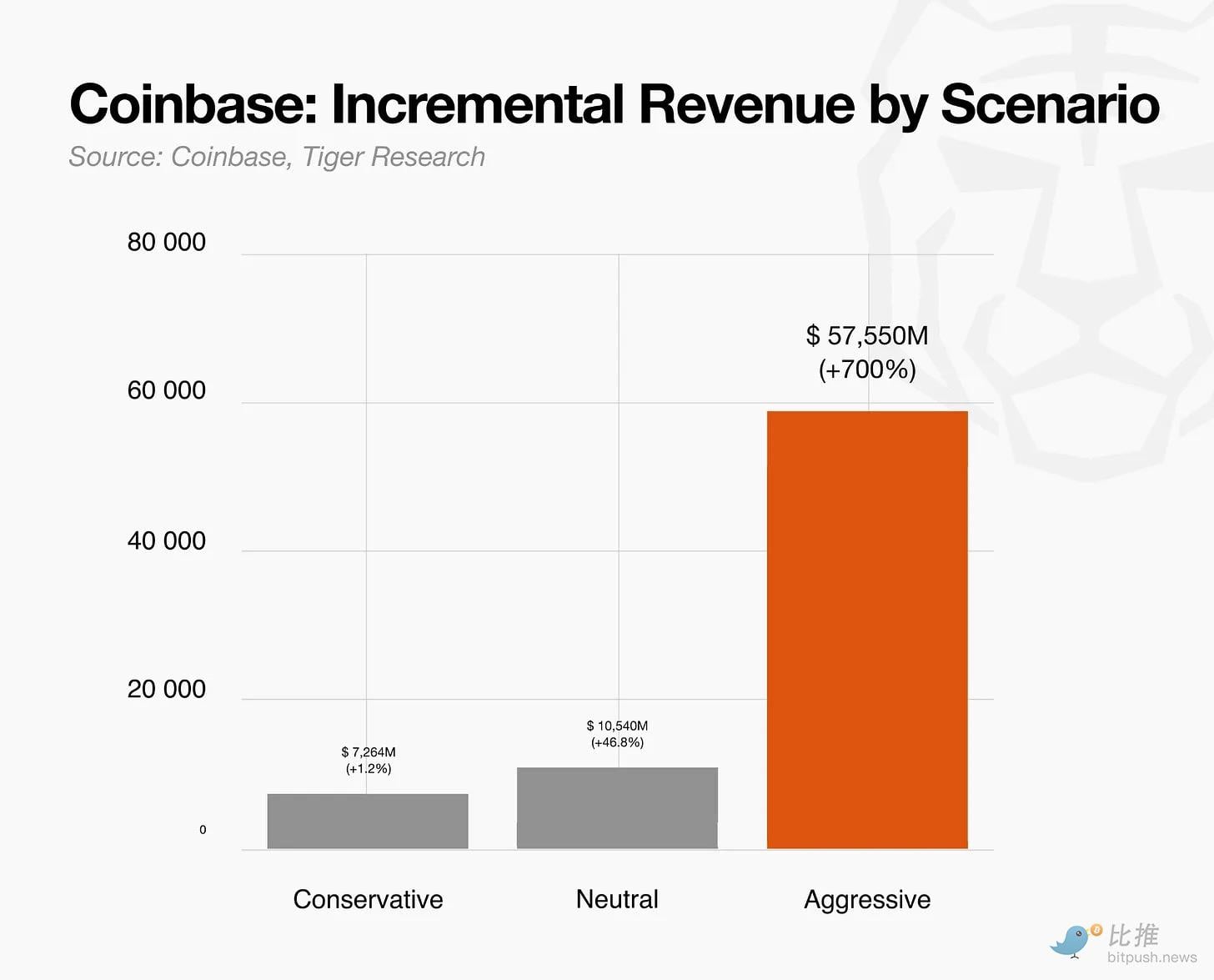
This change in payment environment can be projected to affect a company's profitability through publicly available data from Coinbase. This calculation is based on Coinbase's 9.2 million monthly trading users (MTU) rather than its approximately 120 million total registered users.
Combining three variables: adoption rate, the number of Agents per user, and daily call frequency, the following scenario projections can be derived:
- Conservative scenario (10% adoption rate, 1 Agent per user, 50 calls per day): approximately $84 million in additional annual revenue, a growth of 1.2%.
- Neutral scenario (50% adoption rate, 2 Agents per user, 200 calls per day): additional revenue rises significantly to about $3.36 billion, a growth of 46.8%.
- Aggressive scenario (100% adoption rate, 3 Agents per user, 1000 calls per day): annual revenue reaches about $50.37 billion, approximately seven times Coinbase's current total revenue.
What stands out in this comparison is that the gap between these three scenarios expands geometrically rather than arithmetically. The adoption rate itself only increases tenfold (from 10% to 100%), yet the resulting revenue gap expands by about 600 times (from $84 million to $50.37 billion).
Because the relationships between "adoption rate," "Agents per user," and "daily calls" are multiplicative, even a small increase in any one of these variables can lead to an exponential rise in total. Therefore, once Agents achieve large-scale popularity and the number of users surges, the resultant cash flow could potentially reach about seven times the current total revenue.
This is why Coinbase, even in the absence of explicit revenue today, is still vigorously promoting Agent wallet infrastructure. This is to secure its market share when the era of AI Agents arrives.
4. Moving Towards New Type of Banking for Agents
The transaction data accumulated through wallet infrastructure is not just simple records. It lays the foundation for entirely new business models — as the payment history stored in wallets can serve as a credit assessment standard to demonstrate the financial status and operating performance of AI Agents.
Once this data-based credit assessment system is established, wallet providers can naturally expand into next-generation financial services, such as revenue-based financing specifically for Agents.
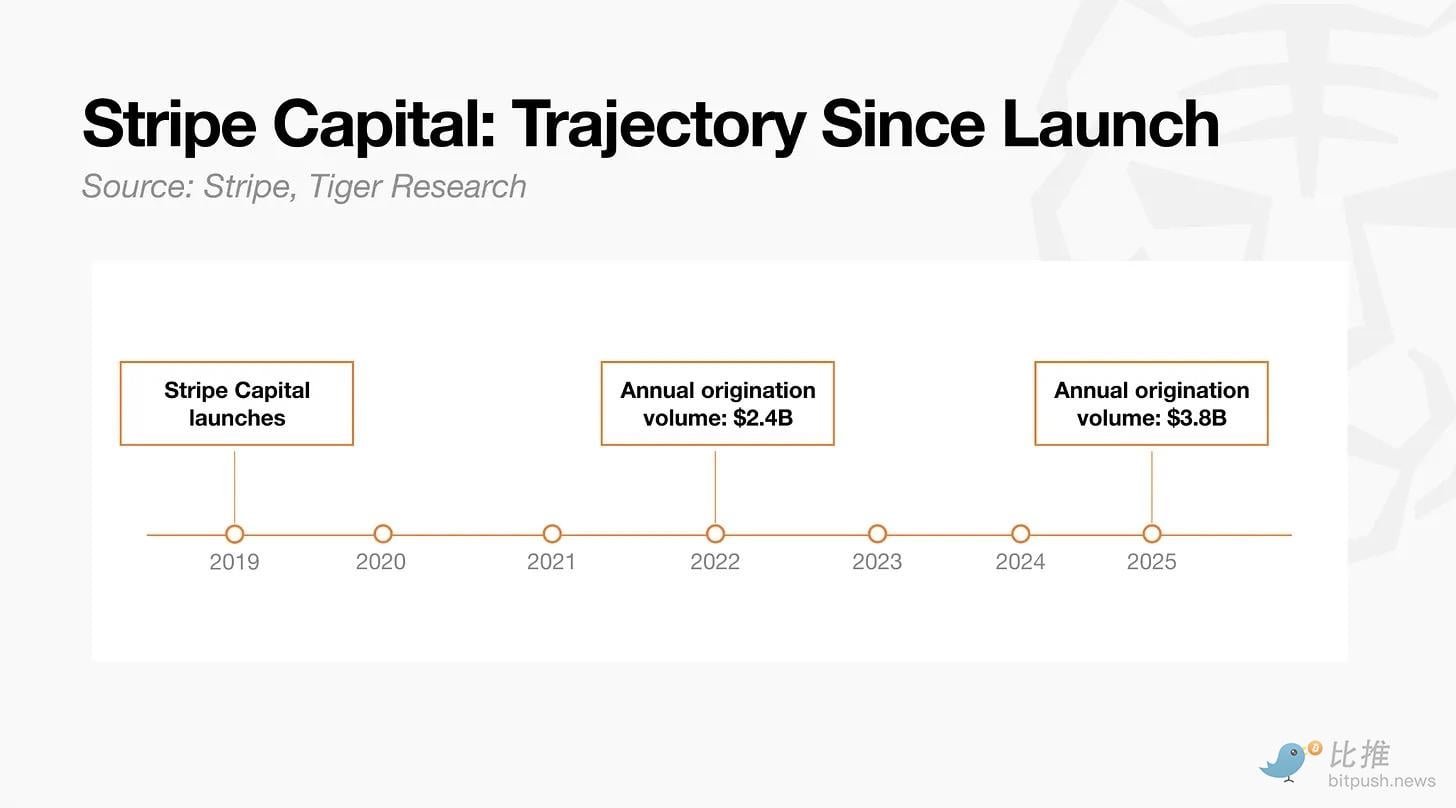
Stripe Capital is a typical representative that successfully built a new financial business on existing payment data. When Stripe launched its lending service Stripe Capital in September 2019, it did not rely on external credit agencies or cumbersome loan documents. It could assess loan eligibility and amounts using the real-time sales data flowing through its own payment network.
The case of Stripe illustrates that a company can build high-value financial services on top of its existing business data pipeline without establishing separate sales networks or engaging in additional marketing expansions.
Agent wallet providers are likely to follow the same path of expansion. By continuously accumulating income data of Agents through wallets, they can create a basis for providing operating funds through revenue-based financing and transform into a financial platform focused on Agents to profit from it.
However, building this new line of business depends on a prerequisite: AI Agents must evolve beyond simple payment execution tools into asset-holding entities that can generate their own revenue and earn enough real income to repay loans.
5. This Growth is Not Yet Verified
The previously predicted sevenfold revenue growth for Coinbase and the expansion into revenue-based financing are based on the optimistic scenario that "Agent payments become widespread." There are still enormous obstacles to establishing this system in the real economy.
Firstly, there remain significant doubts about the actual purchase conversion rates and payment reliability of AI Agents. Agents still make operational mistakes and cause erroneous payments due to "hallucinations"; sometimes transactions are directly intercepted due to the card issuer's fraud detection system (FDS). Therefore, the current actual payment completion rate is still low.
In addition, payment protocols such as x402, AP2, and MPP remain fragmented and have not unified into a single standard; meanwhile, the lack of clear KYC (Know Your Customer) and financial regulatory policies for AI Agents, which are not legal entities, poses another major obstacle to further market expansion.
Thus, the current goal of wallet providers is not short-term fee-based income. Apple's App Store took 15 years to establish a fee market worth $10 billion annually, while WeChat Pay took 7 years to build a massive mini-program ecosystem. Agent wallets are following a similar long-term timeline, focusing on building an ecosystem rather than vying for short-term returns.
This current competition is not about today's marginal revenue. It is about who can first control the data flow in the soon-to-be-fully-formed economies of agents five to ten years from now.
免责声明:本文章仅代表作者个人观点,不代表本平台的立场和观点。本文章仅供信息分享,不构成对任何人的任何投资建议。用户与作者之间的任何争议,与本平台无关。如网页中刊载的文章或图片涉及侵权,请提供相关的权利证明和身份证明发送邮件到support@aicoin.com,本平台相关工作人员将会进行核查。


