Original | Odaily Star Daily (@OdailyChina)
Author | Asher (@Asher_ 0210)

In the past six months, the two hottest trading tracks, prediction markets and Perp DEX, have been penetrating each other's territories.
In April, Polymarket announced the launch of Perp, covering cryptocurrencies, US stocks, and commodities; by the end of May, Kalshi officially launched crypto perpetual contracts regulated by the CFTC. On the other hand, the leading Perp DEX, Hyperliquid, has cut into the prediction market through HIP-4, hoping to extend its mature order book, account system, and liquidity advantages to trading of real-life events.
The prediction market has attracted a group of users keen to participate in trading sports, esports, politics, and hot events, while Hyperliquid has retained a group of crypto-native traders who are more focused on high-frequency trading and leveraged trading. The cross-boundary attempts from both sides essentially aim to bring their respective advantages in core users and trading scenarios into each other's domain.
However, months later, the results are not ideal. The user habits and liquidity accumulated in the original tracks did not naturally migrate along with the expansion of product boundaries.
Hyperliquid: Active prediction markets drop from 125 to fewer than 20
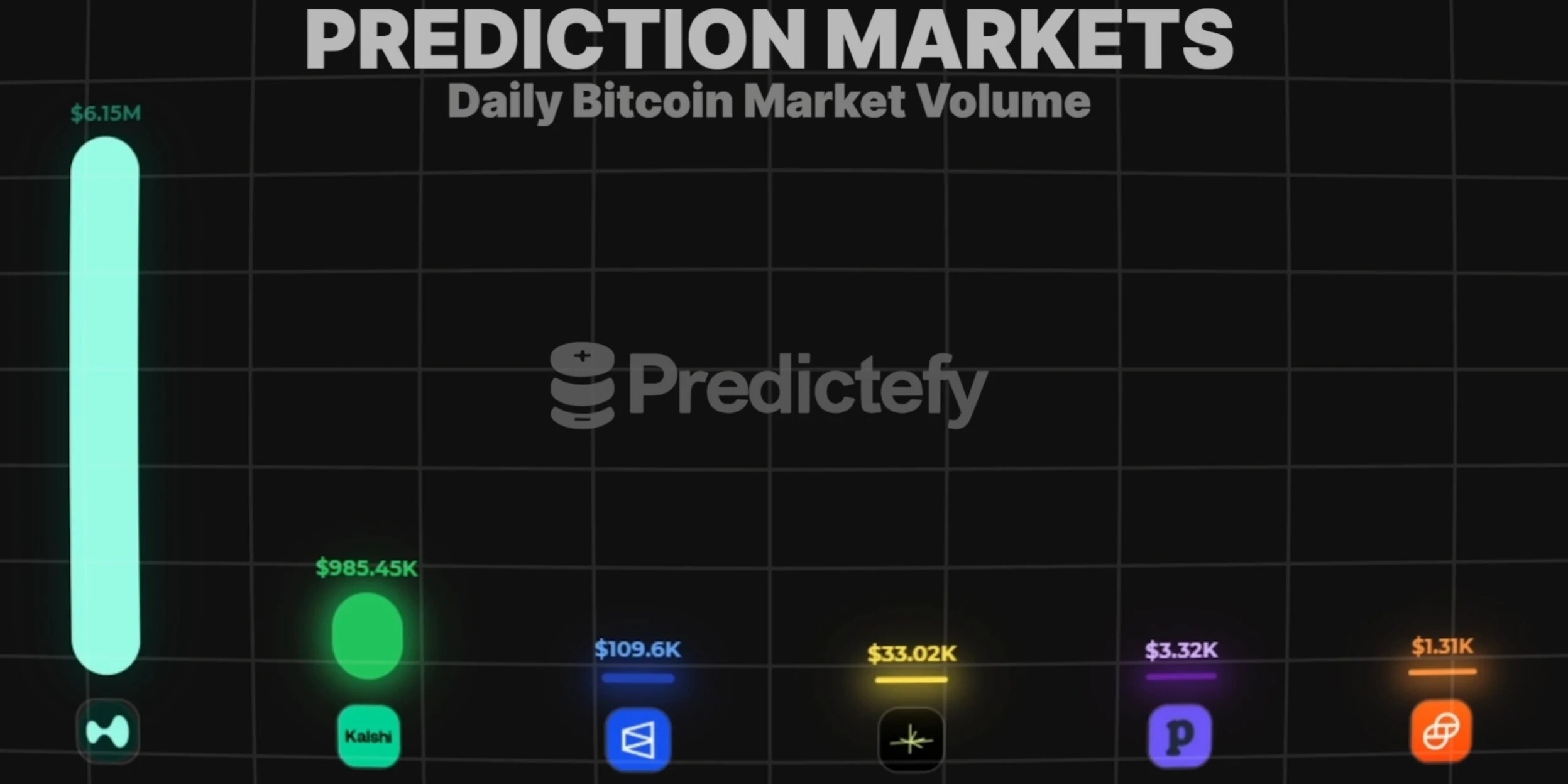
On May 2, Hyperliquid launched HIP-4 Outcome Markets on the mainnet, officially introducing outcome markets into its on-chain trading system. The first batch launched included BTC intraday binary outcome contracts, and the trading volume on the first day reached as high as 6.15 million USD, far exceeding similar prediction events on Kalshi and Polymarket. Additionally, over 54,000 transactions were completed that day, involving more than 3,000 participants.
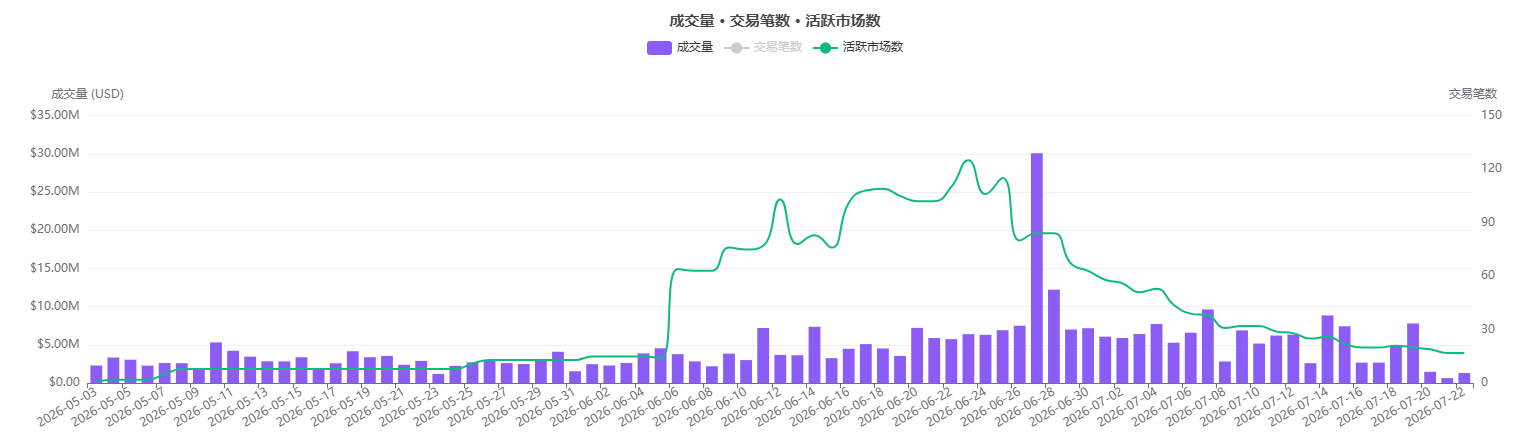
The World Cup further magnified this round of growth. At the beginning of June, there were only a few dozen active markets in HIP-4, which quickly rose to over 100, peaking at over 120. Trading volume also increased, nearing 30 million USD in a single day on June 27, and remained at tens of millions the following day. With continuous events in sports, macro data, and crypto price incidents being added, HIP-4 temporarily broke away from the early state dominated by BTC short-term contracts and began expanding into a more complete event trading platform.
However, the rapid increase in the number of markets did not translate into sustained trading demand. After the World Cup entered the second half, the active market count on HIP-4 began to decline continuously, falling from a high of 125 to around 50, and further dropping to just over 20 in mid-July, now less than 20, shrinking over 85% from its peak. Trading volume also weakened, with most dates reverting to the million-dollar range and recently dipping below 1 million USD.
This is due to the completely different liquidity structure between Perp and event contracts. Perpetual contract trading mainly revolves around core assets like BTC and ETH, allowing market makers, capital, and traders to continually settle within the same batch of markets; however, event contracts are constantly settled as competitions conclude, data is released, or political events occur. New markets often need to regroup liquidity and trading interest. Hyperliquid can reuse its matching system, accounts, and funding infrastructure but cannot directly replicate the liquidity and user trading frequency formed in Perp into HIP-4.
Polymarket: Daily trading volume of perpetual contracts below 20 million USD
Polymarket announced its foray into perpetual contracts in April and began opening Perp products to more users in July, supporting leverage of up to 20 times, currently still requiring an invitation code to activate or join a waiting list. The products cover crypto assets like BTC, ETH, and SOL, and have also extended to certain stocks and commodities.
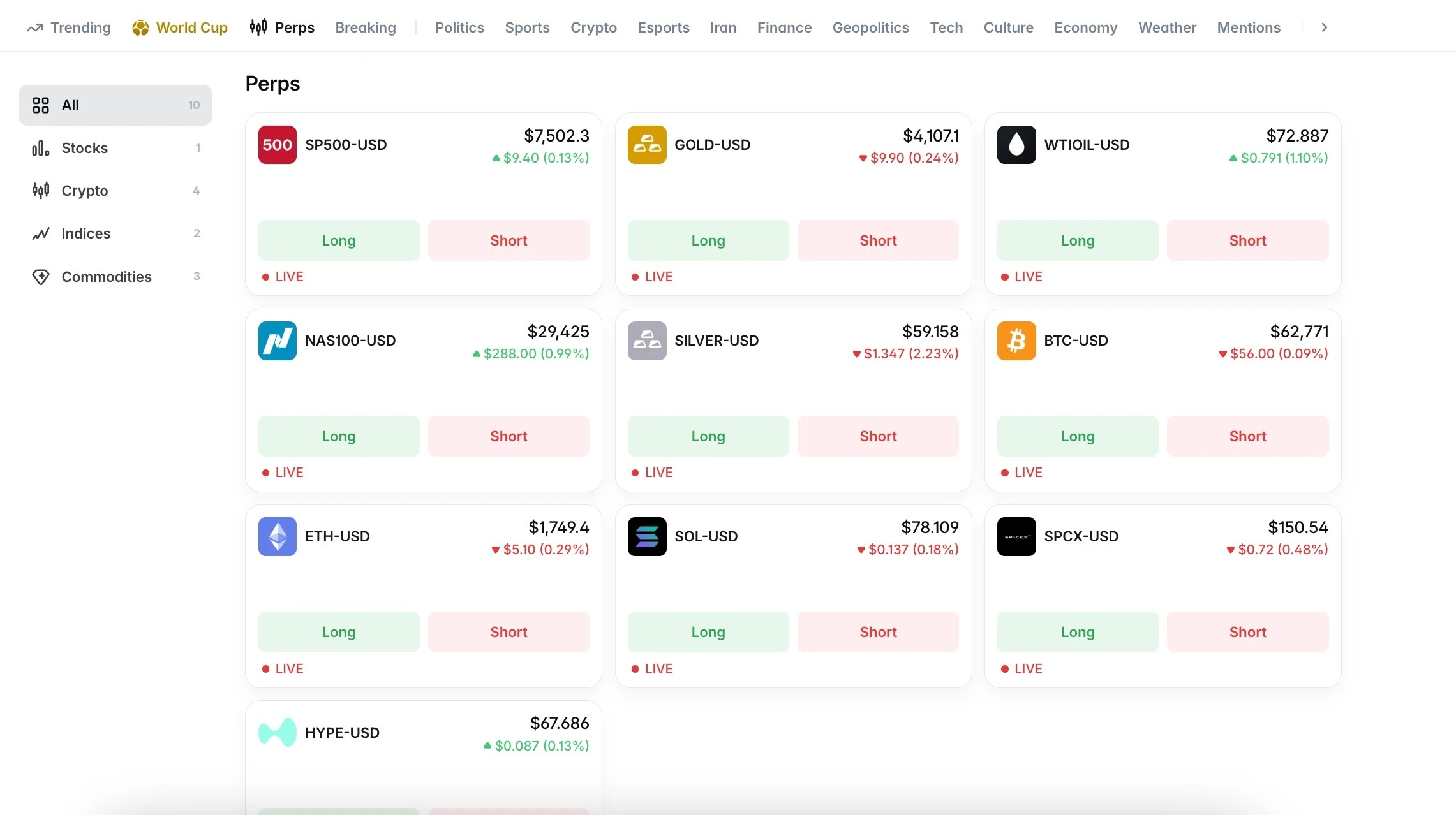
During the early launch of Polymarket Perps, the 24-hour trading volume briefly reached about 48 million USD, but this level did not sustain. By late July, daily trading volume had dropped to about 18.2 million USD and open interest (OI) was about 26.4 million USD, with OI for core trading pairs like BTC and ETH only at a few million USD. Compared to the initial launch, the trading activity of Polymarket Perps has clearly cooled down.
However, Polymarket Perps is still in the early phase, needing an invitation code for trading, so comparing it directly to mature Perp platforms may not be entirely fair. Yet even accounting for this, the gap in scale is still quite evident. Around the same time, Hyperliquid's open interest was about 7.7 billion USD, with a 24-hour trading volume of about 1.58 billion USD, while Polymarket Perps' OI was only about 26.4 million USD, equivalent to roughly 0.3% of the former; daily transaction volume was also only about 1% of Hyperliquid's.
Currently, Polymarket’s trading volume on Perps looks more like an early user attempt at the new product, and has yet to form stable trading habits and ongoing discussion heat. At least from the current data, the user and brand advantages that Polymarket has accumulated in the prediction market have not smoothly replicated to the Perp domain, making this cross-border attempt not yet a success.
Kalshi Perps: 16.1 billion USD in trading volume over six weeks, but recent cooling
Compared to Polymarket, Kalshi's Perps has taken off more quickly. At the end of May, Kalshi officially launched CFTC-regulated crypto perpetual contracts, initially covering BTC, ETH, SOL, XRP, and other assets. By July 9, about six weeks after launch, Kalshi Perps had accumulated a trading volume of 16.1 billion USD.
In contrast to the rapid volume increases at launch, Kalshi Perps' current trading heat has noticeably cooled down. Loris Tools data shows that Kalshi’s Perps segment still reached a daily trading volume of 448 million USD on July 20, but has recently fallen to about 80 million USD, with daily trading volume plummeting over 80% in just a few days.
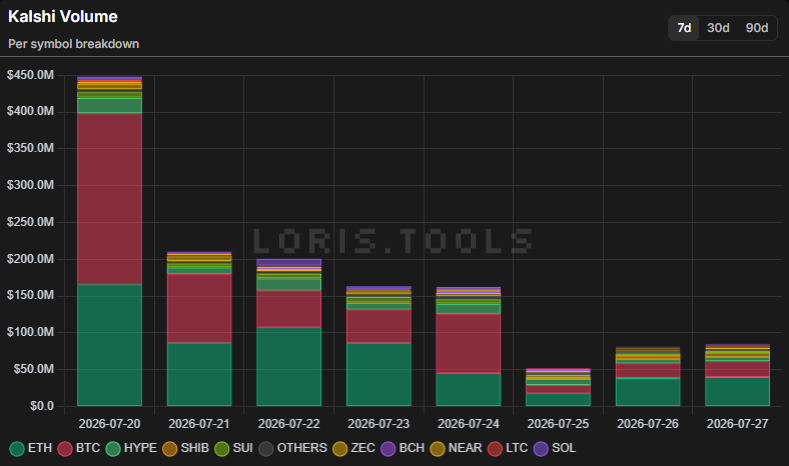
Meanwhile, Hyperliquid’s daily trading volume for Perp remains at the billion-dollar level. Even considering Kalshi's recent high of 448 million USD on July 20, its trading scale still has a significant gap compared to Hyperliquid; after Kalshi's daily trades fell to about 80 million USD, the disparity further widened.
The gap in open interest is even more significant. Kalshi's Perps segment currently has an OI of only several million USD, while Hyperliquid has reached about 7.5 billion USD. The accumulated 16.1 billion USD in six weeks for Kalshi indicates that its Perps cold start is not bad, yet recent trading volume has quickly receded, with OI still at low levels, suggesting it still has a clear distance from competing with major Perp platforms.
Kalshi's "U.S. compliant entry" remains its most evident differentiating advantage, but this advantage currently mainly addresses the question of "can U.S. users trade Perp," and does not yet solve the problem of "why professional Perp traders would want to stay on Kalshi long-term."
Cross-boundary is not easy; maintaining the home field may be more important than the "everything trading platform" slogan
The cross-boundary attempts by Hyperliquid, Polymarket, and Kalshi find their true difficulty in the user habits and liquidity that have been long accumulated in their original tracks. Hyperliquid’s core users are more accustomed to high-frequency, leveraged, and on-chain derivative trading, while Polymarket and Kalshi's users are primarily focused on judgments related to sports, politics, and trending events. Platforms can rapidly introduce new categories, but it is challenging to make users transition their existing trading methods simultaneously.
For Hyperliquid, deepening the Perp and on-chain asset trading may be more important than proving its capability to trade everything; for Polymarket and Kalshi, what remains scarce are still event supply, user mentality, and prediction market liquidity. Cross-boundary efforts may bring new growth imaginations, but if new categories fail to form independent demand, they may dilute the platform's original advantageous resources.
The so-called Everything Exchange ultimately competes not necessarily on who covers the most categories, but on who can continuously accumulate users, liquidity, and market depth in core tracks. For these platforms that already have clear advantages, focusing on making their home ground deep enough may be more critical than continuously expanding boundaries.
免责声明:本文章仅代表作者个人观点,不代表本平台的立场和观点。本文章仅供信息分享,不构成对任何人的任何投资建议。用户与作者之间的任何争议,与本平台无关。如网页中刊载的文章或图片涉及侵权,请提供相关的权利证明和身份证明发送邮件到support@aicoin.com,本平台相关工作人员将会进行核查。


