Original author: Long Yue
Original source: Wall Street Journal
Changxin Technology (688825) is about to be listed today, becoming the largest IPO on the Sci-Tech Innovation Board. The IPO issuance price is 8.66 yuan, and the total share capital after issuance is 66.881 billion shares (before the exercise of over-allotment options), with a total market value of 579.188 billion yuan. However, the market clearly does not intend to stay at this price.
Northeast Securities analyst Li Jiu evaluates Changxin from three mutually independent perspectives, with conclusions converging in the range of 3.2-5.7 trillion yuan. On the same day, Nomura Securities initiated coverage with a buy rating, setting a target price of 116 yuan, implying a potential increase of 1239%, corresponding to a market value of approximately 7.76 trillion — 1.4 times Northeast Securities' upper limit. The core of the divergence between the two institutions lies in their judgment of Changxin's long-term share ceiling — Northeast Securities' baseline assumption is 17%, while Nomura bets on a larger share space and a higher growth premium.
The above valuation may not be exaggerated. Changxin is a unique entity in A-share market: a pure DRAM IDM leader, holding full-chain capabilities in design and manufacturing, currently at a performance explosion period of "cycle reversal + share increase." The company’s products cover DDR4/5 and LPDDR4X/5/5X, and its products have entered the supply chains of Alibaba, Tencent, ByteDance, and major mobile phone manufacturers. According to Omdia data, in the fourth quarter of 2025, the company’s global market share is 7.67%, ranking first in China and fourth globally. Benefiting from rising storage prices and the increase in high-end products, the company’s performance elasticity is accelerating.
The supply-demand gap for DRAM continues, and Changxin enjoys the dual dividends of "growth in volume and price + domestic substitution." The real issue is not whether it is valuable, but which ruler to use for measurement.
Perspective 1: Relative valuation of market share — Target market value approximately 3.49 trillion yuan
Logic: Since DRAM is a globally unified market, the market value of storage companies listed overseas already incorporates the market pricing for "each percentage point of share." Using the market values of comparable U.S. stocks, we can reverse calculate "how much market value corresponds to 1% of future global market share," then multiply it by Changxin's future share.
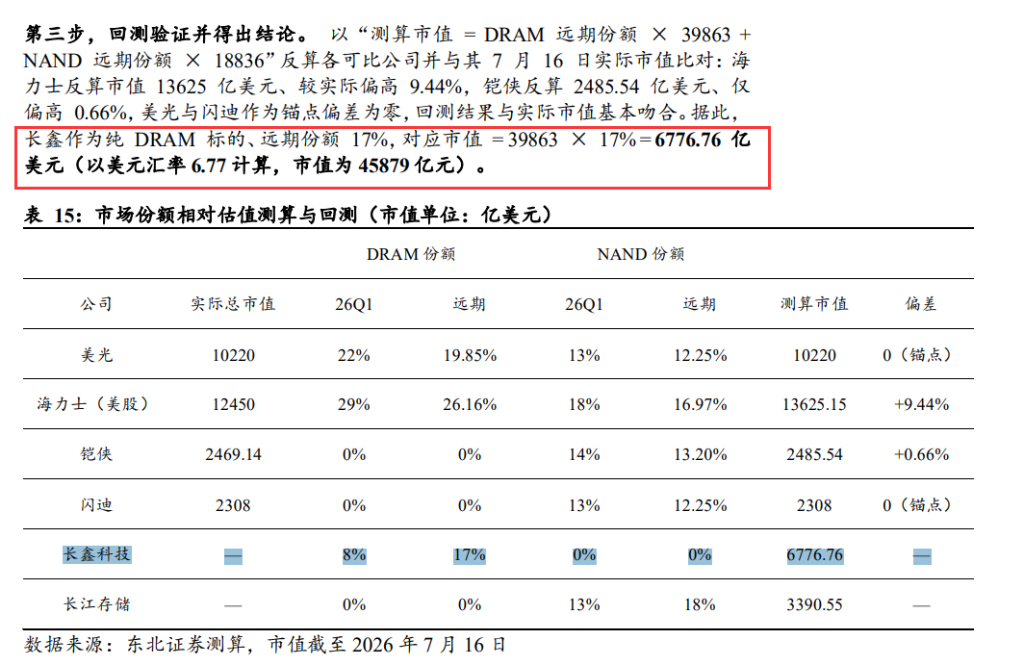
Operation: Micron and SanDisk's NAND shares are exactly the same (both at 13%), so the market value of Micron (DRAM and NAND target company) minus the market value of SanDisk (pure NAND target) equals the market value corresponding to Micron's DRAM business — 102.2 billion USD - 23.08 billion USD = 79.12 billion USD. Dividing this by Micron's 19.85% future DRAM share gives approximately 39.86 billion USD for every 1% future share of DRAM.
Conclusion: As a pure DRAM target, Changxin’s future share of 17% (currently about 8%) corresponds to a market value of approximately 67.7676 billion USD, equivalent to about 4.58 trillion yuan (calculated at an exchange rate of 6.77). After deducting the minority shareholder profit and loss ratio of approximately 24%, the net value attributable to the parent company is about 3.49 trillion.
Backtesting verification: The recalculated market value of SK Hynix is about 9.44% higher than the actual value, while Kioxia is only 0.66% higher, and the results are generally consistent with the actual market value.
Perspective 2: PE valuation based on profit split — Target market value 2.85 trillion to 4.27 trillion yuan
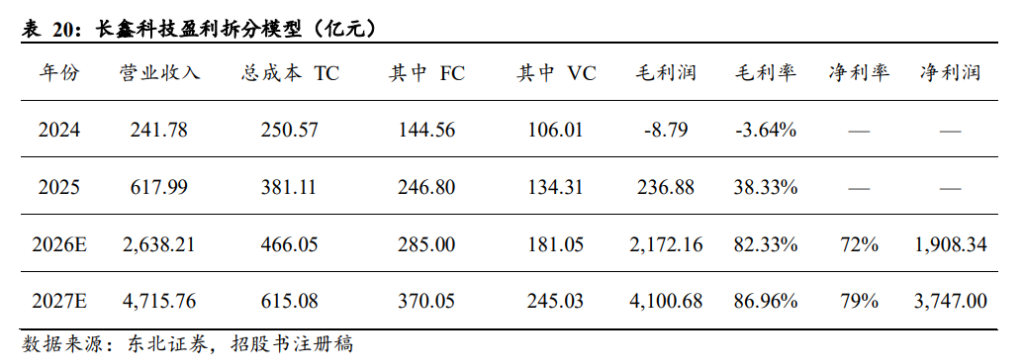
The second method is more fundamental: without external anchor points, directly predicting Changxin's own profits. The cost structure of storage factories is highly standardized, with fixed costs primarily consisting of depreciation determined by capital expenditure; variable costs change linearly with shipment volume. Since the prospectus does not disclose actual wafer capacity data, the assessment assumes the original value of fixed assets as a proxy for capacity, multiplying by utilization and production-sales ratios to estimate sales, then combining with ASP to obtain revenue.
Logic: Decomposing revenue (capacity × utilization rate × production-sales ratio × ASP) and costs (fixed cost depreciation + variable costs), predicting net profit, and applying a PE multiple.
Key forecasts:
- 2027 revenue of 471.6 billion yuan, gross margin of 86.96%, net profit of 374.7 billion yuan (overall caliber)
- After excluding minority shareholder profit and loss (assuming the ratio remains at 24%), net profit attributable to the parent company is approximately 284.8 billion yuan
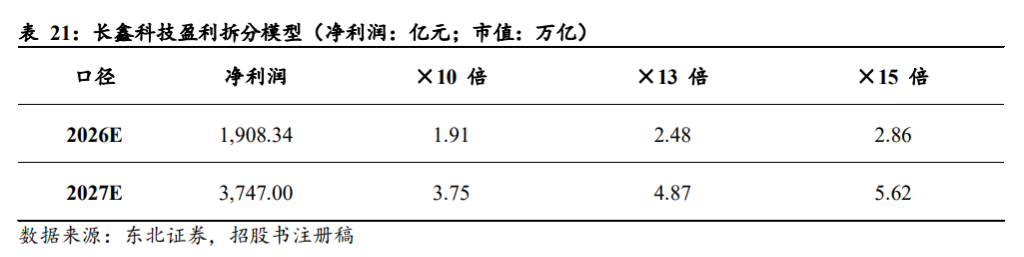
Valuation: Northeast Securities believes that Micron and SK Hynix correspond to a PE of 7.51 times and 7.94 times for 2027, respectively, but Changxin is in a stage of rapidly increasing share (expected to reach about 30% in future shares), which allows for a growth premium, applying a PE of 10-15 times. After excluding minority shareholder profit and loss, the corresponding market value for the net profit attributable to the parent is approximately 2.85 trillion to 4.27 trillion yuan.
Perspective 3: Relative valuation based on unit capacity — Target market value 3.22 trillion to 3.99 trillion yuan
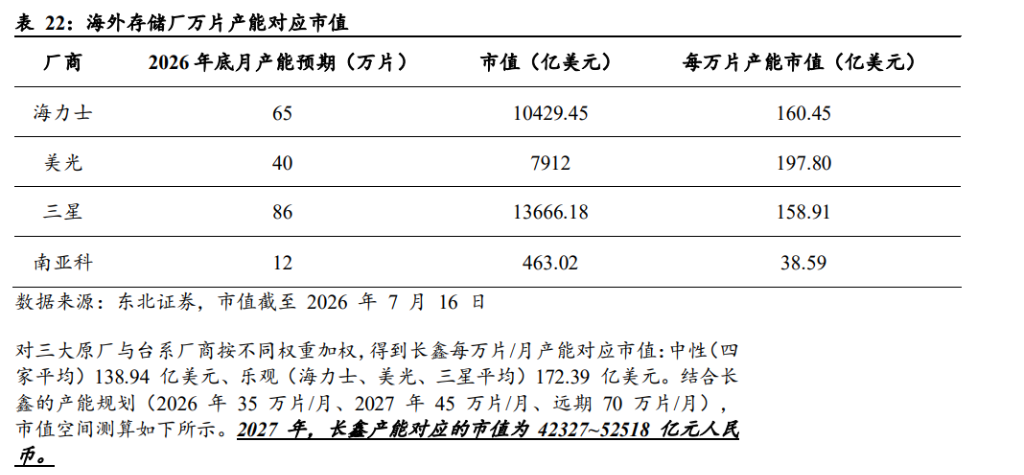
Logic: Using the market value of overseas storage factories divided by monthly production capacity to obtain "the market value corresponding to every 10,000 pieces of monthly capacity," then multiplying by Changxin's capacity plan.
Reference: The market value corresponding to the monthly capacity of the three major original plants is concentrated in the range of 15.8-19.8 billion USD — Hynix at 16.045 billion USD, Micron at 19.780 billion USD, Samsung at 15.891 billion USD.
Conclusion: In 2027, Changxin's capacity is 450,000 pieces per month, corresponding to a market value:
- Optimistic scenario (average of the three major original plants at 17.2 billion USD/10,000 pieces): 525.18 billion yuan
- Neutral scenario (including Taiwanese manufacturers' average at 13.9 billion USD/10,000 pieces): 423.27 billion yuan
After excluding minority shareholder profit and loss, this corresponds to approximately 3.22 trillion to 3.99 trillion yuan.
Summary of the three methods: converging to 3.2 trillion to 5.7 trillion yuan
Northeast Securities points out that in 2025, the proportion of profit and loss from minority shareholders in Changxin reached 73.76%, much higher than Samsung, Hynix, and Micron (all below 1%), so the valuation must exclude this part of the impact.
Assuming that the proportion of minority shareholder profit and loss remains constant at 24% in 2026 and 2027, the conclusions from the three methods are as follows: after excluding the impact of minority shareholder profit and loss, the reasonable valuation is 3.2-5.7 trillion.
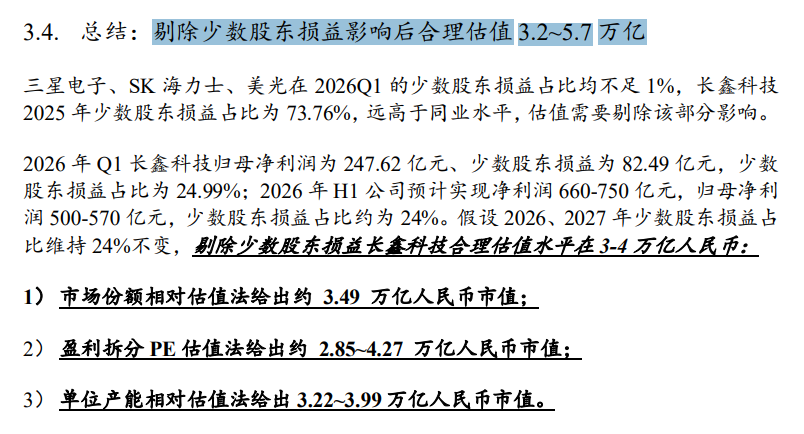
The three perspectives use different data and logical chains, but the range of attributable values to the parent company ultimately falls around 3-4.3 trillion. This convergence itself is a signal: under the current assumptions of share and capacity, pricing at this level has strong self-consistency.
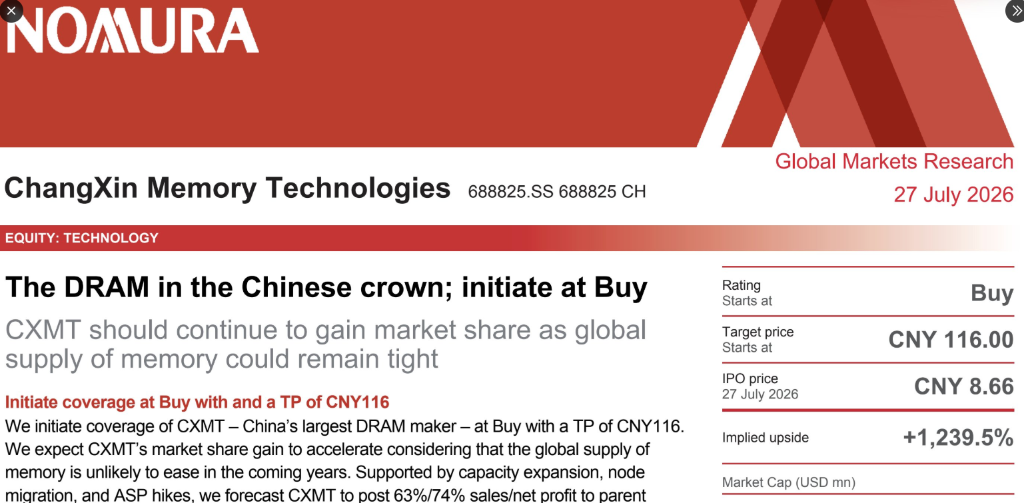
Nomura Securities: Target price 116 yuan, implied increase 1239%
On July 27, Nomura Securities also initiated coverage of Changxin Technology, providing a more aggressive judgment.
The bank has initiated coverage with a "buy" rating and a target price of 116 yuan, corresponding to approximately 20 times PE — twice Micron's current valuation (about 10 times) and more than twice the current valuation of SK Hynix.
Calculated at an IPO issuance price of 8.66 yuan, a target price of 116 yuan implies an implied increase of 1239.5%, corresponding to a market value of approximately 7.76 trillion yuan.
This figure far exceeds the upper limit of Northeast Securities' valuation range of 5.7 trillion; the gap of about 2 trillion between the two fundamentally reflects different bets on two core variables: where Changxin's share ceiling lies and how much growth premium the market should give to this company.
2026 is just the starting point! Domestic substitution plus AI demand, Nomura grants Changxin a double growth premium
Nomura's underlying logic for a 20 times PE premium is based on three judgments.
First, structural tightening on the supply side will last for several years. The bank’s core argument is: "Global storage supply is unlikely to loosen in the next few years." Capital expenditures from Samsung, SK Hynix, and Micron have largely shifted towards HBM and advanced process technologies, structurally suppressing new supply of general DRAM. This means that the general DRAM market where Changxin operates will maintain a supply-demand imbalance for a considerable period, rather than the traditional storage cycle of "two years up, two years down."
Second, the logic of Changxin’s share increase is "acceleration" rather than "linear." The bank believes that as Changxin's capacity continues to expand and the process shifts from the fourth generation to the fifth, the speed at which it increases share in the global general DRAM market will exceed market expectations. The current share of about 8% corresponds to a much larger future space than the 17% upper limit assumed by Northeast Securities. Nomura's implied future share assumptions, combined with a target market value of 7.76 trillion, suggest that the corresponding share space may be in the range of 25% to 30%, or even higher.
Third, domestic substitution plus AI demand provides a double growth premium. The bank believes that Changxin is not just a target within the storage cycle, but also a theme of "domestic substitution." The willingness of Chinese cloud providers and mobile phone manufacturers to procure domestic DRAM continues to rise, providing Changxin with additional growth independent of the global cycle. Meanwhile, the demand for DRAM in AI servers is growing exponentially, with the DRAM load per server being nearly 80 times that of smartphones — this change in demand structure will sustainably support an upward shift in ASP's center. With these dual logics combined, Nomura believes Changxin should enjoy a higher valuation premium compared to similar overseas companies, rather than a discount.
In other words, Nomura does not see 2026 as a peak, but as a starting point.
In specific financial forecasts, Nomura predicts that Changxin's sales and net profit attributable to the parent company will grow by 63% and 74%, respectively. The driving factors include: capacity expanding from 270,000 pieces per month in 2025 to 450,000 pieces per month in 2027, the increase in the value per wafer from process migration, and the continuous rise in the average price of DRAM against the backdrop of tightening supply. Nomura's profit forecasts are more aggressive in absolute terms compared to Northeast Securities, and the 20 times PE multiple assumption further amplifies the final valuation result.
Supporting this more aggressive assumption is the supply-demand data: global general DRAM capacity estimates indicate that gaps will still exist in 2027; DRAM contract prices surged by 93%-98% quarter-on-quarter in Q1 of 2026, significantly exceeding previous double-digit forecasts; Changxin's gross margin in Q1 2026 has risen to 79.16%, with a single-quarter net profit attributable to the parent company of 24.762 billion yuan.
The height of the price increase cycle is real-time adjusting all model input assumptions.
From zero to the world fourth, Changxin took seven years
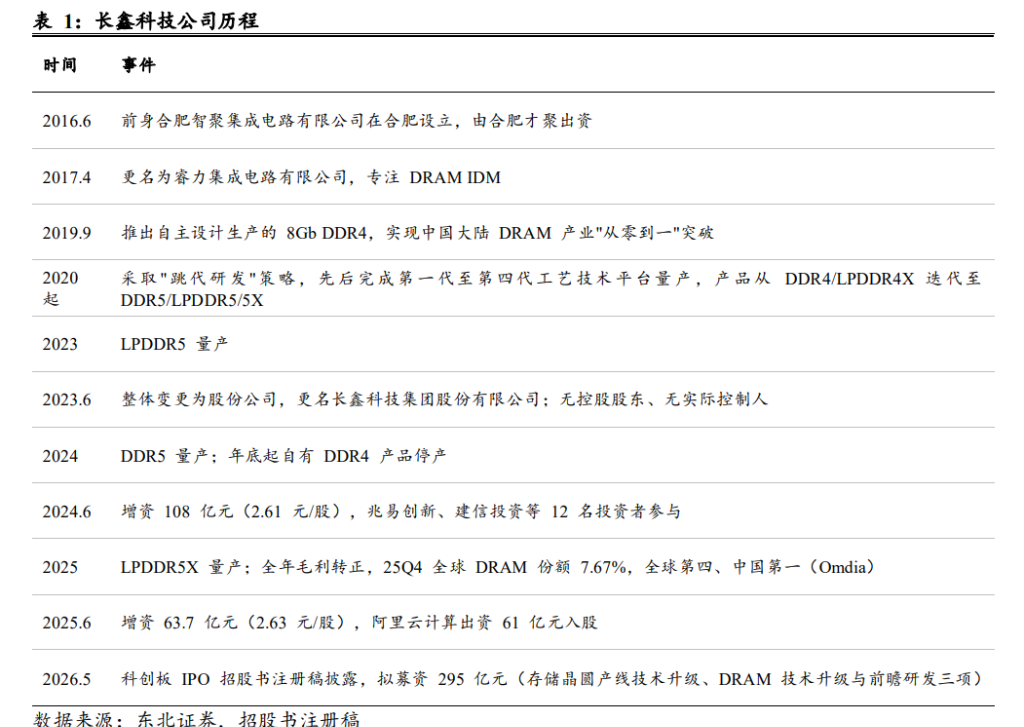
In 2019, Changxin Technology (formerly known as Ruili Integrated Circuits) launched the first 8Gb DDR4 self-produced and mass-produced in mainland China, achieving a breakthrough in domestic DRAM from nothing.
Seven years later, this company is now the largest DRAM manufacturer in China and the fourth in the world. According to Omdia data, Changxin's global market share will reach 7.67% in Q4 2025.
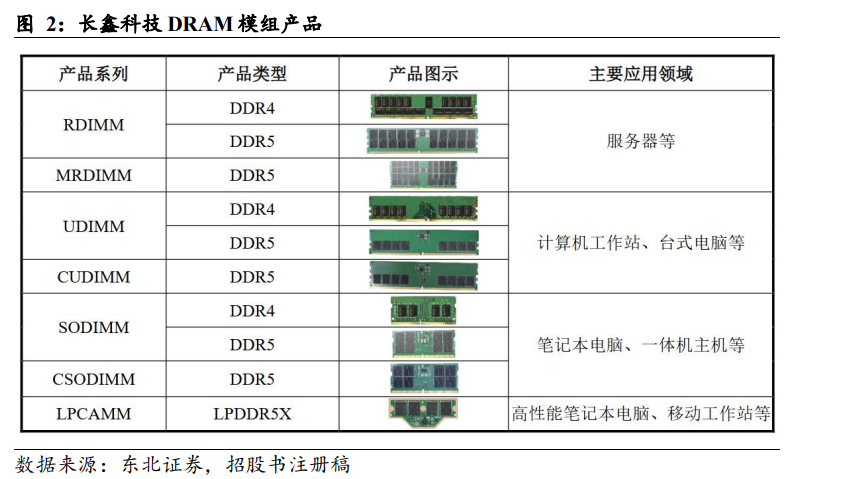
On the product line, Changxin has covered the entire DDR4/5 and LPDDR4X/5/5X generations and plans to stop producing its DDR4 by the end of 2024, shifting capacity completely to high-value products such as DDR5 and LPDDR5/5X. Customers include Alibaba, Tencent, ByteDance, and major mobile phone supply chains.
In terms of capacity, the company has three 12-inch wafer factories: two in Hefei and one in Beijing. Northeast Securities estimates capacity will expand from 270,000 pieces per month in 2025 to 450,000 pieces per month in 2027, with the global share rising from 14% to 17%.
Financial inflection point: under the price increase cycle, profit elasticity is astonishing
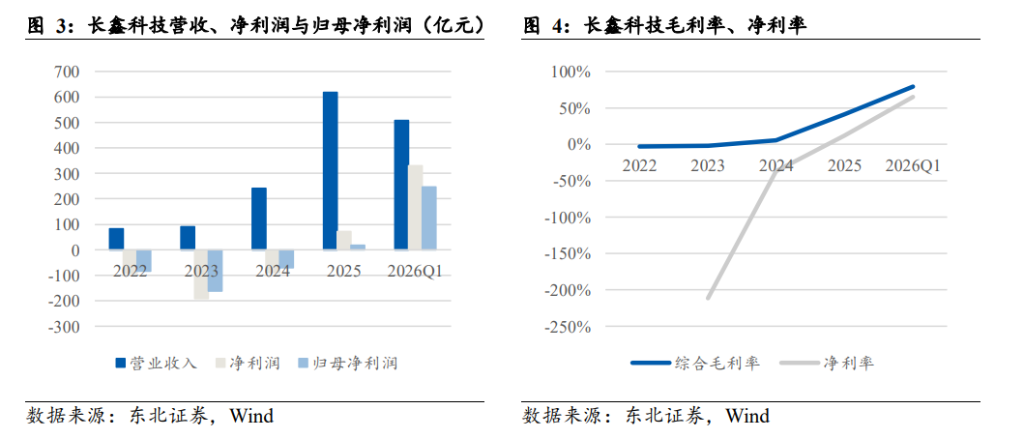
Changxin's financial path is a typical script for a heavy-asset storage factory — losses created by the preposition of fixed costs in a downturn cycle and rapid profit release in an upturn cycle.
The key nodes are as follows:
- 2025: Net profit attributable to the parent company turns from a loss of 16.34 billion yuan to a profit of 1.875 billion yuan, and the comprehensive gross margin rises to 40.99%, roughly on par with Samsung (39.38%)
- Q1 2026: Single-quarter revenue of 50.8 billion yuan (year-on-year +719%), gross margin of 79.16%, net profit attributable to the parent company of 24.762 billion yuan
- First half of 2026: Management expects revenue of 110-120 billion yuan, net profit attributable to the parent company of 50-57 billion yuan
The core driver of profit explosion is price. According to the latest survey by TrendForce in June 2026, the contract price for general DRAM surged approximately 93%-98% quarter-on-quarter in Q1 2026, far exceeding the previous expectations of double-digit ranges.
Northeast Securities also lists four major risks:
- Demand not meeting expectations: Slowdown in AI server construction or lack of recovery in consumer electronics.
- Price cyclic downturn: In 2022-2023, there was a deep downturn in prices, with declines of up to 50% compared to pre-cycle levels.
- Capacity and technology iteration not meeting expectations: Delays in the development of the fifth-generation process platform may affect the realization of volume and price.
- International trade friction and supply chain limitations: Geopolitical tensions may exacerbate instability in the industrial chain.
免责声明:本文章仅代表作者个人观点,不代表本平台的立场和观点。本文章仅供信息分享,不构成对任何人的任何投资建议。用户与作者之间的任何争议,与本平台无关。如网页中刊载的文章或图片涉及侵权,请提供相关的权利证明和身份证明发送邮件到support@aicoin.com,本平台相关工作人员将会进行核查。


