Original | Odaily Planet Daily (@OdailyChina)
Author|Azuma (@azuma_eth)
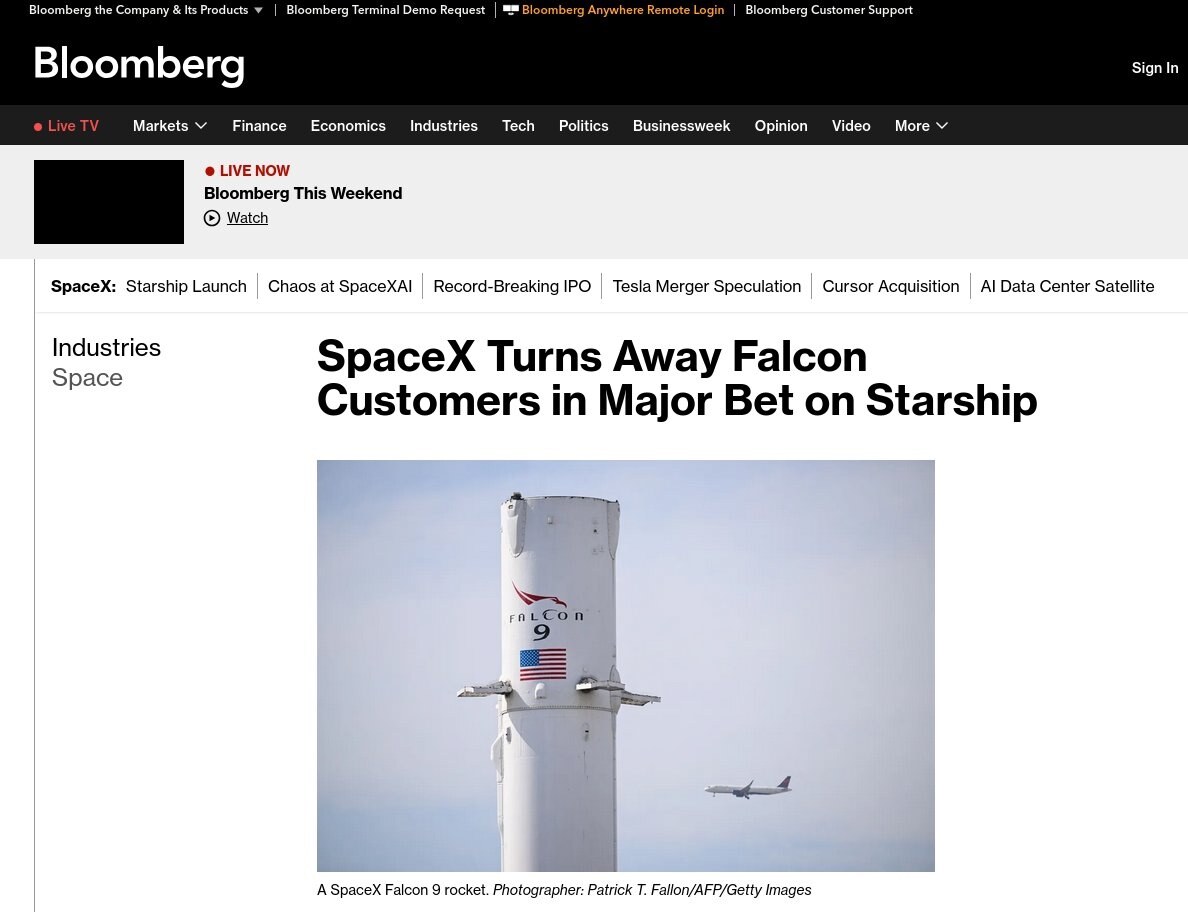
Last week, many mainstream media outlets, including Bloomberg, reported the news that "SpaceX will gradually abandon the Falcon 9 and instead fully bet on Starship."
Related reports indicated that according to a source within the company, SpaceX has begun to refuse exclusive commercial launch orders through its main rocket, the Falcon 9, after 2028, and has suspended accepting new reservations for rideshare launch plans to accelerate the transition to Starship.
The insider also added that SpaceX has stopped producing parts of the Falcon 9 series that are not reusable but is expected to continue using this rocket for launch missions for the U.S. Department of Defense and NASA. If the subsequent development of Starship does not progress as expected, related plans may still be adjusted.
After this news emerged, it quickly stirred the entire commercial space market, prompting analysts to conduct discussions and analyses on the matter.
Some believe that for a long time, the Falcon 9, with its high success rate, low costs, and mature reusability, has dominated the global commercial launch market, while Starship represents SpaceX's bet on the next generation of super heavy-lift launch vehicles and deep space exploration markets. Therefore, if SpaceX starts to actively shrink its Falcon 9 business, it would indicate that its commercial strategy is rapidly shifting, which may alter the competitive landscape of the entire commercial space industry chain.
Others believe that SpaceX's overly aggressive bet on the yet-to-mature Starship could present opportunities for second-tier commercial space companies like Rocket Lab, which might take over some of the market gaps left by SpaceX.
However, just as the market was discussing this news, a more dramatic turn of events occurred.
On July 25, a user named Yatharth Mann posted on social media, stating that the "SpaceX insider" quoted in the above report does not actually exist, and he himself is the creator of this "leak."
Mann claimed that months ago, he had sent emails to several media outlets, including Bloomberg, The Wall Street Journal, and Reuters, disguising himself as an engineer from the SpaceX Falcon rocket team.
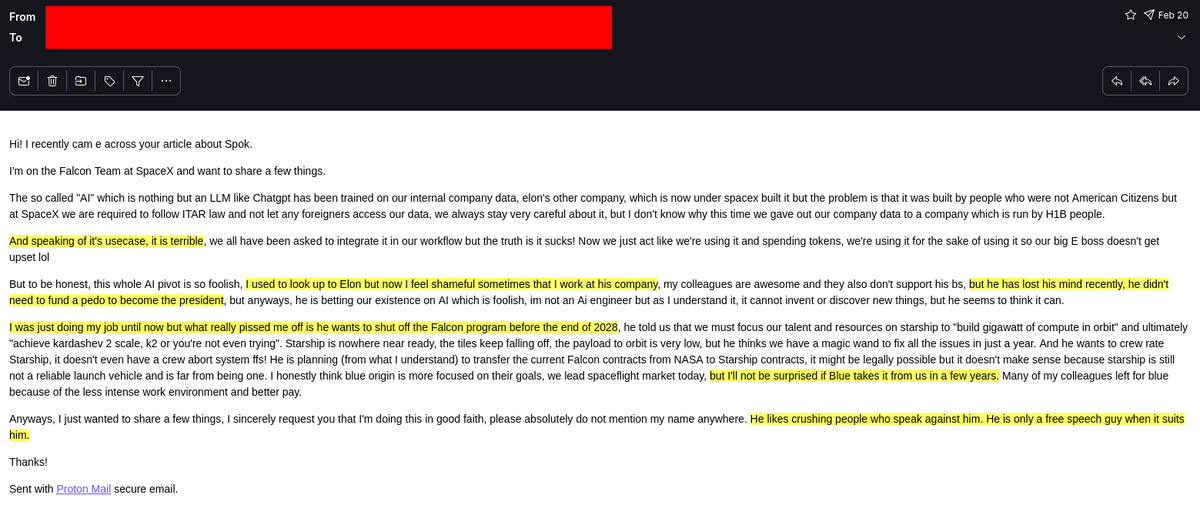
To increase credibility, Mann not only used a seemingly real internal company identity but also deliberately added dissatisfaction towards Elon Musk and Trump in the emails to match the public's expectations of the positions of SpaceX internal employees.
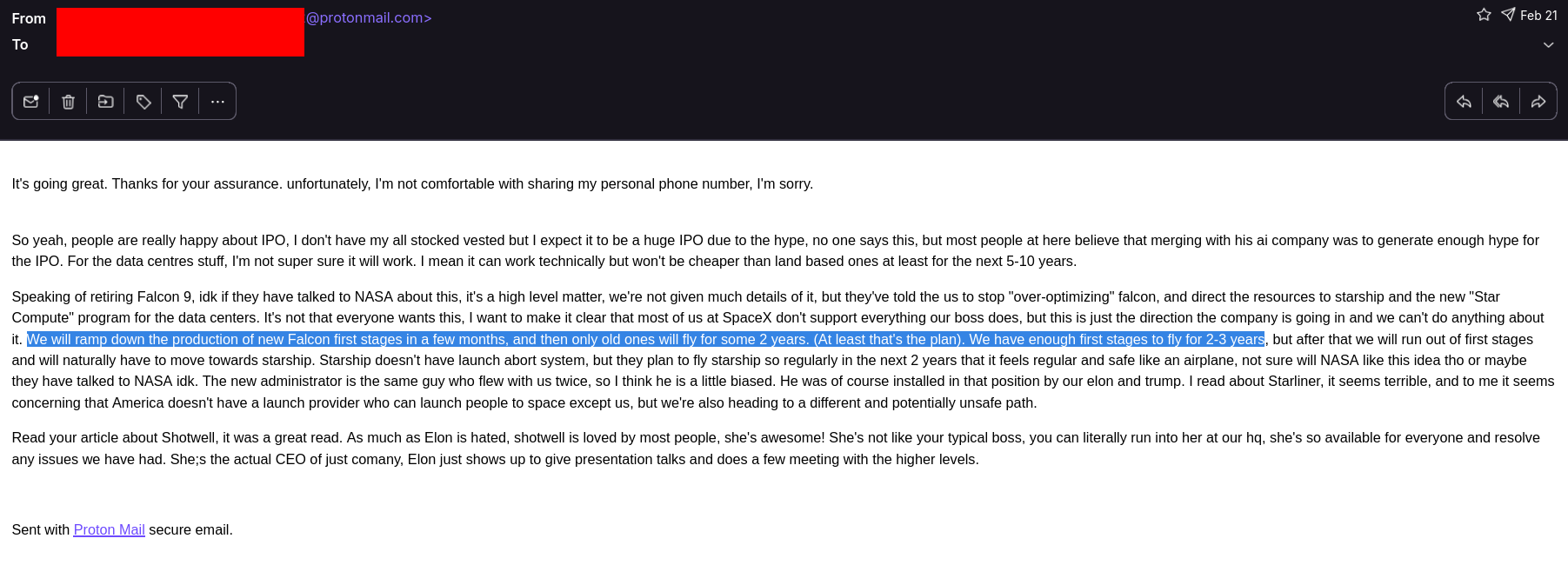
In the emails, Mann fabricated a series of false information about the adjustments to the Falcon 9 business, including SpaceX gradually reducing the production of Falcon 9 parts, only retaining missions for NASA and Axiom in the future, and completing the relevant transition by 2028. This completely fabricated information subsequently appeared in media reports, packaged as "insider revelations"...

Mann specifically mentioned a detail: he had clearly stated that "SpaceX will gradually reduce the production of the first stage rockets of the Falcon 9," but the media reports from Bloomberg and others said "reduce the production of the second stage rockets." Mann raised professional questions to Bloomberg and other media about this and commented that "this doesn't make any sense" because the first stage rocket is reusable, while the second stage rockets are all single-use, so it wouldn't be possible to stockpile them in large quantities like other rockets to meet launch demands.
Currently, Mann's claims have not been publicly confirmed by the relevant media, which have not responded publicly either, but regardless, this controversy triggered by a "fake email" has already become one of the most dramatic episodes in the recent commercial space sector.
The fact is absurd and ironic: a regular netizen, through identity forgery and a few emails, managed to get news about SpaceX's business route adjustments into mainstream media and directly impact market discussions and secondary market dynamics.
Next time you see "anonymous sources," "informed sources," or "insiders" in media reports, you might need to exercise a bit more caution.
免责声明:本文章仅代表作者个人观点,不代表本平台的立场和观点。本文章仅供信息分享,不构成对任何人的任何投资建议。用户与作者之间的任何争议,与本平台无关。如网页中刊载的文章或图片涉及侵权,请提供相关的权利证明和身份证明发送邮件到support@aicoin.com,本平台相关工作人员将会进行核查。


