A lawsuit brings Tether's "good friend" to light.
Written by: 0xFacai, Rhythm
Abraxas Capital is a name both familiar and unfamiliar.
Familiar, because it often appears in reports on on-chain detection accounts. Withdrawals of tens of thousands of ETH at once, and actions that directly drain liquidity of funds, are easily noticeable.
Unfamiliar, because this institution hardly maintains a public image. It has no verifiable X account, nor do employees express opinions on Twitter. Most people recognize them based on labels attached to addresses on on-chain data platforms.
From TradFi to Crypto
Abraxas started in traditional finance. The two founders, Fabio Frontini and Luca Celati, both previously worked at Dresden Kleinwort Wasserstein Bank, and founded Abraxas Capital Management in London in 2002, initially engaging in global macro trading. In 2017, the company shifted its focus to digital assets.

Fabio Frontini
In 2018, Abraxas launched their first product, the Elysium Global Arbitrage Fund, conducting Bitcoin arbitrage between European and American markets and Asian markets, later gradually shifting to stablecoin arbitrage. In February 2019, Frontini met with Tether's then Chief Financial Officer Giancarlo Devasini and visited Tether's banking partner, Deltec Bank, in the Bahamas. Shortly thereafter, Elysium began testing USDT liquidity with small transactions, gradually scaling up.
Before long, Abraxas's Heka Funds became one of Tether's largest institutional clients. By 2021, over $1.5 billion USDT was attributed to Heka's address paths, accounting for approximately 1.5% of Tether's historical distribution at that time; of which at least $1.05 billion entered Bitfinex, $144 million entered Binance, and $132 million entered Huobi. By 2023, Elysium was trading over $1 billion USDT annually, with trading fees close to zero.
The asset management scale of the Elysium series funds exceeded $500 million in 2022, over $1 billion in 2023, and is projected to exceed $4 billion by 2025. Of the current four fund products, the Elysium Global Arbitrage Fund has a size of $1.5 billion, the Alpha Bitcoin Fund is $1.9 billion, the Alpha Ethereum Fund is $7 million, and the Alpha Gold Fund is $423 million.
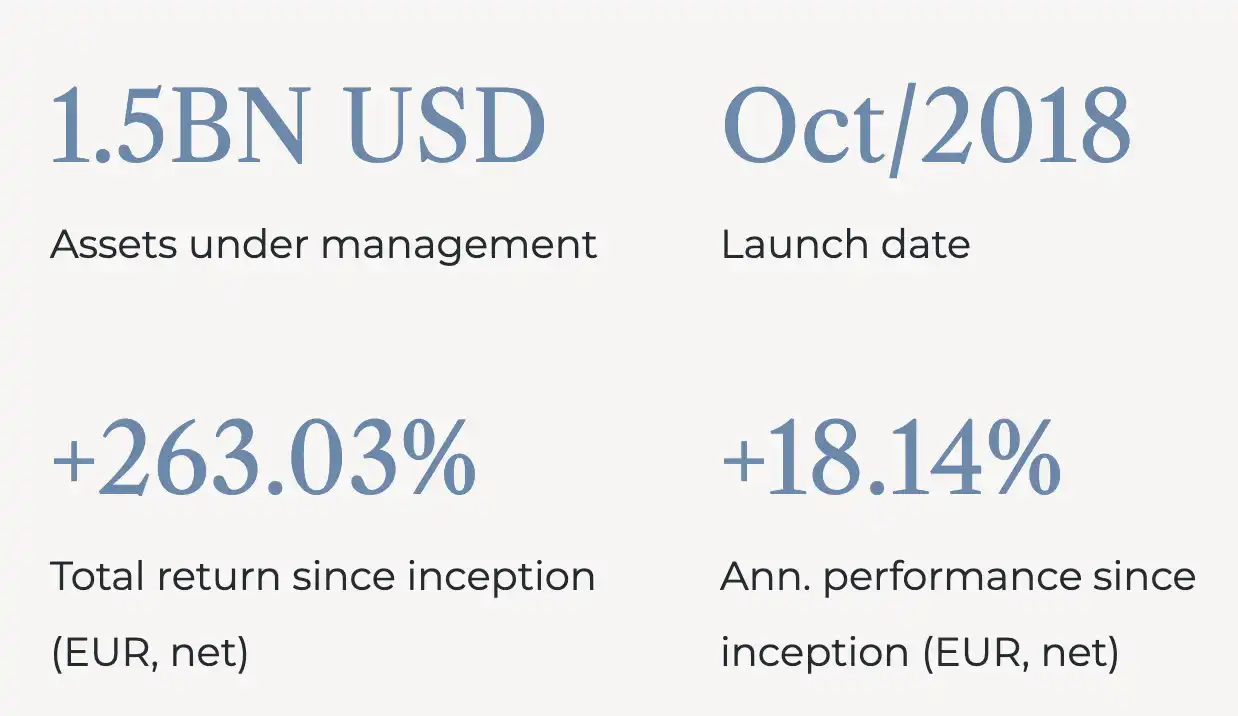
Introduction to Elysium Global Arbitrage Fund on the official website
The post-fee performance of dollar shares by 2025 also provides a reference. Elysium Global Arbitrage Fund returned 12.41%; Alpha Bitcoin Fund returned -2.55%, while BTC fell by 8.28% in the same period; Alpha Ethereum Fund returned -5.21%, while ETH fell by 13.95%; the Alpha Gold Fund, established in October 2025, returned 14.63% over the last three months of that year, while gold rose by 11.50%.
As of July 23, 2026, Abraxas Capital’s 43 identifiable addresses collectively held about $1.142 billion in assets. Among these, Bitcoin accounted for $548.6 million, Ethereum $440.5 million, HyperCore about $69.34 million; additionally, there were 26 Hyperliquid contract positions worth about $70.37 million, and approximately $12.82 million in Hyperliquid staked assets.
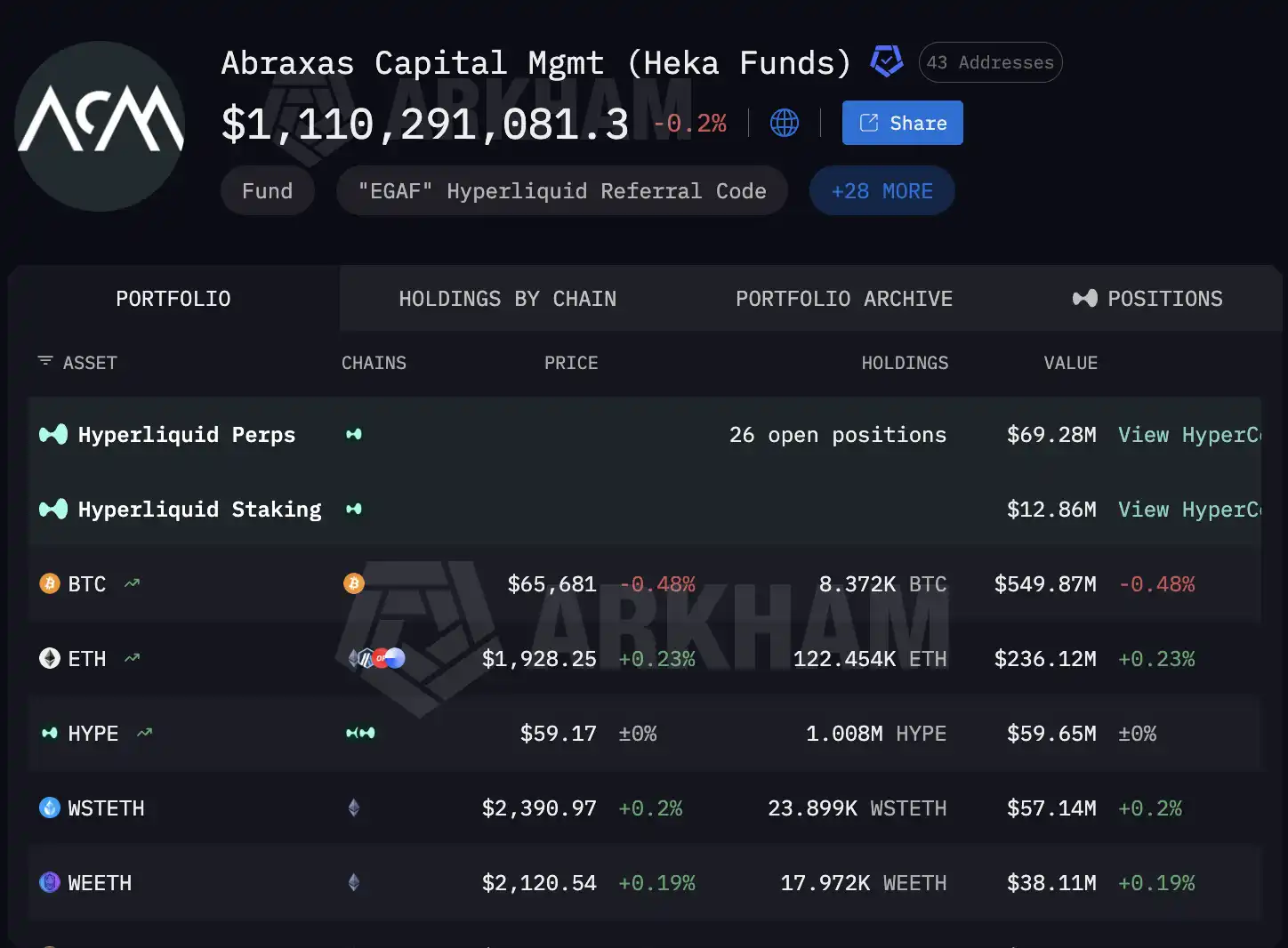
These 43 addresses extended Abraxas's on-chain footprint far beyond just a single trading account. The Hyperliquid addresses that frequently appear in on-chain detection reports are merely a part of the institution's public footprint.
Tether's Good Friend
The arbitration materials between Circle and Heka Funds made public in July 2026 brought Abraxas's capital relationship with Tether to the forefront. On April 28, 2023, Tether's cumulative position in Elysium was approximately $500.2 million; a month later, it increased to about $504.6 million. By the time of arbitration, Tether's investment reached $800 million, accounting for about 75% of Elysium's total assets. Tether also waived the USDT minting fees for Heka. Founder Frontini testified that Tether invested another $500 million into Elysium in February 2024.
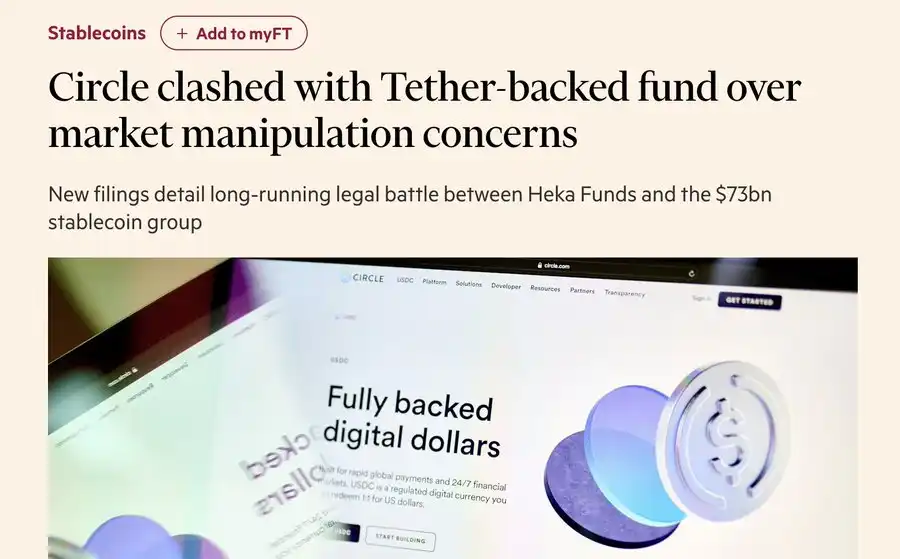
In March 2023, when USDC depegged, Abraxas Capital purchased discounted USDC from the secondary market and redeemed it from Circle at $1, exceeding $587 million in redemptions within two weeks. Circle later suspected these transactions were aiding competitor Tether in expanding its market share and banned Abraxas Capital's account in December of that year. Abraxas Capital denied market manipulation, and the arbitrator confirmed that Circle had the contractual right to restrict the account, but did not rule that Abraxas Capital manipulated the market.
The on-chain fund flow extended this relationship beyond arbitration. In August 2025, a transfer of $250 million USDT flowed from Tether to Abraxas-associated accounts, with part of the funds used to reduce Aave debt, and approximately $79 million temporarily returning to Aave. From April 9 to 24, 2026, according to associated address paths, about $4.3 billion new minted USDT was attributed back to Abraxas's funding network.
The interplay of capital, fees, and on-chain channels indicates that the relationship between Abraxas and Tether surpasses that of a stablecoin issuer and a regular customer. Public documents do not clarify whether Tether holds equity in Abraxas management, but its weight in Elysium's assets has reached three-quarters, and Abraxas has also become an important institutional outlet for Tether's funds entering exchanges, lending protocols, and arbitrage markets.
Profitable Hedging Wallet
We analyzed the most well-known address of Abraxas Capital on Hyperliquid. Its 54 computable trades totaled approximately $78.11 million in profit, with 35 wins and 19 losses, a win rate of 64.81%.
The median position size of this account is only about $520,000, while the average reaches approximately $8.45 million. The average is 16 times the median, indicating that results are clearly driven by a few large positions. 31 short positions contributed about $77.74 million in profits.
These 54 records are only a part of the institutional hedging system, but they are enough to demonstrate the position-bearing capacity of institutional-grade accounts on public order books.
The maximum loss and maximum profit of this account both come from XPL.
On September 23, 2025, the account opened a short position of approximately $19.78 million in XPL at an average price of $0.7504. At that time, XPL had not yet been officially launched. Two days later, Plasma launched its mainnet, and the fully diluted valuation of XPL briefly surpassed $8 billion. The account closed the position four days later at an average of $1.2255, incurring a loss of approximately $12.53 million.
Immediately after this trade, the account re-shorted at an average price of $1.0491. The new position reached about $151.7 million, nearly eight times the previous one. After peaking on September 28, XPL retraced, and the account ultimately exited on October 17 at an average price of $0.692, realizing a profit of about $52.21 million.
Currently, this address holds approximately $97.82 million in ETH short positions, $51 million in HYPE short positions, $60 million in BTC short positions, $15.41 million in SOL short positions, and $2.35 million in FARTCOIN short positions. The FARTCOIN position accounts for about 11.07% of the total outstanding contracts in the market, SOL for 4.33%, ETH for 4.16%, HYPE for 3.89%, and BTC for 2.13%.
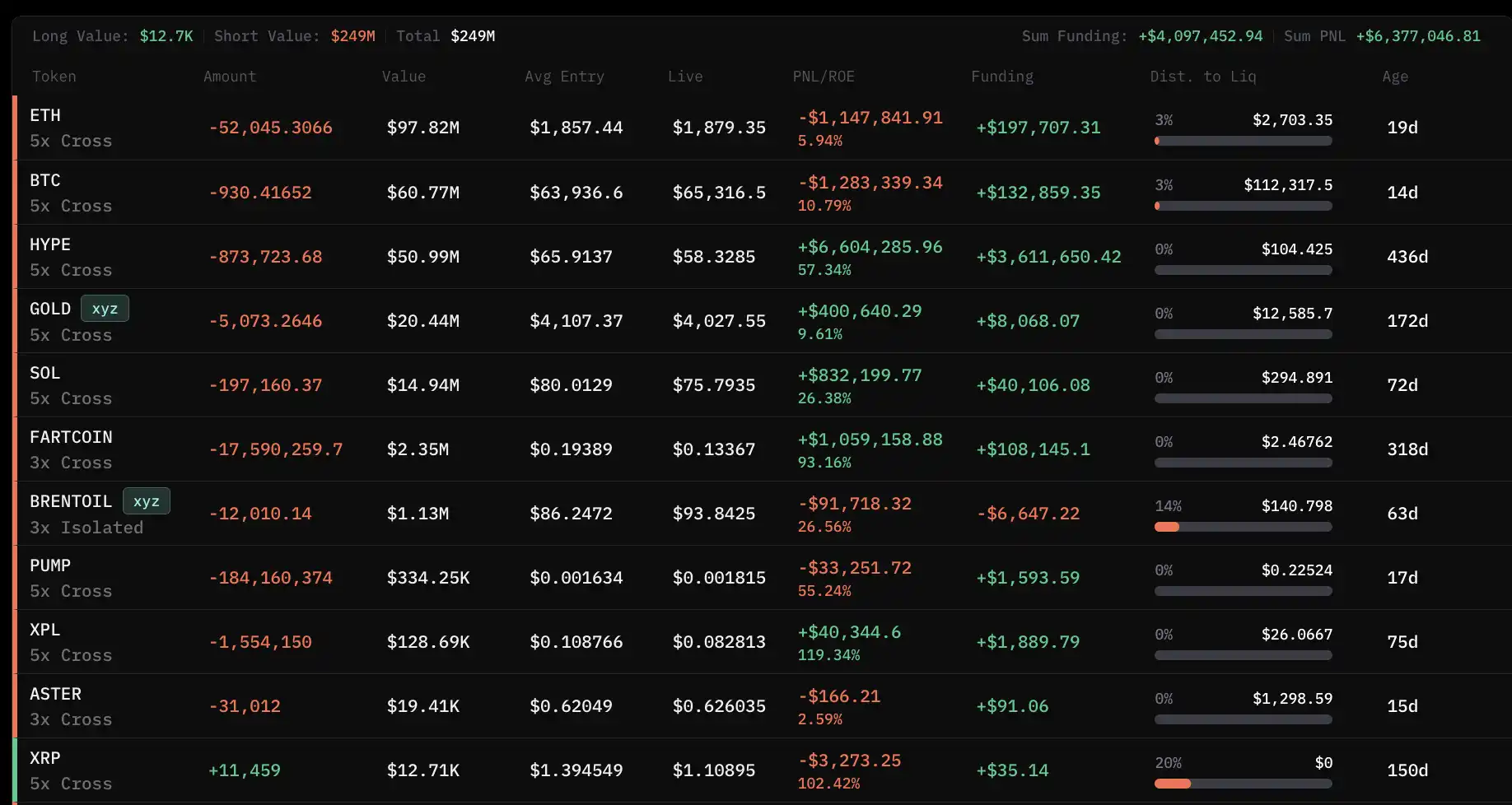
An address simultaneously occupies several percentage points of multiple perpetual market sizes, and opening and closing positions have already become variables that the market needs to digest. But pulling back the camera, this is still just one of the 43 labeled addresses.
On-Chain Whales
In May 2025, Abraxas completed a round of large-scale ETH scheduling. As of May 20, the two identified associated addresses held assets exceeding $1.15 billion; from May 13 to 20, these two addresses withdrew nearly 270,000 ETH from exchanges, valued at over $690 million.
Of these, more than 174,000 ETH subsequently entered Aave, Ether.fi, and Compound, valued at approximately $440 million at the time, with Aave V3 positions nearing $480 million. The ETH scheduling volume during this week was far greater than the total nominal positions of the aforementioned Hyperliquid addresses.
From April 25, 2019, to July 22, 2026, Abraxas deposited approximately $121.7 billion into centralized trading platforms and withdrew approximately $105.54 billion from the platforms, totaling a flow of over $227.2 billion.
Exceeding $227.2 billion in exchange inflows and outflows has thoroughly exposed Abraxas's financial turnover capability.
Even disaggregated to a single address, the fund flow remains impressive. In 2024, the address 0xed0c…4312 held over $216 million in assets and generated over $6 billion in trading volume through protocols like Aave, 1inch, Spark, and Compound, while transferring over $800 million to other Abraxas addresses within five months.
In the nearly 90 days of about $3.75 billion in ETH-related funds flowing through this address, approximately $2.06 billion passed through Aave, Compound, and Spark. It has cumulatively deposited about $4.61 billion in ETH and BTC derivative assets into Aave V3 and lent out approximately $3.01 billion USDT. Billions have repeatedly cycled between lending protocols and exchanges, constituting the daily activities of this address.
The Most Expensive Advertisement
In September 2024, Abraxas redeemed $100 million USDe in about 20 minutes, briefly exhausting Ethena's protocol withdrawal buffer. After 25 minutes, the buffer was restored to $30 million. The fund scheduling of one institution accidentally became a stress test for leading DeFi protocols.
The same scale can be seen in the lending market. In July 2025, Abraxas once controlled about 36% of USDe deposits on Aave. One Abraxas address cycled nearly $1 billion sUSDe; another address held approximately $547 million in collateral in SparkLend, while yet another address once deposited approximately 66.68 million sUSDe into Aave.
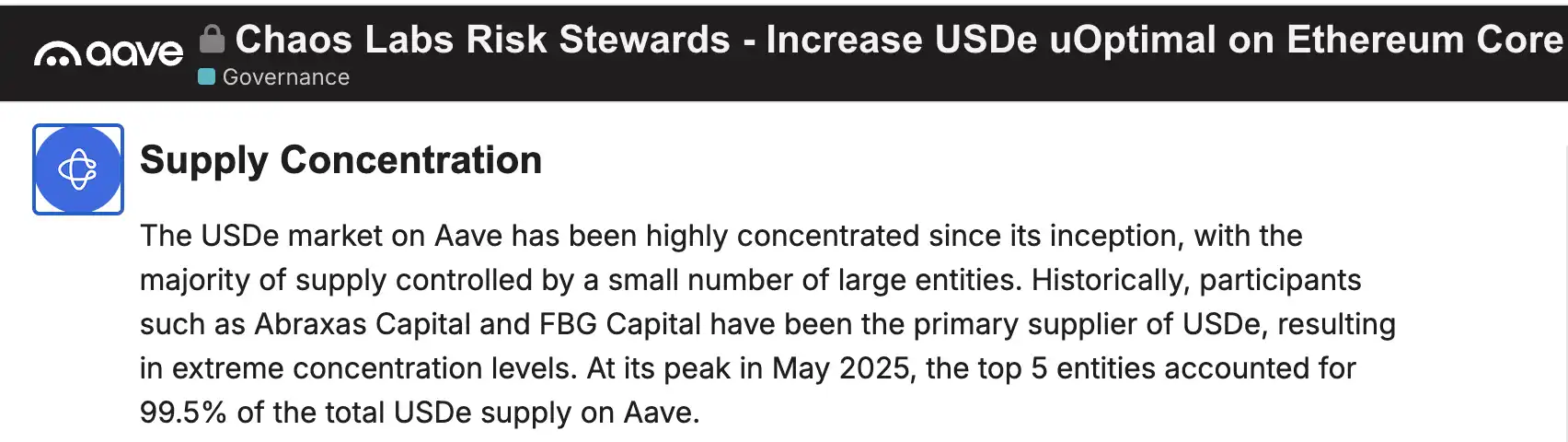
Chaos Labs reminded Aave’s governance forum that the market for Aave's USDe is primarily controlled by whales such as Abraxas Capital
The ETH scheduling continued into 2026. From July 13 to 17, Abraxas withdrew a total of 45,996 ETH from Binance, Bybit, and Bitfinex, valued at about $8.439 million at the time. During the same period, approximately 82,300 ETH were deposited into Spark and Aave, with about 54,500 ETH going to Spark and 27,845 ETH going to Aave.
Meanwhile, the Hyperliquid addresses analyzed in this article continued to expand their ETH short positions. On July 24, the shorts reached about 50,245 ETH, with a nominal value of about $97.82 million and an unrealized loss of about $1.14 million. Tens of thousands of ETH in spot market were sent to lending protocols, while nearly $100 million in short positions hedged against price fluctuations on Hyperliquid. Abraxas possesses the ability to mobilize tens of thousands of ETH in spot markets while establishing short positions of close to $100 million in public hedging.
Beyond ETH, Abraxas's holdings in tokenized gold are also dominant. Abraxas holds approximately 86,947 XAUT across wallets, accounting for 12.3% of the supply, valued at approximately $400 million. At one point in June 2025, one Abraxas address contributed 99.26% of the liquidity to the Uniswap V3 XAUT/WBTC liquidity pool.
The air of mystery surrounding Abraxas has not dissipated. We still do not know why it establishes each position, nor can we derive the overall fund strategy and performance from on-chain labels.
But it is clear that they do not need to manage social media. The scale of capital flow itself is the most expensive advertisement.
免责声明:本文章仅代表作者个人观点,不代表本平台的立场和观点。本文章仅供信息分享,不构成对任何人的任何投资建议。用户与作者之间的任何争议,与本平台无关。如网页中刊载的文章或图片涉及侵权,请提供相关的权利证明和身份证明发送邮件到support@aicoin.com,本平台相关工作人员将会进行核查。


