Written by: Rita
Trend Guide
On July 27, Changxin Technology landed on the STAR Market, opening with a surge of 471%, and its market value briefly surpassed 3.3 trillion yuan.
On the same day, Nomura Securities released its initial coverage report, giving a "buy" rating with a target price of 116 yuan, corresponding to a 20 times price-to-earnings ratio of an expected earnings per share of 5.8 yuan in 2028. Based on an issuance price of 8.66 yuan, this implies a potential upside of over 12 times.
Nomura's core logic is that the demand growth for AI (over 60%) will long outpace the supply growth (30% to 40%), leading to a structural shortage of DRAM becoming the norm. As the world's fourth-largest DRAM manufacturer, Changxin is at a turning point for capacity expansion and domestic substitution.
Technical Catch-Up: Five Generations Gap is Closing
Currently, Changxin's mainstream process is at 16 to 17 nanometers (1x to 1y node), with DDR5 yields around 80% and DDR4 over 90%, still having about a five-generation gap with overseas leaders.
However, the pace of catch-up is accelerating. The company is promoting the technical migration to 12 to 1a nodes (10 to 15 nanometers), without relying on EUV lithography machines, with plans for mass production of HBM3 in 2027. HBM3 has already been sampled to leading ICT companies in China, and HBM3e is under simultaneous development. The Shanghai HBM packaging plant (Xinpux Tianmei) plans for a capacity of 50kwpm, expected to be operational by the end of 2026.
In terms of pricing, Changxin’s products are priced 0 to 20% lower than overseas competitors, but the advantage is limited, mainly benefiting from policy support rather than cost leadership. Nomura estimates its wafer ASP for 2026 to be around 14 to 15k USD, upgrading to 14 to 15 nanometers, with the expectation to rise to 21 to 25k USD in 2027 to 2028.
The localization rate of equipment is currently below 40%. Core suppliers include Zhongwei Company (etching), Northern Huachuang, Changchuan Technology (testing), and Shengmei Semiconductor (cleaning). Nomura believes that Changxin will cautiously assess the impact of domestic equipment on yield and profitability.
Market Share Rising from 10% to 18%
China consumes about 25% of the world's DRAM, but domestic manufacturers hold only a 10% share of the market value, with a self-sufficiency rate of only 30%. This is the biggest growth driver for Changxin.
Nomura expects Changxin's global market share to rise from the current approximately 10% to 18% by the end of 2028, approaching Micron's scale. Clients include Alibaba Cloud, Bytedance, Tencent, Lenovo, Xiaomi, Transsion, Honor, OPPO, vivo, and others.
Financial data is already validating the trend. Cumulative losses from 2022 to 2024 exceed 30 billion yuan, with a turnaround to a net profit of 1.875 billion yuan in 2025. In the first quarter of 2026, revenue was 50.8 billion yuan (up 719% year-on-year), with a net profit attributable to the parent company of 24.76 billion yuan (up 1688% year-on-year), with quarterly profits exceeding the total for 2025. The company expects revenue in the first half of 2026 to be between 110 billion and 120 billion yuan, with a net profit between 50 billion and 57 billion yuan.
Capacity expansion is accelerating. By the end of 2025, capacity will reach 280kwpm, expected to reach 350kwpm by the end of 2026, and an increase of 100kwpm for both 2027 and 2028, reaching 550kwpm by the end of 2028. The compound annual growth rate of bit shipments is projected at 40% to 45%, far exceeding the industry average.
AI Agents are Consuming Memory
Nomura's report provides specific technological insights. A complete AI agent task goes through 8 phases: user request arrival, model weight loading, pre-filling, inference planning, tool execution, context integration, multi-step iteration, and response generation.
The most memory-intensive phase is the multi-step iteration, where KV-Cache expands exponentially. Even considering a maximum 5-fold compression effect brought by memory optimization technologies, the compound growth rate of AI-driven memory usage from 2026 to 2030 is still expected to exceed 60%, with total growth of over 7 times.
Nomura also proposed a more aggressive hypothesis. If AI robots autonomously run tasks, no longer limited by human operational rhythms, the demand ceiling would only be constrained by infrastructure and capital expenditures, theoretically having no upper limit.
Supply Side Can't Keep Up, Four Major Bottlenecks Are Stuck
With a demand compound growth rate over 60%, Nomura estimates the supply side to only be 30% to 40%.
The reasons for the unaddressable gap are very specific. The expansion of semiconductor capacity faces four major bottlenecks: clean rooms, equipment, materials, and talent, with each requiring several years to solve.
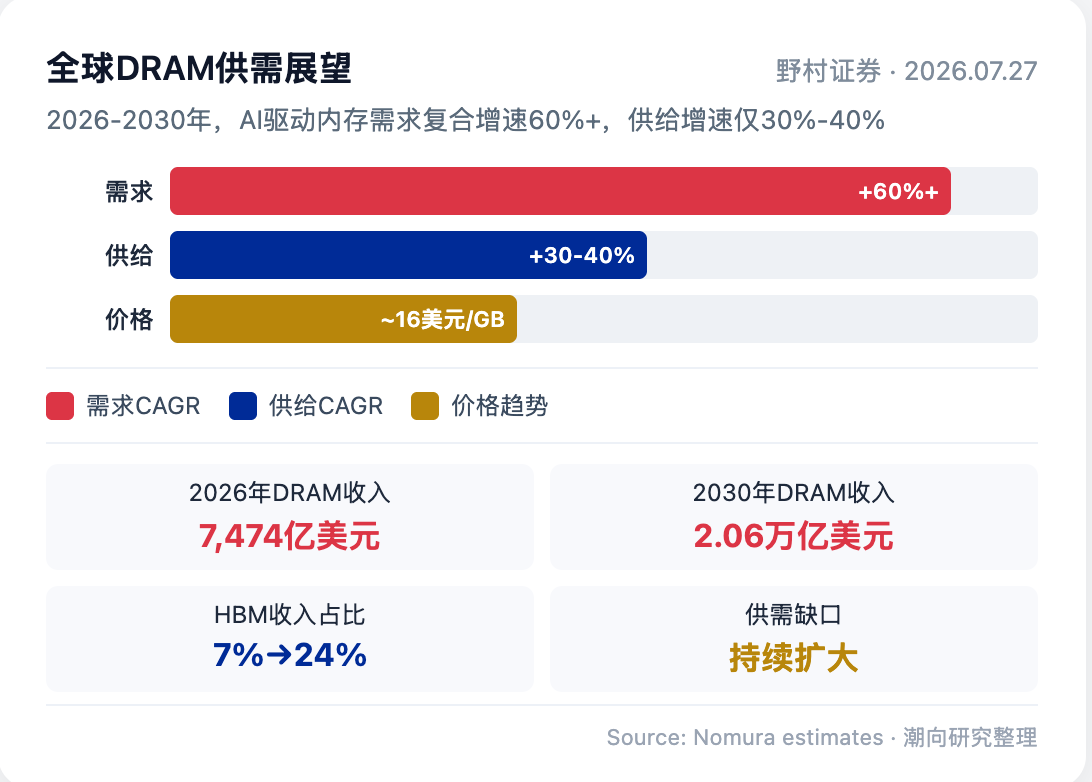
Nomura believes that even if memory efficiency technologies can alleviate pressure to a certain extent, it is merely delaying rather than reversing the trend. Ultimately, solutions such as NAND offloading (100 times higher capacity but slower speed) and HBF (ultra-high bandwidth NAND) may need to be deployed simultaneously, but this could also exacerbate NAND's supply tightness.
20 Times PE, Is It Expensive?
The target price of 116 yuan equals the 2028 EPS of 5.8 yuan multiplied by 20 times PE.
Nomura breaks down the logic behind this valuation into two steps. Micron's average PE over the past five years is around 10 times. There has long been a valuation gap of 1 to 3 times between US and Chinese listed semiconductor equipment stocks, taking ACM Research Shanghai compared to its US parent company as an example. Changxin, as the leading DRAM manufacturer in China, should enjoy a China premium, with a PE range of 10 to 30 times, taking the median of 20 times.
Calculated based on an issuance price of 8.66 yuan, the corresponding PE for 2026, 2027, and 2028 would be 4.2 times, 2.1 times, and 1.5 times, respectively.
It is worth noting that Northeast Securities on the same day provided a valuation range of 3.2 to 5.7 trillion yuan, while Nomura's 7.76 trillion yuan is 1.4 times the former. The core of the divergence lies in the future market share ceiling of Changxin, with Northeast Securities's baseline assumption at 17%, while Nomura is betting on a larger share space.
Disclaimer
This article is a compilation and interpretation of third-party brokerage research reports (Nomura Securities, July 27, 2026) by Trend Research. The ratings, target prices, earnings forecasts, and related judgments cited in this article are solely the opinions of analysts at that brokerage and represent the position of their respective institution, not the views of Trend Research, and do not constitute any investment advice.
The market carries risks; decisions should be made independently. This article should not be used as a basis for buying or selling any securities.
免责声明:本文章仅代表作者个人观点,不代表本平台的立场和观点。本文章仅供信息分享,不构成对任何人的任何投资建议。用户与作者之间的任何争议,与本平台无关。如网页中刊载的文章或图片涉及侵权,请提供相关的权利证明和身份证明发送邮件到support@aicoin.com,本平台相关工作人员将会进行核查。


