When AI starts to pay for itself: Why the wallet track has become a battleground for exchanges and stablecoin giants.
Written by: Ekko an, Ryan Yoon, Tiger Research
Translated by: AididiaoJP, Foresight News
News headlines are constantly reporting on AI agents trading autonomously and handling payments on their own. In fact, the cryptocurrency wallet industry has long been quietly paving the way. Currently, more than ten companies are specifically creating wallets for agents. What do they really want? What are the potential returns?
Key Points
When AI agents browse the internet, purchase goods or information on behalf of humans, they initiate hundreds or thousands of small transactions worth just a few cents or even less. The existing bank card payment system simply cannot support this volume, hence there is a need for wallets that can automatically split and send funds according to predefined conditions.
Despite not seeing any revenue in the short term, companies like Coinbase and Binance are still investing heavily in AI wallet infrastructure. The reason is simple: to secure the future user base before mass trading by agents takes place. This current phase is about seizing the opportunity before actual demand explodes.
According to data estimated by Coinbase, after the increased usage of AI agents, their revenue could reach up to about seven times the current level.
The payment records accumulated in the wallet can intuitively show whether a specific AI agent is generating income, which opens the door for loans based on expected future earnings—similar to how credit is granted based on the credit card transaction flow of a small business.
However, all of this is still in the realm of possibility, rather than established fact. AI agents can still make mistakes and execute incorrect payments; rules differ among countries and companies; and the legal status of agents is still unclear. Therefore, the current competition is not about making money today, but about positioning oneself in a market that is expected to take shape in the coming years.
AI agents are becoming fully active
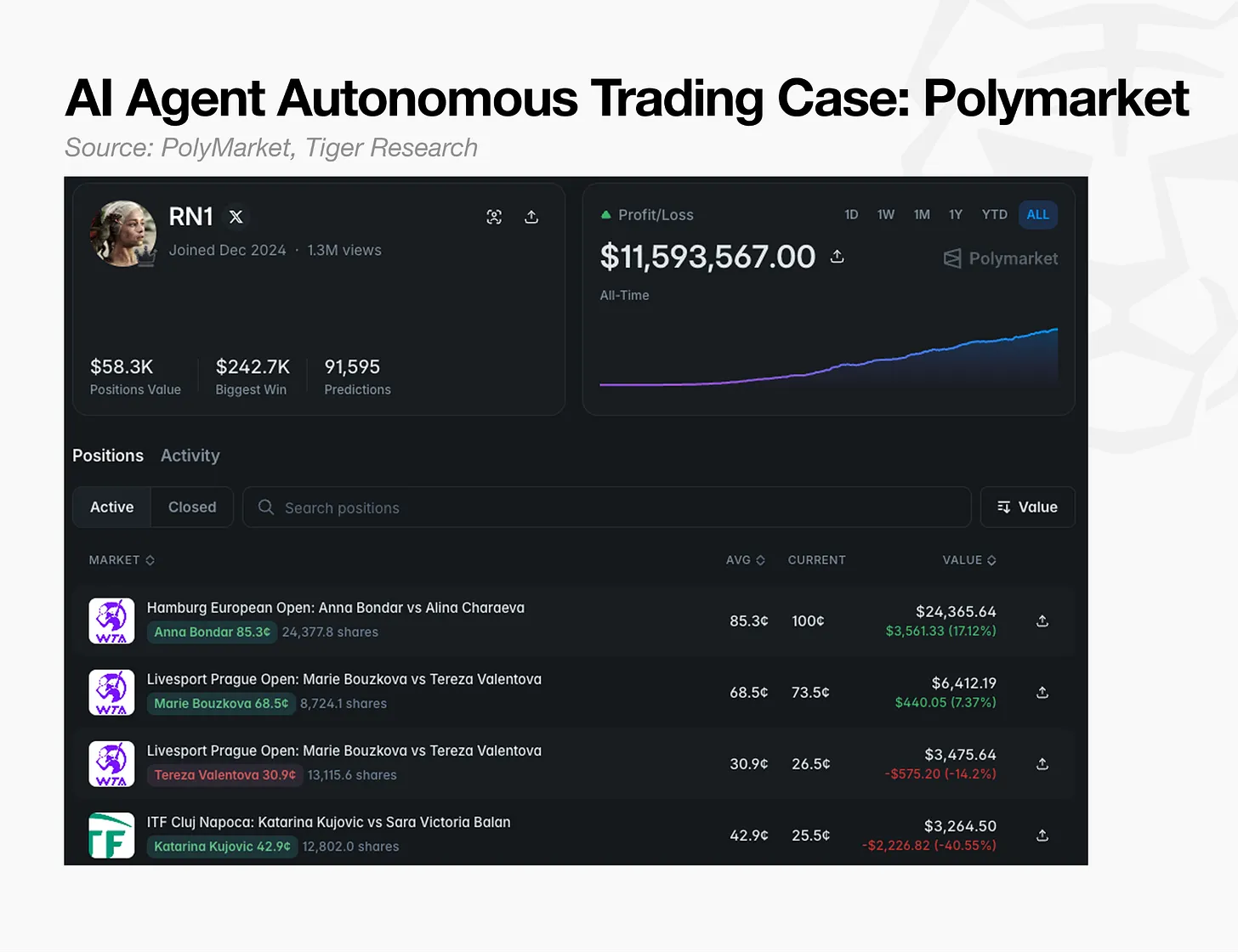
Earlier this year, there was a widely discussed experiment on the prediction market Polymarket: an AI agent was given $50 in start-up capital to trade on its own, with the condition that if it did not earn enough to cover API and server costs, it would "disappear." As a result, this agent successfully traded. Subsequently, a batch of similar agents began trading in the same way.
AI agents have not yet entered daily life, but it is already clear that they will be used on a large scale in the near future.
Every agent's transaction starts with a wallet
Currently, AI agents have not yet entered daily payment scenarios. Their most active application remains in trading bots in the cryptocurrency ecosystem—independent of traditional payment tracks, focusing on cryptocurrency trading.
In the future, payments will extend to areas that are hard to imagine today. As noted in our previous report, AI is changing the nature of payments. Once actions are taken online by agents instead of humans, the amount of each payment will drastically decrease. A single API call or data query could cost as little as $0.001, and in extreme cases, even just $0.00001.
To go beyond the current use of wallets and achieve such small, automatically split payments requiring no human intervention, programmable payment systems are essential. This is the background for the emergence of the x402 payment track, of which the wallet is the foundation for operation.
However, the existing payment tracks are designed around "humans" as the transactional subjects.
Bank cards are issued to specific cardholders, employing a chargeback mechanism—when issues arise, humans debate and reverse transactions, with each transaction incurring a fixed fee of several dimes. When a person occasionally spends $20, these are not issues. But once agents start processing thousands of payments per second, and each API call costs $0.001 or each data record costs $0.00001, this payment model becomes economically unworkable.
The core question is: is money itself programmable?
Bank cards can automate the input of payment information, but cannot be programmed to split by conditions, stream payments, or settle funds instantly. The track on which wallets operate assumes these capabilities by default. Storing payment information on a card can at most execute one "human-scale" transaction on behalf of a person. Once the economy shifts to direct transactions between machines, the wallet becomes the only possible starting point.
Agents could be a $50 billion business
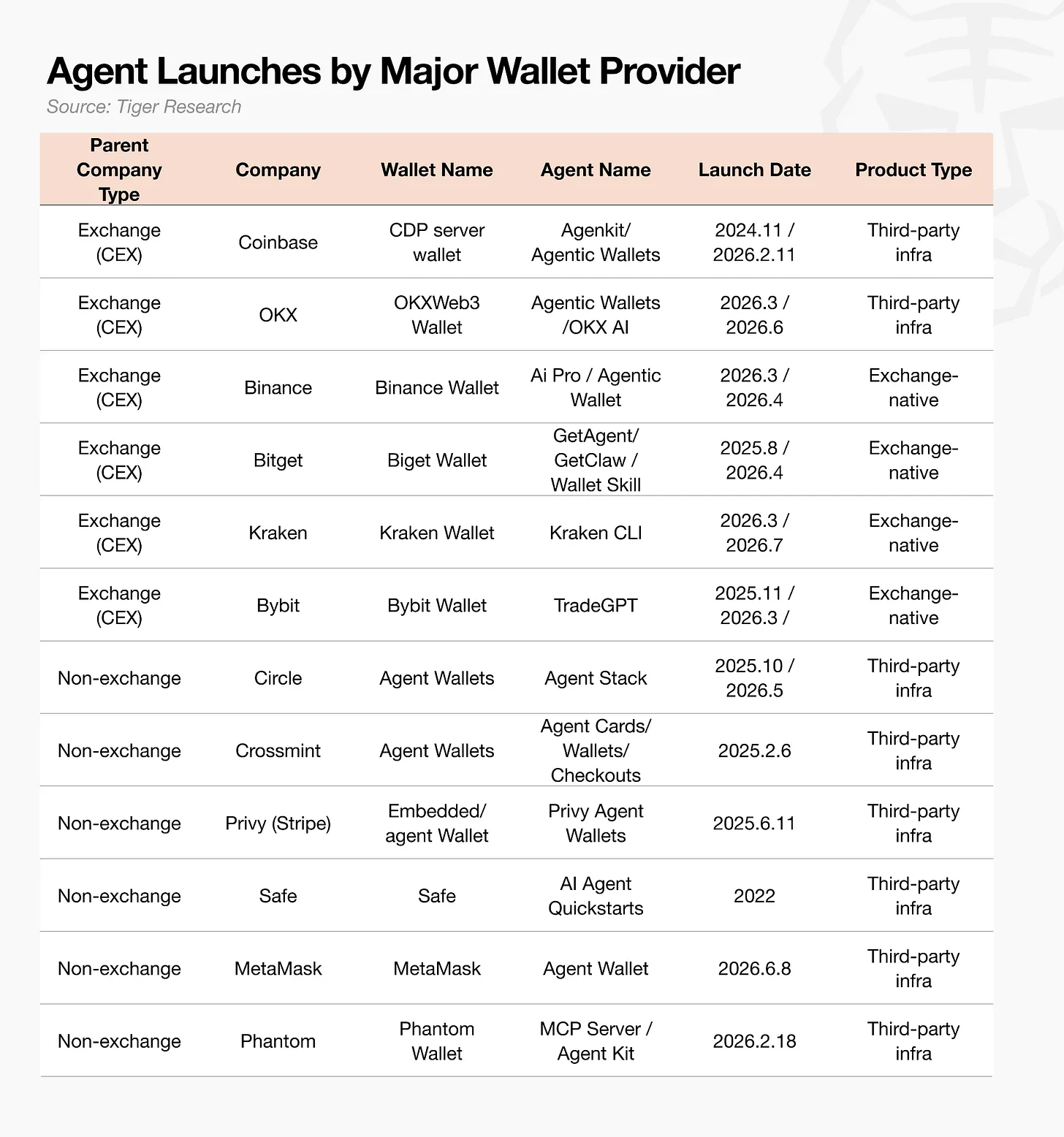
As seen in the relevant charts, wallet providers cover a wide range, from exchanges to stablecoin issuers. Why are so many different types of players entering the AI agent wallet infrastructure, which offers almost no profits in the short term?
The answer is: they are positioning themselves for future revenue and business, not today's. Adding agent functionality to wallets now is not to make immediate profit but to build the capacity to handle massive transaction volumes when agents become active on a large scale.
The key is that AI agents will ultimately operate in a no-browser environment around the clock, requiring no human intervention at all. Imagine a user asking an agent to complete a research report. While collecting information, each time the agent retrieves paid data from different platforms, it will execute a small payment. A single user command could instantly trigger 20 to 30 or even more payments.
What appears to be a simple operation request to humans, once processed by AI agents, becomes a multitude of payment transactions.
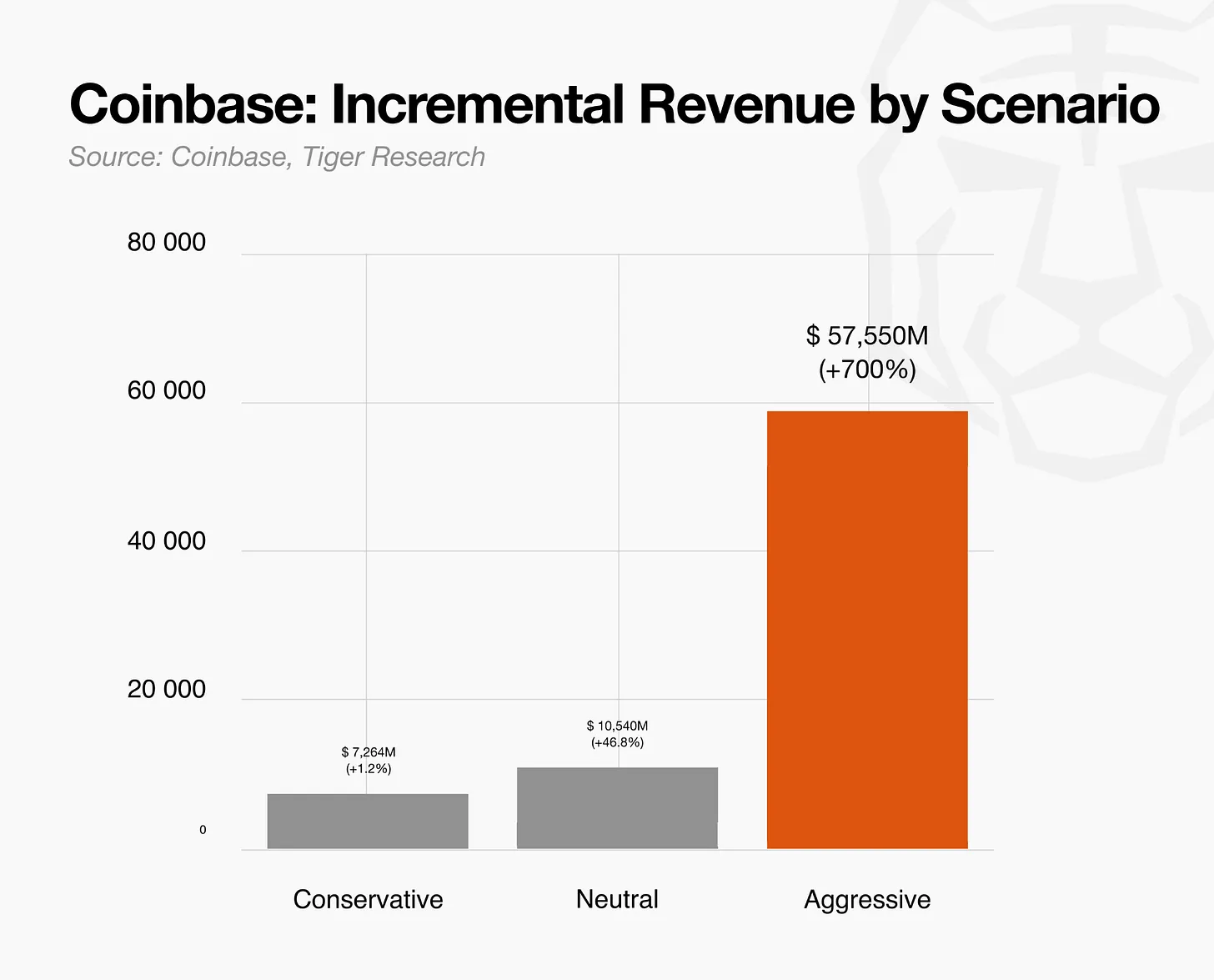
How will this change in the payment environment affect corporate revenues? This can be estimated using data disclosed by Coinbase. The estimation is based on the 9.2 million monthly active trading users (MTU) of Coinbase, rather than its total of about 120 million registered users.
Combining adoption rates, the number of agents per user, and daily call frequency as three variables leads to the following scenarios:
- Conservative scenario (adoption rate 10%, 1 agent per user, 50 calls per day): annual incremental revenue of about $84 million, growth of 1.2%.
- Neutral scenario (adoption rate 50%, 2 agents per user, 200 calls per day): additional revenue soars to about $3.36 billion, growth of 46.8%.
- Aggressive scenario (adoption rate 100%, 3 agents per user, 1000 calls per day): annual revenue of about $50.37 billion, approximately seven times Coinbase's current total revenue.
The most striking point in this comparison is that the discrepancies among the three scenarios are exponentially magnified rather than simply added together. The adoption rate rises from 10% to 100% (10 times), yet the revenue difference expands by about 600 times—from $84 million to $50.37 billion.
Since these three variables—the adoption rate, the number of agents per user, and daily call volume—are multiplicative, any slight increase will lead to an exponential growth in the total. Hence, once agents achieve large-scale adoption and user numbers surge, the revenue flow generated could reach up to seven times the current total revenue.
This is also the reason why Coinbase is actively promoting AI wallet infrastructure, despite seeing almost no related revenue today—it aims to lock in the share of revenue that is expected to emerge in the AI era.
Moving Towards a New Bank for Agents
The transaction data accumulated through wallet infrastructure goes beyond simple record-keeping. It provides a foundation for new business models: the payment history stored in wallets can become a credit standard for assessing the financial status and performance of AI agents.
Once such a data-driven credit assessment system is established, wallet providers can naturally extend into next-generation financial services, such as revenue-based financing (RBF) specifically for agents.
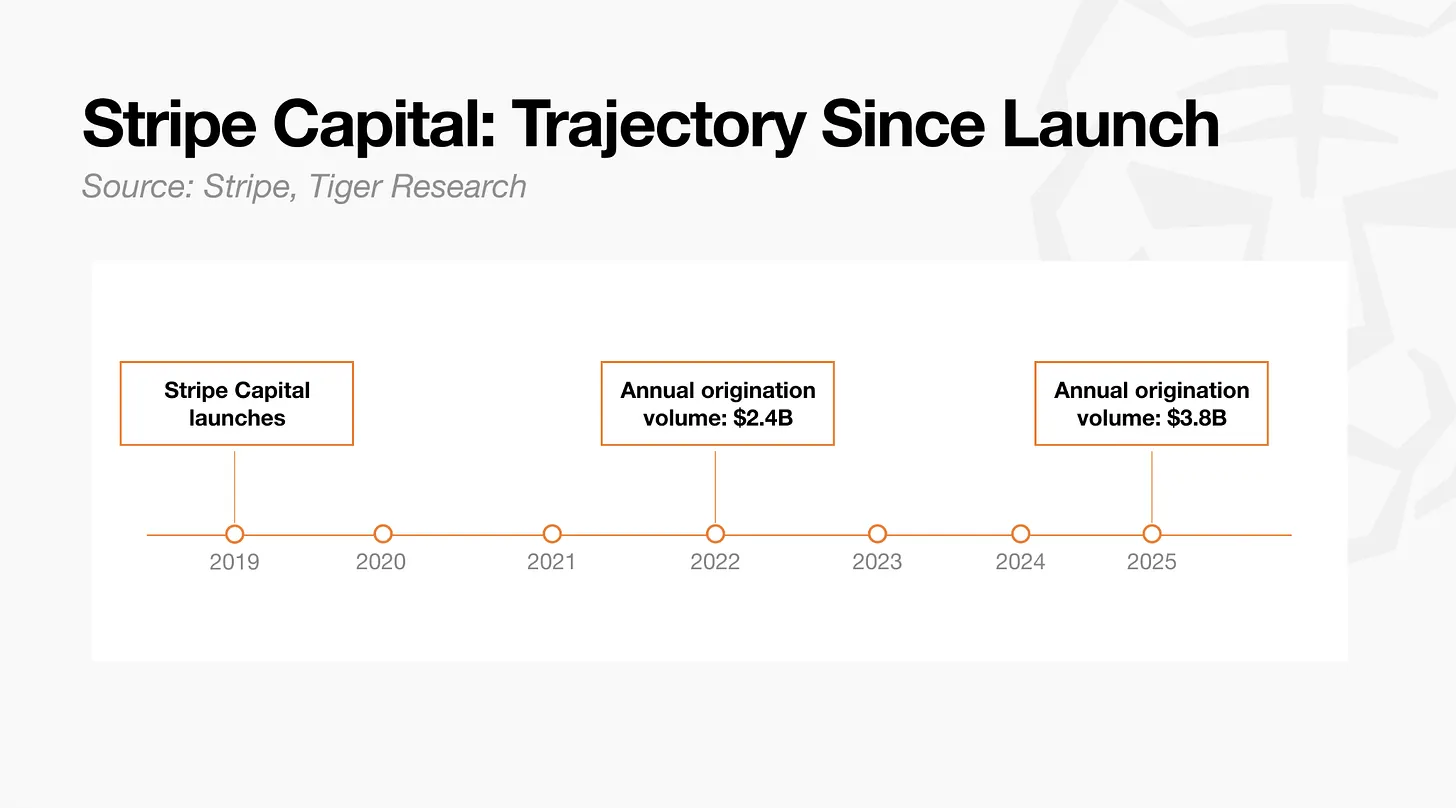
Stripe Capital is a typical example. It successfully built new financial services on top of existing payment data. When Stripe launched its lending service, Stripe Capital, in September 2019, it did not rely on external credit agencies or cumbersome loan materials, but directly used the real-time sales data of each merchant in its payment network to assess loan eligibility and amounts.
The Stripe case shows that a company can build high-value financial services without an additional sales network or marketing investment, based on existing operational data pipelines.
Wallet providers for agents are likely to follow the same expansion path. By continuously accumulating income data from agents through wallets, they will have the foundation to provide operational funding through RBF and earn revenue as a financial platform focused on agents.
However, to truly establish this new business line, there is a prerequisite: AI agents must evolve from mere executors of payments to entities that can generate their own income, earning sufficient real income to repay loans.
This growth is still unverified
The earlier descriptions of Coinbase's revenue potentially increasing by up to seven times and the expansion into RBF describe an optimistic scenario assuming widespread adoption of AI payments. There remain significant barriers to translating this into the real economy.
First, the actual purchase conversion rates and payment reliability of AI agents are still in serious doubt. Agents can still "hallucinate" and make mistakes when placing orders autonomously, leading to erroneous payments; sometimes, they can be directly intercepted by issuing banks' fraud detection systems (FDS). As a result, the actual payment completion rate remains relatively low.
Furthermore, payment protocols such as x402, AP2, MPP, etc. are still fragmented and have not converged to a unified standard; AI agents are not legal entities, lacking clear KYC (Know Your Customer) and financial regulations, which further hampers market expansion.
Therefore, the immediate goal for wallet providers is not short-term fee income. The Apple App Store took 15 years to establish an annual fee market of $10 billion, while WeChat Pay took 7 years to create a large mini-program ecosystem. AI wallets are also on a long timeline—they are building an ecosystem rather than competing for immediate returns.
The current competition is not about marginal revenue today but about which company can take control over the flow of funds data that will emerge in the full maturation of the agent economy in the next five to ten years.
免责声明:本文章仅代表作者个人观点,不代表本平台的立场和观点。本文章仅供信息分享,不构成对任何人的任何投资建议。用户与作者之间的任何争议,与本平台无关。如网页中刊载的文章或图片涉及侵权,请提供相关的权利证明和身份证明发送邮件到support@aicoin.com,本平台相关工作人员将会进行核查。


