
Author: Su Yang, Tencent Technology
Editor丨Xu Qingyang
Changxin's listing has become the hottest topic in China's tech circle.
On July 27, domestic DRAM leader Changxin Technology was listed on the sci-tech innovation board, with an opening price of 49.50 yuan per share, an increase of over 470% compared to the issue price of 8.66 yuan per share. At the same time, with a market value exceeding 3.6 trillion yuan, it surpassed Industrial and Commercial Bank of China to top the market capitalization ranking in China's stock market, more than doubling Guizhou Moutai's market value, becoming the "big brother of A-shares."
As the only IDM company in China that has achieved large-scale production of DRAM, Changxin's net profit in the first half of the year has already exceeded 50 billion yuan, with a global market share climbing from 3% to nearly 8%, breaking into a market long dominated by Samsung, SK Hynix, and Micron.
Alongside Changxin's hype is a report from Nomura Securities.
On the morning of July 27, international investment bank Nomura Securities (referred to as Nomura) released a report, initiating coverage with a "buy" rating for Changxin and a target price of 116 yuan. The estimated upside of over 12 times the opening price instantly brought Changxin into the market spotlight. In the title, Nomura even likened the industrial value of Changxin's DRAM chips to the "pearl on the crown of China."
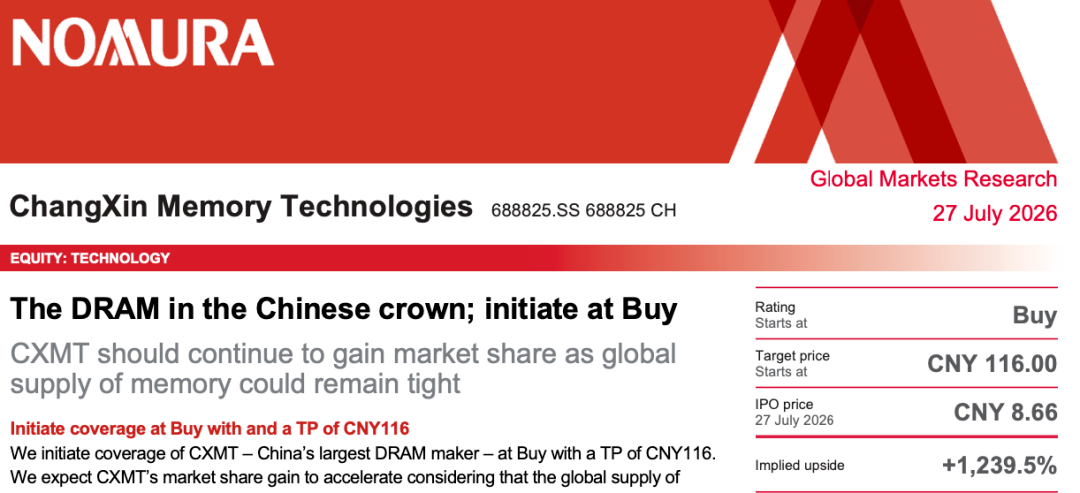
Nomura's research report on Changxin
“A target price above 100 means a market value of over 7 trillion yuan, which is a bit aggressive,” said an investor who has closely followed the Chinese semiconductor industry. “This possibility exists, but it requires a surging market sentiment and would exhaust at least three years of future growth.”
So, with Nomura's 13 times optimistic outlook for Changxin, what is the underlying logic, and how do they assess the risks associated with Changxin?
01. Estimated Revenue of 560 Billion in 2027
According to data disclosed by Changxin in its listing press release, the company expects to achieve revenue of 110 billion to 120 billion yuan in the first half of 2026, a year-on-year increase of 612.53% to 677.31%; it expects a net profit attributable to shareholders of 50 billion to 57 billion yuan, a year-on-year increase of 2244.03% to 2544.19%.
Regarding the growth in performance, Changxin stated, "In recent years, driven by the recovery of the storage industry, product structure optimization, and release of scale effects, the company's operating performance has achieved rapid growth."
Compared to Changxin's own performance projections, Nomura's report is more optimistic. According to its model, Changxin's revenue is projected to rapidly increase from 61.8 billion yuan in 2025 to 290.7 billion yuan in 2026, 560.8 billion yuan in 2027, and 773.3 billion yuan in 2028.
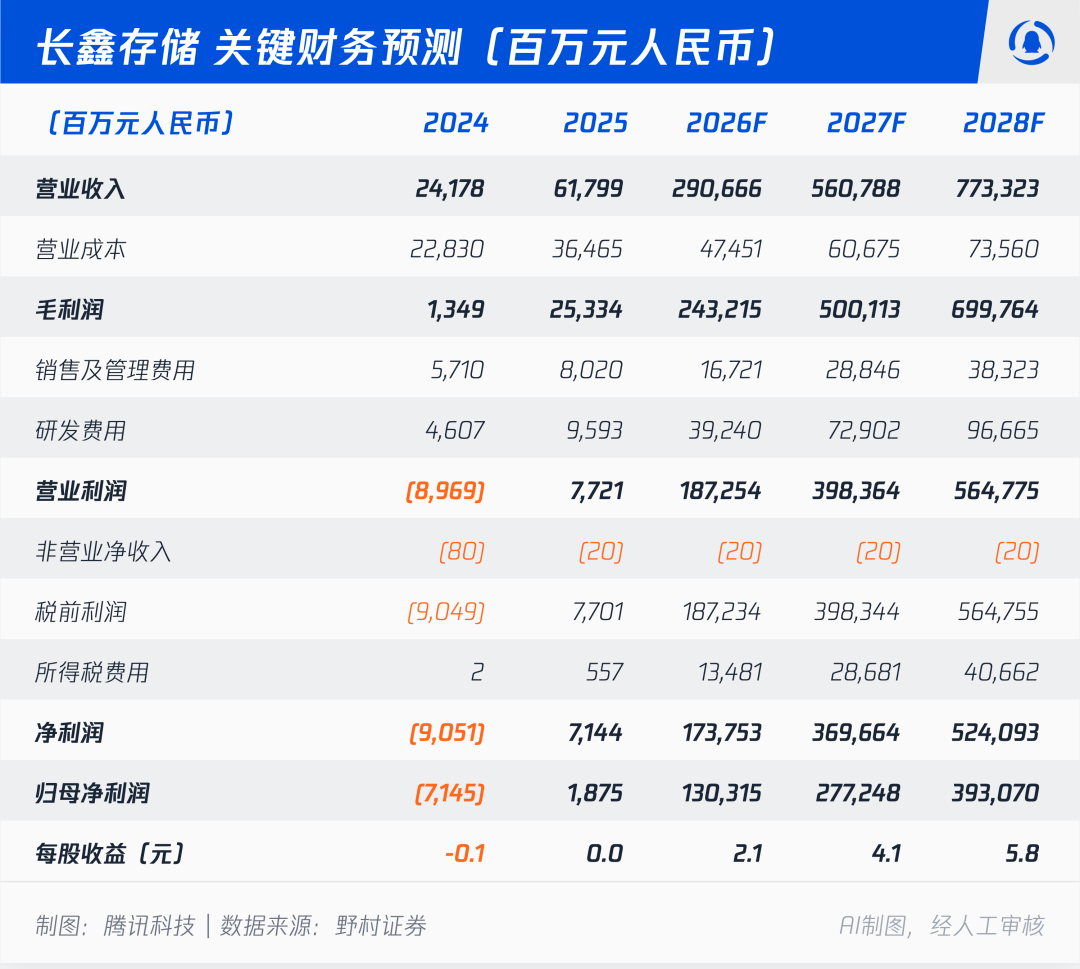
Nomura also expects Changxin's net profit attributable to shareholders to increase from less than 1.9 billion yuan in 2026 to 130.3 billion yuan, 277.2 billion yuan, and 393.1 billion yuan in 2027 and 2028, respectively. The compound annual growth rates for the two indicators are 63% for revenue and 74% for net profit.
The underlying logic for Changxin's performance estimates focuses on three dimensions: capacity expansion, technology upgrades, and price increases. The first two dimensions are strongly correlated with the use of raised funds disclosed in Changxin's prospectus.
Previously, Changxin disclosed in its prospectus that the raised funds will primarily be used for upgrading the production lines for memory wafer manufacturing, upgrading DRAM technology, and researching and developing forward-looking technologies for dynamic random access memory, further enhancing advanced manufacturing capabilities and innovation levels.
It is worth noting that the price increase is mainly reflected in two aspects: on the one hand, it comes from the increase in average selling price per wafer due to technology upgrades; on the other hand, it results from a broad price increase of storage particles in the midst of a super cycle.
“Since the second half of 2025, the continuous rise in product prices has driven rapid increases in product sales gross margins and profit levels, leading to a turnaround in profitability in 2025,” Changxin noted in the overview section of its prospectus.
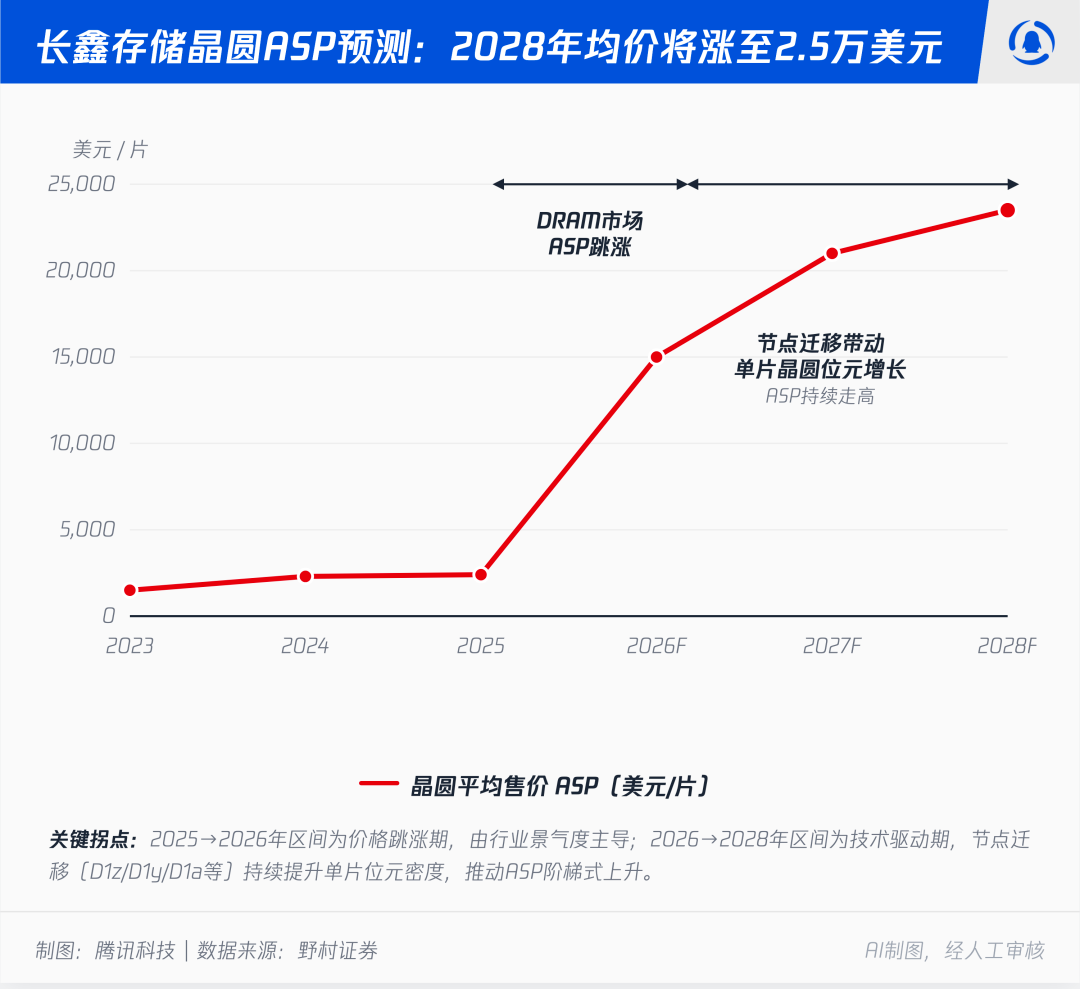
Changxin's product shipment structure is also upgrading.
In a prior response to an inquiry letter, Changxin Technology disclosed that mobile terminal products currently represent its basic revenue base, with smartphone manufacturers like Xiaomi, Transsion, Honor, Vivo, and OPPO corresponding to LPDDR series products; while cloud vendors like Alibaba and ByteDance mainly correspond to DDR series products.
The revenue contribution from the two customer categories is roughly about 9:1.
By May 17, 2026, revenue contribution from AI server-related products represented by the DDR series surged to over 30%, but the mainstay remains the LPDDR series product line, which accounts for over 66%.
During this phase of climbing performance, the movements of a heavyweight potential customer, Apple, are particularly worthy of attention.
According to the Financial Times, Apple has begun testing Changxin's DRAM chips, aiming to use them in entry-level iPhones and other devices sold in the Chinese market. Meanwhile, since May or June of this year, Apple has been lobbying the U.S. government to seek relevant permissions.
If collaboration between the two parties ultimately materializes, Changxin may take on a portion of Apple's global DRAM procurement. The significance of this order lies not only in the sales volume per se but also in the fact that a supplier previously tagged as "domestic alternative" is beginning to transition towards being recognized as a supplier by leading global customers.
However, some institutions believe that Apple is only making small-volume purchases of Changxin's products and may also be looking to introduce new supply variables for negotiations with Samsung and SK Hynix.
02. Capacity Frenzy, Valuation Rivals Micron's Twice
Based on Nomura Securities' target price of 116 yuan, this corresponds to an estimated earnings per share of 5.8 yuan for 2028, giving Changxin a forward P/E ratio of about 20 times.
"Over 100 billion in profit supports a 2 trillion market value, which is reasonable," said investor Chen Qi, who has long followed the semiconductor industry, noting that a 2 trillion market value corresponds to a 20 times P/E.
In comparison, Wall Street's expected P/E for Micron in the 2026 fiscal year is about 10 times, while SK Hynix is only around 5 times. Chen Qi stated, "The semiconductor cycle has arrived; anything can happen."
In Chen Qi's view, a 10 times P/E is reasonable, but a 20 times P/E is also within the realm of possibility. "Changxin's true opportunity lies in being on the opposite side of Samsung, Hynix, and Micron, representing that Chinese storage has truly entered the game."
Nomura's 20 times P/E assessment for Changxin has another layer of logic—Micron can be regarded as the valuation anchor point in the global DRAM sector, with a historical mean forward P/E of around 10 times. The A-share semiconductor sector has historically had a valuation premium of 1 to 3 times over its U.S. counterparts, averaging about 2 times, arriving at Changxin's P/E of 20 times.
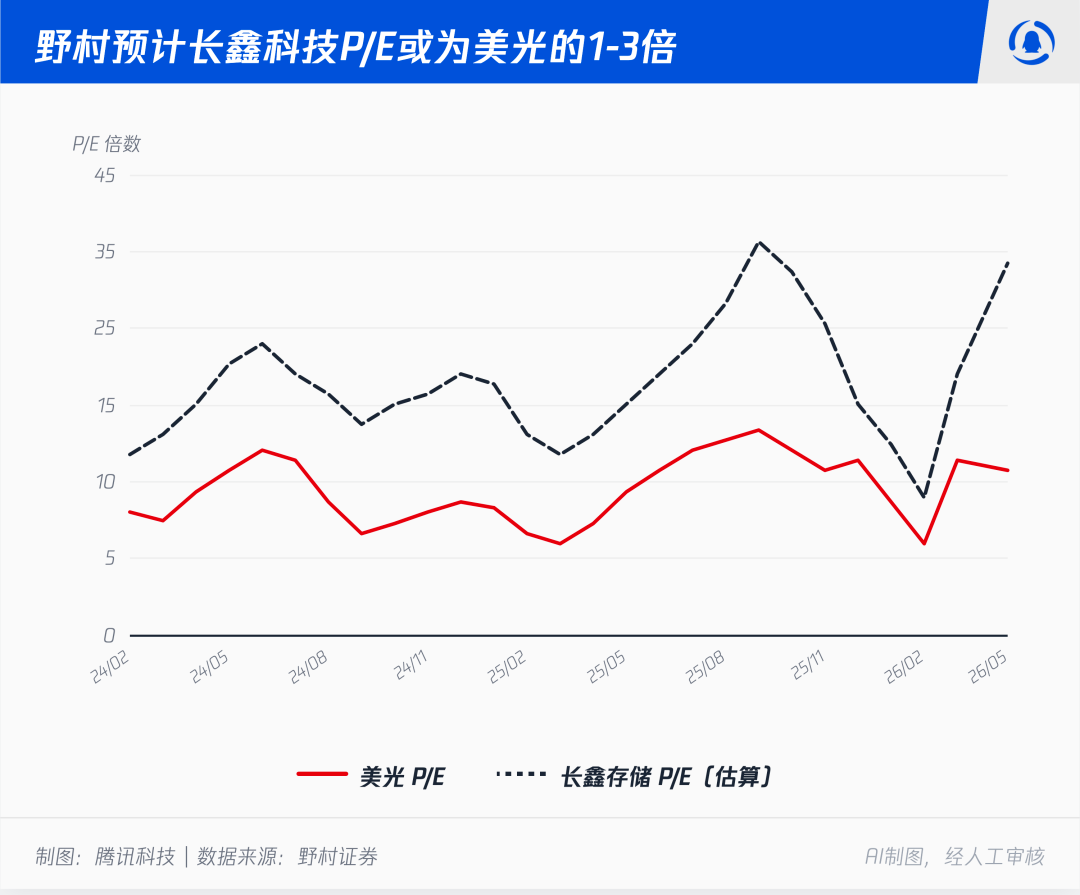
What underpins Changxin's valuation is that global storage demand is being dragged into exponential expansion by AI, while the supply side is constrained by physical bottlenecks, severely lagging behind demand. Nomura estimates that even if the compression effects of various storage efficiency technologies are calculated at 40%, global storage demand is still expected to increase by more than seven times between 2026 and 2030, with a compound annual growth rate exceeding 60%.
Nomura even proposed a more extreme scenario: if AI robots operate autonomously without the constraints of human operational rhythms, the upper limit for demand would only be the authorized boundaries, infrastructure capacity, and capital expenditure budgets.
But the pace of supply expansion is far from keeping up with this.
Nomura expects the industry's capacity expansion to have a compound annual growth rate of only 30% to 40%, while Changxin's bit expansion during 2026 to 2030 is estimated to have a compound annual growth rate of about 40% to 45%, still significantly lower than the growth rate of demand despite being above the industry average.
Additionally, at the same time Nomura published its report, Korean and American chip giants entered a new round of collaboration.
On July 24, U.S. time, Samsung Electronics and Broadcom signed a cooperation memorandum worth over $200 billion, covering advanced memory supplies such as HBM4, 2nm process foundry, and advanced packaging. Concurrently, SK Group and Hynix reached a long-term cooperation intention with NVIDIA, scaled over $500 billion, collaborating on the next generation of HBM for joint development and stable supply.
For Changxin, the more focused leading manufacturers are on HBM, the more obvious the supply gap in the traditional DRAM market becomes. Nomura predicts that Changxin's share in the global DRAM market will increase from the current approximate 10% to 18% by the end of 2028.
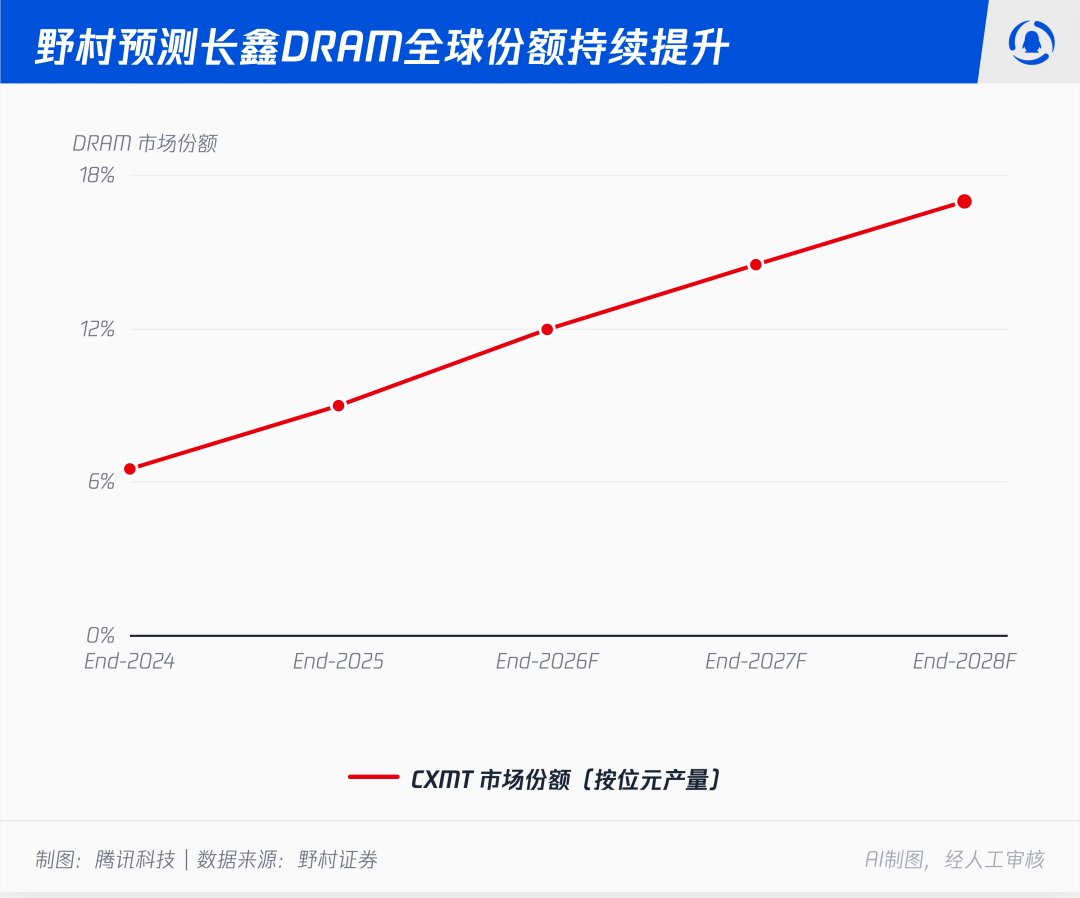
Furthermore, from the perspective of the domestic market, there is still ample room for improvement in self-sufficiency, providing a growth window for Changxin's performance.
According to WSTS data, in 2025, China is expected to account for about 25% of the global DRAM consumption market, yet domestic manufacturers have only about 10% of the global market share in production revenue, with a self-sufficiency rate of around 30%. Looking solely at the internal Chinese market, the substitution space is quite considerable.
03. Dual Examination Under Spotlight
The prospects are enticing, but Nomura also devoted considerable space in its report to discussing risks.
First and foremost are the key equipment and material sanctions resulting from the U.S. MATCH Act, including photolithography, etching, and high-end photoresists. In a worst-case scenario, aside from capacity expansion restrictions, Changxin's revenue and net profit for 2027 and 2028 could shrink by approximately 13%-14% and 30%-33%, respectively.
These external risks overlap significantly with several shortcomings mentioned in the prospectus.
Changxin mentioned "geopolitical risks" including the 1260H list, along with the highly monopolized market competition risks globally. Most critically is the industry's cyclical risk— the strong cyclicality and significant volatility risk of the DRAM industry.
Currently, the industry still operates under a rising super cycle, but market consensus on storage has begun to fracture.
Taking Micron as an example, since reaching a historical high of $1,255 on June 25, its stock dropped to as low as $804 in just three weeks, with a maximum retreat of 36%; SK Hynix experienced a more severe drop, with its share price in South Korea falling from 2,987,000 won on June 25 to as low as 1,678,000 won, a drop of 43.8%. Its ADR saw a one-day spike of 27% on July 14, followed by a 9% drop the next day.
The aforementioned investor who has closely followed the Chinese semiconductor industry told Tencent Technology that cycles ultimately return to the basic theories of supply and demand. "As long as the market is crazy, expanding production is limitless. However, demand will suddenly stop at some pilot project. This is true for any market, and storage is just a more extreme case."
This investor cited Hua Hong's investment in storage during the internet bubble in the 1990s, which experienced sharp rises and falls, ultimately transitioning logic chip foundry to emphasize the impact of the cyclical nature of storage. "Very few other markets experience 5-10 times rises in just 1-2 years in times of boom, and then plummet by 90% in 1-2 years during downturns. Since 1990, there have been at least five cycles, with a rough six-year pattern—it’s a very regular change."
Therefore, how to strictly adhere to financial discipline during an upcycle and avoid aggressive expansion will also test Changxin's long-term wisdom.
免责声明:本文章仅代表作者个人观点,不代表本平台的立场和观点。本文章仅供信息分享,不构成对任何人的任何投资建议。用户与作者之间的任何争议,与本平台无关。如网页中刊载的文章或图片涉及侵权,请提供相关的权利证明和身份证明发送邮件到support@aicoin.com,本平台相关工作人员将会进行核查。


