Original author: Dong Jing
Original source: Wall Street Watch
The bond market is becoming the most dangerous variable in the AI bull market.
On July 27, Michael Hartnett, Chief Investment Strategist at Bank of America, issued a warning in the latest Flow Show report: The 30-year U.S. Treasury yield has risen to its highest level since June 2007 at 5.2%, real yields have reached their peak since November 2008 at 3%, and U.S. tech bond prices have dropped to a two-year low—the tightening of financial conditions is surpassing the support of corporate earnings in the market.
Hartnett's core judgment is: The pressure in the bond market will not dissipate on its own; rather, it may force the Fed to raise interest rates, which is precisely the outcome the stock market most dreads. He warned that once the bullish combination of "rising bond yields and rising bank stocks" flips to "the higher the yields, the more the bank stocks fall," it will trigger a new round of deleveraging for risk assets.
At the same time, the credit default swaps (CDS) of hyperscaler cloud computing companies have risen to historical highs, bondholders are voting with their feet, questioning the return logic of the AI capital expenditure frenzy.
The backdrop of this warning is: Chip stocks continued to face selling pressure even after Google and Intel released solid earnings, with market concerns shifting from "can they make money?" to "who will foot the bill"—if the bond market no longer provides funding for the AI feast, where will the money come from for those expensive memory chips and negative-return cutting-edge models?
Bond market pressure exceeds earnings, financial conditions become core variable
In the report, Hartnett clearly proposed the core framework of "FCI > EPS," meaning that the tightening of the Financial Conditions Index (FCI) has had a greater impact on the market than the support provided by corporate earnings (EPS).
The nominal yield on 30-year U.S. Treasuries has reached 5.2%, the highest since June 2007; real yields have risen to 3%, the highest since November 2008; U.S. tech bond prices have dropped to a two-year low. The combination of these three indicators means that the cost of financing in the market is systematically rising, and this pressure has not yet been fully priced by equity investors.
Hartnett pointed out that as of 2026, there have been 23 central bank rate hikes worldwide, and Bank of America expects 18 more by the end of the year. More notably, the implied probability of the Fed raising rates at the July 29 meeting has risen to 38%, and the September 16 meeting has fully priced in one rate hike. He even threw out a rather provocative judgment in the report:
"Politically, it's smarter for the Fed to raise rates this week rather than wait until September, isn't it?"
Hartnett's chain of logic leads to a paradoxical conclusion: The pressure in the bond market may paradoxically force the Fed to stabilize long-term rates by raising interest rates. He believes that resolving this situation can only rely on Fed rate hikes to curb the disorderly rise of long-term yields.
However, interest rate hikes are not good news for the stock market. Hartnett warned to closely watch if the bullish combination of "rising yields and rising bank stocks" flips to "the higher the yields, the more the bank stocks fall"—once it flips, it will trigger a deleveraging of risk assets. In this scenario, he believes that going long on the U.S. dollar is the best hedge against the Fed's hawkish stance.
He also noted that stock investors have not yet regarded interest rate levels as a threat to the "Anything But Bonds" bull market, but if the pro-market Trump administration tolerates rate hikes to "hit the brakes" on the stock market and anti-billionaire sentiment, the market will suffer significant negative impacts.
Hyper-scale cloud service providers face record credit risks, AI capital expenditure logic questioned
The most direct manifestation of pressure in the bond market is the sharp deterioration of credit risk indicators for hyperscale cloud computing companies. According to the report, the credit spreads for hyperscaler cloud service providers have widened significantly, and CDS has risen to historical highs, with the concessions on bond issuances also continuing to expand.
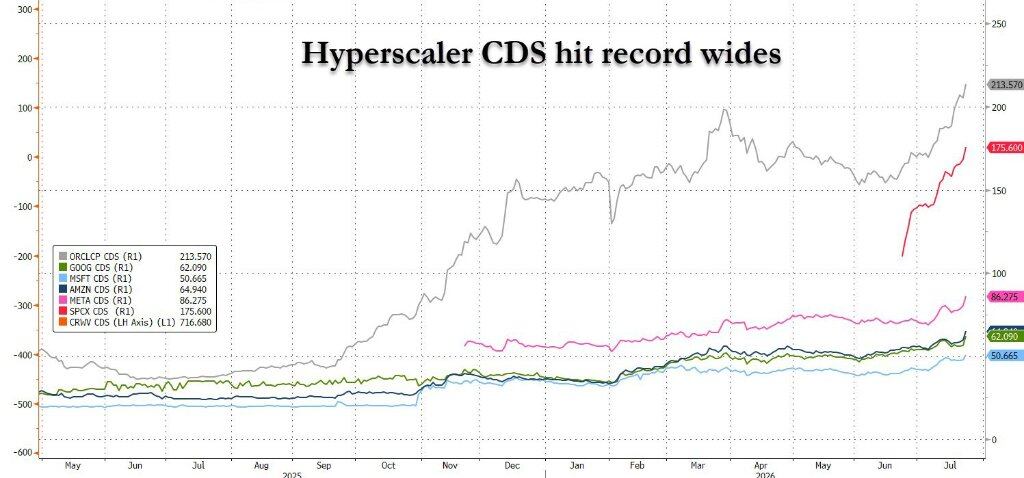
The root of this phenomenon lies in market skepticism about the return on investment (ROI) for AI capital expenditure. Google and Tesla are seen as benchmark companies for "capital expenditure return," yet despite stable performances in last week's earnings from Google and Intel, chip stocks were still sold off. The core question posed by the market is:
If bondholders are no longer willing to fund the AI feast, then models and memory chips that heavily rely on continuous capital investment will face the risk of funding disruption.
Hartnett previously resonated with Goldman Sachs' top derivatives trader Brian Garrett's judgment—The real risk of AI stocks does not lie within the stock market but rather in the bond market. Garrett had warned for two consecutive weeks that pain in the credit market would intensify, pointing out that the S&P 500 index has become increasingly difficult to represent the performance of ordinary stocks, with market fragmentation (low correlation, high dispersion) intensifying.
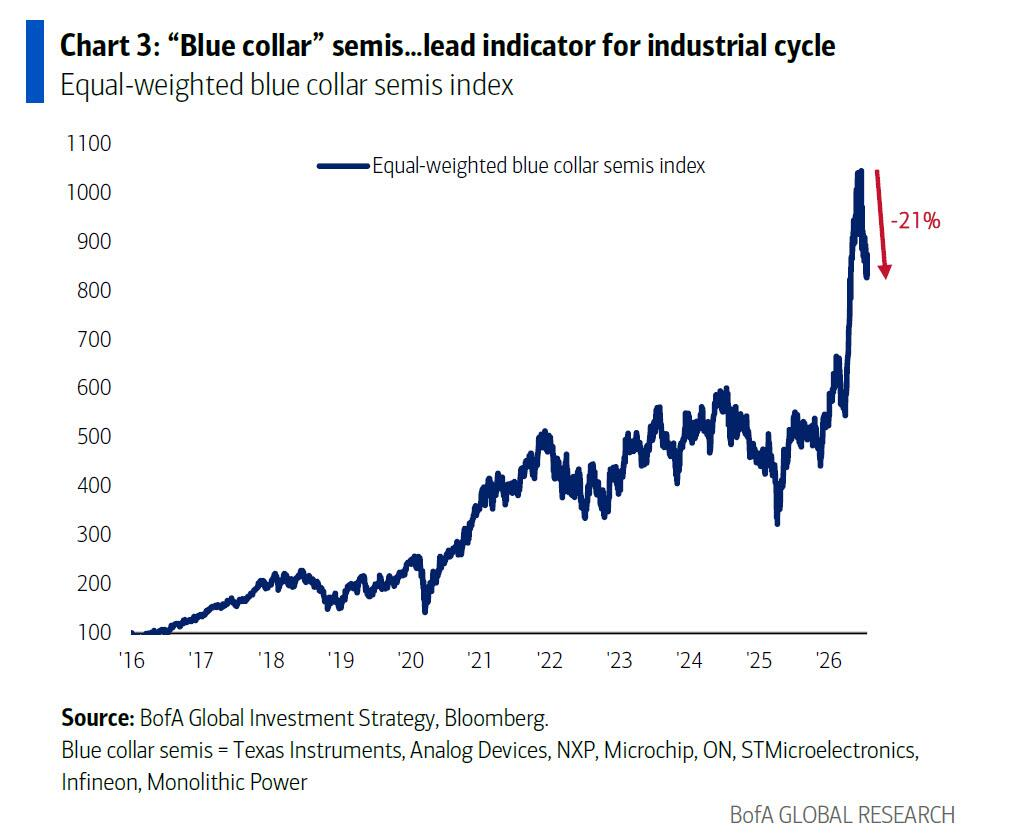
Additionally, Hartnett regards "blue-collar semiconductors"—including Texas Instruments, Analog Devices, NXP, Microchip, ON, STMicroelectronics, Infineon, and Monolithic Power—as leading indicators of the industrial cycle. This group has already lost 21% since the June peak.
Meanwhile, the hyper-scale tech giants (MAGS) are struggling to maintain support at the 200-day moving average (65 USD), challenging the widely held consensus of "prosperity" in the market. Bank of America's July fund manager survey shows that investors’ overweight in industrial stocks is at the highest level since July 2021.
In response to the above signals, Hartnett's short-term trading advice is to: go long on defensive stocks, high-dividend stocks, and long-duration bonds, while shorting bank stocks (which have recently seen significant capital inflow), brokerage stocks, tech stocks, and industrial stocks to respond to the reversal of "prosperity" expectations.
Bond and stock supply under dual pressure, gold and Bitcoin quietly building a base
From a more macro perspective, Hartnett characterizes the 2020s as: an era marked by the rise of political populism, globalization giving way to national security, fiscal surplus turning into an excess of AI capital expenditure, Fed independence shifting to political compromise, and U.S. exceptionalism evolving into global rebalancing.
In this context, "supply" rather than "demand" becomes the main driving force of the macro and market. This is reflected in three dimensions:
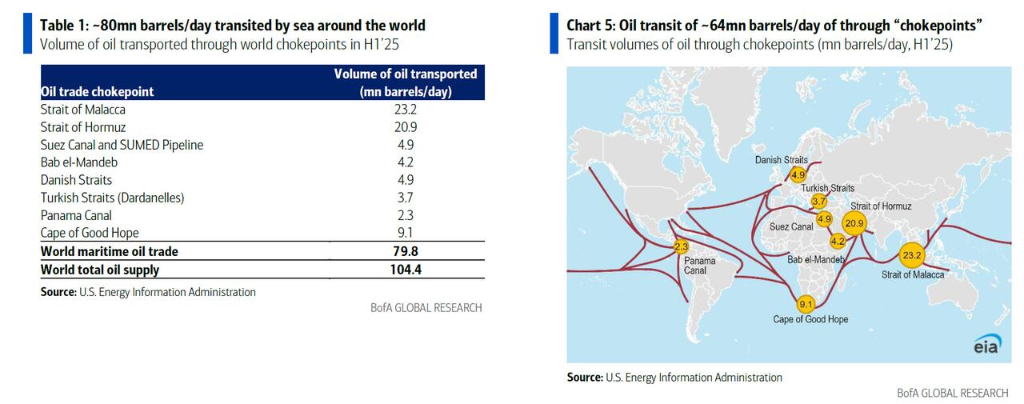
Immigration controls compress labor supply (U.S. initial jobless claims fall to the lowest level since 1969); protectionism and tariffs limit import supply (the U.S. plans to impose new tariffs on 60 trade partners); geopolitical disturbances affect oil supply (out of approximately 80 million barrels of maritime oil per day globally, about 64 million barrels pass through fragile chokepoints like the Strait of Hormuz and the Malacca Strait).
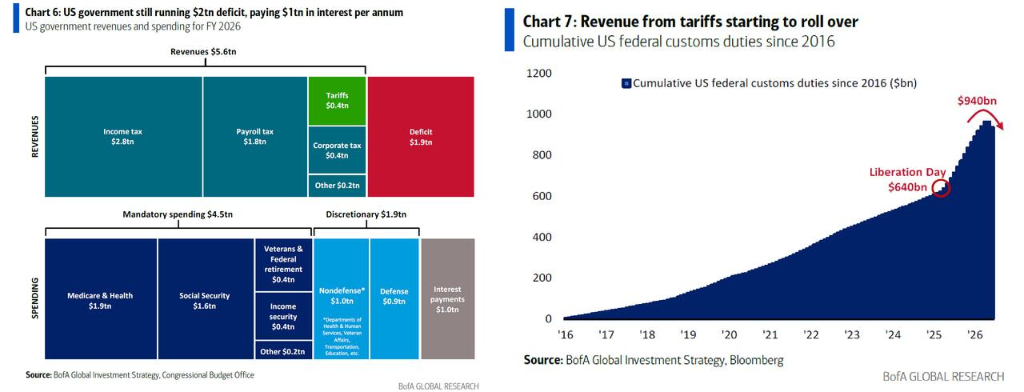
In contrast, the constraints on bond supply and stock supply have been loosening. The U.S. government still maintains an annual fiscal deficit of $2 trillion, with annual interest expenses reaching $1 trillion, and even though tariff revenues over the past 12 months have reached $250 billion, this is not enough to cover the deficit. Companies with negative free cash flow are reducing stock buybacks, further squeezing stock supply support.
In this context, Hartnett believes that gold and Bitcoin are quietly building a base for 2026, while the bank stock index representing "Main Street" will outperform the broker and private equity indices representing "Wall Street" in the second half of the 2020s.
Additionally, he has also listed Hong Kong real estate stocks as one of the most attractive long-term buying opportunities—these stocks are currently priced at the same level as 30 years ago, and he stated that he plans to buy the dips in any declines caused by Fed tightening or crises triggered by the Bank of Japan.
免责声明:本文章仅代表作者个人观点,不代表本平台的立场和观点。本文章仅供信息分享,不构成对任何人的任何投资建议。用户与作者之间的任何争议,与本平台无关。如网页中刊载的文章或图片涉及侵权,请提供相关的权利证明和身份证明发送邮件到support@aicoin.com,本平台相关工作人员将会进行核查。


