
Author: Nancy, PANews
The wave of shutdowns of small and medium-sized CEX (Centralized Exchanges) is adding chill to the crypto bear market. Recently, established platforms such as BitMEX, BitMart, and AscendEx have announced their closure, and several exchanges have also reported news of sale or merger.
Unlike previous exits caused by meltdowns, hacker attacks, or regulatory penalties, this round of CEX contraction is more rooted in changes in the industry environment. Nowadays, those exchanges that previously expanded rapidly relying on bull market cycles and traffic dividends are now facing long-term operational pressures, forcing some small and medium-sized CEX to withdraw from the market voluntarily.
Established exchanges also cannot escape the exit; CEX enters a new reshuffling period
Since entering July, BitMEX, BitMart, and AscendEx have all announced shutdowns.
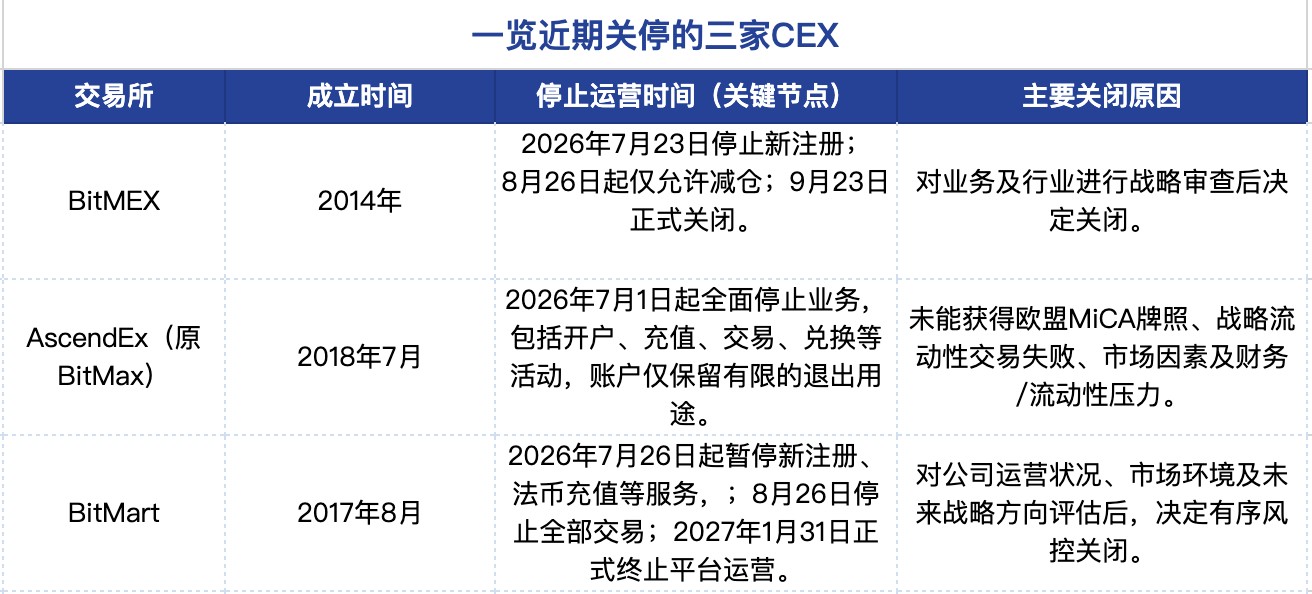
From the timeline of their establishment, these three platforms were all born during the early to rapid expansion phase of the crypto industry. Among them, BitMEX, founded in 2014, is one of the most representative established exchanges, operating for about 12 years, having pioneered 100x perpetual contracts, and once being a giant in crypto derivatives; AscendEx (formerly known as BitMax), founded in 2017, and BitMart, established in 2018, emerged as mid-level trading platforms during the crypto market's rapid growth phase and have also operated for over 8 years until now.
All three platforms have experienced multiple bull and bear cycles and have accumulated a certain user base and market influence during their long-term operations. However, even with years of industry experience and brand accumulation, they ultimately could not escape the fate of exiting the market.
From public information, changes in the market environment, rising compliance pressures, and increasing operational costs are the main factors behind this wave of CEX exits. BitMEX and BitMart chose to shrink voluntarily after a comprehensive assessment of their operational conditions, market environment, and future strategic direction; AscendEx also claimed it stopped platform services due to licensing compliance issues, alongside decreasing trading activity, liquidity pressure, and other factors.
Meanwhile, in addition to direct market exits, there have been multiple reports of CEXs being sold or acquired lately, and the trend of industry consolidation is accelerating.
For example, institutional-level crypto trading platform LMAX Group has been reported to be evaluating various strategic options including sale, SPAC merger, and listings in the US or Europe with Morgan Stanley and investment bank KBW; Korean Future Asset Group acquired 97.15% of South Korean crypto exchange Korbit for approximately 141.367 billion Korean won (about 10.2 million USD); Japan's financial group SBI has successively acquired Singapore trading platform Coinhako and Japan's exchange Bitbank; and South Korean payment solutions company WeHub has also acquired crypto trading platform Flybit, among others.
However, it should be noted that CEX mergers and acquisitions are not simple asset or user acquisitions, but also involve taking over their historical operations, technical security, and compliance systems. Recently, Binance founder CZ also publicly mentioned this point, stating that acquiring CEX differs from other businesses; once a hacker attack occurs post-acquisition, it is difficult to determine whether it is an issue left by the previous team or a new problem, thus posing higher safety and compliance risks. He emphasized that acquiring CEX is still possible, but the due diligence and risk control processes are more complex. Therefore, for potential buyers, CEX acquisitions require stricter due diligence and risk control processes.
The CEX landscape is undergoing a new change. For small and medium-sized platforms lacking scale advantages, brand barriers, and compliance capabilities, survival pressures may further increase in the future, and industry reshuffling and resource consolidation will continue to advance.
Liquidity accelerates concentration to the leading edge, and the market has yet to emerge from the soft cycle
No meltdowns, no hackers, and no sudden regulatory crises; the exits of multiple CEXs today are by no means accidental events, but rather a proactive contraction and market clearing after the industry entered a stage of stock competition.
In past cycles, exchanges often exited the crypto stage due to safety incidents, misappropriation of funds, or regulatory penalties. However, today, as the crypto market enters a low-growth phase, factors such as declining user activity, shrinking trading volume, intensifying competition, and tightening global regulations are continuously squeezing CEX's profit margins.
As CEX enters a new cycle, capital reserves, trading depth, and user fund flows are becoming important indicators for measuring trading platforms' comprehensive strength and survival capability.
From the perspective of reserve funds, asset scale is one of the core factors for measuring an exchange's risk-bearing ability. Sufficient reserves mean that in extreme situations, severe market fluctuations, or concentrated user withdrawals, the platform still has enough fund buffers to ensure user asset redemption capabilities and the stable operation of the market.
According to data from DeFiLlama, the current asset scale of CEX exhibits a significant concentration trend towards the top. Among them, Binance's reserve assets reached 138.718 billion USD, accounting for about 58.4% of the total statistical scale, far surpassing other platforms, making it the exchange with the largest industry fund reserves.
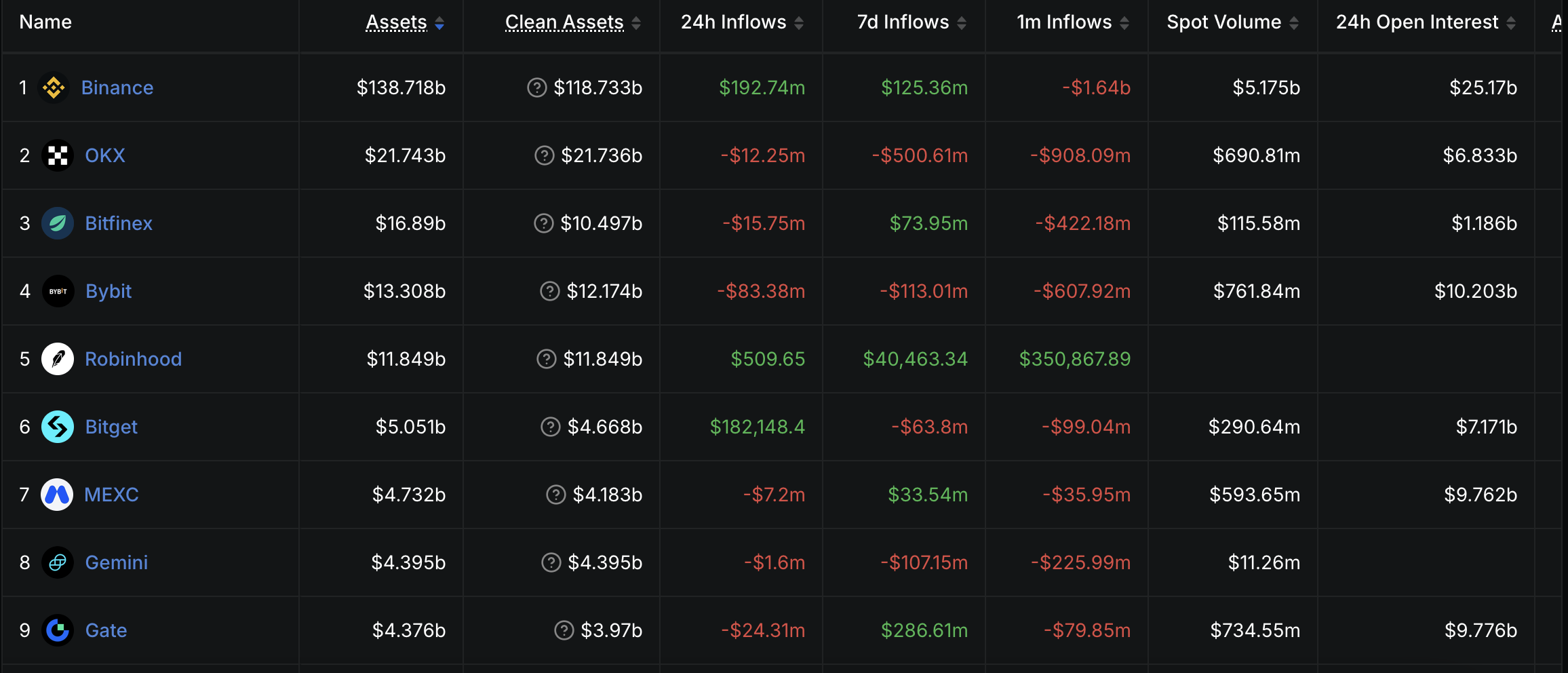
Other top-ranking exchanges include OKX, Bitfinex, Bybit, and Robinhood, with asset scales of 21.743 billion USD (approximately 9.1%), 13.308 billion USD (7.1%), 16.89 billion USD (5.6%), and 11.85 billion USD (5%), all at the billion-dollar level, possessing strong liquidity support capabilities. Moreover, exchanges such as Bitget, MEXC, HTX, Gate, Deribit, and KuCoin also have asset scales reaching several billion USD levels, maintaining certain competitiveness. In contrast, the gap in capital reserves among some small and medium exchanges is more pronounced, and when facing extreme situations, concentrated user withdrawals, or market fluctuations, their liquidity management capabilities and risk resistance will be under greater test.
In addition to asset reserves, trading volume is also an important indicator of user activity and market liquidity for exchanges; higher spot trading volumes indicate that the platform has deeper trading depth, a more stable liquidity environment, and higher user participation.
According to DeFiLlama data, Binance tops the list with 5.175 billion USD in 24-hour spot trading volume, accounting for about 34% of the total volume on statistical platforms, maintaining its position as the world's largest spot trading platform; other platforms such as Bybit, Gate, KuCoin, MEXC, Upbit, OKX, and Coinbase have 24-hour spot trading volumes ranging between 600 million to 800 million USD, accounting for about 3.7% to 6.4%, still maintaining strong market activity.
At the same time, the derivatives market is also showing a highly concentrated pattern. Data shows that Binance has an open contract size of 25.17 billion USD, accounting for about 27.5% of the total size; Bybit ranks second with 10.203 billion USD, accounting for about 11.1%; Gate closely follows with 9.776 billion USD, accounting for about 10.7%. Moreover, MEXC, Bitget, OKX, Deribit, and other platforms also have open contract sizes within the range of 7% to 10%.
Overall, market liquidity is further concentrating towards leading exchanges, creating more apparent competitive barriers. However, the current crypto market is still in a low-activity phase, with investors' enthusiasm for participation decreasing, and fund inflows significantly slowing down, indicating that CEX as a whole still faces challenges of sluggish growth.
DeFiLlama data shows that in the past month, the top ten exchanges by fund outflow have seen a cumulative net outflow of approximately 3.91 billion USD. However, it is important to note that fund outflow does not completely represent user withdrawals, as some changes in funds may come from user asset migrations, investors actively adjusting positions, and funds being reallocated under changing market cycles.
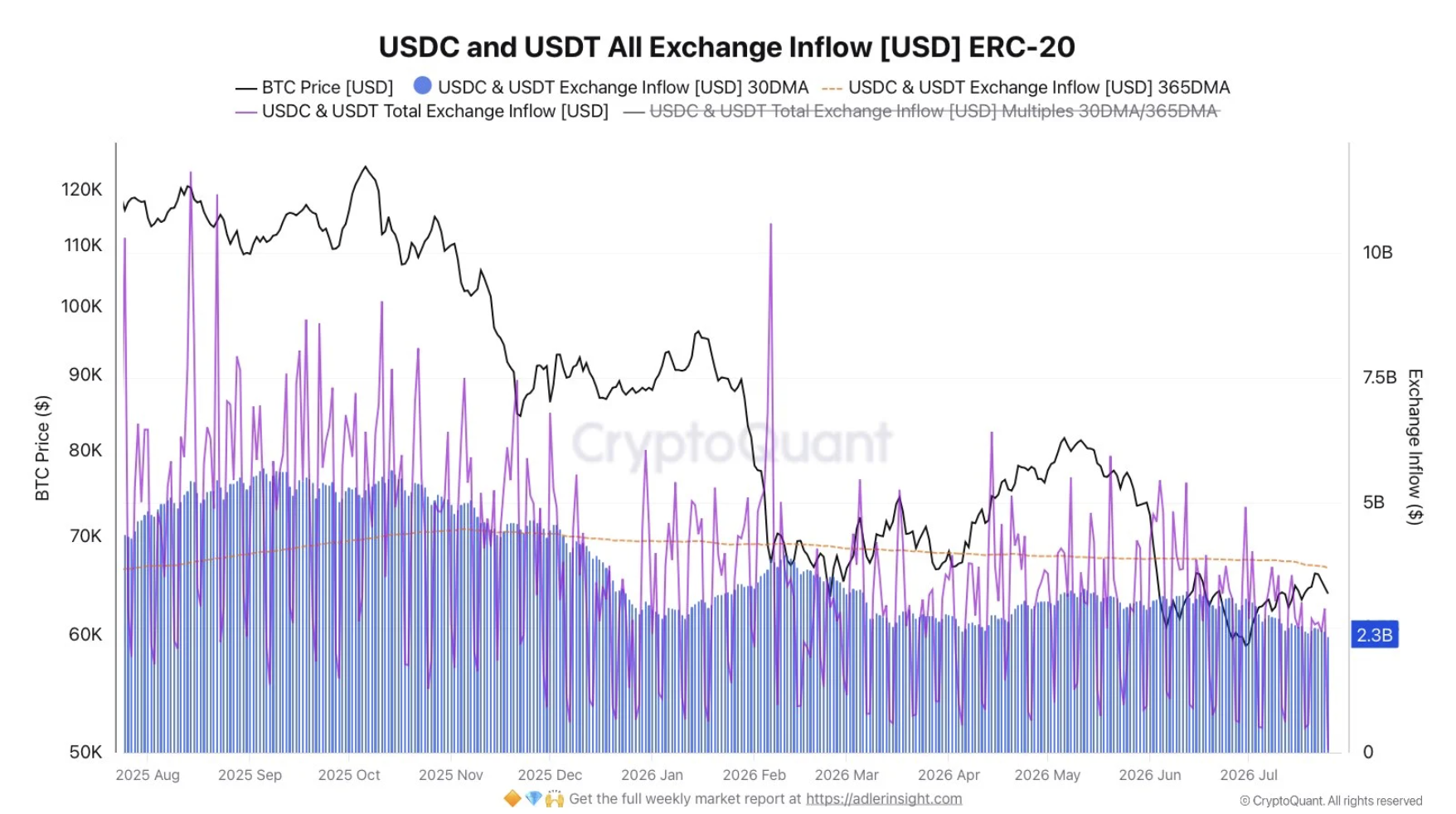
Meanwhile, data on stablecoin inflows to exchanges also reflects weak market demand. Recently, CryptoQuant analyst Darkfost pointed out that the inflow of stablecoins into exchanges has continuously declined, falling to its lowest level since 2025. Currently, the monthly average inflow of stablecoins (USDT, USDC) is about 2.3 billion USD, and the annual average inflow is about 3.7 billion USD. When Bitcoin prices reached their historical peak, the monthly average inflow was 5.6 billion USD, and the annual average inflow was 4.3 billion USD. This data further reflects that current market investors' risk appetite is declining, and trading demand is insufficient.
TradFi becomes a new battlefield for growth; small and medium CEXs need to find differentiated paths
In the past, small and medium-sized CEX mainly relied on listing fees for long-tail tokens, trading fees, and market hotspots for growth. However, as the market continues to languish, the Meme craze has shifted more to on-chain DEXs, causing the traditional growth model to quickly lose effectiveness. Platforms lacking scale advantages, brand barriers, and differentiation capabilities are voluntarily exiting under long-term operational pressure.
Compared to crypto-native businesses, TradFi business is becoming a new growth battlefield for mainstream exchanges.
Market data also corroborates the trend of users migrating their funds. According to the latest report from TokenInsight, in the second quarter of this year, TradFi perpetual contracts became the most noticeable incremental sector for CEX, with monthly total trading volume growing from 52 billion USD in January to 268 billion USD in June. Among them, equity perpetual contracts have become the main driver of growth, with trading volume quickly climbing from 45 billion USD in May to 141 billion USD in June.
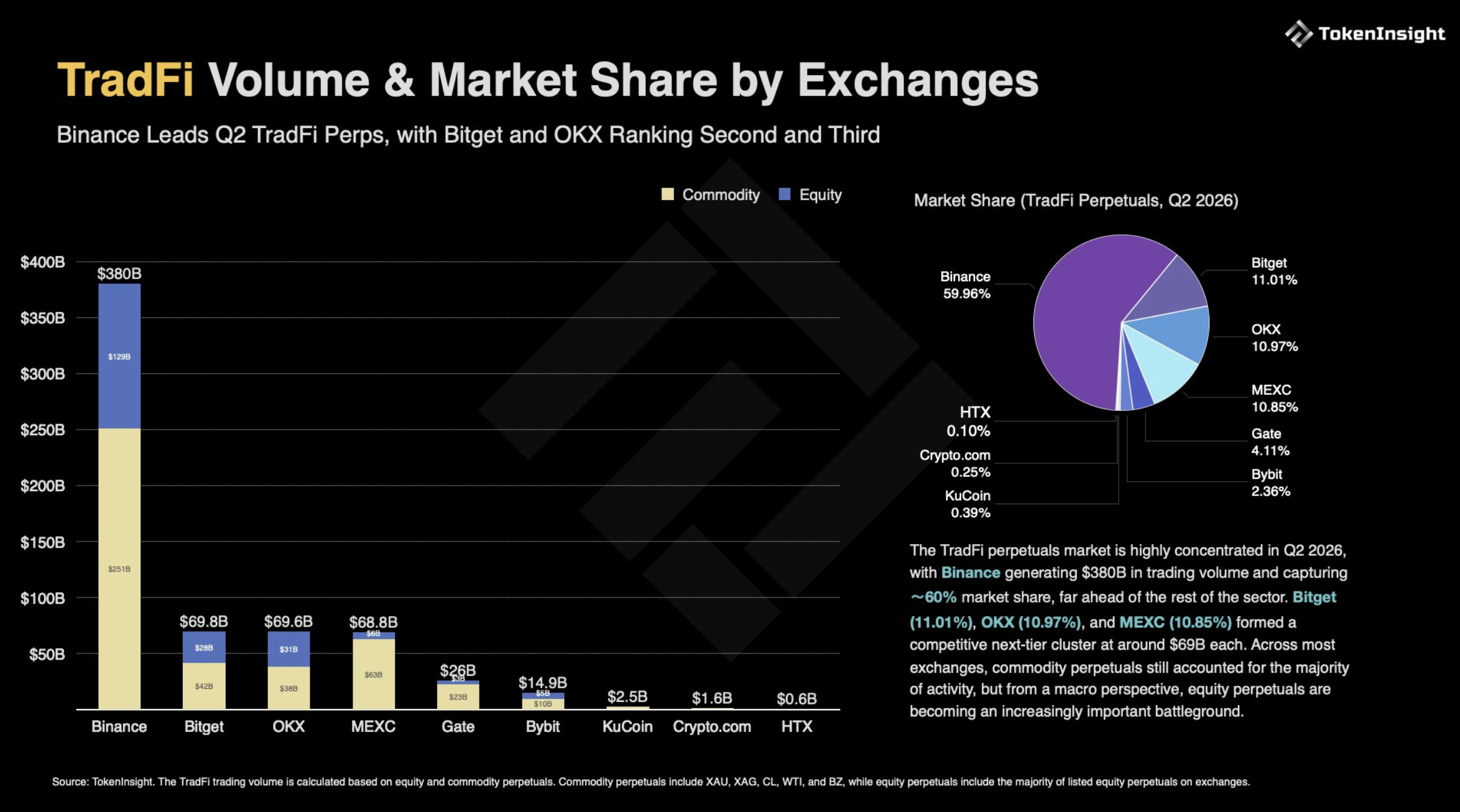
From the performance of exchanges, the share of TradFi perpetual contracts in the derivatives business of major platforms continually increased during Q2. Among them, Binance, Bitget, and MEXC's TradFi perpetual trading volumes accounted for 8.65%, 8.61%, and 7.22% of their total derivatives trading volumes, ranking at the forefront of the industry. In terms of market share, Binance's Q2 TradFi perpetual trading volume reached 380 billion USD, taking approximately 60% of the market share; Bitget, OKX, and MEXC are in the second tier, with market shares of 11.01%, 10.97%, and 10.85% respectively.
This trend reflects that user demand is shifting from a single exposure to crypto-native assets to traditional financial asset exposure, and CEXs are also attempting to transform from crypto trading platforms into more comprehensive financial gateways.
Crypto researcher Haotian pointed out that CEX introducing tokenized US stocks, ETFs, and Pre-IPO assets as traditional financial targets is essentially a quest for new growth spaces. However, the replacement of traditional TradFi assets for crypto-native assets represents a loss of power over pricing and settlement for CEX. In the short term, relying on Perps may seem to maintain trading volumes and revenues, but in the long run, the loss of pricing centers to become mere passageways and gateways must be faced. Therefore, the more fiercely the tokenization of US stocks is contested, the greater the survival pressure on CEX, making it difficult for exchanges that lack qualification to survive.
On the other hand, the trend towards compliance is further accelerating industry differentiation. With the tightening of the global regulatory environment, leading exchanges are consolidating their market shares in mature financial markets through compliance arrangements, capital strength, and brand advantages, while the survival space for exchanges that previously relied on offshore markets and regulatory arbitrage is shrinking. At the same time, high-risk regional markets such as Iran and Russia face greater compliance challenges, making it increasingly difficult to sustain growth models that depend on covering sensitive regional users.
Haotian believes that under the overall compliance trend, competition among CEXs is much more brutal than expected, and issues such as licensing, reserve proof, KYC/AML/KYT, and customer asset segregation have become the ticket for exchanges to survive. This significantly compresses the "space for meltdowns" for today's CEXs, rendering the past zero-sum game logic of "when a whales fall, everything thrives" obsolete. Thus, rather than meltdowns, it is more accurate to say that the proactive shutdowns in the face of immense competitive pressure are the results of healthy market competition.
For small and medium-sized CEXs, the key to survival in the future is no longer merely expanding trading volumes but establishing differentiated competitive advantages. Haotian believes that, like how small exchanges attracted traffic and users in the last cycle through IE0 and quality on-chain assets, today's CEXs have only one route: either deeply cultivate specific regional licenses and localized services to capture regulatory arbitrage opportunities, or focus on specific sub-products like TradFi assets, Perps, RWAFi, etc., or further embrace DeFi, Agentic Economy, MEME, and other crypto innovative directions, leveraging the strength of the crypto-native community to weather the cycle. Regardless, if CEX continues down the path of homogenization, it will only accelerate elimination, but clearing out some less competitive platforms is not necessarily a bad thing.
Overall, the CEX industry is undergoing a transformation from scale expansion to capability competition. In the past, exchanges expanded rapidly relying on bull markets, market hotspots, and user growth; today, capital reserves, liquidity depth, compliance capabilities, and business innovation capabilities are becoming the core factors determining platform competitiveness.
If the crypto market enters a longer adjustment phase next, small and medium-sized CEXs may lose their survival space in the ongoing intensifying industry reshuffling if they cannot establish a differentiated positioning and expand new growth directions.
免责声明:本文章仅代表作者个人观点,不代表本平台的立场和观点。本文章仅供信息分享,不构成对任何人的任何投资建议。用户与作者之间的任何争议,与本平台无关。如网页中刊载的文章或图片涉及侵权,请提供相关的权利证明和身份证明发送邮件到support@aicoin.com,本平台相关工作人员将会进行核查。


