1. The Next Competition of Crypto Platforms is No Longer Crypto
Since 2026, the entire cryptocurrency industry has been shifting from digital assets to traditional financial assets, with US stocks at the core of this transition.
One of the most impactful signals is that the exchanges that invented perpetual contracts are exiting the market. On July 23, BitMEX announced it would permanently close on September 23. This exchange, which invented perpetual contracts in 2014, has completed a journey from rule-maker to marginal player in eleven years. The collapse of BitMart has added another heavy blow to this wave of exits. This is by no means an isolated pain. Behind the departure of older players, the core battleground for cryptocurrency exchanges is undergoing a fundamental shift: it is rapidly transitioning from simply competing for crypto-native assets to fully integrating and reconstructing traditional financial assets (TradFi). The departure of old players and the opening of new battlegrounds are happening simultaneously.
Data is clearer. CoinGecko data shows that from early 2025 to now, cryptocurrency exchanges have cumulatively launched 358 types of spot and perpetual products for real-world assets, covering stocks, ETFs, commodities, foreign exchange, and Pre-IPO contracts. By category, growth is fastest in US stocks. In May 2026, the monthly trading volume of RWA-related perpetual contracts surged to $347 billion, with a cumulative total exceeding $1.32 trillion this year. The three leading assets by trading volume are Micron, Circle, and Nvidia, all listed US stocks. The conclusion is not complicated: users have not left cryptocurrency platforms; they have simply converted their positions from cryptocurrencies to US stocks.
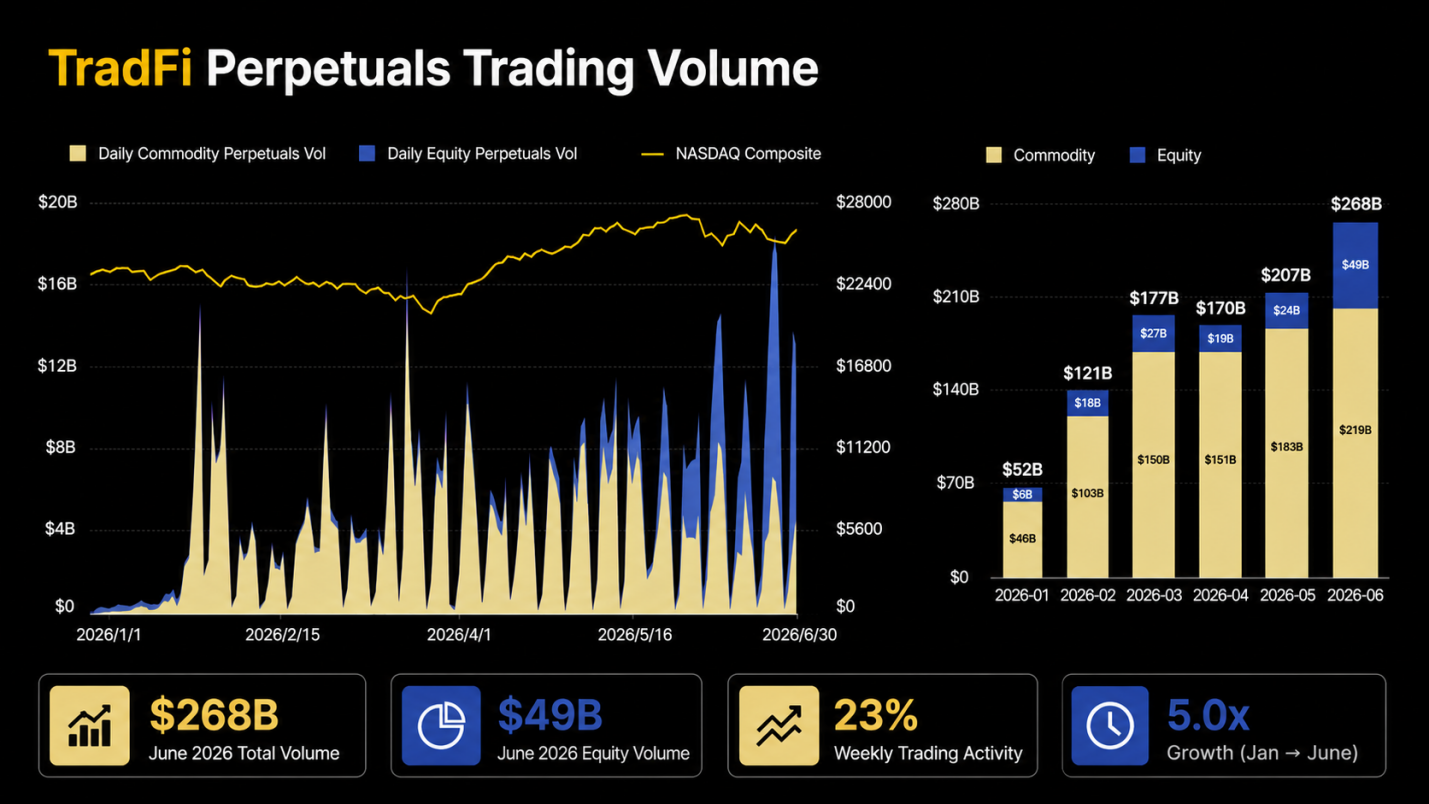
Data source: TokenInsight
Meanwhile, demand is also deepening. According to Cboe data, US-listed options trading volume has set a record for the sixth consecutive year in 2025, exceeding 15.2 billion contracts for the year, with an average of 61 million contracts per day, a year-on-year increase of 26%. Options are no longer exclusive tools for institutions. When users start seriously trading US stocks on cryptocurrency platforms, they will eventually ask: Can they use margin, short selling, and options to go long, short, and hedge, much like with traditional brokers?
2. From "Available to Buy" to "Able to Use": The Competition for Crypto US Stocks Intensifies
If we look at the past year of cryptocurrency platforms doing US stocks, it can be clearly divided into two distinct phases.
The first phase addresses "access to US stock exposure," allowing users to obtain exposure that corresponds to stock prices. Typical products include perpetual stocks, contracts for difference, and early tokenized stocks. What users obtain is a price, not necessarily the stocks themselves. This solves the zero to one transition, but the ceiling is evident: a synthetically created price exposure cannot support serious trading demands, and you cannot build margin, short selling, and options on top of it.
The second phase addresses "the ability to fully enter the US stock market," bringing the complete capabilities of real US stocks into cryptocurrency accounts: allowing the purchase of spot, the ability to increase positions with margin, short selling, hedging with options, with every process connected to the real infrastructure of the US securities market. If a product exists in the US stock market, it must also exist on the cryptocurrency platform. Options are the most iconic element of the "complete" aspect; they sit at the top of the entire capability and represent the most challenging aspect, which best illustrates the solidity of the underlying foundation.
The premise for entering the second phase is establishing direct connections with brokers. Tokenized stocks and perpetual stocks solve the "existence of price exposure," which is essentially the platform's design; only through direct connections with brokers can each order placed by users correspond to a real holding in a licensed broker's account in the US, and only then can margin, short selling, and options be built on top of it.
Platforms that previously didn't need to make such connections are proving the necessity of direct broker connections. Several leading centralized exchanges already hold tokenized stocks and perpetual stocks, which are quick to launch and cost-effective; from a business perspective, this has been sufficient. However, in the past year, they have still invested resources to build heavier and slower broker connection products. This is just the beginning; the level of direct broker connection can vary greatly. Some platforms only connect to a ready-made upstream broker channel, and simply listing US stocks counts as progress, while most of the chain's process is controlled by others, often limited to spot trading; others have built every link of execution, clearing, and custody themselves, taking responsibility for the whole chain and can discuss building margin, short selling, and options step by step. The former has only established a channel, while the latter is genuinely doing US stocks.
Thus, as competition enters the second phase, the contest is no longer who lists US stocks, but whose broker connection chain is more complete and solid. The quality of this chain directly reflects five dimensions:
· Product Completeness: Spot is just the starting point; margin, short selling, and options must be complete and able to function together within the same account; options are the most challenging, and whether they can be produced directly indicates the depth of the underlying infrastructure.
· Compliance Completeness: Whether clearing, custody, information disclosure, and investor suitability are in place determines whether user assets have institutional protection in extreme cases.
· Regulatory Entities and Investor Protection: Where the operating entity is registered, under whom it is regulated, and whether assets are securely managed; while differences may not be evident in normal times, they become dramatically different when issues arise.
· Experience and Accessibility: Stability in deposit and withdrawal of stablecoins, minute-level account crediting, and lower account opening thresholds represent the greatest advantages of cryptocurrency platforms over traditional brokers.
· Trading Costs: It is essential to look beyond just commissions, considering how platform fees are calculated, whether there is a minimum fee for single transactions, and if regulatory fees are transparent; charging per share versus as a percentage of transaction value has significant implications for large traders.
"Is there access to US stocks?" is a past issue; "Is it good enough and genuine enough?" is where the competition will be determined. The ability to meet these five dimensions depends on the same broker connection chain's support.
3. BIT's Answer: Embracing Competition with Comprehensive Broker Capabilities
Following this main thread, BIT is a sample worth closely examining because it has established its own complete broker connection chain. It started early, has the most solid foundation, offers the most complete products, and values user experience the most. This recent launch of options perfectly embodies these four points.
One side of the coin is the product rhythm. BIT's US stock business did not come together all at once but was built step by step in a clear order. In February 2026, it launched real US stock spot trading while establishing the most solid foundations of broker connections, clearing, and custody. In June, it introduced margin trading, becoming one of the first cryptocurrency platforms to provide real US stock margin; on July 13, it launched short selling; and on July 24, it launched US stock options, covering over 2000 mainstream stocks and ETFs in the first phase. Spot trading, direct broker connections, and clearing & custody form the foundation, while margin trading, short selling, and options are tools added sequentially on top of that foundation, interconnected.
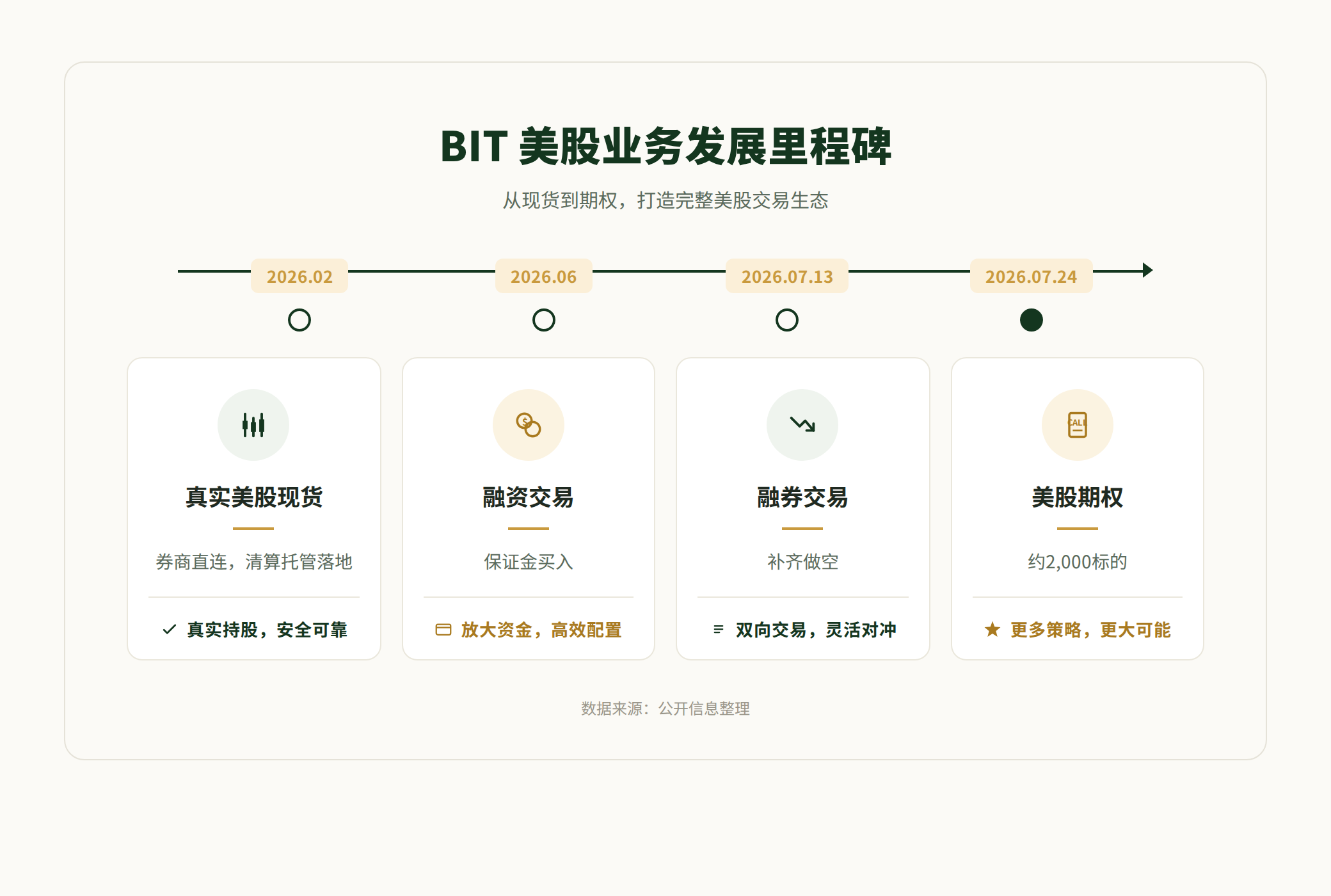
A key point to note is the options launched on July 24. Options are the toughest exam for the entire broker chain. They cannot be synthesized internally on the platform; they must genuinely connect with the clearing and execution systems of the US options market. Standard contracts require physical delivery of stock at 100 shares per contract upon exercise, and if any link is not solid, options cannot be produced or would only exist in a defective version.
BIT's options are not only launched but can also be purchased directly using margin, running in the same account system as spot, margin, and short selling. This clearly indicates that its entire broker chain is ahead: only when the basic elements of execution, clearing, custody, and margin are integrated and work together can options be embedded seamlessly into the entire account system. Therefore, evaluating the option aspect should not only be about "adding another category." It is more like a public ability assessment: whether a platform can fill in the options layer of the US stock product landscape directly exposes the true depth of its entire broker chain. BIT has filled this layer and done so thoroughly, which itself is evidence of being ahead.
To complement the full range of products and reduce user migration friction, BIT has simultaneously launched a US stock transfer activity, allowing up to $300 in dual rewards for first-time transfers into stock assets (including US stock trading vouchers and cash cards for stocks, with a total prize pool of $10,000, first come first served), accelerating the support for users to allocate assets at a low cost.
The other side of the coin is the complete account experience. In BIT, spot, margin, short selling, and options operate within the same account system, interconnected; it supports deposits and withdrawals in USDT and USDC stablecoins, saving users from the cumbersome processes of traditional brokers involving overseas banks and address verification; US stock trading is free of commission, with platform fees calculated per share and regulatory fees transparently listed, while options see zero commissions plus a fixed low platform fee per contract. Its goal is to combine the low barrier, low cost, and quick settlement experience of cryptocurrency platforms with the complete functionalities and compliant custody of the real securities market within a single account.
Starting early means having more time to solidify the foundation; a solid foundation means that each additional tool added on top is more stable; a complete landscape means users do not need to transfer positions between multiple platforms for a single function. Together, these factors create a true barrier for BIT in the entire broker connection chain. And options represent the latest and most challenging brick in this barrier.
4. Conclusion
As cryptocurrency platforms enter the second phase of US stock trading, the real differentiator moving forward will be who can fully develop the tools of spot, margin, short selling, and options, solidifying the foundations of compliance and custody, while retaining the inherent convenience and low cost of cryptocurrency platforms, and ensuring that users are always clear that what they are buying is not just a price, but a real asset.
Risk Warning: The content of this article is for reference only, compiled from publicly available information, and does not constitute investment advice or an offer to sell or buy any financial products. Trading US stocks and ETFs involves market risk; margin and short selling involve leverage risks that may lead to losses exceeding the principal; options trading carries significant risks, which may result in the total loss of the premium paid, and purchasing options using margin will further amplify risks. The specific rules, quotas, and validity periods of the transfer activity mentioned in the text are subject to BIT's official announcements; please do not trade solely for rewards. Market and industry data is sourced from third-party agencies, and BIT does not guarantee its accuracy.
免责声明:本文章仅代表作者个人观点,不代表本平台的立场和观点。本文章仅供信息分享,不构成对任何人的任何投资建议。用户与作者之间的任何争议,与本平台无关。如网页中刊载的文章或图片涉及侵权,请提供相关的权利证明和身份证明发送邮件到support@aicoin.com,本平台相关工作人员将会进行核查。


