Gnosis Chain is officially transforming from an independent L1 into an Ethereum Economic Zone (EEZ) ZK Rollup seeking directional consensus from the community.
Written by: ChandlerZ, Foresight News
On July 27, the GnosisDAO governance proposal GIP-153 was formally proposed to transition Gnosis Chain from an independent Layer 1 to an Ethereum Economic Zone (EEZ) Rollup. The proposal was co-authored by Gnosis co-founder Friederike Ernst along with Philippe Schommers and Ben Carvill, currently in its initial phase, solely seeking directional consensus without involving funding requests. The proposal candidly states that Gnosis Chain's positioning as an independent L1 has failed.
The proposal points out that Gnosis Chain's core value proposition is credibility neutrality, but this positioning greatly overlaps with Ethereum. Gnosis lags far behind Ethereum in scale and liquidity while bearing the full cost of a complete security infrastructure independently.
Specifically, the transaction fee revenue from Gnosis Chain is far from sufficient to cover network security costs. Security expenditure has long relied on GnosisDAO treasury subsidies, leading to approximately 2.3% dilution for non-stakers each year. In contrast, Ethereum's annual issuance rate is below 1%, partially offset by fee burns, resulting in even smaller net dilution. Gnosis Chain currently has a Total Value Locked (TVL) of about $91 million, with a GNO token market cap of approximately $280 million, classifying it as a marginal player in the L1 competition. Apart from security costs, GnosisDAO also needs to pay for infrastructure such as block explorers, RPC endpoints, and incentives for third-party protocols, with liquidity requiring continuous guidance and maintenance, and network effects never approaching mainnet levels.
The proposal also states that simply becoming an ordinary L2 will not solve the problems. Among more than 100 L2s, most lack significant usage, and only a few with real usage succeed not through technical differentiation but through existing distribution channels. The issue of differentiation merely shifts from the L1 layer to the L2 layer. Gnosis concludes: A technological capability must be provided that existing L2s do not possess to justify this transformation.
Sync Composability: A Capability Lacking in Over 100 L2s
The transformation plan proposed in GIP-153 is based on the Ethereum Economic Zone (EEZ) framework, which was jointly released by Friederike Ernst and Zisk founder Jordi Baylina at the EthCC conference in Cannes in March 2026, co-sponsored by the Ethereum Foundation.
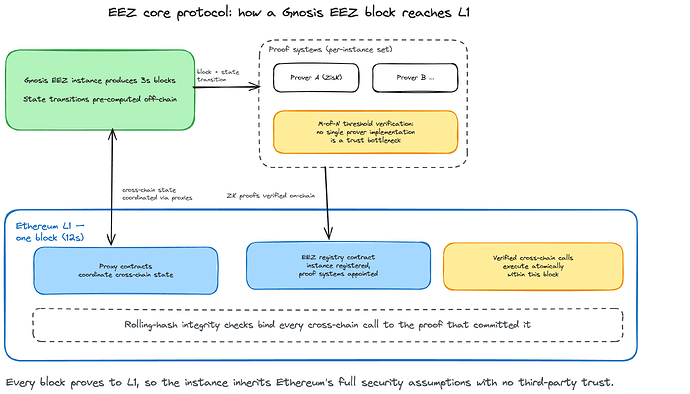
The core technological feature of EEZ is synchronous composability. The transformed Gnosis Chain will generate blocks at a speed of 2 seconds per block, with each Ethereum block undergoing a state proof and settlement to Ethereum L1. Smart contracts on Gnosis EEZ can invoke contracts on the Ethereum mainnet in a single transaction, obtaining return values and utilizing them in the same transaction, all executed atomically, meaning either all succeed or none roll back. This allows all liquidity, oracles, deposit and withdrawal channels, and even centralized exchange channels on the Ethereum mainnet to be directly called as if they were deployed locally on Gnosis Chain, without the need for bridging.
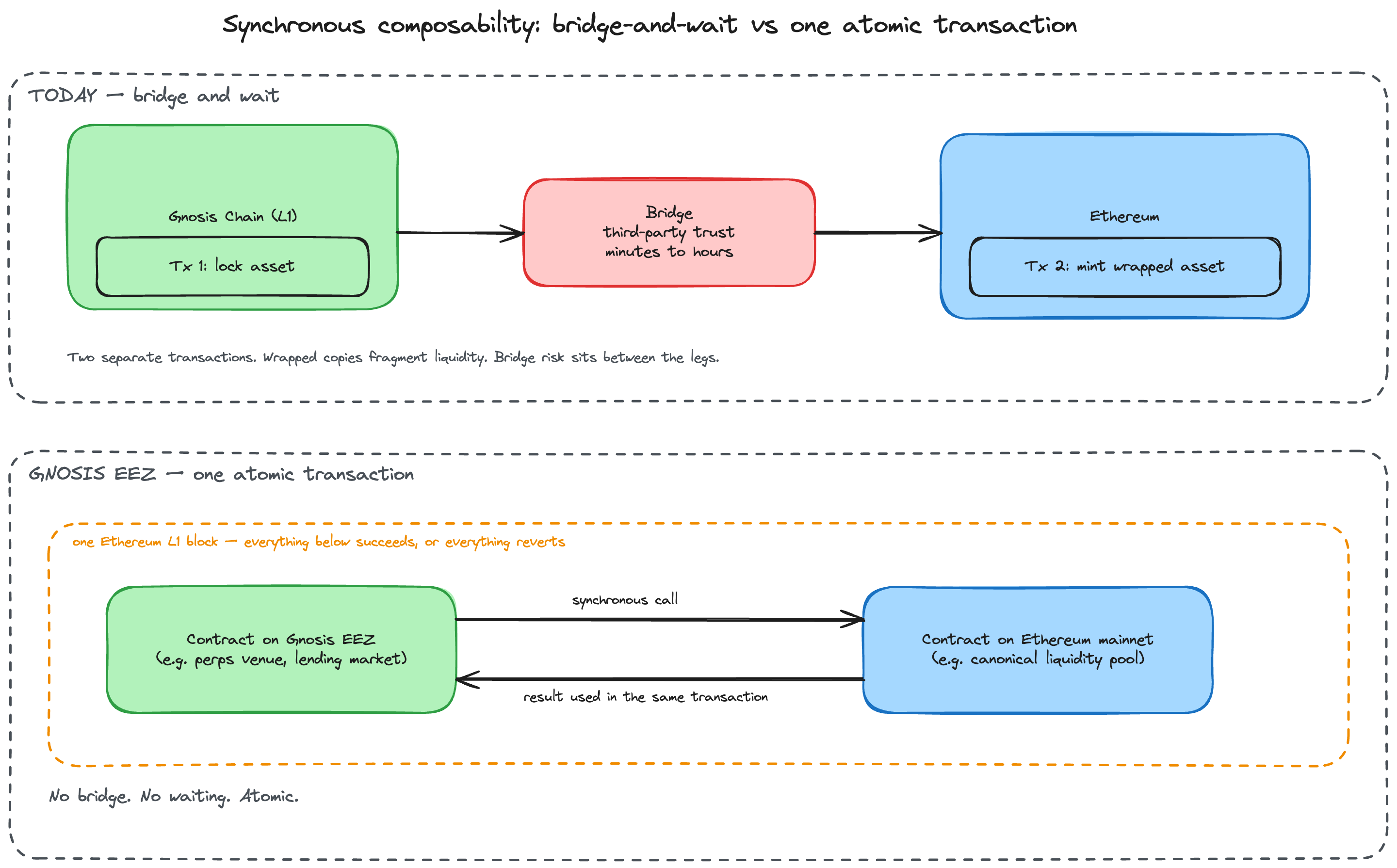
It should be made clear that the initial composability will be unidirectional, only supporting calls from L2 to L1. Complete bidirectional cross-instance composability will have to wait for subsequent development of the EEZ protocol, expected to roll out gradually in 2027. During the transition period, an intent-based bridge will provide bidirectional atomic bridging capabilities. The proposal estimates that the first version can deliver 80% of the value of synchronous composability, with an engineering workload of about 40% to 50% of the complete solution.
This is fundamentally different from existing cross-rollup solutions, where current bridging protocols, messaging solutions, and shared sequencers are asynchronous, with message delays ranging from minutes to hours. Optimism's Superchain, Polygon's AggLayer, and =nil;'s zkSharding are also attempting to solve the L2 fragmentation issue, but none have achieved true synchronous atomic execution. The EEZ framework is currently operating on a devnet, including end-to-end cross-chain execution.
The key technical contribution comes from Jordi Baylina, the creator of the ZK proof programming language Circom, who co-created Polygon's zkEVM and founded Zisk independently in June 2025, developing a ZKVM aimed at real-time proof generation. However, the proposal clearly states that the first version of Gnosis EEZ will not use ZK proofs but will employ temporary verification solutions like TEE, with specific mechanisms to be decided during the technical specification phase. Real-time ZK proofs will be launched with the completion of the full EEZ specifications. The proposal emphasizes that the direction of trust assumptions will only decrease, not increase.
Friederike Ernst stated during the EEZ launch that Ethereum does not have a scaling issue, it has a fragmentation problem. Each new L2 with its own liquidity pool and bridge is a new walled garden.
The founding members of the EEZ Alliance include Aave, block builder Titan and Beaver Build, RWA platform Centrifuge, and tokenized stock project xStocks. The EEZ framework itself is a public good and operates in the form of a Swiss non-profit organization, co-led by Gnosis and Zisk, with joint funding from the Ethereum Foundation, all software is open source, and it has no native token.
Impact on GNO Stakers
Currently, approximately 350,000 GNO is staked, accounting for about 27% of the circulating supply. Once the transformation is implemented, these stakes will be fully unlocked, and Gnosis Chain's large independent validator set will exit. The proposal acknowledges this as the biggest regret and plans to look for new roles for the validator community, potentially focusing on participation in Gnosis VPN operations. Existing bridge validators will transition into Prover nodes, serving as the initial operators in an M-of-N multi-prover architecture.
The sequencing rights will be centralized to Gnosis Ltd. The proposal's stance on this is quite direct: becoming less decentralized is a well-considered choice. The rationale is that the risks of centralized sequencers are bounded; each block is proven and settled on Ethereum, which prevents sequencers from fabricating states or stealing funds, with the maximum damage limited to delays or exclusion of transactions. Furthermore, the proposal suggests that maximizing anti-censorship is exclusively Ethereum's territory, incompatible with the majority of financial applications that require fraud responses, compliance, and recourse. A chain controlled by an operator can intercept suspicious transactions and proactively protect users, which the proposal positions as a feature rather than a flaw.
With the cancellation of staking rewards, value capture will shift to fees generated from network activity, dynamically priced according to pathways. The specific mechanism (fee sharing or buyback) will be proposed in subsequent GIPs after the Prover economic model becomes observable. Before the new model is revealed, the potential down pressure from the unlocked stakes is the market's focus of concern.
GnosisDAO's Radical Restructuring
GIP-153 needs to be understood against the backdrop of a recent series of radical governance actions by GnosisDAO. On June 27, 2026, GnosisDAO passed the GIP-150 proposal, allowing GNO holders to proportionally redeem DAO treasury assets, with the treasury's liquid assets valued at approximately $223 million. This proposal transformed GNO from a pure governance token to a direct claim on the DAO's balance sheet.
The total value of the GnosisDAO treasury is approximately $300 million, with about 51% in GNO itself, while the rest includes mainstream assets like ETH (approximately $93 million) and stablecoins (approximately $23 million).
Combined, GIP-150 and GIP-153 indicate that GnosisDAO is undertaking two simultaneous actions: allowing token holders to exit at net value while completely rewriting the underlying technological architecture of the chain. The Gnosis team is attempting to persuade the community to stay by offering exit options while showcasing the synchronous composability capability of the EEZ.
In terms of business positioning, Gnosis Ltd simultaneously serves as a co-architect of the EEZ framework and the operator of the first production instance, planning to commercialize the experience of migrating active chains, operating the technology stack, and building compliant modules by offering EEZ instances as a service to banks and fintech companies. The EEZ framework is a public good, but the specialized capabilities to deploy and operate it are not. Gnosis's own Pay, Circles, and VPN products will serve as consumer-layer anchoring applications, directly accessing L1's stablecoin liquidity through synchronous composability.
Roadmap and Observables
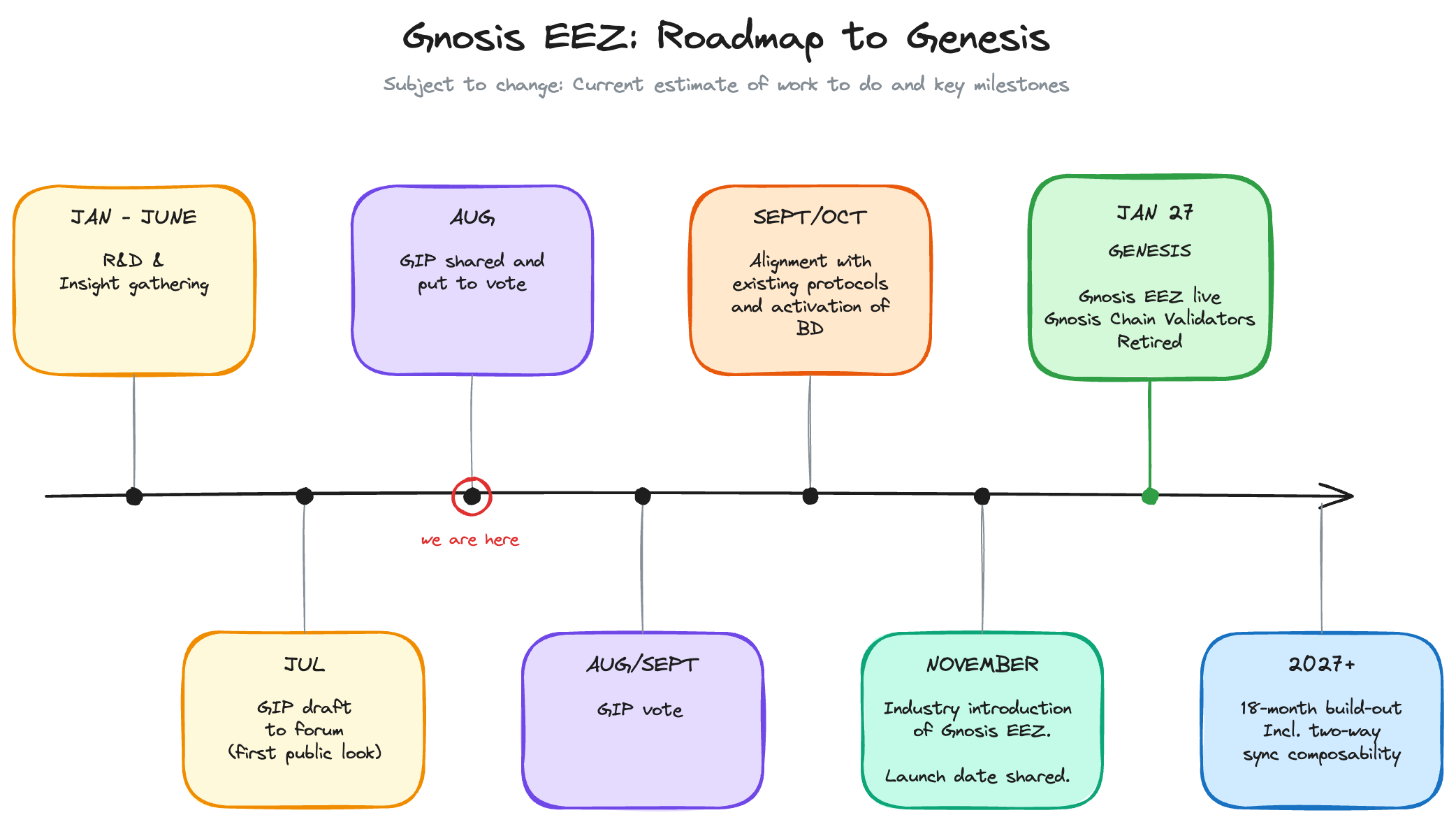
According to the GIP-153 roadmap, community voting is expected to take place between August and September 2026, with the genesis block targeted for the end of 2026 to early 2027, at which point Gnosis Chain validators will exit formally, and the first EEZ block will be produced. The complete EEZ specifications, including bidirectional composability, nested calls, and real-time ZK proofs, are expected to be rolled out throughout 2027.
The governance after the transformation will be divided into three layers: changes at the EEZ protocol level (rollup protocols, proof specifications, L1 to L2 messaging primitives) will be led by Ethereum governance processes; the GnosisDAO will continue to govern gas token policies, fee distributions, and ecological treasury; and the long-term governance mechanism for Prover operations will be specified in subsequent GIPs.
Key variables to watch in the future include whether the GIP-153 voting results can achieve directional consensus, the market pressure from the unlocking of 350,000 GNO, whether the new token economic model can provide sufficient fee capture to replace staking rewards, the acceptability of the security performance of the TEE temporary proof scheme by the community, and the censorship risk of centralized sequencers in actual operation. Synchronous composability is a highly attractive vision, but there is still a considerable path to traverse from the initial unidirectional L2 to L1 calls with TEE proof to the ultimate bidirectional ZK proof complete experience.
免责声明:本文章仅代表作者个人观点,不代表本平台的立场和观点。本文章仅供信息分享,不构成对任何人的任何投资建议。用户与作者之间的任何争议,与本平台无关。如网页中刊载的文章或图片涉及侵权,请提供相关的权利证明和身份证明发送邮件到support@aicoin.com,本平台相关工作人员将会进行核查。


