The crypto industry is no longer at the forefront of pioneering paths; it is turning into a business.
Written by: Matti
Translated by: Chopper, Foresight News
There is a prevailing view in the current market that the crypto industry has become a relief valve for excessive liquidity.
A large number of practitioners are leaving the field. The core reason is that the financial returns the industry brought fall far short of the expectations built over the past decade. The market ultimately did not fulfill the visions that everyone once believed in.
This round of bear market truly marks the end of an era. We need to ask: what is it we truly lament?
Looking back, the prosperity of 2021 has been confirmed to be nothing but an illusion. Using the Gartner Hype Cycle, 2021 coincidentally falls at the peak of inflated expectations.
Now we are welcoming a moment of sobriety. This forces everyone to return to first principles, re-evaluate token value, reinforce the security of decentralized financial protocols, and explore new application scenarios that can generate real value from crypto technology.
Ironically, it can be said that "the only fact we can see clearly is that it is still full of uncertainty." The industry has never clarified the root causes of its failures, thus constantly repeating the same cyclical and reflexive hype loop.
As early as the multiple rounds of market validation in 2017 and 2021, we fell into a train of thought: with a hammer in hand, everything looks like a nail. Under the influx of massive capital, the crypto industry has become a "solution" looking for problems.
History has long verified that "genius is always scarce, but as long as there are gullible people, it will surely give rise to an endless stream of scams." This also makes crypto assets perhaps the most reflexive asset class in history.
The underlying foundation of this financial frenzy is the characteristic of tokens being tradable from early on. However, the excessive proliferation of this characteristic ultimately led to the collapse of the bubble.
By 2024, it can be seen that between "exploratory innovation" and "harvesting monetization," the entire industry chose the latter. The industry’s incentive mechanisms continuously drive participants to pursue maximum short-term gains. Two years later, we are bearing the corresponding consequences.
I have always believed that demand fosters invention. But recently I have been inspired that curiosity fosters invention, whereas demand leads to engineering implementation. The recent surge of DeFi hacking attacks is a signal for the necessity of engineering transformation. At the same time, it is also an opportunity to refine initial solutions and continue iterating, with token models being an important aspect of it.
However, curiosity cannot be stimulated by external forces. It originates from a genuine inner passion, not from a profit motive. Returns can complement curiosity but cannot become a prerequisite for frontier innovation.
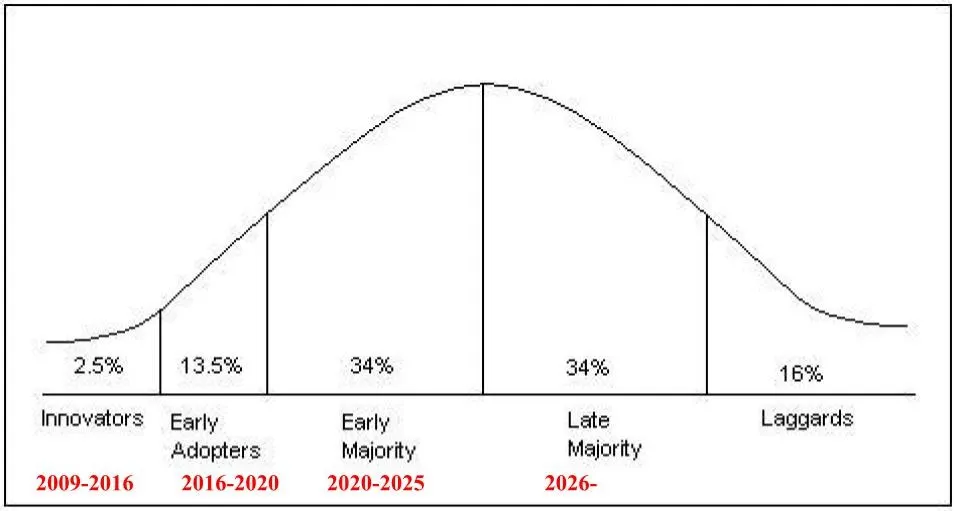
Behind the shattering of illusions is also a shift in industry culture. People are gradually recognizing a key reality: we are no longer in the early stage of the industry. But for excellent builders and investors, this is merely a challenge, not an insurmountable obstacle.
If we overlay the technology adoption curve with the hype cycle, the trough of disillusionment coincidentally lands in the middle of the curve. This position is also the turning point mentioned in Carlota Perez's theory.
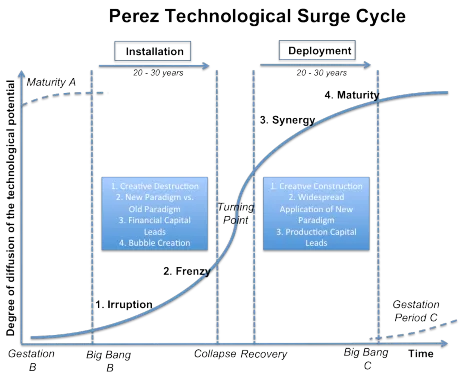
The core challenge remains unchanged: the crypto industry attempts to reconstruct the financial industry from scratch. This is no easy task; the process inevitably involves multiple iterations, ongoing failures, and continually facing the harsh realities of testing.
In a certain sense, we have returned to the starting point. But this does not mean that all past efforts have been in vain. Even if the industry is temporarily stagnant, asymmetric investment opportunities still exist. On an individual level, there are still chances to shape the future.
The real risk currently is to discard the essence and accept the dross, wholly negating everything. Even the once staunch believers and advocates have chosen to exit. The once envisioned future of a market worth trillions has resulted in only a mere 200 cryptocurrency treasury enterprises.
Discussing Crypto Venture Capital
Many opinions claim that "crypto VC is dead," or is soon to die. I do not agree. Venture capital itself is facing an industry crisis: the fund return multiples (DPI) are below expectations, and fundraising difficulties have surged.
Focusing on the crypto track, those limited partners (LPs) accustomed to "four-year cycles for high returns" are disappointed and leaving. But it needs clarification: the super high returns of the crypto industry from 2016 to 2021 are exceptional in the venture capital field and not the norm.
During that period, cryptocurrencies were packaged as a revolution, a brand new asset class. An immature market attracted massive capital, significantly exceeding the industry’s effective digestion capacity. The frenzy peaked in 2021, followed by a long clearing phase, with short-term speculation dominating until now, as the industry enters a consolidation stage.
The book "Mania and Imitation" explores the nature of technological bubbles, stating: "Revolutions can still take root - Britain is still filled with railway networks. But the utopia imagined by enthusiastic participants will never come true."
More attention should be paid to the ideological reversal. The original cyberpunk subculture that spawned Bitcoin is now actively gravitating towards Wall Street and regulatory bodies, with the industry's fate firmly tied to policymakers.
This is not merely irony but a characteristic inherent to the bubble cycle. The Google case can be referenced: the company publicly warned that ads would degrade search quality, yet ultimately built a massive commercial empire on ads. Returning to the discussion in "Mania and Imitation":
"This is one of the most extreme cases of ideological reversal in history. To find similar phenomena, one might look back to Martin Luther, a devout Catholic priest who ultimately split the church; or Napoleon, who joined a movement against monarchies and ultimately became a dictator. Such cases are highly typical and not exceptional: if you are determined to destroy a powerful system, you often end up building another even more powerful system. This new system is also bound by evolutionary laws, replicating many traits of the entity it replaced."
It can be stated with certainty that the industry has abandoned the fantasy of a crypto utopia. The revolution has not arrived as expected. On the contrary, the industry has been assimilated by the existing systems (from different perspectives, this can also be referred to as being co-opted or corrupted). The industry has made many compromises, which is the only feasible way out since it became a speculative casino after 2021.
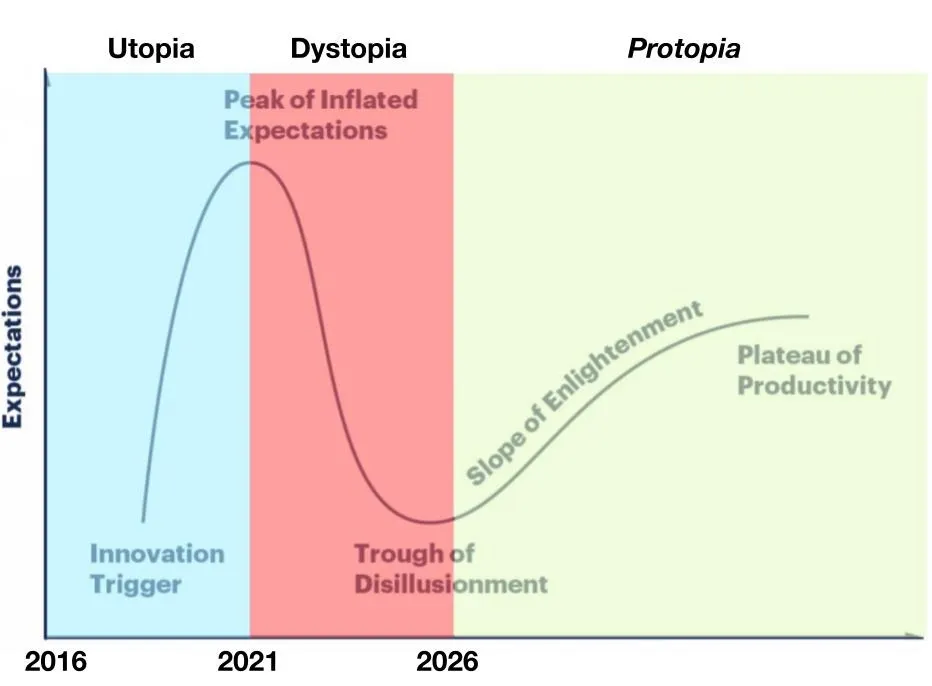
We can also use Carlota Perez's theory to understand this transformation: the utopian vision corresponds to the early deployment stage; the stage of disillusionment is the turning point, after which we will enter the rational deployment stage. Different stages require entirely different investment strategies.
The crypto industry is no longer at the forefront of pioneering paths; it is turning into a business. There is no good or bad; it is merely the industry's maturation. Current new crypto projects can be roughly divided into five categories, each with different value in implementation:
- Stablecoins
- Prediction markets
- Tokenized assets / RWA
- Perpetual contracts
- Artificial intelligence and smart agents
To some extent, cryptocurrencies are consuming fintech, or it can be said that fintech is assimilating cryptocurrencies. This is far removed from the envisioned DeFi revolution. The crypto industry needs to seek killer applications beyond stablecoins within the boundaries allowed by regulation.
Even so, we believe that in the coming years, the crypto space can still produce companies with long-term viability. We will continue to seek out top founders to create quality products.
Reconciliation
I hold two seemingly contradictory viewpoints in my mind. First, cryptocurrencies are changing the underlying methods of value storage and circulation; second, cryptocurrencies are evolving into a business track that adheres to existing financial rules.
I attempt to reconcile the two: cryptocurrencies may infiltrate daily life in subtle ways. Changes often happen quietly and are only clearly visible in hindsight. The most profound transformations seldom come with grand slogans of "trillions in market value." They will quietly embed themselves into the existing system, integrating into public consciousness.
In times of adversity, the crypto industry may more easily burst with creativity, whereas under public scrutiny, it becomes harder. Those who truly possess curiosity will rethink and reconstruct everything. There are still many things waiting to be built, and there are numerous goals worth pursuing. I still maintain my belief.
免责声明:本文章仅代表作者个人观点,不代表本平台的立场和观点。本文章仅供信息分享,不构成对任何人的任何投资建议。用户与作者之间的任何争议,与本平台无关。如网页中刊载的文章或图片涉及侵权,请提供相关的权利证明和身份证明发送邮件到support@aicoin.com,本平台相关工作人员将会进行核查。


