Author: Nancy, PANews
Who could have imagined that in just over seven months of 2026, the South Korean stock market would have triggered the circuit breaker mechanism eight times, setting a rare volatility record in the history of South Korea's capital market. Especially in the last two months, circuit breaker alarms have been sounded frequently, repeatedly shaking investor confidence with sudden drops.
This summer's South Korean stock market is destined to become an unforgettable memory for countless investors.
From the world's strongest stock market to eight circuit breakers, storage giants drag down the market
The South Korean stock market has triggered the circuit breaker again.
On July 28, the KOSPI index in South Korea suffered a severe decline, at one point plunging over 11%, triggering the market's circuit breaker mechanism. This is also the first time since April 14 that the index has fallen below 6000 points, with a cumulative drop of more than 35% compared to the peak it reached in June.
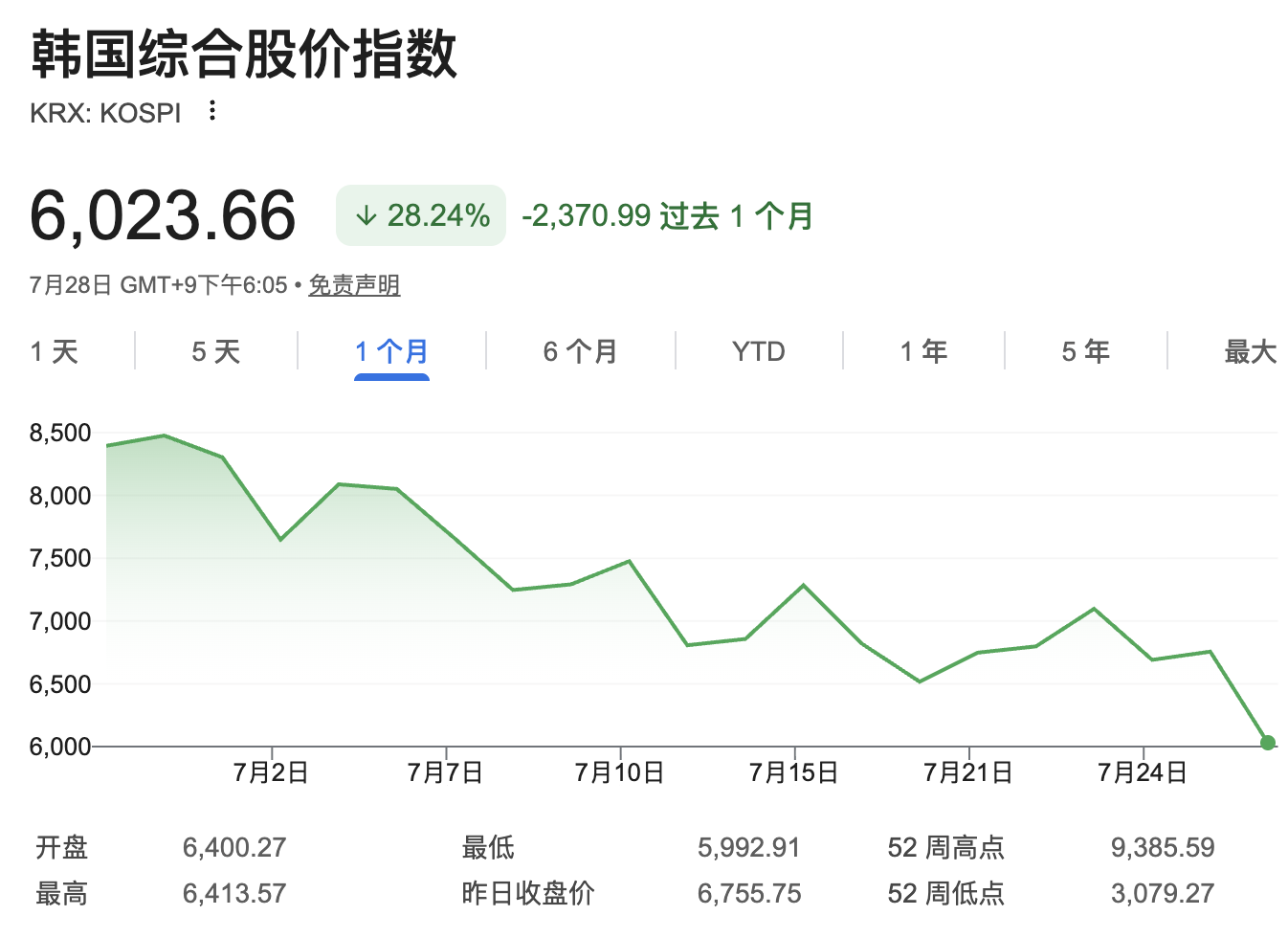
This is the eighth time this year that the South Korean stock market has triggered the circuit breaker.
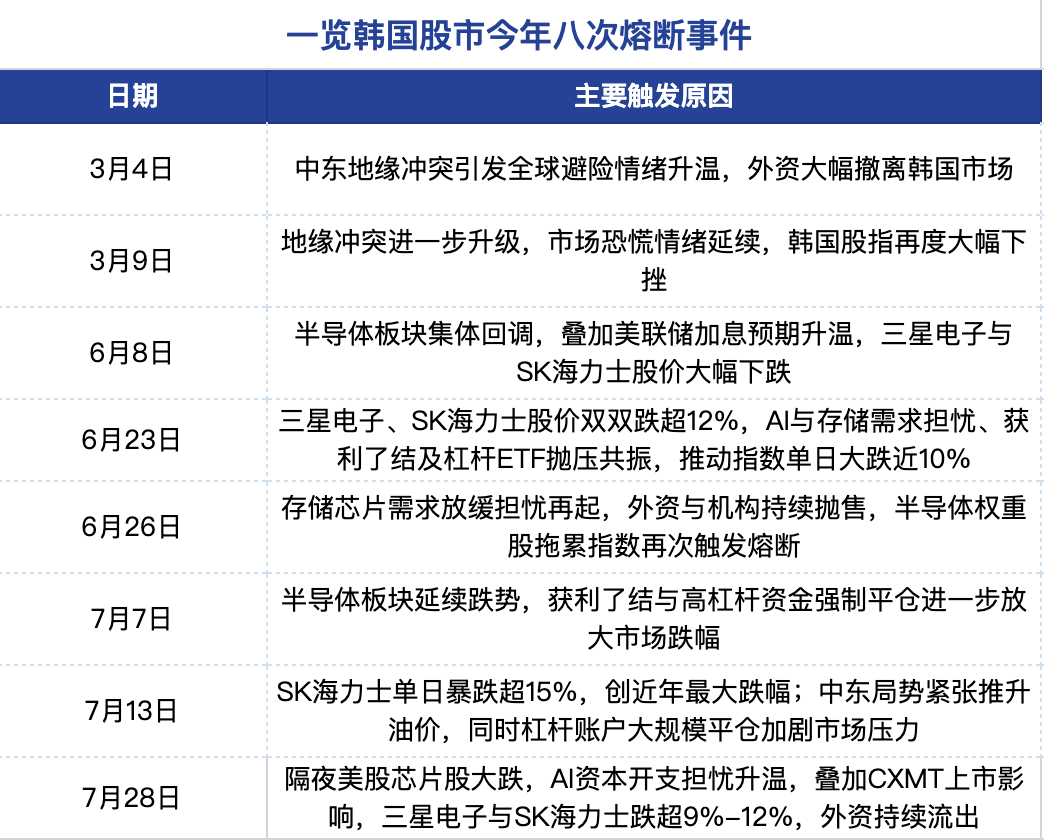
If the two circuit breakers in March were mainly influenced by the escalation of conflicts in the Middle East and rising global risk aversion, the six consecutive circuit breakers since June have exposed the structural risks accumulated within the South Korean stock market itself. Among these, the intense adjustment in the semiconductor sector has become a key factor undermining market confidence.
The main driving force behind this round of the South Korean stock market's rise came from the AI boom, but now the market is also bearing the backlash brought on by the cooling of AI. In particular, the heavy losses of Samsung Electronics and SK Hynix have been major factors dragging down the market.
These two semiconductor leaders once accounted for over 60% of the KOSPI index's weight, contributing to most of the previous gains in the South Korean stock market and helping South Korea's market rank among the strongest performance markets globally. However, at the same time, the market's high dependence on the semiconductor sector has amplified the fragility of the South Korean stock market.
Now, as the market begins to reassess the sustainability of AI capital expenditures, the growth potential for high-end storage chip demand, and the changes in future supply pressure, Samsung Electronics and SK Hynix are among the most affected.
In the past month, Samsung Electronics has fallen about 31.2%, while SK Hynix has dropped over 14.8%, with SK Hynix's American Depositary Receipts (ADR) even falling below the issuing price less than a month after listing.
In some ways, the South Korean stock market is experiencing "gain from semiconductors, loss also from semiconductors."
Hynix's on-chain contract flash crash, 867 USD order triggers Hyperliquid liquidation storm
As the spot market for SK Hynix experiences extreme volatility, the on-chain perpetual contract market also witnessed an unusual "flash crash."
According to HyperInsight's monitoring, at 7 AM Beijing time today, the price of the SKHX perpetual contract on the Hyperliquid platform suddenly plummeted from 1128.2 USD to 927 USD, with a short-term drop of 17.9%, triggering a large-scale liquidation of highly leveraged long positions.
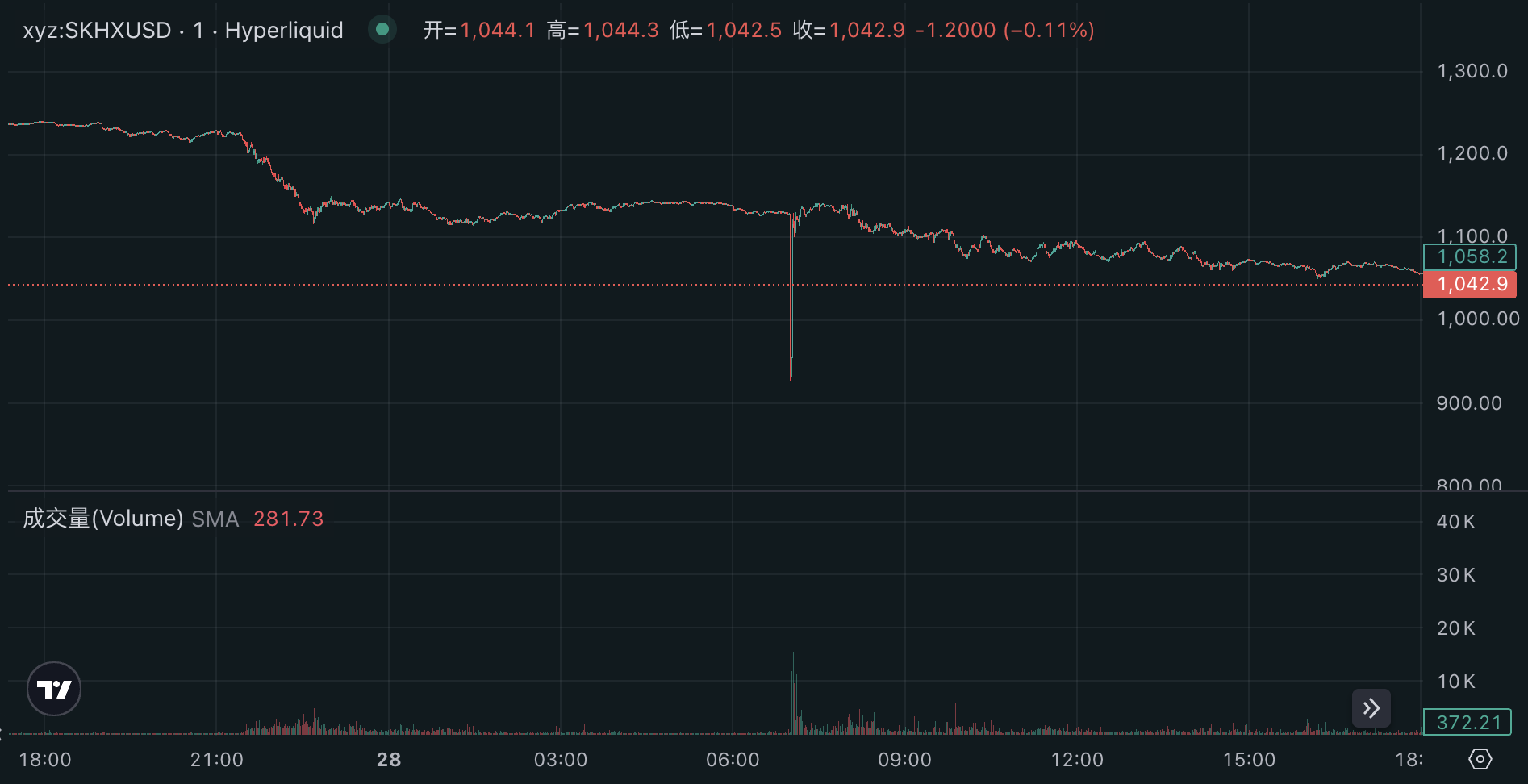
Data shows that the nominal value of outstanding contracts fell sharply from approximately 508 million USD to 388 million USD, with nearly 80 million USD in long liquidations within four hours, exceeding that of Binance during the same period.
The direct trigger for this flash crash was an abnormal order in the pre-market of the Korean NXT, amounting to only about 867 USD. Due to the low liquidity in pre-market trading, this small order, which fully complied with trading rules, unexpectedly became an important source of external price data and was adopted by the Trade.XYZ oracle system.
Subsequently, the marked price of the SK Hynix perpetual contract on Hyperliquid adjusted accordingly. In the high-leverage derivatives market, brief deviations in marked prices can also trigger large-scale liquidations. As long positions were forced to close, selling pressure further amplified, ultimately forming a chain reaction.
In contrast, the impact on the Binance market was relatively limited. Before the opening of the Korean main market, Binance still primarily used an internal pricing mechanism and did not immediately switch to external quotes, thus avoiding a similar scale of cascading liquidations. However, due to arbitrage trading between markets, the price of SK Hynix perpetual contracts was still affected and showed a synchronized decline.
This incident was not market manipulation but rather a butterfly effect triggered by insufficient liquidity, external price input mechanisms, and high leverage.
In mature spot markets, transactions of less than a thousand dollars typically do not have a significant impact. However, in the on-chain derivatives market, small trades can influence the marked price via oracle mechanisms and further transmit to large-scale leveraged positions.
After the incident, Hyperliquid responded by stating that the SKHYNIX perpetual contracts are deployed and operated by the Trade.xyz team, and relevant teams are investigating the cause of the event and will update progress after completing the analysis.
Regarding the HIP-3 market mechanism, Hyperliquid explained that the deployer is responsible for pushing the marked price, oracles, and external price input of its market and can use a marking price method similar to that operated by validators for perpetual contracts, contributing one of the three median components of the protocol, with the other two components pushed by the deployer affecting the final marked price. For example, if the median of on-chain (latest transaction price, best bid price, best ask price) is 100 and the deployer pushes 150 and 151, the marked price will be 150.
This chain liquidation triggered by a small transaction also reminds the market that as the on-chain derivatives market continues to expand, the stability of price sources, oracle design, and liquidation protection mechanisms under extreme conditions are becoming issues that on-chain markets must confront.
The South Korean stock market faces a confidence crisis, regulators intervene to "extinguish fires"
The "Black July" of the South Korean stock market is still ongoing, with market confidence severely impacted, and regulators are beginning to accelerate their intervention.
Among them, the long-standing popularity of leveraged trading among South Korean retail investors has become an important amplifier of this market volatility. According to data previously disclosed by South Korean officials, as of July 13, the cumulative scale of forced liquidations in July reached 344.2 billion KRW, with over 1.2 million leveraged retail accounts touching the margin call line, of which about 320,000 to 360,000 accounts have already been forcibly liquidated by brokers, and some investors even found themselves in debt to brokers.
Therefore, Kim Eun-hye, a member of the Korean ruling party, is currently discussing whether to file a national compensation lawsuit against the government for the losses of relevant investors, while fellow party member Na Kyung-won has publicly advocated for a comprehensive investigation of national losses and is actively considering national compensation, proposing to investigate and examine the "rushed introduction" process of the Blue House and financial authorities through a national inquiry and special investigation.
Meanwhile, facing the expanding risks, the South Korean Financial Services Commission (FSC) has started tightening regulations on single-stock leveraged products. Under new regulations, starting from July 31, 2026, the basic margin threshold for individual retail investors investing in related products will be raised from 10 million KRW to 30 million KRW, while further perfecting margin calculation rules to reduce the impact of retail investors using leverage to chase market fluctuations. The regulatory agency has also indicated that it may further raise investment thresholds in the future and set restrictions on individual investment limits.
In addition to leveraged ETFs, the FOMO sentiment of South Korean retail investors borrowing money to speculate in stocks is also amplifying market risks. Stimulated by rising markets, many investors are pursuing stock market returns through loans, and the loan quotas of Korean banks had once flashed a red light halfway through this year. Meanwhile, some investors with poor credit conditions have begun to turn to illegal private lending, with the number of affected individuals rising from 59,000 in May last year to 119,000.
To reduce financial risks, the Bank of Korea has recently tightened credit loan policies, and South Korean financial regulatory agencies are also considering limiting borrowed funds to invest in high-risk financial products, for example, stipulating that a maximum of only 20% of the funds used to invest in financial products can be allocated to single-stock leveraged products.
As the South Korean stock market experiences a "roller coaster," foreign capital is also accelerating its withdrawal. A recent strategy report on the South Korean stock market from JPMorgan indicated that net outflows from the South Korean stock market have exceeded 110 billion USD this year, setting the record for the largest outflow in the history of a single Asian market. About 90% of this outflow is concentrated in Samsung Electronics and SK Hynix.
The decline in market confidence has also prompted South Korean investors to turn back to overseas markets. According to a report by the Seoul Economic Daily in South Korea, net purchases of US stocks in this month have exceeded 5 trillion KRW. According to the data from South Korea's securities depository and settlement agency's Seibro information portal, from July 1 to 27 this month, domestic investors have net purchased about 3.59 billion USD in US stocks, which is about 5.5 times the total net purchases for the entire month of June, with funds mainly flowing into the semiconductor and technology stock sectors.
From the global star market benefiting from the AI cycle to the current situation of continuous circuit breakers, leverage clearance, and foreign capital withdrawal, the South Korean stock market is undergoing a fierce but necessary repricing.
免责声明:本文章仅代表作者个人观点,不代表本平台的立场和观点。本文章仅供信息分享,不构成对任何人的任何投资建议。用户与作者之间的任何争议,与本平台无关。如网页中刊载的文章或图片涉及侵权,请提供相关的权利证明和身份证明发送邮件到support@aicoin.com,本平台相关工作人员将会进行核查。


