Author: Coinstack
Translation: ShenChao TechFlow
ShenChao's Introduction: Bitcoin briefly broke through $66,000 last week before retreating to the $63,000 range, coinciding with the crucial FOMC window of new Fed Chair Warsh. When the market first trades the Fed and then itself, the cross-market linkage between macro and crypto is becoming the strongest signal for short-term direction, accurately pinpointing the main line of “cross-market linkage.”
This Week's Overview
- Bitcoin closed above $64,300 on July 26 (trading reached a high of $66,910 on Tuesday) before entering the Fed's decision week.
- The spot Bitcoin ETF recorded a net inflow of $33.79 million that week, while the Ethereum ETF saw a net inflow of $103.9 million (on July 24); Bitcoin's consecutive seven-day inflow ended with a net outflow of $240.08 million on Friday (SoSoValue).
- Tesla's second quarter maintained 11,509 BTC, reporting an unrealized tax loss of $112 million at fair value.
- Morgan Stanley submitted the final documents for the MSSE and MSOL spot staking ETFs on July 22, aiming to list on NYSE Arca with a management fee of 0.14%.
- CME FedWatch shows about 64% chance of maintaining rates in July and 35.5% chance of a 25 basis point rate hike.
- This week's focus: The FOMC statement will be released on July 29 at 2:00 PM Eastern Time, followed by Warsh's press conference at 2:30 PM.
Weekly Market Dashboard
Ethereum closed near $1,953 on Sunday, with the spot Ethereum ETF seeing net inflows for the third consecutive week and attracting more funds than Bitcoin funds for the second week in a row. The rebound on Sunday evening touched an intraday $1,960, boosted by news of a ceasefire between the U.S. and Iran, with risk assets generally rising.
All major altcoins closed up this week. XRP had the smallest gain, closing near $1.10, consolidating near support levels; Bitcoin (+1.0%) and Solana (+0.3%) also saw slight increases.
Institutional demand dominated early in the week before retreating as Treasury yields climbed ahead of the FOMC. Bitcoin ETFs recorded the longest consecutive inflow since May before Thursday, then erased about $465 million on Thursday and Friday. Ethereum showed stronger performance mid-week, then retraced with Bitcoin. Tesla's earnings report and Morgan Stanley’s staking ETF application were the narrative mainlines throughout Wednesday.
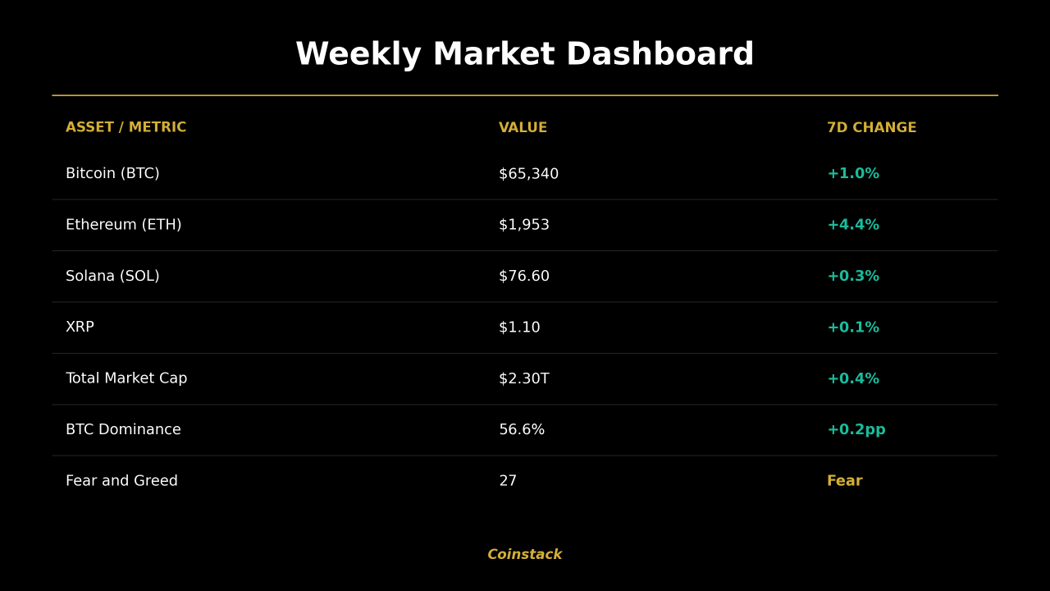
Chart: Weekly dashboard of the crypto market (as of July 26, 2026). Sources: CoinMarketCap, CoinGecko, SoSoValue, Yahoo Finance, Alternative.me.
Bitcoin: Withdrawal After Peak of $66,000
Bitcoin rose on Tuesday, breaking the $66,500 level driven by five consecutive days of ETF net inflows (totaling about $727.25 million from July 14 to 20, the strongest institutional pulse since May); by Friday, as Treasury yields rose ahead of the FOMC, the spot Bitcoin ETF saw outflows of $465.26 million within two trading days (SoSoValue). Ethereum continues to maintain structural buying pressure, marking its third week of net inflows, while Tesla did not alter its 11,509 BTC reserves. Attention now turns to Chair Warsh, whose press conference on Wednesday will set the tone for the September trajectory.
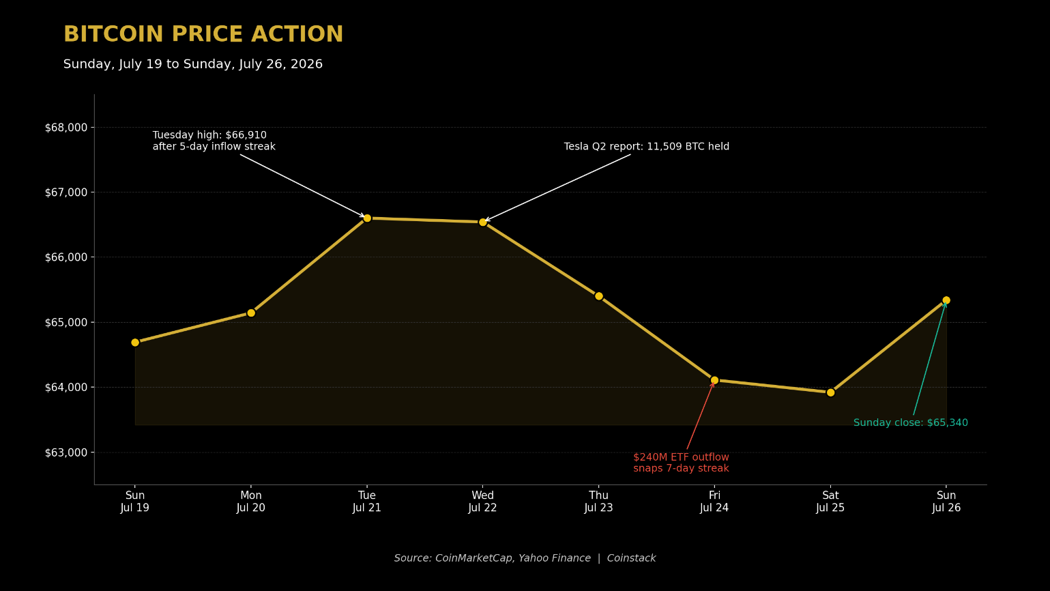
Chart: Bitcoin price movement (July 19 to 26, 2026).
Focus Shifts to FOMC: Warsh's Second Meeting
The FOMC meeting on July 28-29 is Warsh's second during his tenure, with the federal funds rate maintained at 3.50%–3.75% for four consecutive times.
CME FedWatch showed about 64% chance of maintaining rates and 35.5% chance of a 25 basis point rate hike as of Friday. No economic projections summary (SEP) will be released at this meeting, hence the wording of the statement and the press conference will bear the entire repricing.
The rebound of Bitcoin to $66,910 on Tuesday, and the subsequent drop on Friday, stemmed from changes in Fed expectations rather than crypto-native capital flows. If a hawkish maintenance of rates advances the September rate cut expectations, it could reignite ETF demand; if Warsh's press conference strengthens September rate hike expectations, tightening trades will persist.
Focus on positioning for paths rather than points. Watch for September and December federal funds contracts as well as the 10-year Treasury yield until Wednesday afternoon.
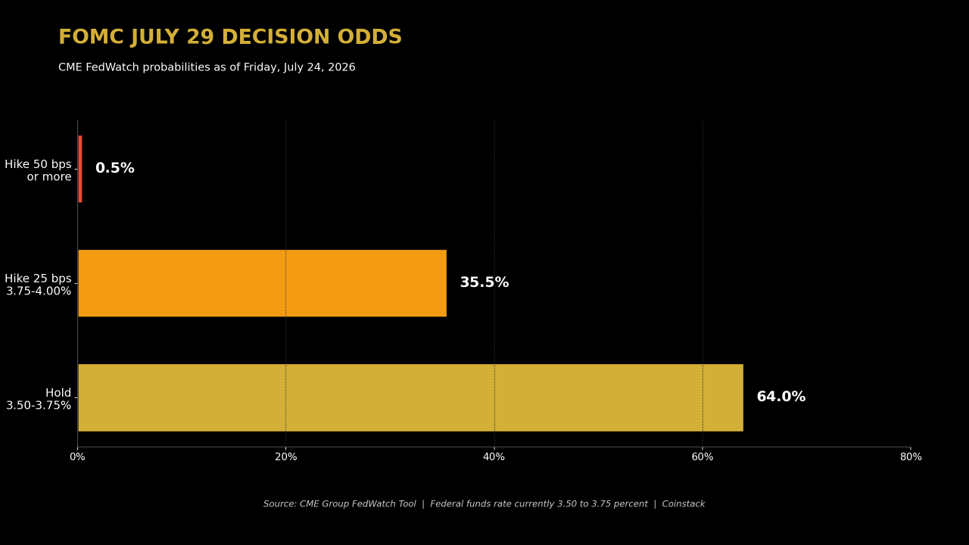
Chart: CME FedWatch tool showing July rate probabilities (as of July 24, 2026). Source: CME FedWatch Tool.
Tesla: Four-Year Unchanged Holdings, But Records Book Loss
Tesla's holdings remained at 11,509 BTC in the second quarter, recording an unrealized tax loss of $112 million per the 2024 FASB fair value rules. The adjusted EPS was $0.33, below market expectations.
In this quarter where MSTR shifted to cash reserves, this four-year holding through retracement is the clearest institutional endorsement.
As long as the price is below cost, fair value measurement will continue to generate quarterly noise; while Tesla's HODL has not added demand marginally.
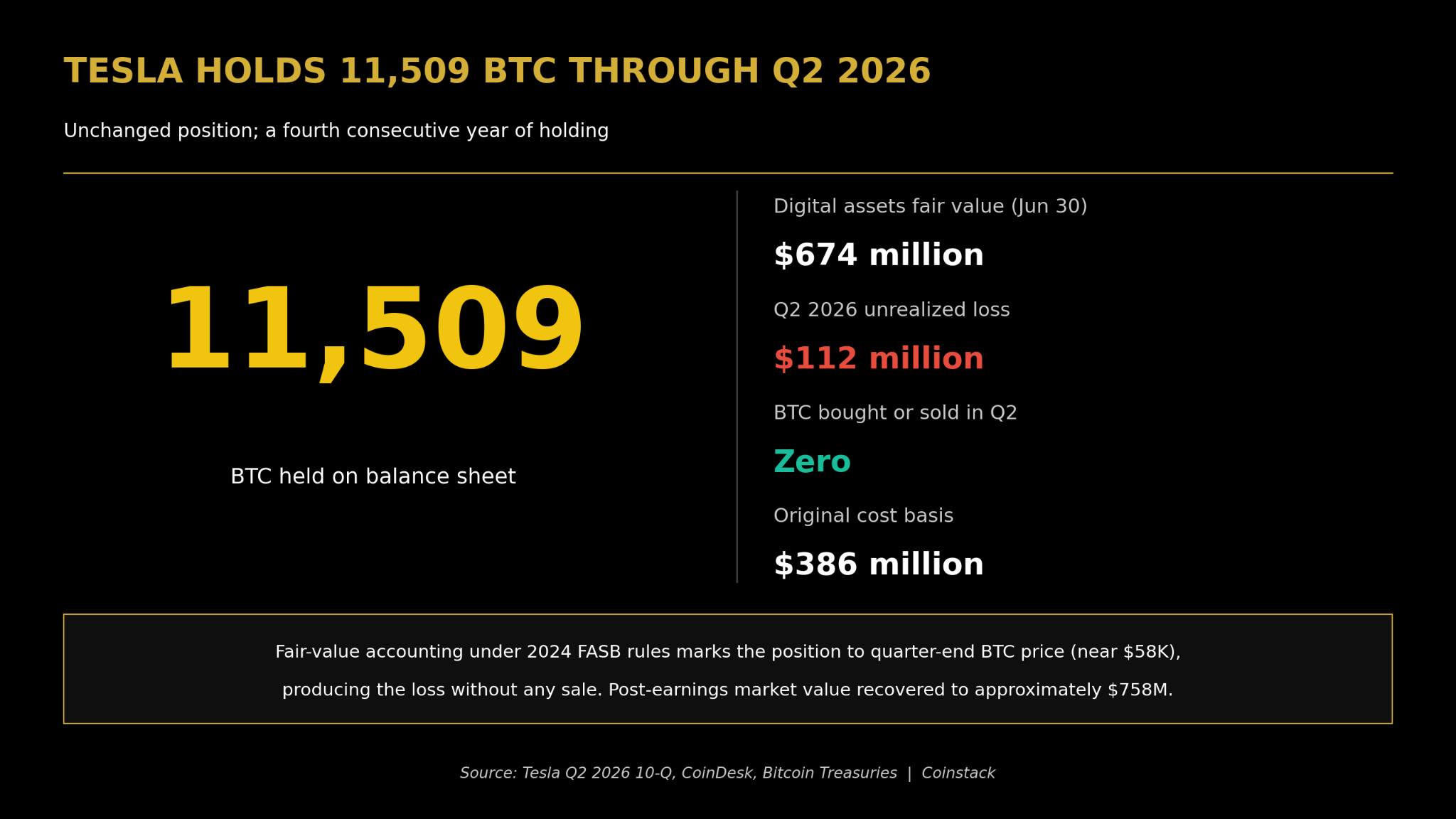
Chart: Bitcoin holdings and fair value changes in Tesla's Q2 2026 report. Source: Tesla Q2 2026 Update.
Morgan Stanley Races to Launch Staking ETF
Morgan Stanley submitted final documents for the spot Ethereum (MSSE) and Solana (MSOL) staking ETFs on July 22, aiming for NYSE Arca listing, with a fee structure of 0.14%. Coinbase Prime and BNY Mellon will serve as custodians; MSSE plans to stake 50%–80% of ETH, while MSOL can stake up to 100% of SOL.
A fee rate of 0.14% is lower than most Bitcoin ETFs and packages staking returns into a vehicle accessible for advisors and retirement accounts.
The staking design and tax treatment are still undecided by the SEC. If final approvals are delayed, this fee compression selling point will lose shelf appeal over time.
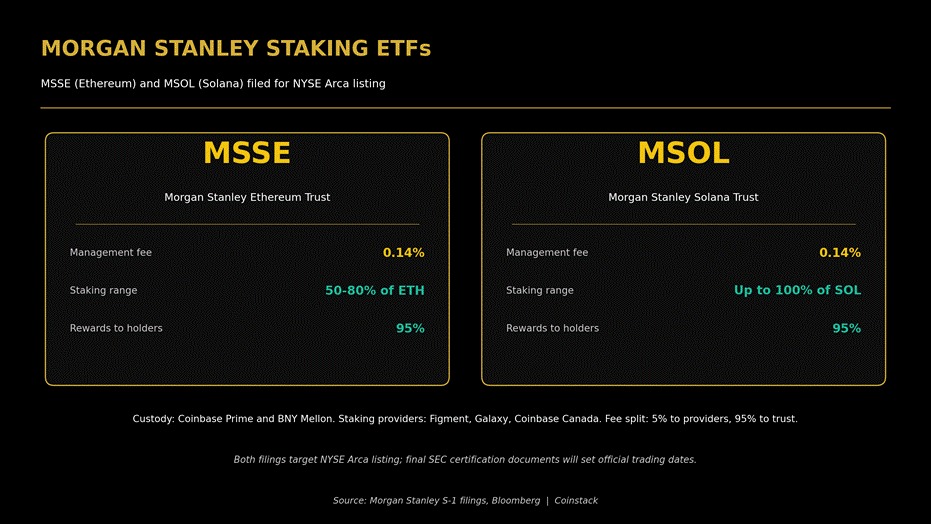
Chart: Structure of Morgan Stanley's spot Ethereum (MSSE) and Solana (MSOL) staking ETFs. Source: SEC filing.
Strategy: Two Weeks of Zero Purchases, Cash Reserves Rise to $3.2 Billion
Strategy (formerly MicroStrategy) disclosed the sale of $263.5 million in MSTR stock from July 13 to 19, pushing its dollar reserves to $3.225 billion. No BTC was bought or sold, with the company holding 843,775 BTC (Form 8-K as of July 20).
A larger cash buffer enhances Strategy’s ability to pay Digital Credit dividends without being forced to sell BTC.
Strategy has not made any Bitcoin purchases for two consecutive weeks, causing its Bitcoin accumulation flywheel to temporarily stop.
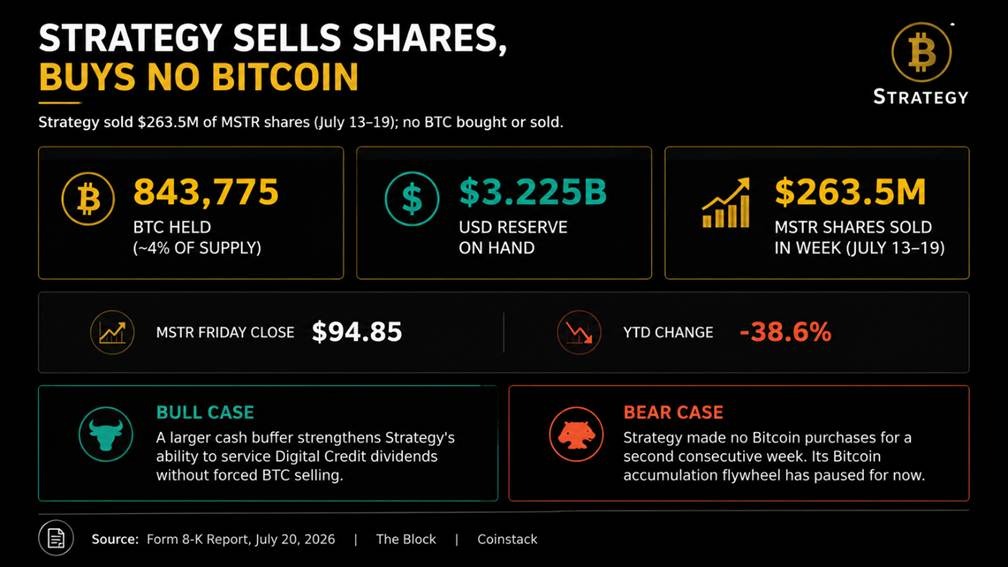
Chart: Changes in cash reserves and BTC holdings for Strategy (formerly MicroStrategy) (as of July 20, 2026). Source: Form 8-K.
Ethereum Staking Queue: 2.52 Million ETH in Line
Over 2.52 million ETH are in the validator entry queue, accounting for about 2% of the circulating supply, with an activation wait time of 43 days and 22 hours (as of July 27, 10:30 AM Eastern Time), with almost zero exit demand.
New ETH is queuing to be locked instead of sold. Similar backlogs have appeared in line with ETH accumulation phases and increases in staking ratios.
Institutional demand for yield-bearing ETH is accelerating, coinciding with Grayscale's plans to start quarterly cash payments for Ethereum staking ETF rewards around August 7 (pending SEC approval). Together, they point to a mature structural buying pressure that does not require price momentum.
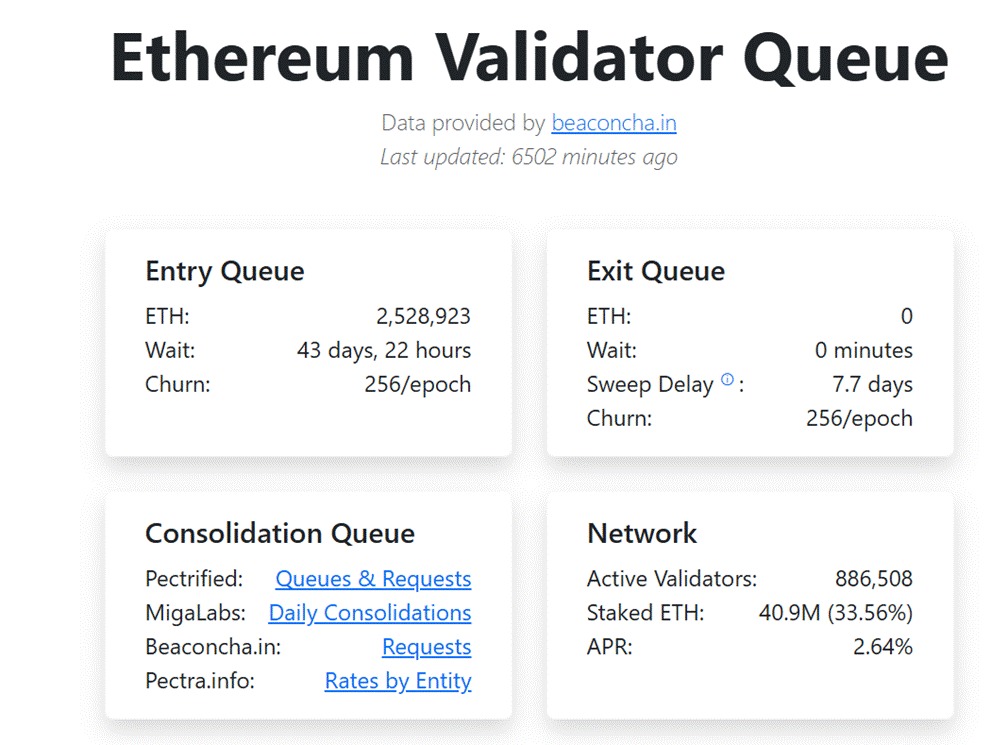
Chart: Size of the Ethereum validator entry queue and activation wait times (as of July 27, 2026). Source: Validator Queue.
Staking Yields Become New Battlefield for ETFs
Grayscale is about to pay ETH staking rewards in cash, Morgan Stanley plans to stake 50%–80% of its ETH and up to 100% of its SOL, and Bitwise's BSOL has adopted staking designs. Yields are becoming a differentiating factor among U.S. crypto ETFs.
Staking yields turn crypto ETFs into yield-generating products beside REITs and dividend stocks that advisors can embed. The nearly 44-day ETH entry queue signifies real institutional demand.
The SEC has yet to finalize staking treatment under the Investment Company Act, and any variable involving taxes or custody could weaken this selling point.
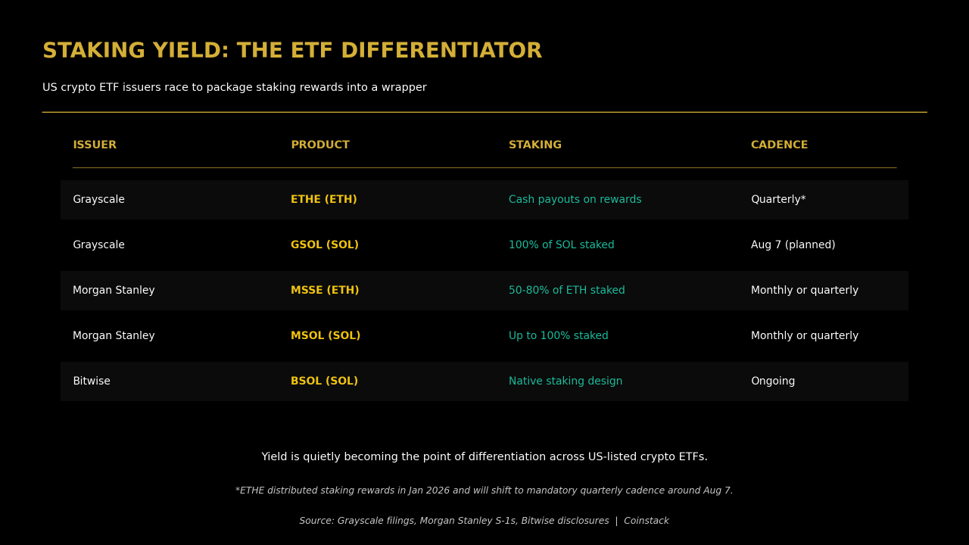
Chart: Overview of U.S.-listed crypto staking ETFs.
Overview of U.S.-Listed Staking ETFs
U.S.-listed staking ETFs turn ETH and SOL into packaged yield instruments with regulated custody and cash distributions, opening pathways for capital that will never directly touch validators.
Key points to watch: Grayscale's Ethereum staking distribution starting August 7, the final actions on MSSE and MSOL by the SEC, and more filings with fees ≤0.14%.
A hawkish Warsh press conference could compress risk preferences for high beta Layer 1 networks, and any staking rules limiting fee accumulation would reprice this vehicle.
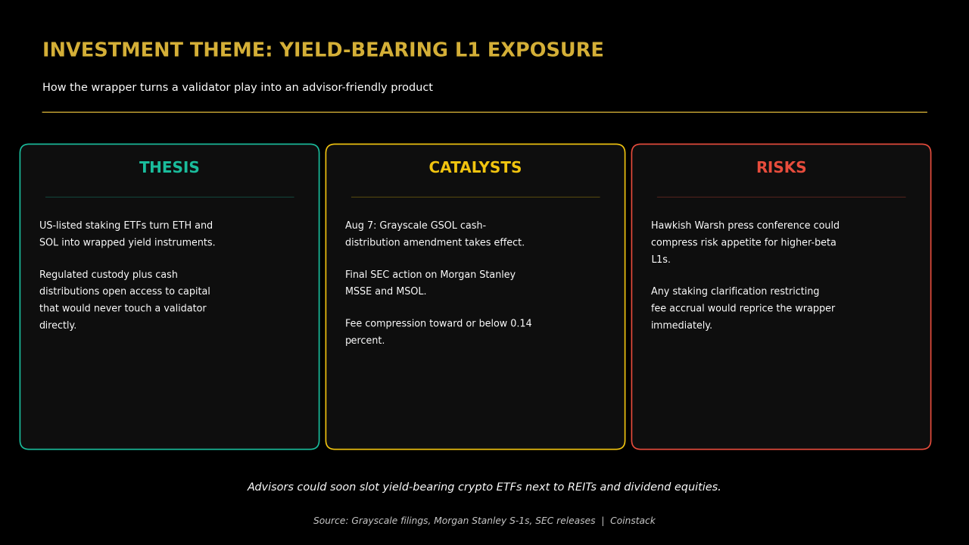
Chart: Comparison of Ethereum staking entry queue and exit queue.
Entry Queue: Locked Supply as a Leading Indicator
Ethereum's staking design limits the activation rate of new validators, so when demand surges, ETH accumulates in the entry queue. Long queues mean holders are willing to lock capital for weeks in exchange for underlying layer yields.
The queue is a leading indicator of committed supply. Coins in the queue are unlikely to enter exchanges soon, while sellable ETH shares contract as the exit queue empties. A surge in the exit queue will reverse the signal.
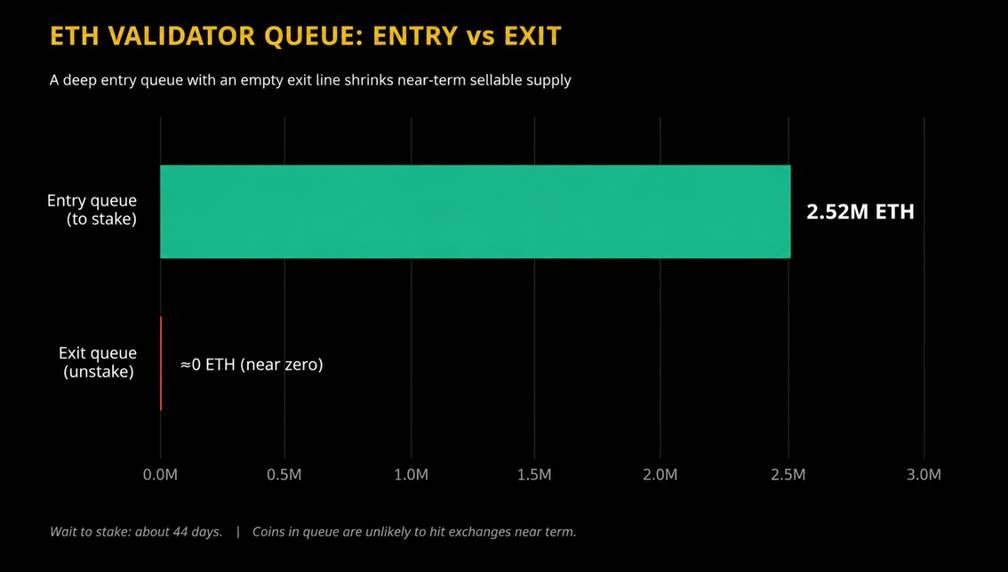
Chart: Rate of activation for Ethereum validators and schematic of entry queue mechanism.
免责声明:本文章仅代表作者个人观点,不代表本平台的立场和观点。本文章仅供信息分享,不构成对任何人的任何投资建议。用户与作者之间的任何争议,与本平台无关。如网页中刊载的文章或图片涉及侵权,请提供相关的权利证明和身份证明发送邮件到support@aicoin.com,本平台相关工作人员将会进行核查。


