When it comes to young people's money, there are always two impressions online:
Either it's "exquisite at the beginning of the month, eating dirt by the end," or "after watching a few short videos, they rush into the market."
But after recently seeing a set of trading data released by Binance Research, I found that people may have underestimated this generation of young people's awareness of financial management.
The data shows that Generation Z not only enters the market earlier but also has a higher proportion of financial education; more surprisingly, when confronted with leverage, they may not be more aggressive than the previous generation.
Their understanding of investment is slowly changing.
1. You think they are 'going all in', but many have started managing their finances early
Generation Z typically refers to those born between 1997 and 2012. An earlier group has already entered the workforce and is becoming an important participant in the financial market.
The data shows:
- About 30% of Generation Z started investing during college or right after starting work;
- This percentage is about twice that of the millennial generation and 3.3 times that of Generation X;
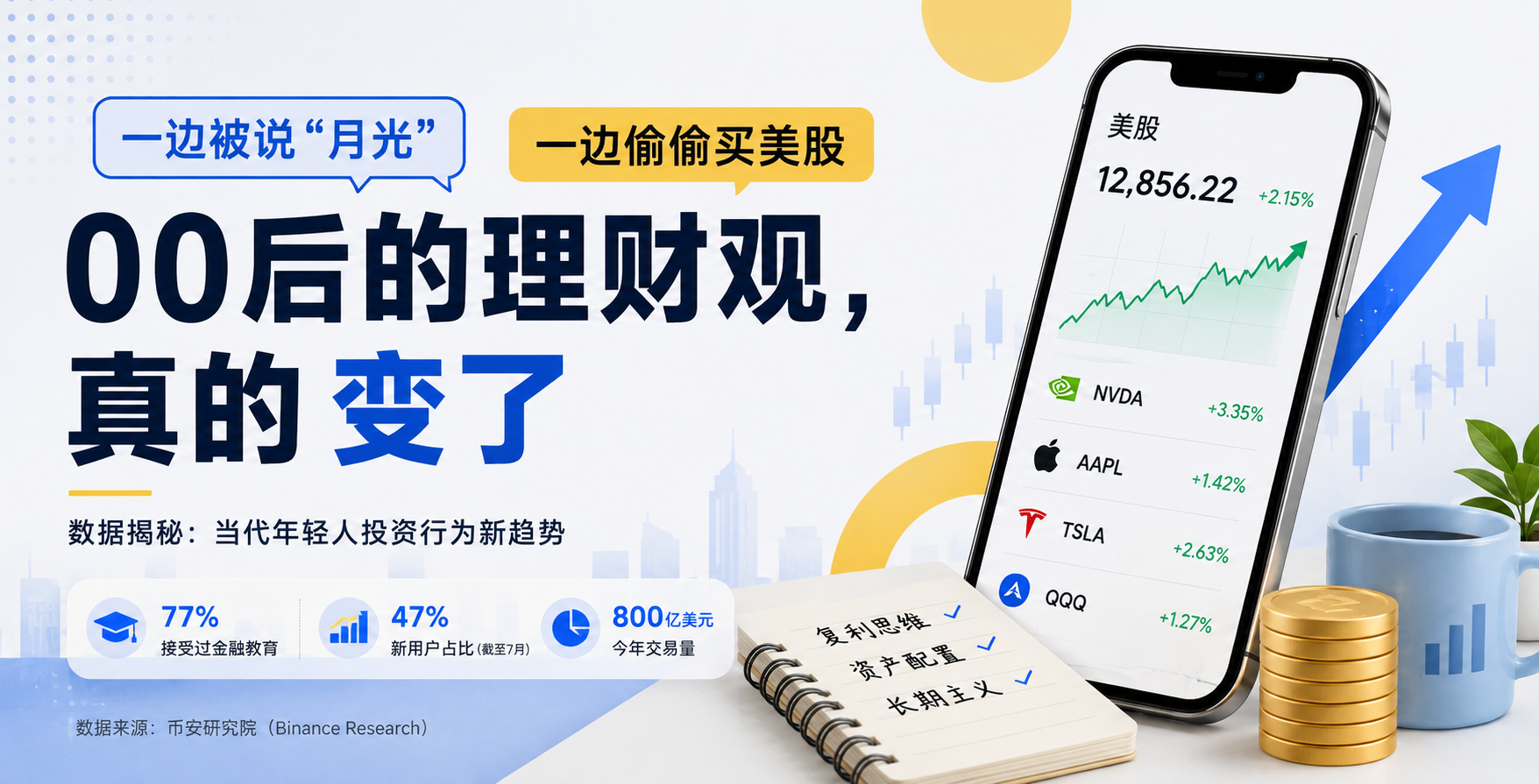
- About 77% of Generation Z investors have received formal financial education, higher than the 69% of millennials and 58% of Generation X.
The previous generation often only began to seriously study financial management after buying a home and supporting a family.
However, many young people have already been exposed to compound interest, risk, and asset allocation before entering the workforce.
For them, investing isn’t necessarily a one-time "turning point," but rather a long-term skill they start learning early.
2. Young people are becoming important participants in emerging markets
Looking at data from emerging trading products, Generation Z is no longer just "trying it out."
In products like Direct Stocks, bStocks, and TradFi perpetual contracts, Generation Z users account for about 44%-45%; among users of multiple products, the proportion is closer to 48%.
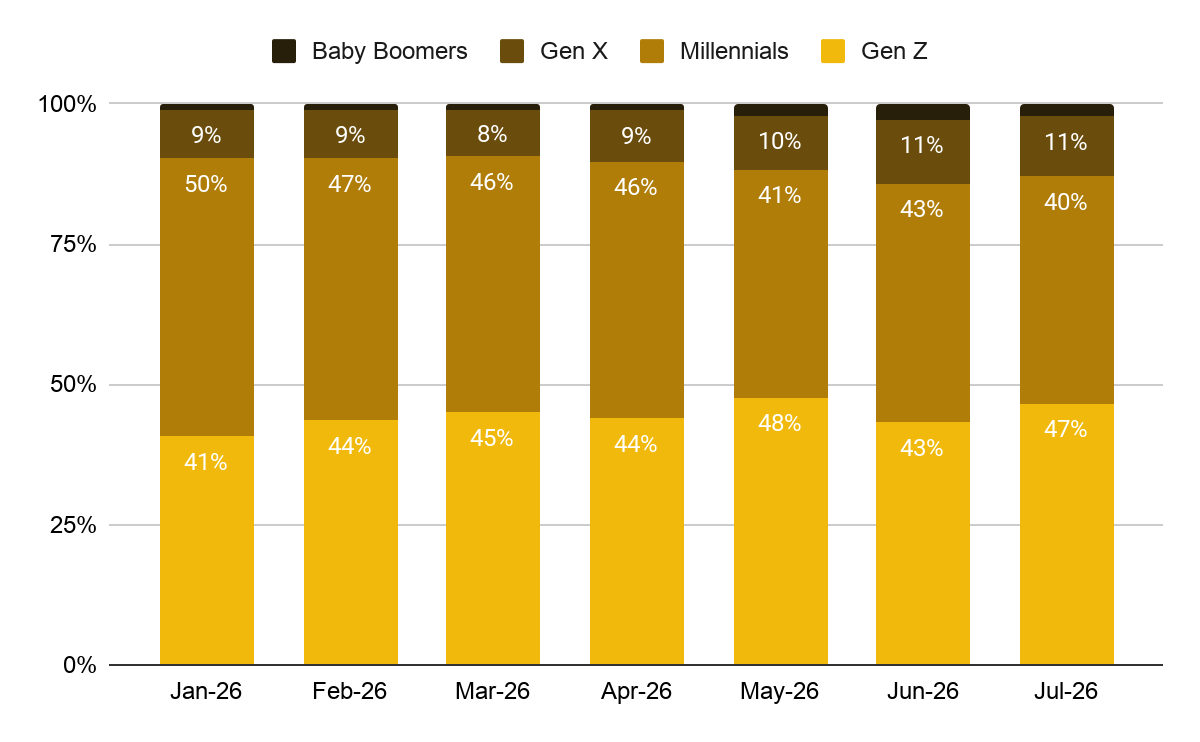
As of July this year, Generation Z accounts for 47% of new trading users and has contributed about $80 billion in transaction volume this year.
Behind this is actually a change in investment tools.
Mobile trading and fractional share investing have lowered the barriers to entry. Markets that once required considerable capital and complex processes can now potentially be accessed through a smartphone.
Investing is gradually becoming part of young people's digital lives.
3. Contrary to common belief: they may be more cautious about leverage
Many believe that young people are more likely to follow trends and take risks.
But the data does not fully support this judgment.
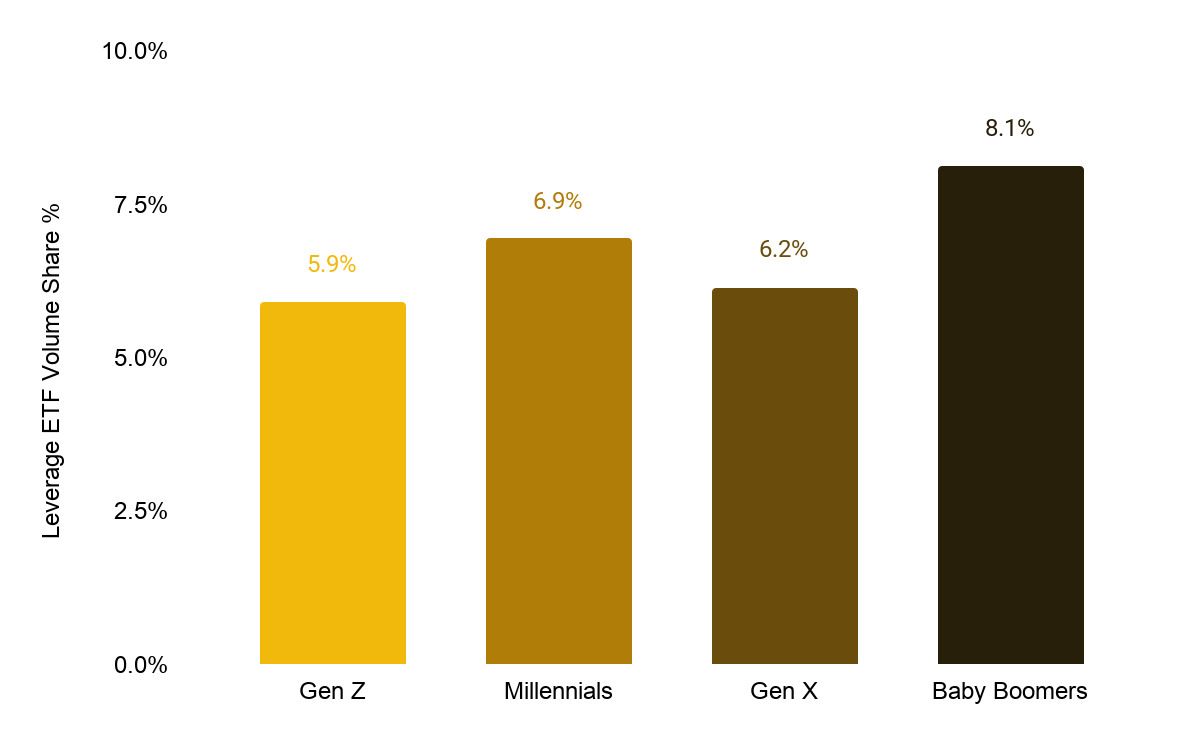
The proportion of Generation Z participating in leveraged ETFs is about 5.9%, lower than the 8.1% of the baby boomer generation.
The trading frequency is also not as high as imagined: overall users trade an average of about 3 times a day, while Generation Z averages about 2.6 times.
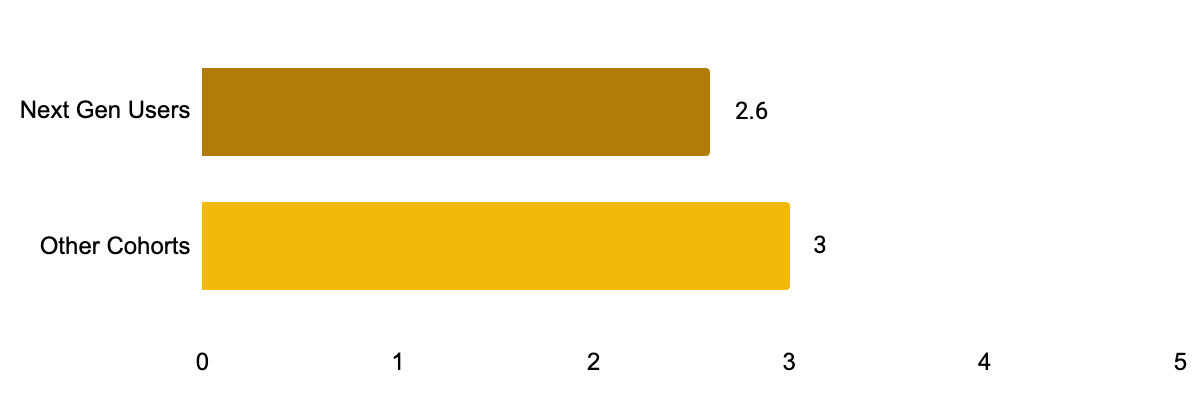
This does not mean that all young people are conservative; it indicates that the stereotype of "youth = high risk tolerance" may not be accurate.
Many do not rely on high leverage or frequent trading but prefer to invest in fields they are familiar with and willing to pay attention to in the long term.
4. They are not necessarily buying 'cheap'; they are buying a comprehensible future
So, what do Generation Z typically purchase as their first US stocks?
The data shows that about 20% of Generation Z investors chose NVIDIA (NVDA) for their first US stock. Micron Technology, Tesla, Apple, and the Nasdaq 100 index also attract attention.
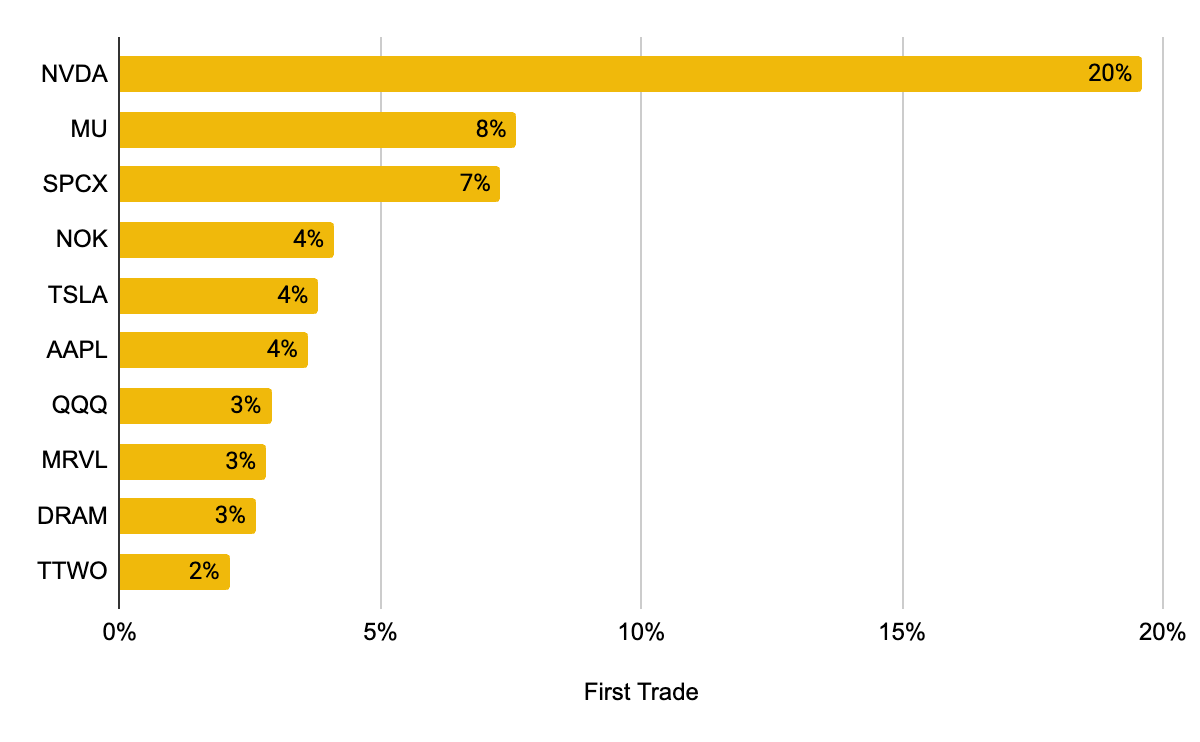
From an industry perspective, about 60% of their allocations are concentrated in information technology and communications, with about 26% related to semiconductors.
They may not research valuation models first and then look for "undervalued companies."
Many people's logic might be more straightforward:
AI, chips, cloud computing are things they encounter every day. Although they may not be able to predict whether it will rise or fall tomorrow, they believe these technologies will continue to change the future.
Therefore, they are buying not just stocks but also betting on long-term trends they understand.
5. With just a few dozen dollars, you can start accessing global assets
Another detail worth noting in the report:
Over 90% of users of emerging financial products come from emerging markets, with about 13% being Generation Z with stock assets of less than $2,000.
In the past, participating in overseas markets often meant a high capital threshold.
Now, fractional share trading allows investors not to have to buy a whole share at once. With just a few dozen dollars, one can start attempting to allocate global assets.
Of course, lowering the threshold does not mean risks disappear.
However, at least investing is no longer an option only accessible to a small group of high-income individuals.
Final Thoughts
We are used to describing young people with terms like "impulsive," "moonlight," and "easily harvested."
But the Generation Z portrayed by the data is much more complex than these labels.
They enter the market earlier, have a higher rate of financial education; embrace technology, yet may not rely on high leverage; are willing to endure volatility, and are beginning to understand assets with a longer-term perspective.
Investing early does not necessarily mean making a profit; there are risks in any market.
But one change is already clear: an increasing number of young people are starting to think about assets, risks, and the future in advance, beyond their salaries.
Salaries solve the immediate need for living, while long-term financial planning may determine how many choices one has in the future.
To do well, good tools are often the first step.
👉 Click here to register with Binance and unlock global assets in one place
Whether it's experiencing fractional share trading or conducting all-weather diversified asset allocation, choosing a safe and convenient trading platform is crucial.
https://jump.do/zh-Hans/xlink-proxy?id=3
(Invitation code: aicoin668, enjoy a 10% rebate)
Join our community to discuss and get stronger together!
Official Telegram community:
AiCoin Chinese Twitter:
Binance benefit group:
https://www.aicoin.com/link/chat?cid=gmLgwvKD1
Risk Warning: This content is for market observation sharing only and does not constitute investment advice. The cryptocurrency market is highly volatile; please participate within your risk tolerance.
免责声明:本文章仅代表作者个人观点,不代表本平台的立场和观点。本文章仅供信息分享,不构成对任何人的任何投资建议。用户与作者之间的任何争议,与本平台无关。如网页中刊载的文章或图片涉及侵权,请提供相关的权利证明和身份证明发送邮件到support@aicoin.com,本平台相关工作人员将会进行核查。