
Author: Alan, Amelia I Biteye Content Team
Binance may be becoming the Apple of the financial sector.
Seven weeks, $680 million AUM.
In just seven weeks since launch, bStocks has surpassed the asset management scale of the xStocks ecosystem, which has been operational for more than a year and covers hundreds of assets across multiple public chains. This has forced the industry to re-examine the competitive landscape of tokenized stocks.
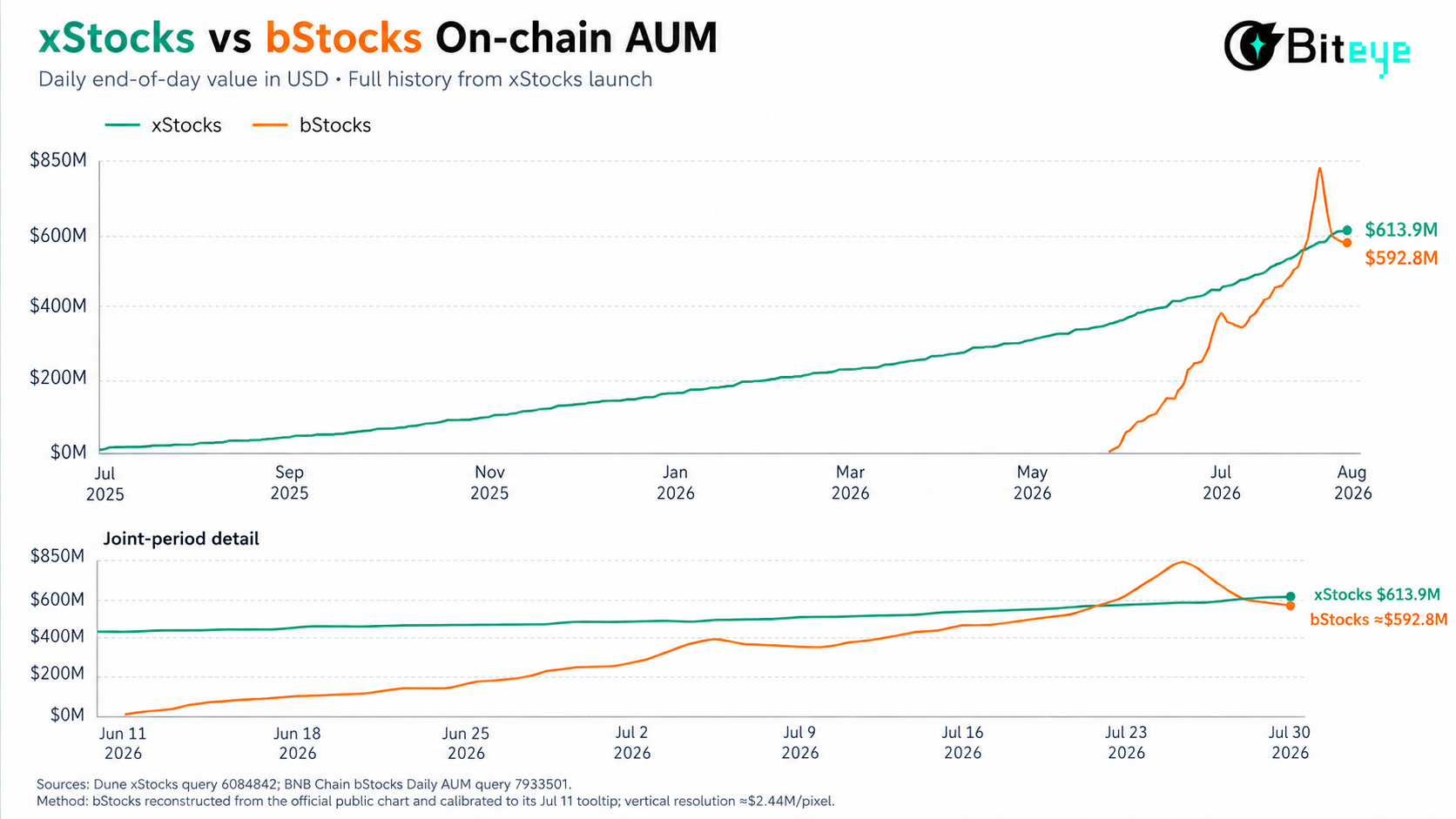
xStocks offers a richer variety of assets, a more open ecosystem, and a broader on-chain portfolio capability; bStocks has neither invented a new stock token nor created new underlying technology. Why is the newcomer growing faster?
There is an interesting phenomenon in the history of Internet business: what often determines the competitive landscape is not who has more products, but who has the ability to organize those products.
Apple didn't really change the industry by inventing any particular technology, but by organizing chips, systems, app stores, and developer ecosystems into a unified experience for the first time.
Today, RWA may also be entering the same phase: previously, competition was over assets. In the future, it will be over operating systems.
And bStocks is simply the first case that makes this change sufficiently apparent.
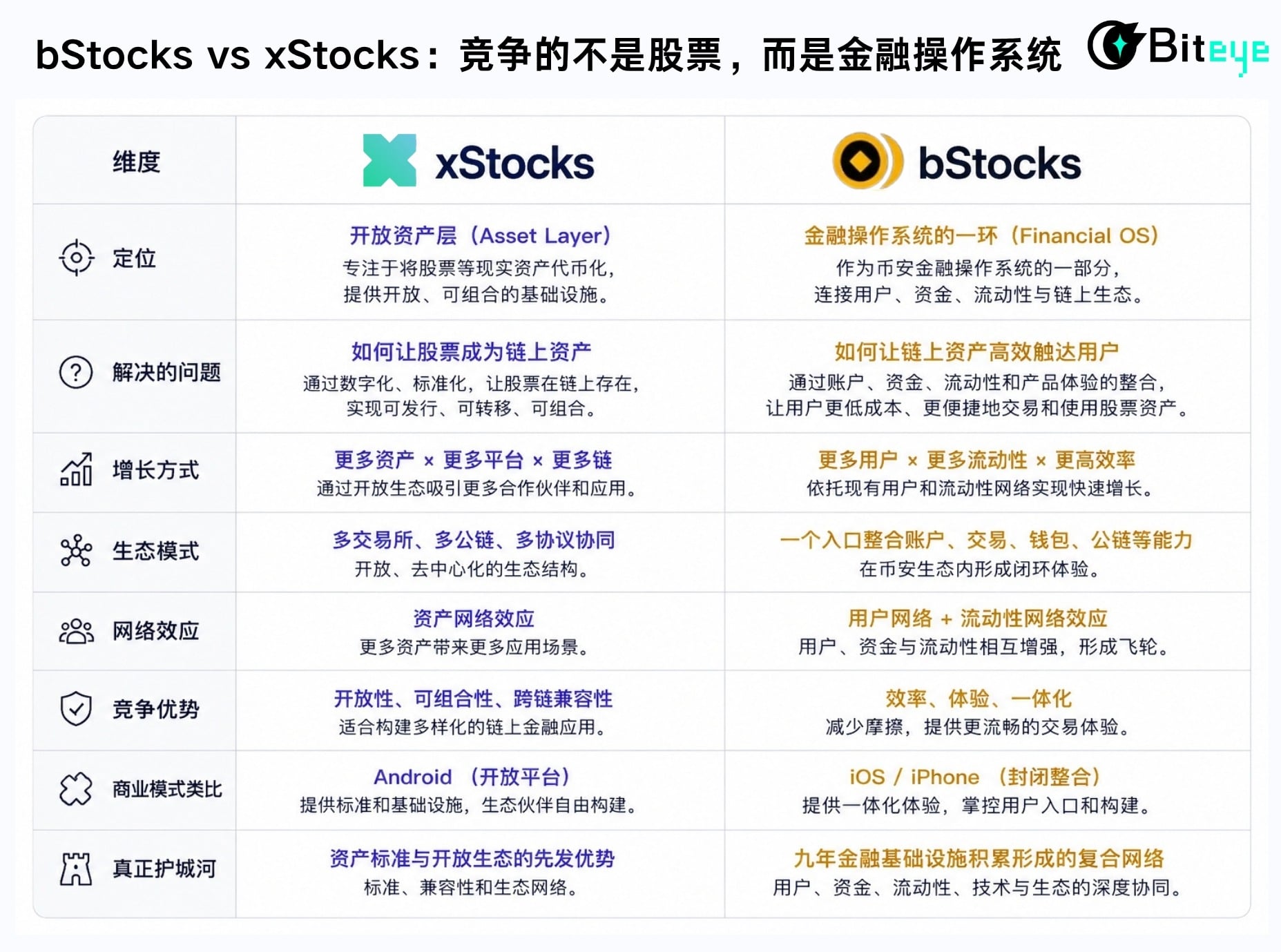
1. bStocks did not change stocks; it changed the way stocks reach users
When many people see bStocks for the first time, they often feel confused: what exactly has it innovated?
Stock tokens already exist in the industry. On-chain wallets have also been around for a long time. 24-hour trading, stablecoin settlement, self-custody... these capabilities are not new.
Biteye once wrote an article that spent great effort trying to understand where bStock's innovation point lies.
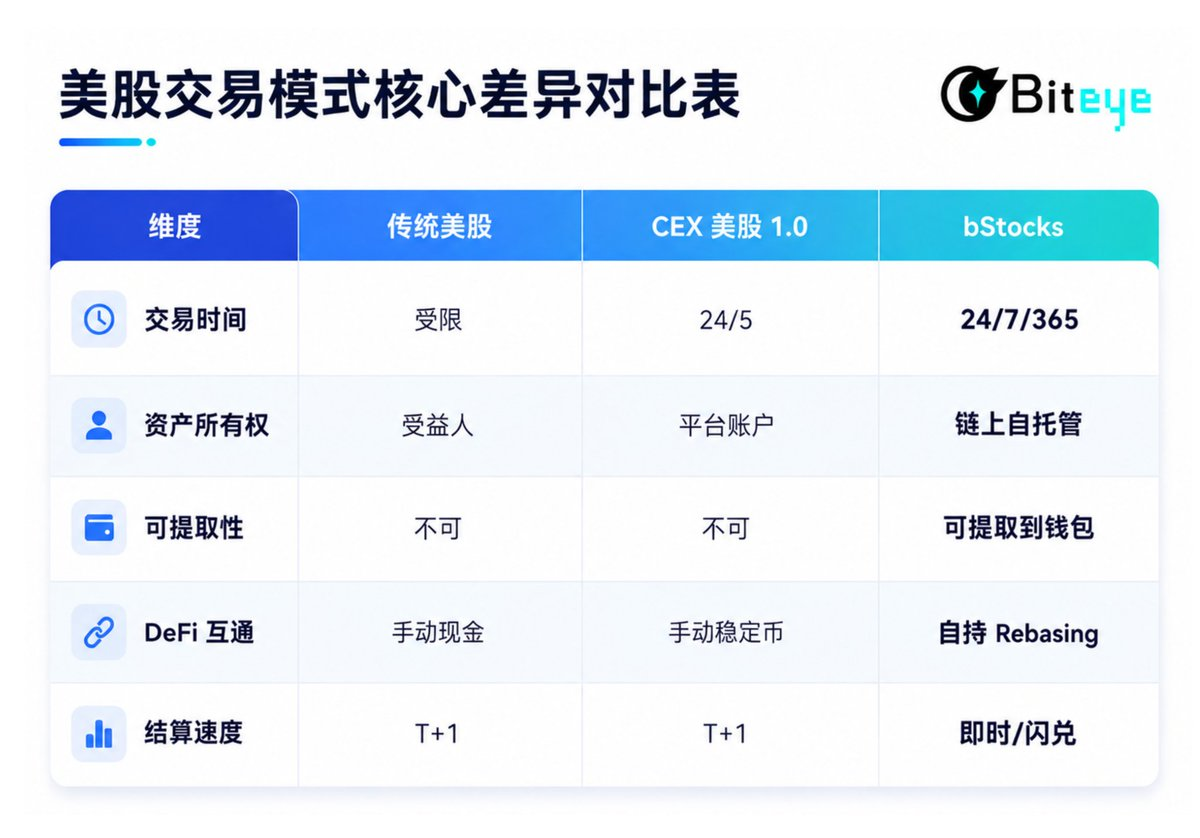
In fact, the key to understanding bStocks lies not in finding a new technological innovation point, but in observing how it reorganizes existing capabilities.
Just as Apple never invented CPUs or cameras. Touchscreens, OLEDs, and mobile payments were not created first by Apple. But today, few would deny that the iPhone changed the smartphone industry.
What Apple truly created was not a specific technology, but a new way of organizing. It placed chips, systems, app stores, payment solutions, and developer ecosystems all into the same closed loop. What users feel is not that a specific function has improved, but that the entire experience has become simpler.
The value of bStocks is much closer to this logic. It hasn’t reinvented stock tokenization; instead, it has integrated financial capabilities that were originally scattered across different platforms and products into a single access point: users' funds are already in their Binance accounts. Stablecoins have already completed settlement. The order book already has mature liquidity. Market makers have been providing quotes for a long time. Wallets can already accomplish self-custody. The BNB Chain already offers rich on-chain applications.
For users, purchasing a stock no longer means searching for a new platform, reloading funds, spanning chains, or finding liquidity again. All paths have been compressed into the same system.
It seems like just a few fewer mouse clicks. But fundamentally, it shortens an entire financial link.
2. bStocks' moat lies within a financial flywheel formed over nine years
Many people say that the moat is the large number of Binance users. This is certainly true. But user scale is merely a result, not the cause.
The truly important factor is that over the past nine years, Binance has built a highly collaborative financial network: by 2026, Binance's global registered users have surpassed 323 million, covering over 100 countries and regions. According to the latest data, the trading volume of TradFi perpetual contracts exceeded $5.8 billion in just one weekend, with oil and gas transactions exceeding $1.5 billion and the five most popular assets exceeding $2.3 billion. Users can trade over 7,000 popular assets covering stocks, commodities, and more with a single account 7×24 hours. The data reflects not just the short-term popularity of one type of contract but that demand can be quickly released when the same set of accounts, funds, and trading systems connect to more global assets.
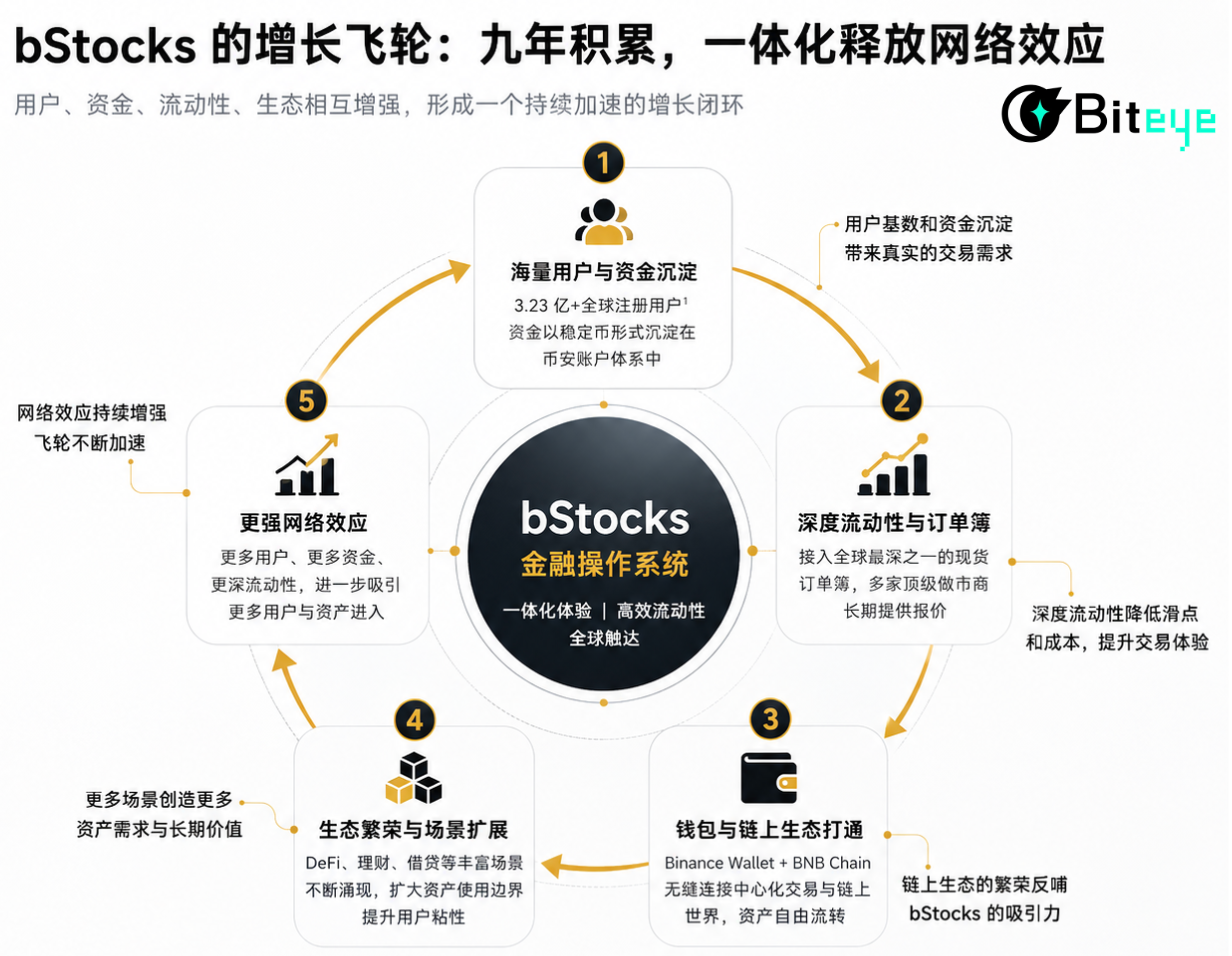
Behind these numbers is a three-layer growth flywheel.
- The first layer: accumulated user accounts and capital pools, which eliminate the biggest conversion friction between traditional finance and early RWA products.
- The second layer: a liquidity network that has been validated over years. From day one, bStocks has directly connected to one of the deepest and long-running spot order books globally. Several top market makers have been providing long-term quotes within it; liquidity is not built up, but connected.
- The third layer: complete self-custody and on-chain outlets. bStocks is the only product that combines “top exchange liquidity + self-custodial wallets + large public chain ecosystems” in a single login experience. After a transaction is completed, assets can seamlessly move from centralized order books to on-chain wallets and thus participate in DeFi scenarios. This closed loop cannot be independently provided by a simple exchange or a simple public chain.
A massive number of users bring enormous trading demand; huge demand attracts market makers to provide tighter spreads and deeper markets, further attracting users with very low costs, resulting in more users pooling more funds, injecting greater vitality into DeFi on BNB Chain, and a more prosperous on-chain ecosystem feeding back into the attractiveness of bStocks. This is a flywheel that has already begun to turn.
bStocks is not the first mover of the flywheel; it directly leverages the existing momentum of the entire system. Latecomers can mimic zero fees, 7x24 hour trading, or even replicate stock token standards, but they cannot replicate a composite network of users, funds, liquidity, and on-chain ecosystems of equal scale and close interaction.
3. The other side of the system: efficiency, power, and responsibility
However, the more tightly a system is integrated and the smoother the experience becomes, the more its other side is worth examining.
Apple's iOS is known for its smoothness and security, but the cost of this experience is that the review of all applications, the distribution of payments, and the sovereignty of data are ultimately governed by Apple's rules. Users exchanged their choice for convenience.
The strength of iOS lies not only in providing an excellent mobile experience but also in establishing a complete rule system.
The integration model of bStocks also exhibits a similar structure. Currently, its complete experience heavily relies on Binance's order book, custody, and the BNB Chain. The "one-stop convenience" users enjoy is predicated on operating within the platform's set tracks. When this track becomes the main entry point for hundreds of millions of users to access global assets, a key question arises: who decides the direction of the track?
Binance's reported annual compliance investments in hundreds of millions, a risk control team of over a thousand people, and data that intercepts fraud worth billions of dollars, are necessary responses to such systemic responsibility. Whether through continuously increasing compliance investments, building risk control frameworks, or cross-jurisdictional regulatory cooperation, these are essentially costs that a financial operating system must bear.
These investments may not directly create trading growth in the short term, but they determine whether a financial system can operate in the long term. In the future, if bStocks represents a direction of the financial operating system, then it needs to prove that assets can remain secure, orderly, and sustainable when moving at a larger scale.
The value of a super financial entry point is its ability to bear the responsibilities arising from connecting more and more.
In Closing: From Trading Platform to Super Financial Entry Point
bStocks merely eliminates a few mouse clicks for users: it reduces the steps of re-registering, waiting to deposit funds across platforms, and the irritation of switching back and forth between different interfaces. It sounds trivial.
But in the history of business, every true innovation that rewrote industry paradigms often comes down to "fewer mouse clicks."
Amazon’s one-click ordering just reduces the few minutes needed to enter an address and card number. Apple's AirPods only save a few seconds of untangling headphones.
bStocks heralds an era where the power of financial infrastructure is shifting from those who hold the most assets to those who can connect assets and demands in the shortest path.
At that point, the clear boundaries between the brokers, exchanges, and custodial banks we are familiar with may become meaningless. In their place will emerge a few super financial interfaces that integrate accounts, funds, liquidity, assets, and on-chain ecosystems.
When that time comes, it will be the moment blockchain firmly plants its red flag across Wall Street.
Behind bStocks is the financial network built by Binance over nine years; in front of bStocks is Binance's long-term vision of creating a super financial app that allows money to flow more freely.
It is the first shadow cast by the future and the first step of Binance towards becoming a super financial entry point.
免责声明:本文章仅代表作者个人观点,不代表本平台的立场和观点。本文章仅供信息分享,不构成对任何人的任何投资建议。用户与作者之间的任何争议,与本平台无关。如网页中刊载的文章或图片涉及侵权,请提供相关的权利证明和身份证明发送邮件到support@aicoin.com,本平台相关工作人员将会进行核查。


