Author: Wall Street Insights
Gold surged strongly in overnight trading, becoming the most eye-catching asset.
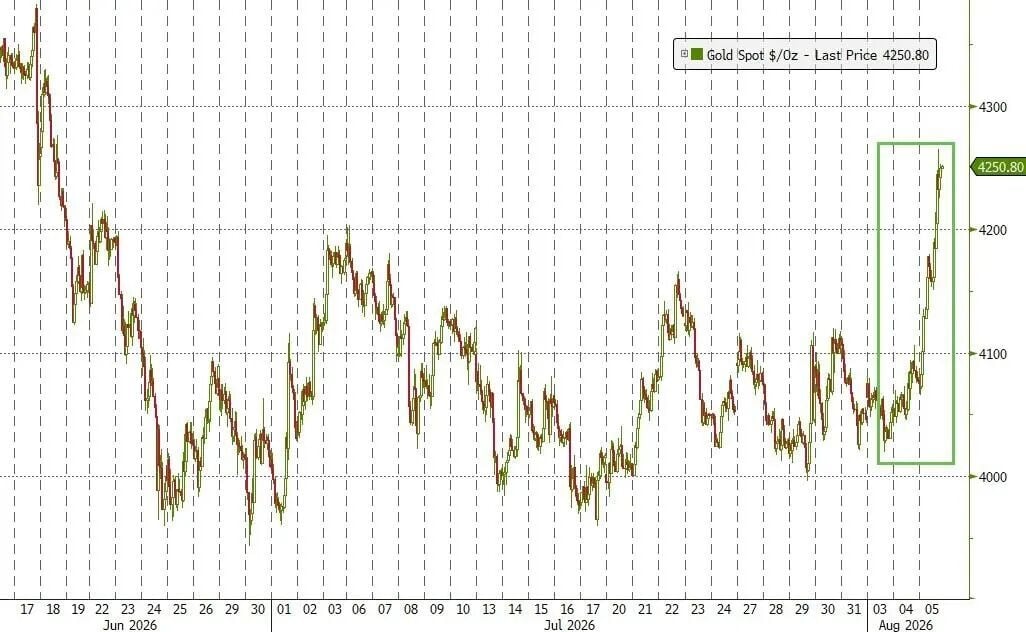
Last night, spot gold reached a high of $4328.20 per ounce during trading, closing at $4308, with a daily increase of 4.20%, rising by $173.80, marking the largest single-day increase in five months.
This trend not only broke through the descending triangle consolidation pattern that had suppressed gold prices for over six weeks but also stood above the 20-day and 50-day moving averages, illuminating bullish signals on the technical front.
This round of rise is driven by multiple catalysts.
Trump's latest remarks on reopening negotiations over the Strait of Hormuz ignited market expectations for geopolitical premiums;
Meanwhile, the expansion of global central bank gold reserves in the second quarter exceeded expectations, with the Bank of Korea notably resuming gold purchases after 13 years, further strengthening market confidence in sustained central bank demand support.
It is noteworthy that this significant rise in gold prices also coincided with a marked decrease in expectations for Fed interest rate hikes— the CME FedWatch tool shows that the probability of maintaining interest rates in September rose to 45%, the highest in over a month.
The bullish sentiment in gold is gathering strength again. A triple resonance of technical breakthroughs, central bank purchases, and a shift in macro expectations has brought the next key resistance level for gold prices to $4400 into view.
Trump's Remarks Ignite Geopolitical Premium
The direct catalyst for this round of gold rise comes from Trump's latest statement regarding the Strait of Hormuz. According to Xinhua News Agency, the U.S. Axios news site reported on the 4th that regional sources and U.S. officials stated that the U.S., Iran, and Oman are "close to reaching" a temporary agreement to reopen the Strait of Hormuz, with the U.S. hoping to announce the achievement of a temporary agreement on the 5th.
According to reports, Trump stated that Iran is actively negotiating for the reopening of the Strait of Hormuz, under the proposed arrangement, Iran will control vessels entering the Strait from the northern route, while Oman will supervise vessels exiting from the southern route, initially establishing a 60-day free transit period, which may be extended further.
This statement did not come out of nowhere. Iran has publicly stated that it has not directly negotiated with the U.S. but instead is discussing the opening of the waterway through Oman, which has long acted as a mediator between Washington and Tehran. The Strait of Hormuz carries about 20% of the world's maritime oil flow, accounting for about 15% of total global oil sales, making its navigation status significantly impactful on the global energy market.
The warming of geopolitical narratives provides short-term hedging premium support for gold and has become a key trigger for this breakthrough.
Central Bank Purchases Hit Record, Korea Returns to Market After 13 Years
Apart from geopolitical factors, the structural changes in central bank demand represent a more long-term significant support in the bullish logic for this round of gold.
According to data from the World Gold Council, global central banks purchased a total of 288.9 tons of gold in the second quarter, a year-on-year increase of 62%, marking the strongest second-quarter performance on record.
Poland had the largest purchase, reaching 51 tons, with its total reserves rising to a historical high of 632 tons, targeting 700 tons. Adam Glapiński, the governor of the National Bank of Poland, frankly stated: "We have been continuously buying gold, taking advantage of recent price corrections." China increased its holdings by 33 tons, continuing its long-term buying trend.
The most notable is the Bank of Korea's resumption of gold purchases after 13 years. Seoul stopped gold purchases in 2013, coinciding with a significant drop in gold prices, leading to enormous unrealized loss pressures for the Bank of Korea, and the then-governor was even summoned to Congress for questioning.
However, history has provided the answer— the 90 tons of gold Korea purchased at an average of $1629 per ounce that year is now worth about $11.8 billion, approximately $7 billion higher than the original purchase cost.
This time, the scale of the Bank of Korea's resumption of purchases is limited, planning only to purchase 4 to 5 tons of gold output per year from domestic copper and zinc smelting by-products, maintaining reserve levels at about 104.4 tons.
But its symbolic significance far outweighs the actual volume— this marks the reentry of an economy that has long been absent from the gold market.
The head of the reserve management department at the Bank of Korea, Jung Hee-sub, stated that the decision to purchase gold was not based on specific price judgments but made after comprehensively considering domestic and foreign gold prices and market conditions.
Interest Rate Expectations Cool, Technical Bullish Signals Fully Confirmed
In addition to geopolitical and central bank lines, the marginal changes in the Federal Reserve's policy expectations also provide macro background support for this gold rise.
The CME FedWatch tool shows that market expectations for the Fed to maintain interest rates in September have risen to 45%, the lowest level of interest rate hike expectations in over a month. The cooling of interest rate expectations reduces the opportunity cost of holding gold, further opening up upward space for gold prices.
On the technical level, this breakthrough is also significant. Gold prices not only effectively broke through the descending triangle consolidation area that had been pressing down since June 22, but they also simultaneously stood above the 20-day and 50-day simple moving averages— the latter being effectively breached for the first time since March. Bloomberg strategist Cameron Crise pointed out that although gold surged over 4% in a single day, according to its traditional driving factor model, gold prices "should" have slightly declined, indicating an extra momentum beyond conventional explanations exists in this rise.
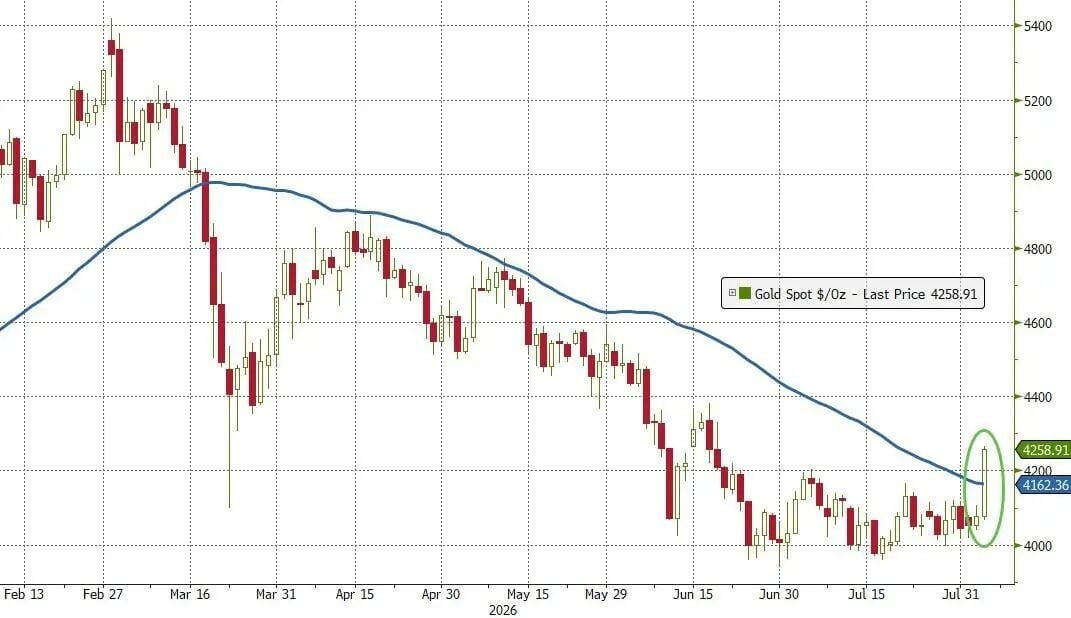
Looking ahead, the next target for the bulls is around $4400, which aligns closely with the historical turning point in November to December 2025, and is also close to the 23% Fibonacci retracement level from gold's decline from its historical high down to recent lows around the $4020 range.
If bullish momentum weakens, preliminary retracement support levels are sequentially at the 50-day moving average at $4243, the $4200 integer level, and the descending trend line that has now turned from resistance to support around $4070.
Deutsche Bank analysts Michael Hsueh and Bryant Xu expect the year-end target price for gold to be around $4700, while JPMorgan's revised target price still sets the average price at $4500 for the fourth quarter.
The World Gold Council, on the other hand, holds a more conservative stance in its mid-year outlook, believing that if there are no significant changes in the macro environment, gold prices will remain within a 5% range around $4100.
Analysts also remind that central bank gold purchases play more of a "supporting" role rather than being the main force pushing prices upward significantly— a truly sustained bull market still relies on the large-scale return of ordinary investors and funds.
免责声明:本文章仅代表作者个人观点,不代表本平台的立场和观点。本文章仅供信息分享,不构成对任何人的任何投资建议。用户与作者之间的任何争议,与本平台无关。如网页中刊载的文章或图片涉及侵权,请提供相关的权利证明和身份证明发送邮件到support@aicoin.com,本平台相关工作人员将会进行核查。


