Written by: Gino Matos
Translated by: Saoirse, Foresight News
Nowadays, Bitcoin holders looking to reduce downside risk typically only have the option to sell their assets or short perpetual futures contracts, but both methods incur capital costs and face the risk of forced liquidation. On-chain options provide a third path: paying a fixed premium while continuing to hold Bitcoin, thereby transferring the risk of a crash to counterparties willing to price it.
The crypto industry has established a mature market that facilitates investors in holding assets and leveraging directional bets; however, the market for managing positions' risks has yet to see sufficient development.
The options exchange Deribit holds 85% of the market share in Bitcoin and Ethereum options. According to data from Coinbase (which completed its acquisition of Deribit in August of the same year), Deribit's options trading volume reached $2.5 billion in the past 24 hours, with an open interest of $27.3 billion.
The on-chain market presents a different scenario. OAK Research estimated in March 2026 that on-chain options trading volume was only 0.2% of on-chain perpetual futures trading volume.
Spot and perpetual futures already provide tools for crypto investors: directly holding BTC or ETH, or establishing leveraged directional positions using borrowed funds. Options can achieve what the first two cannot—investors can independently choose which risks to retain and which to transfer.
Long-term holders can buy put options to hedge against crash risks without having to sell their assets; institutional investors can buy call options to set a maximum loss limit for newly established long positions; traders can buy straddle options to profit from market volatility; treasury management holding long-term static assets can sell covered call options to earn returns.
Options transform the previously binary risks of either profit or loss into standardized tradeable objects with pricing, expiration dates, and counterparties available to take on the risk.

How a mature options market can attract incremental funds
In an environment lacking a well-established options market, the general way to reduce risk is to sell the underlying asset or short perpetual contracts. Both actions either lead to capital flowing out of the market or increase leverage, making liquidation more likely. Buying put options allows investors to continue holding assets while paying for others to take on some downside risk.
This way, even if the market experiences a pullback, capital remains in the market; investors continue to hold asset exposure, with downside risks priced by other participants.
Options market makers will follow price movements, trading the underlying asset or corresponding futures to manage their directional exposure, which directly links options market liquidity to the spot and perpetual markets.
As hedge costs decrease, market makers can offer narrower spreads in options pricing; smaller bid-ask spreads attract more trading volume, subsequently driving more hedging orders back to the spot and perpetual contract markets.
The activity level of spot trading depends on investors' willingness to hold coins, while perpetual contract trading largely relies on bets on unilateral market movements. Options can attract a wider variety of funds: when volatility pricing is distorted, hedging costs are high, or event risks have trading value, volatility funds, market-neutral trading teams, insurance institutions, premium sellers, arbitrage teams, and structured product issuers will choose to enter the market. Even when the market is sideways or declines, these trading opportunities still exist.
On-chain options can price uncertainties regarding different strike prices and expiration dates, visually reflecting the costs investors are willing to pay for hedging, the concentrated range of bullish demand, and the time frames in which market expectations for large fluctuations arise.
This makes options a leading indicator, capable of reflecting the uncertainty of the crypto market rather than merely illustrating a snapshot of asset prices at a single moment.
Why on-chain options need the existing infrastructure of perpetual contracts
According to DeFiLlama's "2025 DeFi Industry Report": by 2025, the weekly trading volume of DeFi perpetual contracts is expected to reach $250 billion to $300 billion, far exceeding approximately $50 billion in 2024; the size of open interest is nearly expected to double, approaching $90 billion.
The new generation of perpetual contract platforms has already built exchange-level matching systems, deep order books, unified collateral systems, and institutional-grade risk control systems on-chain.
When traders purchase options, market makers typically trade the underlying asset or perpetual contracts to hedge their directional exposure as prices fluctuate. Research related to market structure shows that the bid-ask spread for options directly depends on the ease of market makers implementing hedges in the underlying market. Perpetual contracts can serve as a hedging vehicle, enabling on-chain options' feasibility.
The DeFiLlama options data dashboard reveals that the open interest in the on-chain options platform Derive has exceeded $1.2 billion; in March 2026, the trading volume of on-chain options premiums hit a new high, surpassing $51 million.
Compared to the daily average trading volume of approximately $21.4 billion in on-chain perpetual contracts, the size of the DeFi options market remains small. OAK Research estimates that the trading volume of options at that time accounted for just 0.2% of perpetual contract trading volume.
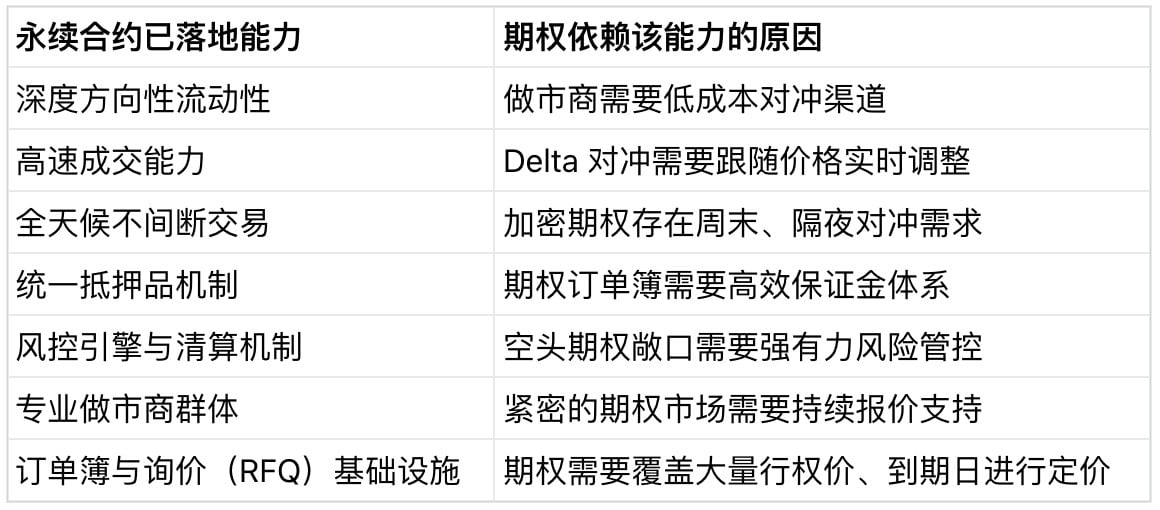
What changes can robust on-chain options development bring?
Protective put options can allow long-term holders to maintain positions during market crashes without panic selling, thus locking in maximum downside losses.
A covered call fund pool facilitates holders in earning returns based on long-held assets; cash-backed put options can allow asset management treasuries to generate revenue by purchasing assets at lower prices when prices drop to target levels.
Liquidation will no longer be the only way to mitigate downside risks in DeFi; investors can establish clear risk protection through options before receiving margin call notifications.
A paper on on-chain options published in 2026 stated that automated market makers have revolutionized decentralized spot trading, but no mature universal standards have emerged in the options space. The paper points out that a robust options infrastructure relies on high-frequency price oracles and stable, reliable liquidation engines, while most public chains currently lack these components.
A recent report on on-chain options published by Block Scholes believes that obstacles in the early development of the industry stem from liquidity shortages, difficult hedging, low participation willingness from market makers, and poor user experience.
The report also mentioned that new generation infrastructures like central limit order books and inquiry systems are helping market makers provide pricing for various strike prices and expiration dates more steadily.
A more realistic development path involves relying on capital pools and structured products to shield complex underlying logic: Bitcoin positions with downside protection, fixed-income notes, embedded insurance tools, in which ordinary users do not need to accomplish complex pricing themselves.
Market makers' hedging operations can both mitigate market volatility and potentially amplify fluctuations. If a large number of traders consolidate around the same strike price, market makers holding negative Gamma exposure will need to sell assets when prices fall and buy when prices rise, further amplifying existing market fluctuations.

What hurdles need to be overcome for on-chain options to achieve scalable development?
Optimistic scenario: liquidity in perpetual contracts, portfolio margin systems, and market maker participation continuously improve, allowing the market to maintain narrow options pricing across a wide range of strike prices and expiration dates.
Various funds, asset management treasuries, and hedging traders begin to adopt on-chain options as widely as they currently use Deribit. During periods of market volatility, investors continue to hold assets, transferring downside risk to others. DeFi has native hedging tools, volatility trading products, and insurance derivatives, allowing investors to manage risks without selling the underlying assets.
Pessimistic scenario: the complexity of options remains high over the long term, bid-ask spreads continue to widen, and liquidity cannot be concentrated. The strike prices and expiration date markets across different public chains and trading platforms are fragmented; market makers are constrained by limited hedging conditions, causing continued conservative pricing.
On-chain options remain a niche tool for professional trading teams, with the vast majority of users still relying on existing risk control methods: relying on perpetual contracts or directly selling the underlying asset during volatility spikes.
Perpetual contracts enable crypto leverage to achieve on-chain circulation, while options are expected to allow for the free on-chain flow of risks as well.
免责声明:本文章仅代表作者个人观点,不代表本平台的立场和观点。本文章仅供信息分享,不构成对任何人的任何投资建议。用户与作者之间的任何争议,与本平台无关。如网页中刊载的文章或图片涉及侵权,请提供相关的权利证明和身份证明发送邮件到support@aicoin.com,本平台相关工作人员将会进行核查。


