Key Takeaways
- Polymarket prices the CLARITY Act at 21% to become law by Dec. 31.
- Galaxy Research previously cut its 2026 passage estimate from 50% to 30%.
- The Senate filed a cloture motion Aug. 8 without holding a floor vote.
Polymarket traders assigned the Digital Asset Market Clarity Act a 21% chance of becoming law by Dec. 31, with more than $5.5 million in trading volume as of Aug. 9. That price puts a number on the question facing U.S. exchanges, token issuers, and custodians: whether comprehensive federal crypto rules arrive this year.
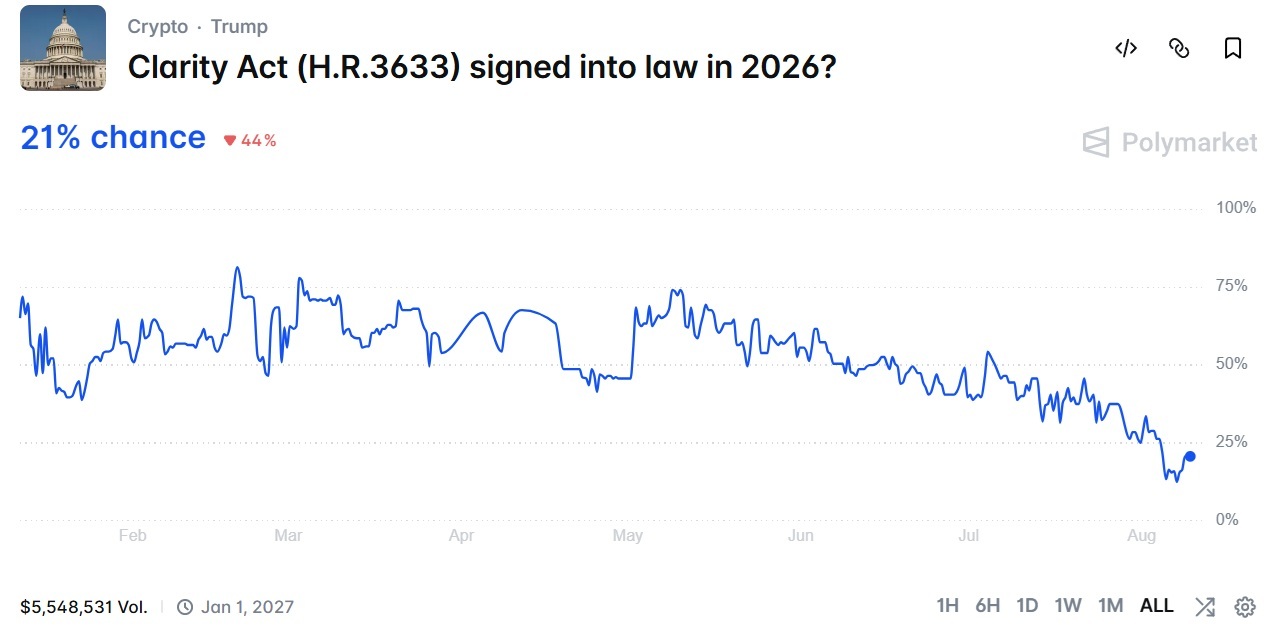
Polymarket’s CLARITY Act odds of being signed into law in 2026. Source: Polymarket
Introduced as H.R. 3633, the Digital Asset Market Clarity Act (CLARITY Act) is a market structure bill that divides oversight of digital assets between the U.S. Securities and Exchange Commission (SEC) and the U.S. Commodity Futures Trading Commission (CFTC). Senate negotiators merged the Banking and Agriculture committee versions into a 616-page text of 104 sections covering ethics, enforcement, custody, and stablecoin provisions.
Galaxy Research had already trimmed its own passage estimate from 50% to 30% on July 24, pointing to the unresolved disputes now weighing on the contract.
Democratic lawmakers concentrated their objections on the bill’s ethics language covering elected officials and digital-asset businesses. Minority staff at the U.S. Senate Committee on Banking, Housing, and Urban Affairs argued on July 30 that those provisions would leave President Donald Trump’s existing crypto interests largely untouched.
Committee staff widened the critique on Aug. 5, identifying five provisions they characterized as major loopholes. Their list spanned securities law, illicit finance, financial stability, consumer protections and ethics, extending the dispute from political safeguards into the rules that would govern trading platforms, pensions and regulators.
Negotiators entered August with three open items: ethics enforcement, illicit finance provisions and stablecoin yield. Republicans hold 53 seats, and Galaxy expects at least two to vote against, leaving supporters near 50 dependable votes and short of the 60 required to break a filibuster.
Supporters entered the final pre-recess stretch with a merged text built to satisfy two committees at once. U.S. Senator Cynthia Lummis (R-WY), who chairs the Senate Banking Digital Assets Subcommittee, released updated CLARITY Act language on July 22 combining Banking and Agriculture committee work.
Opposition hardened as the recess approached, and the procedural vote never materialized. Senate Majority Leader John Thune stated on Aug. 3 that the bill would reach the floor before the break, then confirmed on Aug. 6 that no August vote would occur, two days after Democrats signaled they would withhold cloture support absent movement on the three open items.
The chamber filed a cloture motion on the motion to proceed on Aug. 8, its latest recorded action, starting the procedural clock without settling the text. Senators return Sept. 14, placing the first cloture vote on Sept. 15 under Senate procedure.
Prediction markets convert legislative news into prices that traders back with capital, which is why the 21% figure keeps moving. Polymarket is a prediction market where contracts settle at $1 once an event resolves, so a share changing hands near 21 cents implies a 21% probability.
September returns senators to an unresolved text, a 60-vote threshold and ethics language no side has yet accepted. Payout on the contract requires more than a Senate floor win. The bill must clear Congress and receive a presidential signature before Dec. 31, leaving less than five months on the calendar and a considerably shorter congressional working window for those steps.
免责声明:本文章仅代表作者个人观点,不代表本平台的立场和观点。本文章仅供信息分享,不构成对任何人的任何投资建议。用户与作者之间的任何争议,与本平台无关。如网页中刊载的文章或图片涉及侵权,请提供相关的权利证明和身份证明发送邮件到support@aicoin.com,本平台相关工作人员将会进行核查。


