1. Proposal Background: "Fork Attempt" at Block Height 961,632
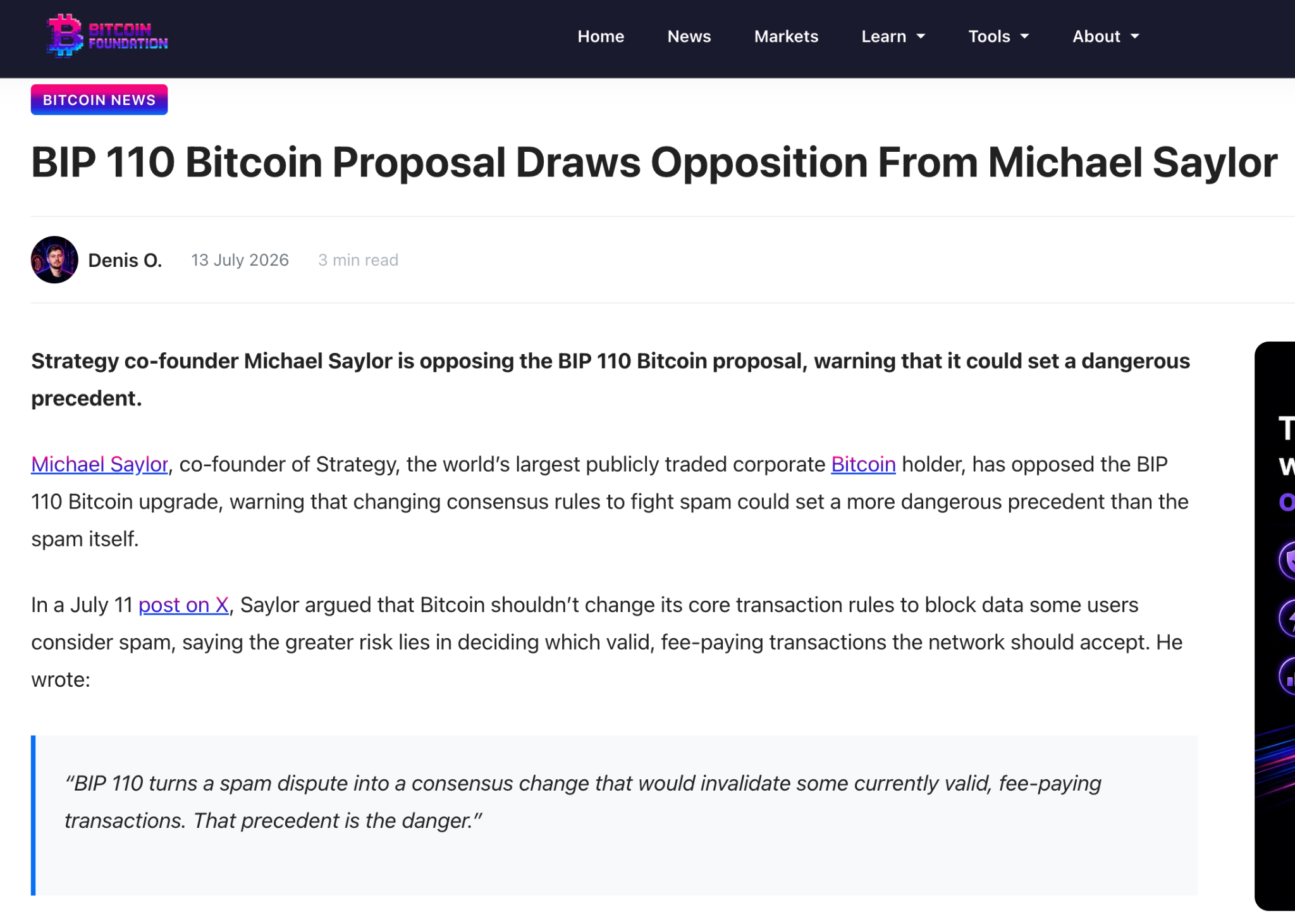
In August 2026, the Bitcoin community engaged in heated debates over an improvement proposal numbered BIP-110 (Bitcoin Improvement Proposal 110), which ultimately evolved into a hard fork attempt.
The origin of this proposal stemmed from the significant amount of non-financial data (such as Ordinals inscriptions, images, and text storage) occupying block space on the Bitcoin network in recent years, leading to a spike in on-chain transaction fees. Supporters of BIP-110 (primarily certain geeks and developers) advocated for modifying the underlying rules to restrict or prohibit the storage of such non-financial data in Bitcoin transactions for a specific period to purify the network and reduce costs for average transfers.
However, due to the proposal changing the underlying rules of the Bitcoin network and involving backward compatibility damage, it sparked significant controversy within the community:
- Lack of Consensus: The vast majority of forces, including mainstream miners, large custodians, exchanges, and the Bitcoin Core developer community, believed that forcibly excluding data types violated the free and permissionless attributes of blockchain, thus clearly rejecting the adoption of the proposal.
- Forced Upgrade and Fork: Without obtaining mainstream consensus across the network, a minority of nodes supporting BIP-110 chose to forcibly activate new rules at block height 961,632, severing compatibility with the original mainnet and forcibly initiating a hard fork.
This hard fork attempt, although generating widespread attention and discussion on social media, did not result in substantial confrontation at the on-chain hash power level.
2. Simple Breakdown: What Exactly is the BIP-110 Hard Fork?
To provide a clear understanding of this dispute for non-technical investors, we can use a traffic analogy from everyday life.
The Bitcoin mainnet can be imagined as a "highway" designed with a limited load capacity, while the financial transactions running on it are compliant "standard cash transport vehicles." In recent years, with the development of the blockchain ecosystem, some have begun to use Bitcoin's underlying space to store a large amount of images, texts, artworks, and even mini-games (the so-called on-chain inscriptions and non-financial data), which is akin to a flood of "tourist buses" inundating the highway, crowding the limited lanes, resulting in network congestion and soaring transfer fees.
The core demand of the BIP-110 proposal was put forward by some geeks and conservative developers: to modify Bitcoin's protocol rules to completely prohibit the storage of any non-financial data in Bitcoin transactions for a period of one year. Its intent was to purify block space and reduce everyday transfer costs for ordinary users.
However, in the blockchain field, the methods of changing rules are fundamentally different:
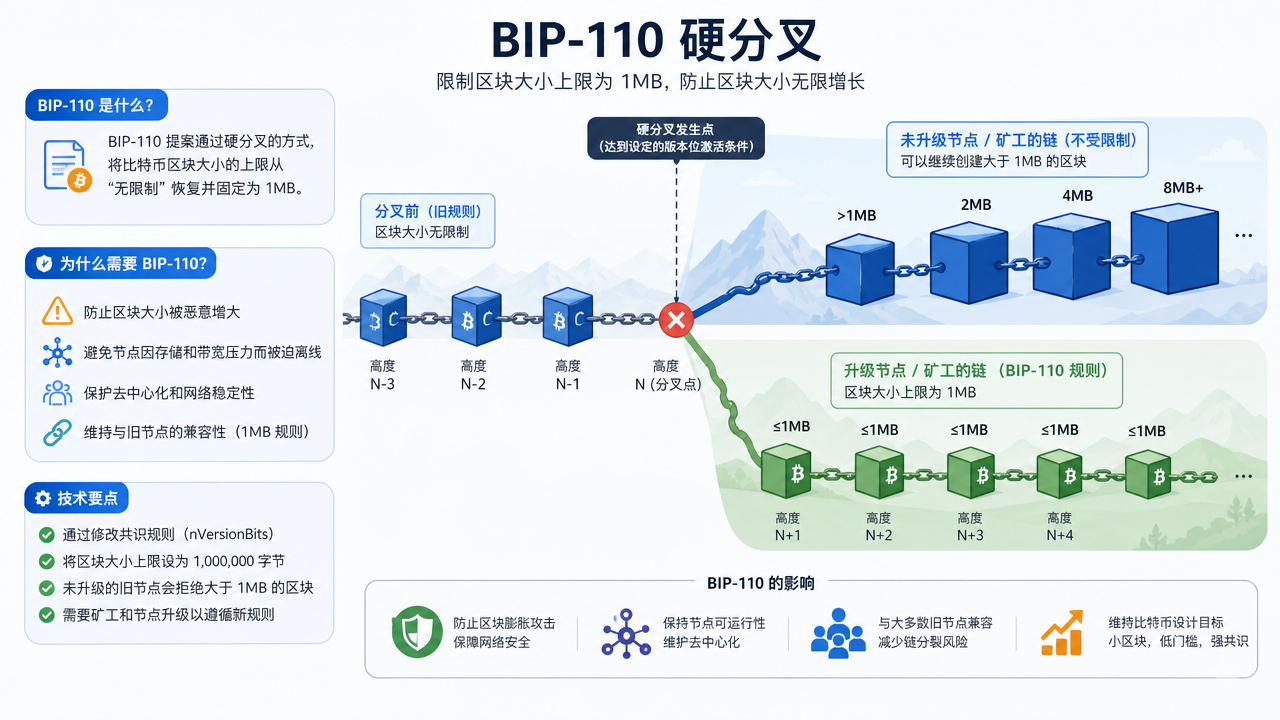
One method is called Soft Fork. A soft fork maintains backward compatibility, like establishing a new minimum speed limit on the highway. Old vehicles (nodes that have not been upgraded) may not understand the new rules but can still drive on the road; thus, the system does not split into two independent highways.
The other method is the Hard Fork that occurred this time. A hard fork completely disrupts backward compatibility, equivalent to a direct change in the roadway's topology. Unupgraded old nodes cannot recognize the blocks issued by the new rules, thus the old and new systems completely split at their intersection, operating independently in different directions and creating an entirely new blockchain system and a new derivative token.
When the BIP-110 proposal did not achieve absolute consensus within the community and only a minority of hash power responded, its supporters chose to upgrade nodes aggressively, forcibly splitting the Bitcoin ledger into two incompatible parallel universes—one retaining the diverse ecosystem of the BTC mainnet and the other pursuing a minimalist pure financial attribute of the BIP-110 fork chain.
3. What Would Happen If the Hard Fork Were Fully Implemented in the Crypto World?
If the BIP-110 fork gained dominant community support and was fully implemented, the underlying logic and operational rules of the entire crypto ecosystem would undergo profound rewriting.
1. Structural Reshaping of the Cryptocurrency Ecosystem
Firstly, Bitcoin's value anchoring would be torn apart. In the past, Bitcoin established its status as "digital gold" relying on unique absolute consensus globally. The implementation of the hard fork would cause it to diverge into two chains with distinctly different functions: one focusing on absolutely pure value storage and financial settlement, and the other retaining rich data storage capacity and cultural art inscriptions. This differentiation would disperse the previously highly centralized flow of funds and developer resources, significantly weakening Bitcoin's gathering effect as the only core asset of the entire network.
Secondly, the economic model for miners would be completely altered. If non-financial data is entirely banned, miners would lose substantial inscription transaction fee income they enjoyed in recent years. To maximize profits, the mining community might frequently switch hash power between the two chains, potentially triggering dramatic fluctuations in security protection levels and hash power wars.
2. Exchanges Facing Risk Control and Operational Challenges
For centralized exchanges, the hard fork presents a severe technological and compliance exam. During the fork, exchanges must comprehensively suspend deposits and withdrawals of related assets and complete an extremely precise asset snapshot at a specific block height to distribute the newly forked tokens to users on a one-to-one basis.
At the same time, to fend off the 51% hash power attacks and replay attacks that are easy to occur early in the fork, exchanges must significantly increase the number of blocks required for deposit confirmations. What originally could be completed in a few minutes might require waiting for confirmation from hundreds of blocks, which greatly reduces the overall capital turnover efficiency of the market.
3. Dramatic Disruption of Market Trends and Derivatives
Market liquidity would severely dry up in the short term. During the window of the fork, Bitcoin lending rates on decentralized lending platforms often spike dramatically as a large number of investors choose to borrow Bitcoin spot in hopes of obtaining free new coins after the fork. This behavior would lead to violent fluctuations in the basis between the spot and futures markets, and traditional risk hedging models would fail.
In the long run, frequent and destructive hard fork events may damage institutional investors' trust in the blockchain's "absolute immutability," possibly causing substantial compliant capital to delay entry and observe, casting a shadow over the overall market capitalization growth of the crypto market.
4. Transformation of Investment Habits and Trading Strategies
For quantitative trading teams and high-frequency arbitrage firms, traditional risk-free arbitrage strategies will become unsafe in the face of forked chains without proper replay protection. Severe delays in on-chain confirmations and enormous slippage risks could lead to logical confusion or even liquidation in automated strategies.
As a result, investors' asset storage habits will profoundly change. More users will realize that storing assets on small platforms lacking technical strength and risk control capabilities is highly risky, leading to accelerated capital concentration towards large leading platforms with comprehensive risk control systems and solid technological foundations.
4. Aftermath: Current Status and On-Chain Outcome of BIP-110 Proposal
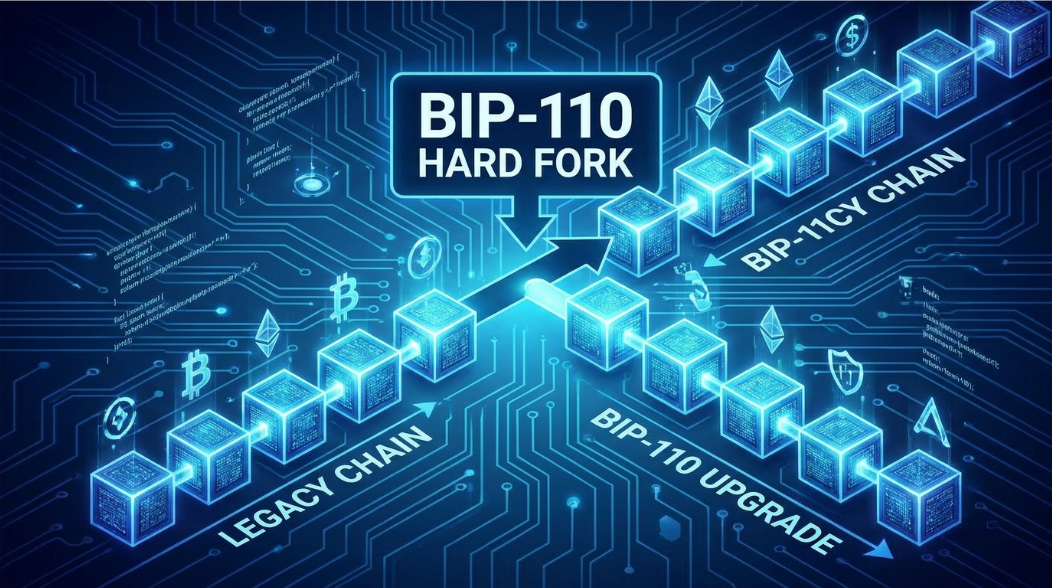
This hard fork crisis, which once tightened the nerves of the entire network, ultimately did not evolve into a prolonged division struggle but rapidly ended in the "instant death" of the fork chain.
1. On-Chain Stagnation: A "Zombie Chain" that Only Mined Two Blocks
After forcibly breaking away from the mainnet at block height 961,632, the BIP-110 fork chain faced devastating hash power shortages. As the vast majority of miners and mining pools chose to stick with the Bitcoin mainnet, the fork chain only received less than 2.5% of the hash power support from the entire network. After barely mining 2 blocks, the entire fork chain became stalled due to the inability to surpass the extremely high mining difficulty left by the mainnet, effectively devolving into a "dead chain" that could not perform any interactions or confirmations.
2. Comprehensive Rejection of Community Consensus and Resistance from the Mainstream Camp
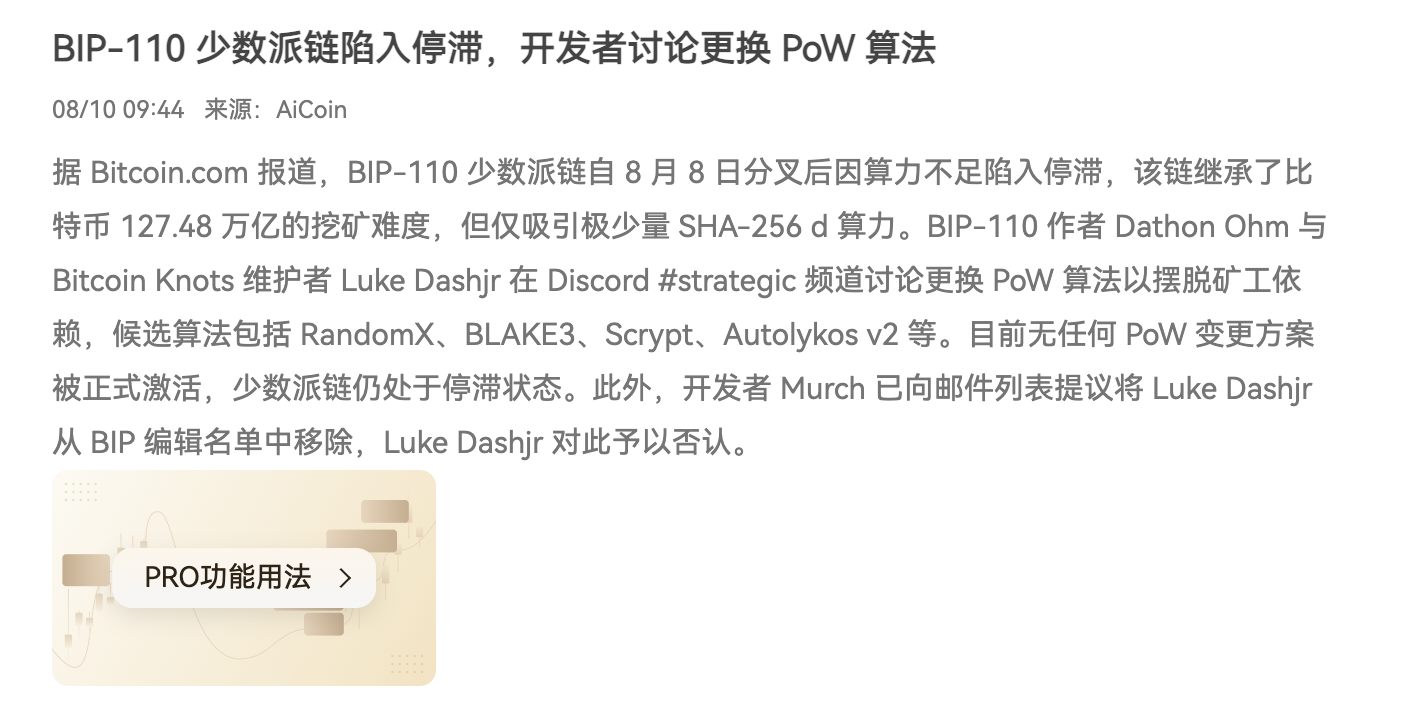
During the proposal's promotion process, key industry leaders, including MicroStrategy founder Michael Saylor, publicly expressed strong opposition. The community widely believed that artificially limiting on-chain data through a forced hard fork not only violated the underlying logic of free market competition in Bitcoin but also posed a dangerous challenge to the network’s decentralized consensus. This widespread resistance led to BIP-110 facing a complete cold shoulder from exchanges, wallet service providers, and institutional fronts.
3. Stable Operation of Mainnet and Factually Failed Proposal
As the hash power of the fork chain diminished to zero and could not maintain basic operations, the BIP-110 proposal has been factually declared a failure. The Bitcoin mainnet and its ecosystem were not substantively damaged and continued to produce blocks smoothly according to the original rules. This crisis ultimately became a landmark event in history—it provided extreme and real data proving that any attempts to split the Bitcoin network through hard forks, without overwhelming consensus and hash power support, will be quickly devoured by the self-regulating mechanisms of a decentralized market.
💡 Industry News Column: OKX Limited-Time Benefits and Quality Trading Experience
In the face of severe market fluctuations and systemic risks on the chain, choosing a safe, reliable, and tightly regulated trading platform is crucial. As a leading global cryptocurrency trading platform, OKX has recently launched limited-time festive activities for both new and existing users:
Exclusive Blind Box for New Users: New users registering and completing identity verification (KYC) can draw a digital asset blind box worth up to 10,000 USDT.
On-Chain Earning Bonus Privilege: Limited-time financial increase vouchers have been launched for mainstream assets like BTC and ETH, helping you easily gain stable annualized returns during risk-averse periods.
Ultimate Trading Experience: OKX has a top-tier replay attack protection system and millisecond-level matching engine, ensuring a smooth and safe trading environment even in extreme market conditions.
Visit the OKX official website or download the official app now to explore more event details and start your journey of prudent investment management.

5. Conclusion
The BIP-110 hard fork incident showcased the brutality and reality of governance games in decentralized networks. While it created a frightening crisis, it also reaffirmed the resilience of blockchain systems, relying on market and hash power selection. For ordinary investors, understanding the logic behind the code, maintaining a respect for risk, and choosing trustworthy service platforms are the ultimate keys to navigating through any turbulent waves.
🎁 AiCoin Exclusive Registration Benefits Are Here!
Register for OKX through the AiCoin exclusive link for a permanent 20% rebate
👉 Register for OKX now:
https://jump.do/zh-Hans/xlink?checkProxy=true&proxyId=2
📢 Join AiCoin community for more information on new coins and earning insights from exchanges
Official Telegram community:
AiCoin Chinese Twitter:
OKX benefits group:
https://aicoin.com/link/chat?cid=l61eM4owQ

The content of this article only represents the author's personal views and does not reflect the stance of this platform. The opinions, conclusions, and suggestions in the text are for investors' reference only and do not constitute any investment advice related to this platform. Markets carry risks, and investments should be approached with caution.
免责声明:本文章仅代表作者个人观点,不代表本平台的立场和观点。本文章仅供信息分享,不构成对任何人的任何投资建议。用户与作者之间的任何争议,与本平台无关。如网页中刊载的文章或图片涉及侵权,请提供相关的权利证明和身份证明发送邮件到support@aicoin.com,本平台相关工作人员将会进行核查。