Written by: AJC
Translated by: Saoirse, Foresight News
Introduction: Robinhood's Crypto Business at a Crossroads
No company has grasped the rise of retail investors like Robinhood. It has become synonymous with retail investing, and with this identity, the company’s main business has thrived.
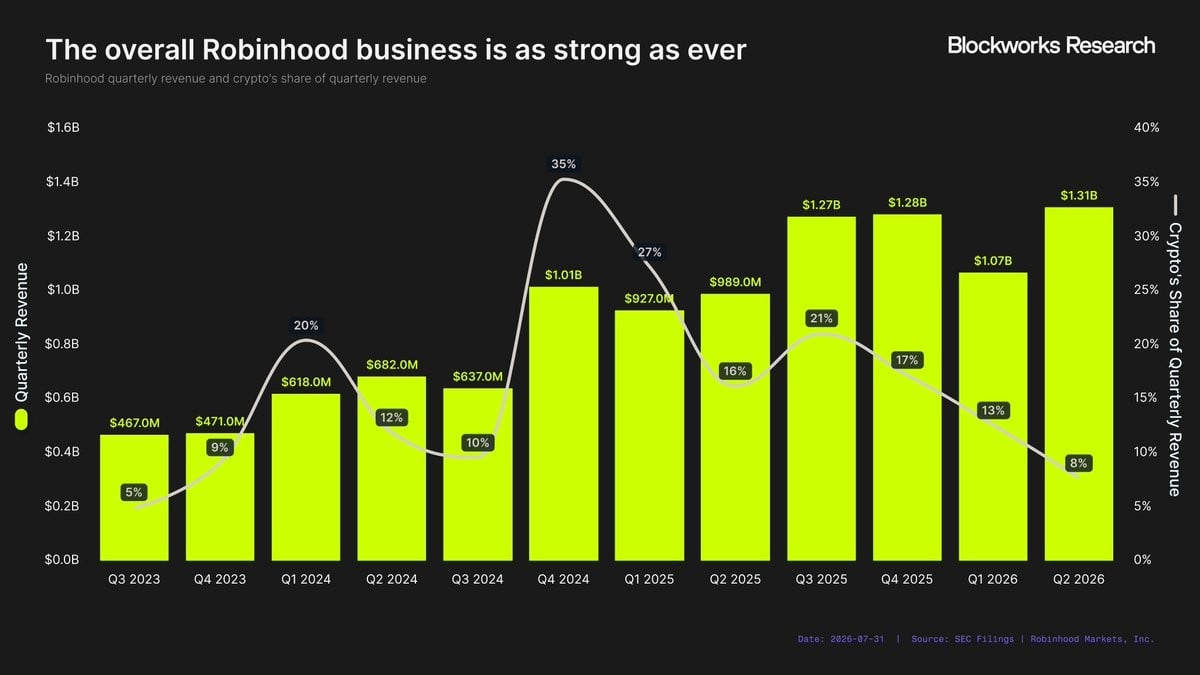
In the second quarter of 2026, Robinhood reported quarterly revenue of $1.31 billion, marking a historic high and a year-on-year increase of 32%, up 92% from the second quarter of 2024. This growth in performance comes not only from its core business in stocks and options trading but also from a continually expanding product matrix. Currently, Robinhood boasts 13 revenue lines, each generating over $100 million annually. In fact, all revenue lines reliant on trading experienced double-digit year-on-year growth in the second quarter — with the exception of its cryptocurrency operations.
Once contributing over a third of Robinhood's revenue, the cryptocurrency segment now accounts for a negligible share. In the second quarter of 2026, cryptocurrency revenue made up only 8% of the company’s total quarterly income, the lowest level since the third quarter of 2023. The share of cryptocurrency revenue is consistently shrinking; even the event contracts business, which launched only last year, generated $156 million in revenue in the second quarter, surpassing the cryptocurrency business's $100 million.
The downturn is evident not just in the declining revenue share; overall, the platform's core users' interest in cryptocurrencies is waning. While this trend isn't unique to Robinhood, the magnitude of the decline is shocking.
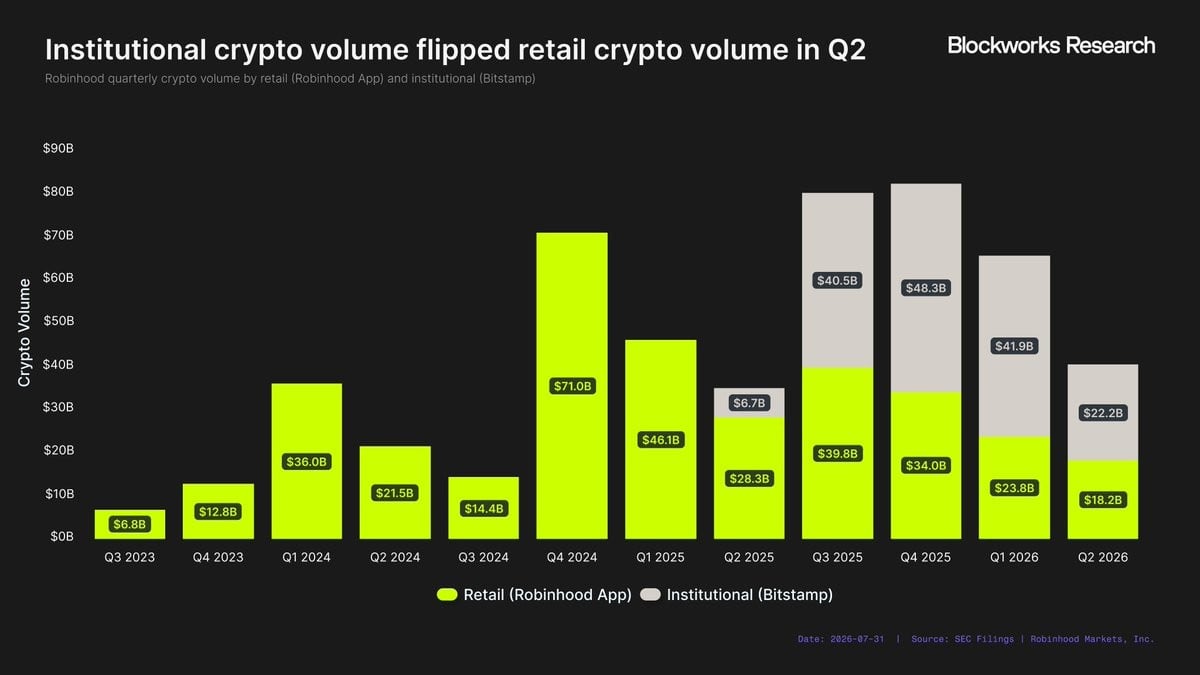
Trading data clearly illustrates this trend. In the second quarter of 2026, the retail cryptocurrency trading volume on the Robinhood app was only $18.2 billion, a year-on-year drop of 36%, reaching the lowest quarterly level since the third quarter of 2024. The significant decrease caused institutional trading volume generated via Bitstamp to exceed retail trading volume for the first time in history. However, institutional market conditions were also sluggish, with Bitstamp's trading volume for the quarter totaling $22.2 billion, the second lowest in history.
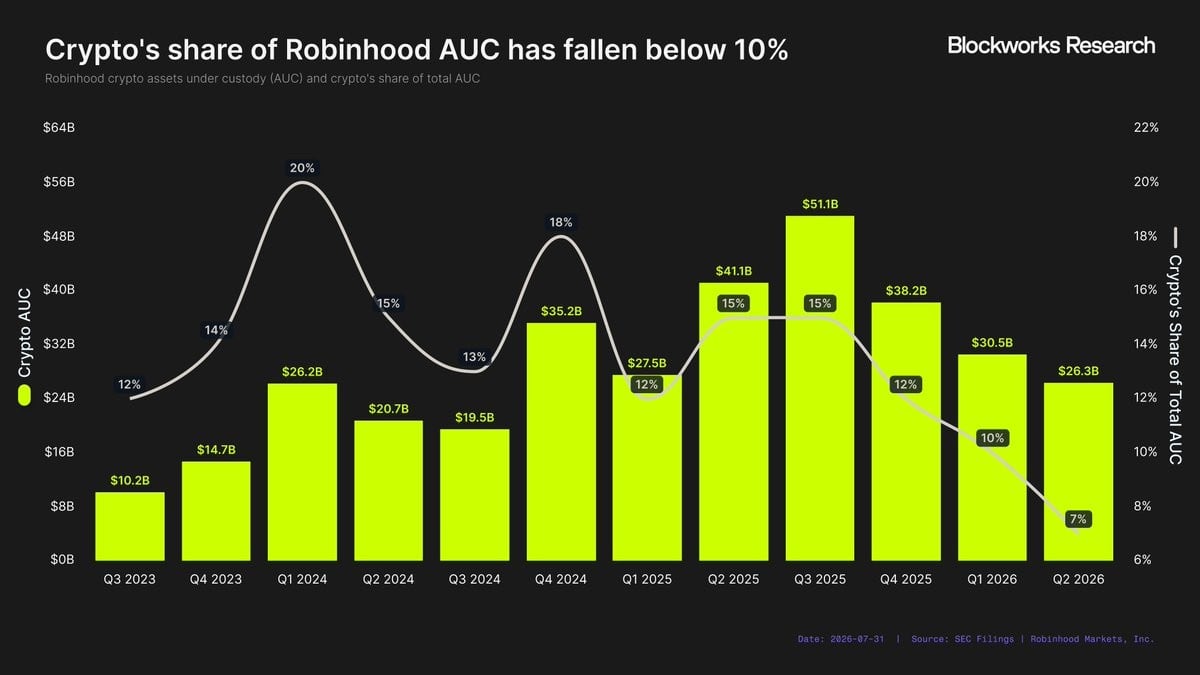
Cryptocurrency trading volume is not the only weakening indicator. In the first quarter of 2024, Robinhood's assets under crypto custody (AUC) stood at $26.2 billion, making up 20% of the platform's total custodial assets. More than two years later, the cryptocurrency custody assets have barely changed, at $26.3 billion, but its proportion of total assets has dropped to 7%, setting a historic quarterly low.
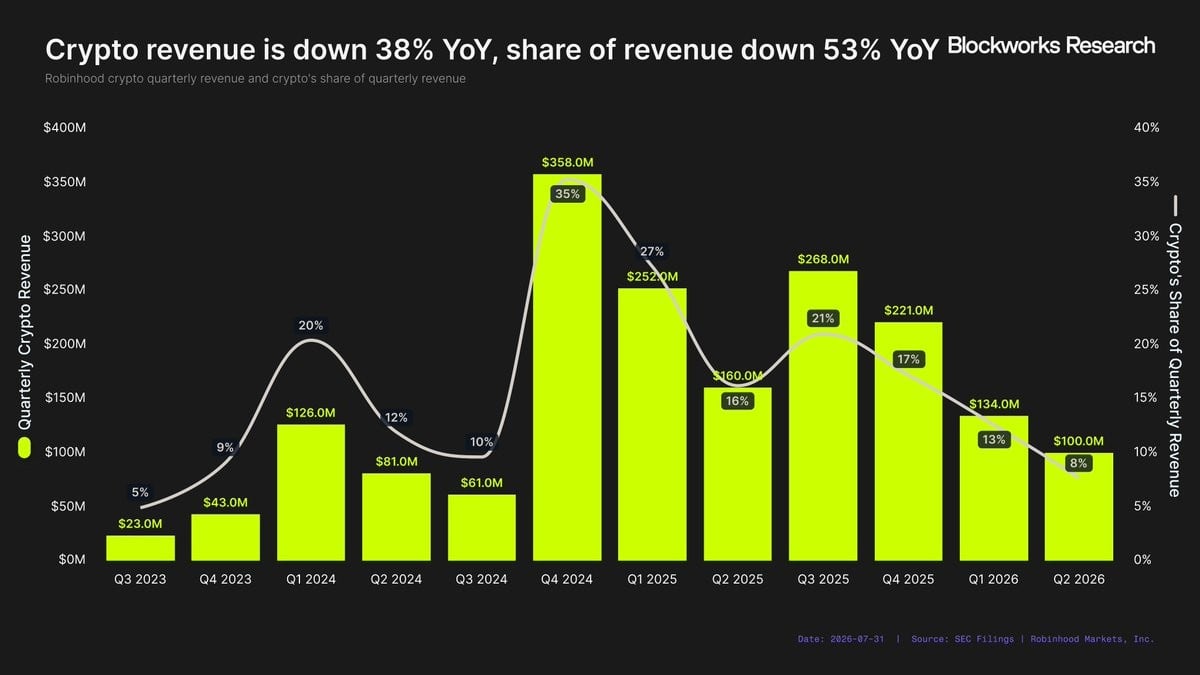
Affected by the broader environment, Robinhood’s cryptocurrency business revenues continue to face pressure. Cryptocurrency revenue in the second quarter fell by 38%, with its proportion of the company's total revenue declining by 53%. In simple terms: Robinhood continues to grow overall, but its cryptocurrency business has stagnated.
Even so, Robinhood has not chosen to exit the cryptocurrency space. On the contrary, the company has launched Robinhood Chain, placing its largest bet in the crypto field to date. Robinhood no longer solely relies on trading fees for profit and is attempting to construct a broader and more sustainable cryptocurrency business. The core question is: Can Robinhood Chain make the cryptocurrency business a significant driver of growth for the company again?
How Much Monetization Potential Does Robinhood Chain Have?
On July 1, 2026, Robinhood officially launched its mainnet — Robinhood Chain — at the "World Is Flat" event. This self-developed Layer 2 blockchain will support the company's continuously expanding on-chain ecosystem. After its launch, Robinhood Chain became one of the fastest-starting blockchains in recent years.
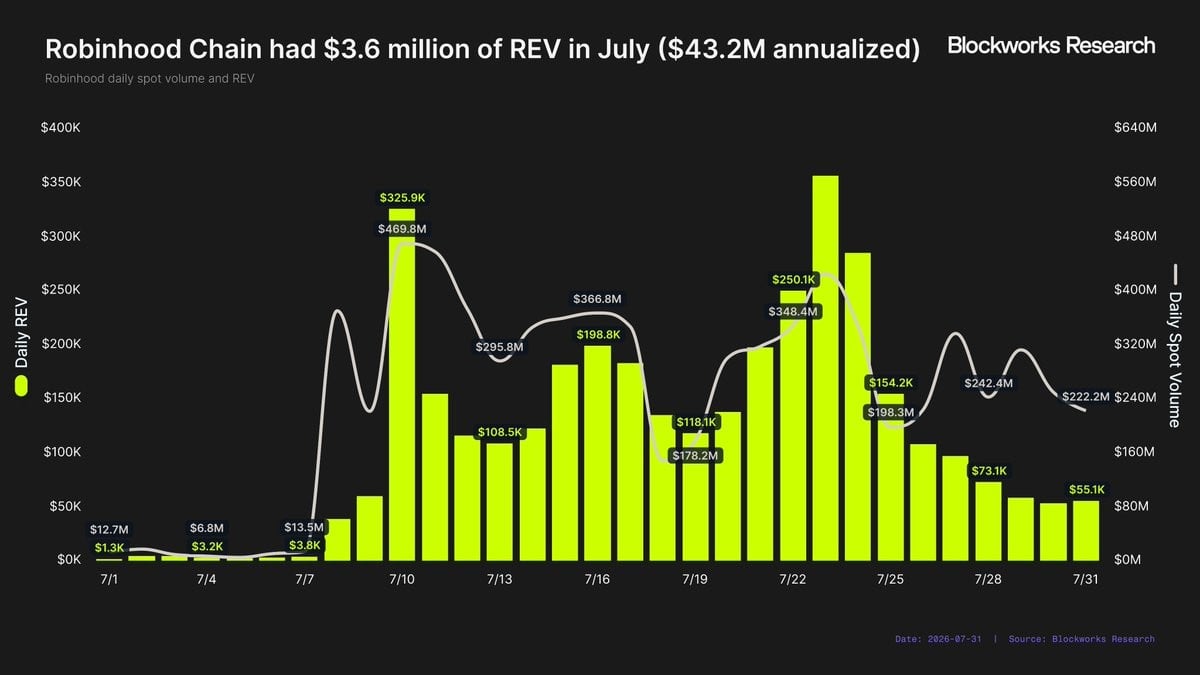
In its first month alone, Robinhood Chain generated $3.6 million in real economic value (REV). With just one month of data, it's still unclear if this level of activity can be sustained long-term; if we annualize the first month’s data, the yearly REV could reach $43.2 million. The launch performance is impressive but relying solely on this revenue is far from sufficient to reverse the downward trend in cryptocurrency business revenues.
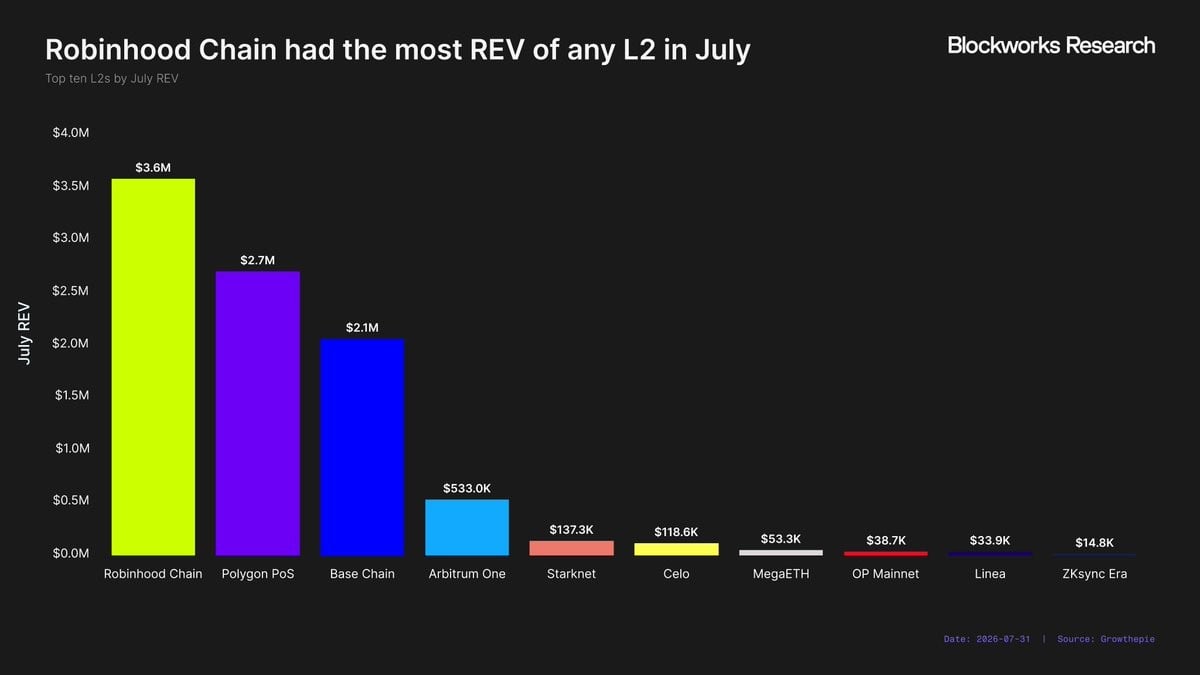
Nonetheless, the launch performance of Robinhood Chain is still noteworthy. In July, the chain's network revenue ranked first among all Layer 2s, surpassing Polygon ($2.7 million) and Base ($2.1 million). In the Layer 2 ecosystem tracked by Growthepie, Robinhood Chain accounted for 38% of all on-chain revenue. This means that in terms of network revenue, it has already become the largest Layer 2 by scale, but the remaining 62% of the market share is still occupied by other public chains. Even if the overall Layer 2 market revenue stagnates, Robinhood Chain can continue to achieve significant growth by capturing market share.
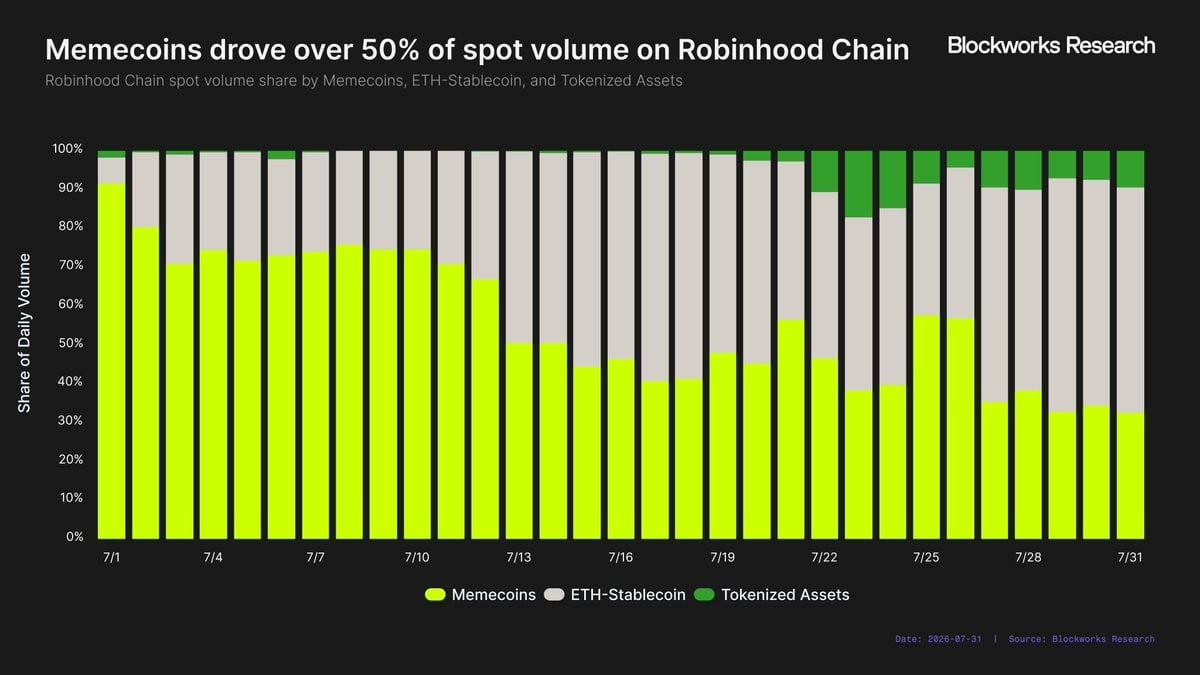
However, a key hidden danger exists in the early prosperity of Robinhood Chain: much of the current activity relies on meme coins, which have historically been one of the most important sources of on-chain REV. Robinhood's founder, Vlad Tenev, has publicly expressed support for meme coins, and the company seems to embrace this development model. Yet, the degree to which meme coins drive on-chain activity is beyond expectations. In July, Robinhood Chain's spot trading volume reached $6.93 billion, with $3.55 billion, or 51%, coming from meme coins. In contrast, the main narrative of Robinhood Chain, RWA (real-world assets), only generated $313.2 million in trading volume, accounting for just 5% of the total.
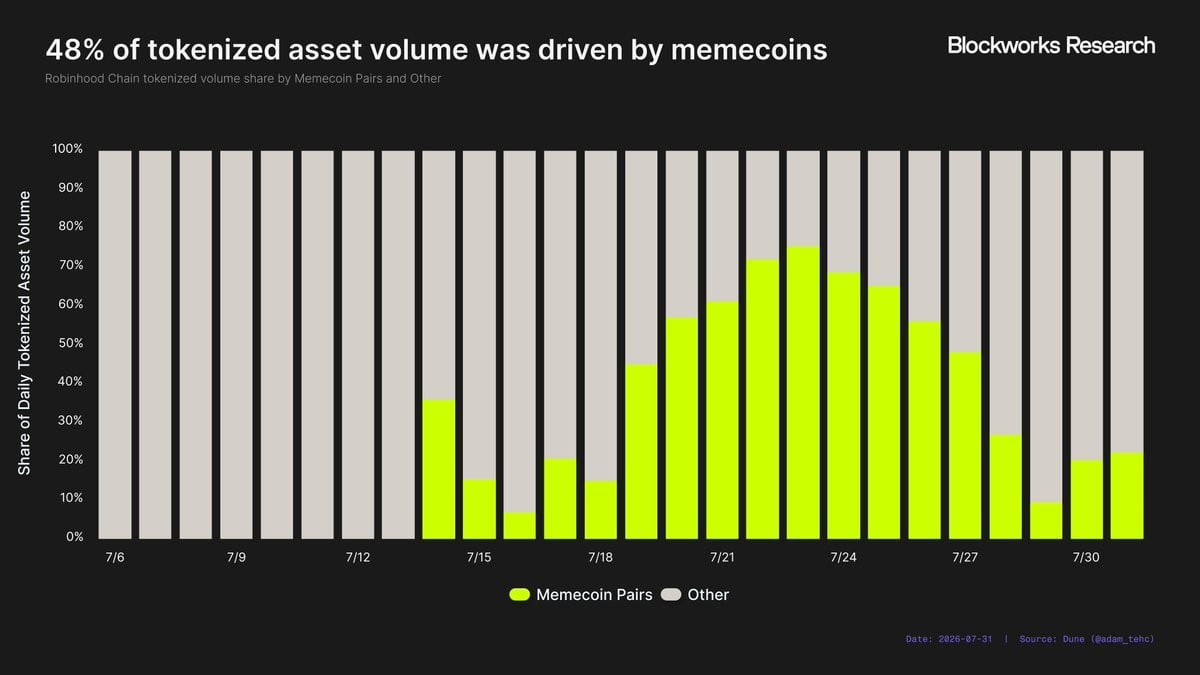
Moreover, the influence of meme coins is not limited to direct trading volume. Taking RWA trading as an example, the meme coin issuing platform launched a popular strategy: creating liquidity pools that pair meme coins with tokenized stocks and ETFs, allowing meme coin prices to be tethered to the underlying RWA assets. If the underlying RWA increases by 5%, the meme coin price also rises by 5%, assuming no users buy or sell meme coins. Consequently, a significant portion of trading volume that seems to belong to RWA essentially stems from meme coins. From July 6 to July 31, 48% of RWA trading volume originated from liquidity pools pairing RWA with meme coins.
Meme coins can temporarily boost on-chain revenue, but they are unlikely to create stable long-term cash flow. Their funding rotation feature is strong; Ethereum, Avalanche, TRON, and Base have all experienced frenzied speculative markets, ultimately leading liquidity to other sectors. Robinhood Chain may have the ability to retain such funds, but one month of data does not allow for conclusions. It remains uncertain whether meme coins can continuously provide stable REV to Robinhood Chain or if this chain is merely a temporary stop for rotating funds, with the eventual return of funds to Solana.
Broader perspectives reveal that relying solely on Robinhood Chain's own network revenue makes it difficult to revitalize Robinhood's cryptocurrency business. The entire crypto industry’s network revenue is currently in a structurally declining channel. Although the first generation of smart contract public chains profited handsomely from block space, this block space has gradually become commoditized, making it challenging for new public chains to create significant revenue through transaction fees.
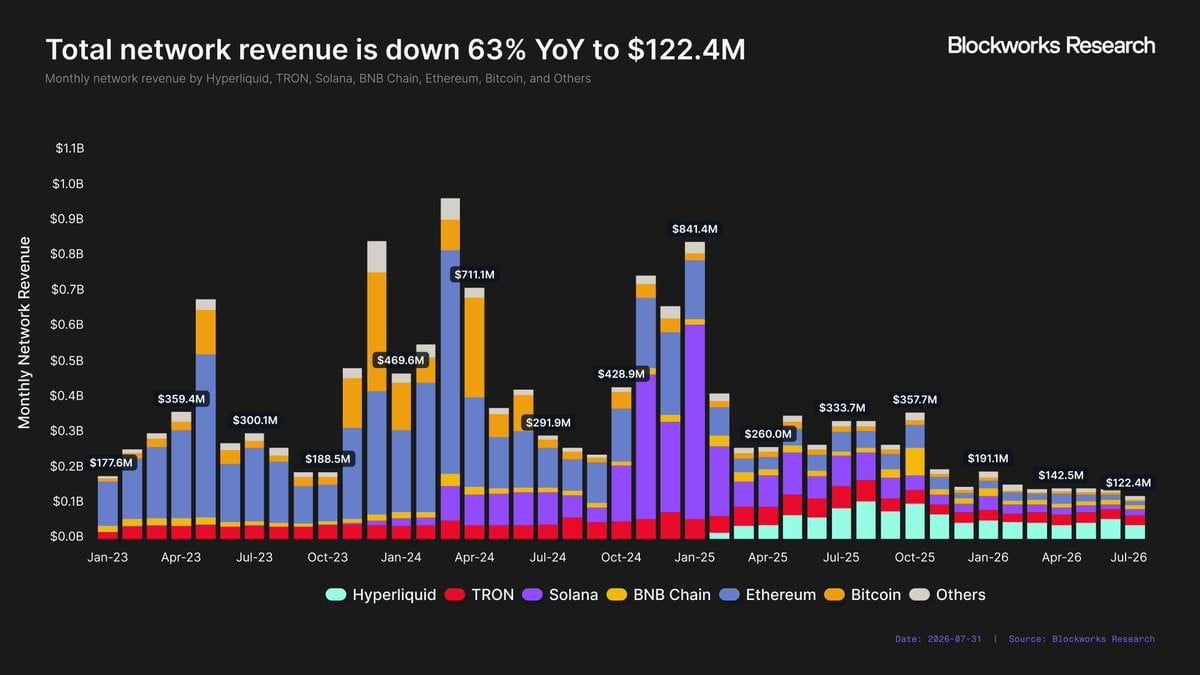
In July, the total network revenue of all public chains within Blockworks' statistical scope was $122.4 million, marking the lowest monthly figure in three and a half years. For comparison, total network revenue in July 2025 was $333.7 million, marking a year-on-year decline of 63%. The shrinking revenue is not solely due to current market conditions; during the bear market in July 2023, total revenues from public chains still reached $300.1 million.
As mentioned earlier, Robinhood has 13 revenue lines, each generating over $100 million annually. Relying solely on network fees, it's challenging for Robinhood Chain to enter this category. Even if Robinhood continues to capture more Layer 2 traffic, on-chain revenue will ultimately hit an industry ceiling, roughly around $100 million annually. To break through this ceiling, the platform must guide its existing users into the on-chain ecosystem. However, since Robinhood users are primarily based in the U.S., and current regulatory policies restrict U.S. users from accessing Robinhood Chain through the main Robinhood app, the user migration process may take quite a long time. If Robinhood hopes to grow Robinhood Chain into a multi-billion dollar revenue line in the short term, it cannot focus solely on network fees.
Seeking Monetization Opportunities at the Application Layer
The monetization focus in the cryptocurrency industry is gradually shifting from the infrastructure layer to the application layer, with Solana being a typical example.
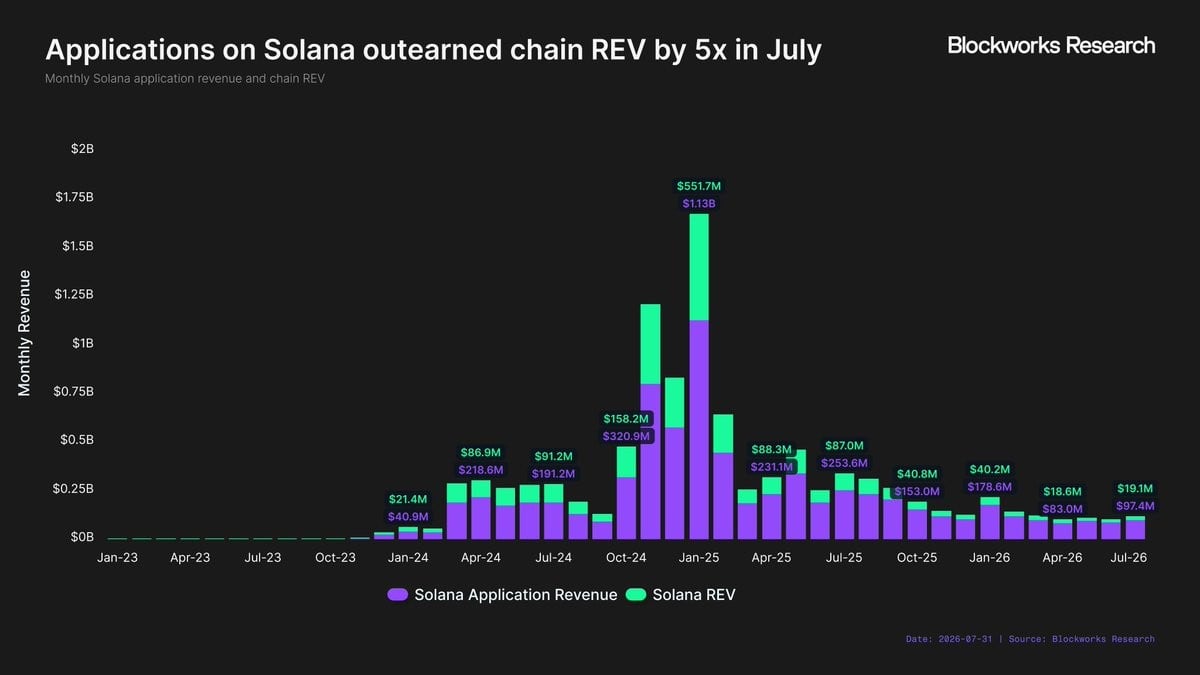
In January 2024, at the beginning of Solana's market surge, the total on-chain application revenue for that month was $40.9 million, with Solana’s native network REV at $21.4 million, yielding a ratio of about 1.9 times. By the peak of the bull market in January 2025, application revenue reached $1.13 billion, while Solana network REV was $551.7 million, maintaining a ratio of around 2 times. However, the gap between the two has continued to widen; by July 2026, for every $5 of revenue generated by Solana on-chain applications, the public chain generated only $1 in REV.
Looking at the entire industry, applications are capturing more and more of the value they create, while the revenue stakes taken by underlying public chains are continuously shrinking. If Robinhood wants Robinhood Chain to grow into a billion-dollar revenue business, it must directly participate in the revenue sharing of on-chain applications. While Robinhood has not formally announced this strategy, early moves are already showing this direction.
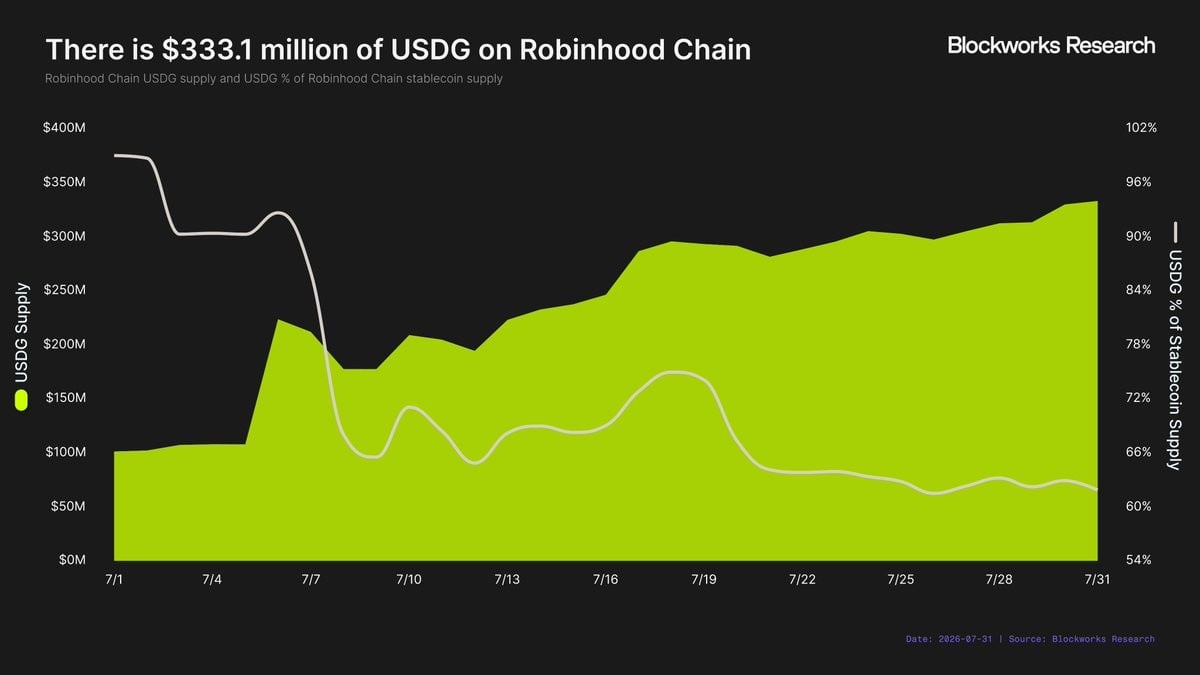
The most typical layout currently is the stablecoin strategy. The vast majority of public chains choose USDC or USDT as their mainstream stablecoins, but Robinhood has designated USDG as the native stablecoin of Robinhood Chain. By relying on USDG's reserve assets to generate interest, Robinhood has created a new revenue channel. As of the end of July, the market cap of USDG on Robinhood Chain was $333.1 million. Assuming a 3.5% yield on reserve assets, and that 90% of the interest income belongs to Robinhood, USDG could generate an additional annual income of $10.5 million.
Expanding the circulation of USDG presents little difficulty, and the stablecoin business is likely to create a sustained cash flow. Once the circulation of USDG reaches $1 billion (currently, 11 public chain stablecoins have surpassed this threshold, making this goal feasible), the corresponding annual income will reach $31.5 million, nearly equivalent to Robinhood Chain's current annual network revenue.
Beyond stablecoins, Robinhood Chain is also continuously exploring more monetization paths at the application layer. The decentralized perpetual contract platform Lighter has completed a custom deployment on Robinhood Chain, with trading fees split 50/50 between both parties. According to the cooperation plan, the standalone self-custody wallet, Robinhood Wallet, will directly launch Lighter’s perpetual contracts. Additionally, there are reports that Morpho has paid fees to Robinhood to integrate services within the main Robinhood app. This is in stark contrast to the industry norm: generally, public chains subsidize applications to attract project deployments, whereas Robinhood relies on traffic to charge projects.
What is the True Value of Robinhood's Traffic Distribution?
The feasibility of this entire application layer monetization strategy ultimately depends on the commercial value of Robinhood's traffic channels. If project teams are willing to pay to acquire Robinhood users, Robinhood can monetize the traffic. From early cases, there are two channels through which project teams can acquire traffic:
- Integrate into the Robinhood main app, such as Morpho;
- Integrate into the standalone wallet, Robinhood Wallet, such as Lighter.
The traffic value of the Robinhood main app has been validated, but the monetization potential of Robinhood Wallet remains uncertain.
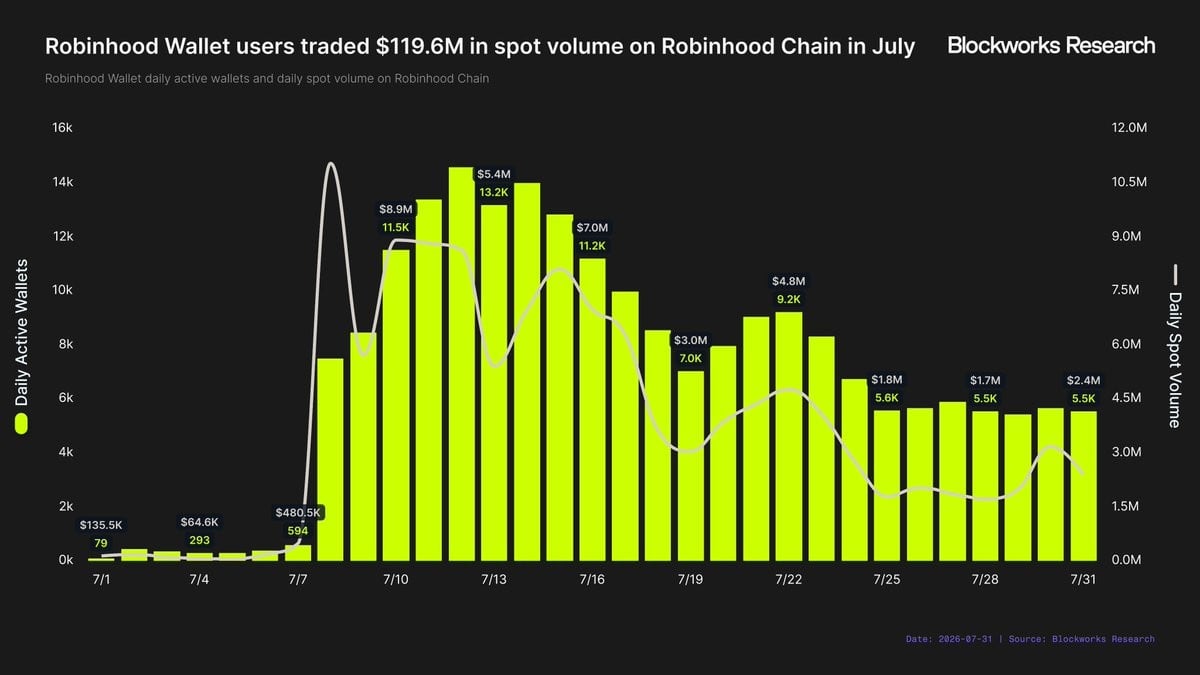
Looking solely at on-chain data from Robinhood Chain: In July, Robinhood Wallet users generated a trading volume of $119.6 million. On July 8, the trading volume peaked at $11 million, while the last week of the month saw an average daily trading volume dropping to $2.1 million. In July, the daily active number of wallets on Robinhood Wallet was fewer than 7,000, and this count does not filter out "witch" addresses, indicating that the actual number of independent users may be lower.
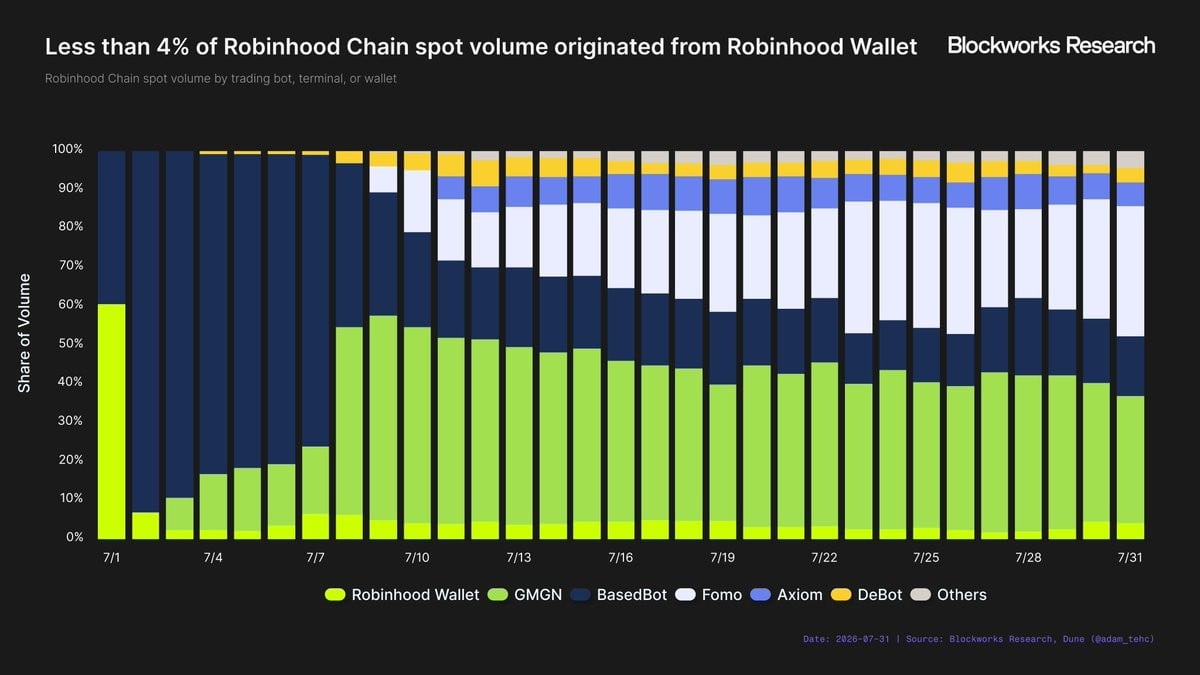
In comparison to other wallets and trading applications on Robinhood Chain, Robinhood Wallet is relatively small in scale. Within the scope of statistical data in July, the total trading volume of wallets and trading applications was $3.08 billion, with Robinhood Wallet contributing $119.6 million, capturing less than 4% of the market share. However, on-chain trading volume is highly concentrated among heavy users, ranking fourth in daily active wallet numbers, with trading volume only ranking sixth.
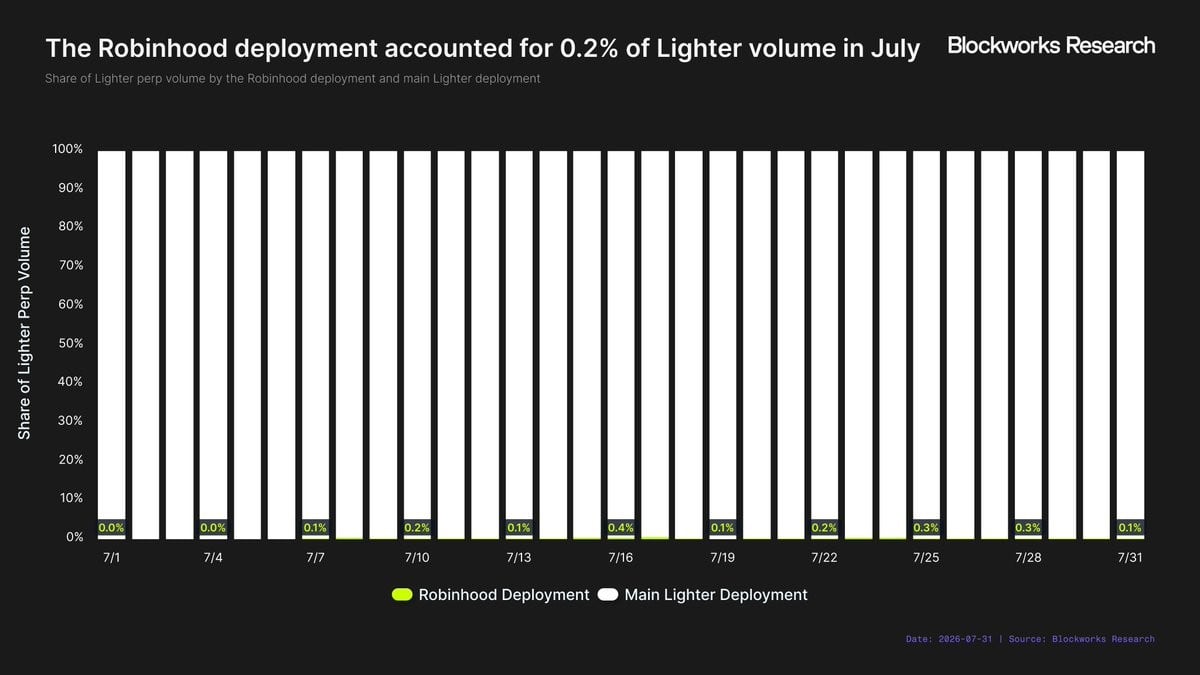
The Lighter cooperation case further confirms the limited traffic value of Robinhood Wallet. After integrating into Robinhood Wallet, Lighter's contract trading volume deployed in the Robinhood ecosystem accounted for only 0.2% of the total platform's perpetual contract trading volume. The corresponding trading volume in July was $86.8 million, lower than Robinhood Wallet’s spot trading volume for the month. More alarmingly, Lighter offered 11 million LIT tokens (currently valued at about $25 million) to incentivize perpetual contract trading on the wallet. The current limited trading volume relies on subsidies, and once the incentives are removed, trading volume is likely to decline further. At this stage, solely relying on Robinhood Wallet for traffic is unlikely to attract project teams to collaborate.
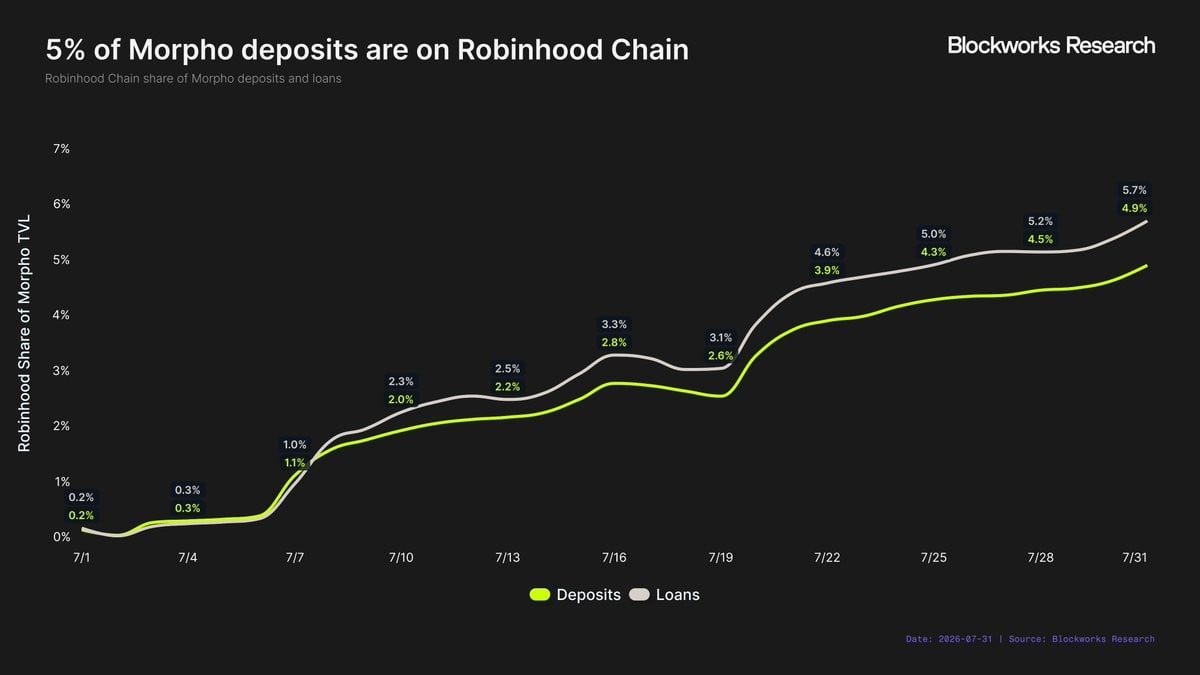
Robinhood Wallet's traffic value is limited, but the Robinhood main app is entirely different, with Morpho being the best example. Users can deposit stablecoins into Morpho through the main app and enjoy a 7% annual yield after incentives. By the end of July, funds deployed on Morpho from Robinhood Chain accounted for 5% of Morpho's total deposits and nearly 6% of total loans. In just one month since launch, Robinhood Chain has become the third largest deployment network for Morpho in terms of total locked value.
It must be acknowledged that this locked-in capital relies on subsidies. Even so, the traffic disparity between the main app and the standalone wallet is immense. While direct comparisons cannot be fully equal, the proportion of Morpho deposits on Robinhood Chain is 25 times that of Lighter's wallet trading volume.
From these early cases, a clear conclusion emerges: If a project can access the Robinhood main app, the traffic value is extremely high; merely accessing the Robinhood Wallet lacks sufficient appeal. Unless wallet access serves as a transitional step before eventual access to the main app, project teams are unlikely to willingly sacrifice profits for wallet traffic.
Of course, this conclusion is based on only two early collaboration cases. Robinhood has not officially defined application traffic collaboration as a long-term strategy, and it is unclear if the company plans to push this model on a large scale. However, the difference in traffic value between the two is evident. The true value of Robinhood's traffic does not lie in deploying on Robinhood Chain or having the Robinhood label, but rather in accessing the massive user entrance of the Robinhood main app.
Conclusion
This article began with a core question: Can Robinhood Chain make the cryptocurrency business a growth engine for Robinhood again?
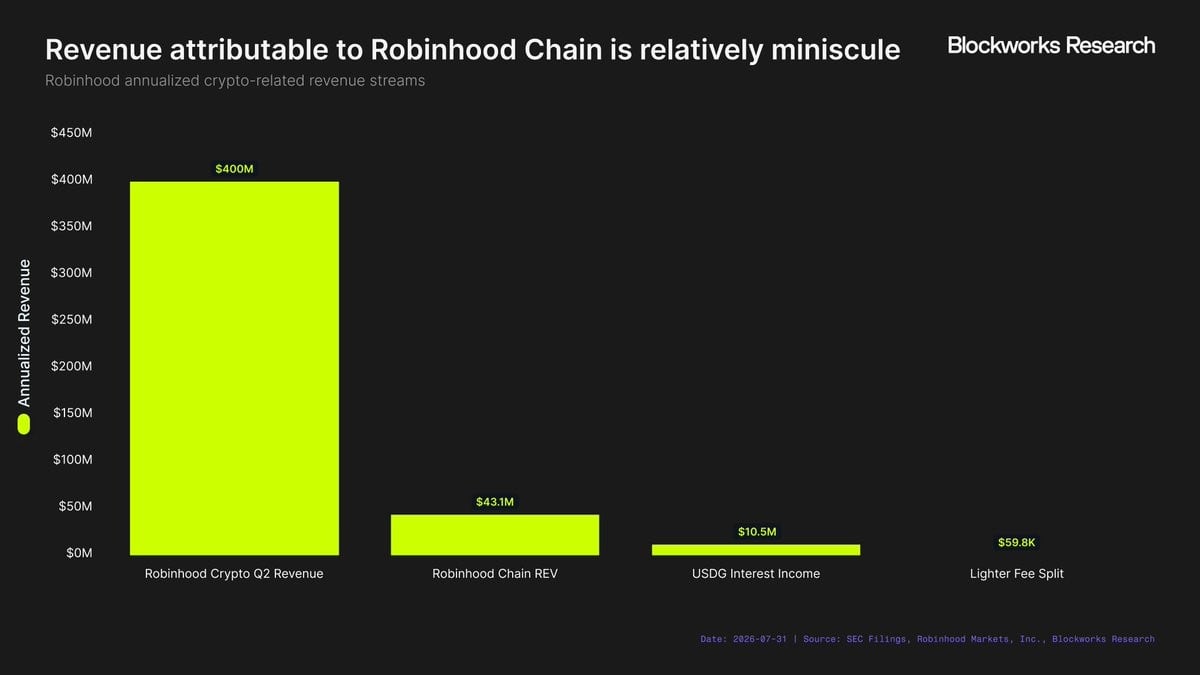
Early data provides a clear answer. Robinhood Chain has made a remarkable start as a public chain but is currently unable to generate significant performance increments for Robinhood. Robinhood's second quarter cryptocurrency business revenue was $100 million, equivalent to an annualized $400 million. In comparison, Robinhood Chain's total quantifiable revenue (on-chain REV, USDG interest, Robinhood's share of Lighter's fees) only annualizes to $54.8 million, about 14% of the cryptocurrency business's annual revenue. It should be noted that this calculation is based on the first month’s data annualized and should not be equated with long-term revenue potential.
Frankly speaking, relying solely on network fees will struggle to drive Robinhood's overall performance. Block space has become commoditized, and there is a ceiling on revenue scale for the entire Layer 2 sector. To revitalize the cryptocurrency business, Robinhood must explore monetization opportunities for various economic activities above the infrastructure layer.
Stablecoins represent the clearest path. Tether and Circle have proven that the profit margins from interest income on stablecoin reserves are huge. Based on a 3.5% yield, if Robinhood captures all the interest, every $1 billion of USDG circulation could correspond to $350 million in annual income, nearly matching the current total annual revenue from the cryptocurrency business. This goal cannot be achieved overnight, but given the scale of Robinhood's business, it is feasible.
Application traffic collaboration represents another high-quality avenue. A resource that nearly all public chains lack is Robinhood's vast base of retail investors. If project teams are willing to pay to access or participate in revenue sharing for user traffic, Robinhood can realize traffic monetization, no longer solely relying on network fees. Early cases demonstrate that the model of integrating projects into the main app is feasible, while the traffic monetization value of standalone wallets is lower.
There is also the possibility that Robinhood does not view this chain as an independent revenue business. Robinhood Chain could serve as a traffic funnel, guiding users toward tokenized assets before further converting them into clients for stocks, options, and cryptocurrencies among other products. Under this logic, the chain's inherent value may not be reflected in network fees but in driving increased activity and overall income across Robinhood's entire platform.
As it stands, the answer to the opening question remains negative. Robinhood Chain cannot yet become the core driving force behind Robinhood's growth; relying solely on network fees will never turn the situation around. To change the status quo, Robinhood needs to expand USDG's scale, commercialize the main app's traffic, and advance various application collaborations. Without these efforts, the value of Robinhood Chain is more about indirect traffic generation, leading users to use the company's high-value core products.
免责声明:本文章仅代表作者个人观点,不代表本平台的立场和观点。本文章仅供信息分享,不构成对任何人的任何投资建议。用户与作者之间的任何争议,与本平台无关。如网页中刊载的文章或图片涉及侵权,请提供相关的权利证明和身份证明发送邮件到support@aicoin.com,本平台相关工作人员将会进行核查。


