CoinWInstitute
Key Points
The combination of robots and cryptocurrency is gradually heating up, but the overall scale remains limited, with the total sector market cap currently at about $700 million, far below that of mature DeFi. Unlike DeFi, which mainly services the existing financial system, the potential market for the robot economy is larger and has a longer lifecycle. As hardware scales up, protocols land, and the regulatory environment becomes clearer, protocols such as x402 payments, ERC-8004, MCP, and A2A with authorization contracts have begun to support discovery, collaboration, and execution. Stablecoins and on-chain settlements have expanded economic capabilities, and cryptography is gradually becoming the underlying infrastructure for machine agent autonomous operations.
There are two layered perspectives to approach the robot sector. From the coverage perspective, the Web3 ecosystem encompasses identity and infrastructure, intelligent decision-making and collaboration, data provisioning, value realization and financialization, applications, and governance; the traditional stock industry chain covers six layers: core transmission, perception sensing, computing control, energy structure, ontological manufacturing, and integration applications. The two sets of layers target different segments of the robot industry chain, focusing on how machines operate autonomously and form economic closed loops from the Web3 side, while the traditional stock side focuses on how machine hardware is manufactured and goes to scale, with both complementing each other.
The robot crypto ecosystem faces five core constraints. First, robot technology is still in its early stages and faces challenges related to system complexity and stability after merging with blockchain; second, the commercialization cycle is long, and costs are high, with most projects not yet forming a verifiable scalable profit model; third, the dual attributes of robots and cryptocurrency create uncertainties regarding real-world and financial regulations; fourth, the token incentive and value distribution mechanisms remain to be verified; without genuine output support, this could weaken long-term ecological sustainability. Additionally, as the robot theme further extends to traditional stocks, ETFs, or pricing exposure related to indices, compliance boundaries will become more complicated.
At present, the robot and cryptocurrency narrative is not a fully validated certainty, but rather an early theme with a mismatch between primary market, secondary market, and real usage volumes. The primary market is willing to open investment space for robots, artificial intelligence, and cutting-edge technology, indicating that capital has begun to seek new long-term asset directions; however, the secondary market's token price pullback and low payment protocol transaction amounts indicate that the market has not yet seen enough strong real demand support.
This report asserts that the value of blockchain in the robot economy lies not in replacing all payment methods, but in handling complex collaborations in open networks. For closed platforms and single enterprises, traditional payments are sufficient; for scenarios requiring cross-platform identity verification, task completion proof, data contribution traceability, multi-party profit-sharing, machine asset financing, and stablecoin clearing, on-chain mechanisms are likely to demonstrate unique value.
Traditional stocks and Web3 assets should assume different roles: traditional robot stocks and ETFs provide real-world anchors, reflecting orders, revenue, supply chain capabilities, cost reductions, and terminal volumes; Web3 robot assets provide optionality, reflecting machine identity, data incentives, on-chain collaboration, stablecoin settlements, and asset financialization expectations. The value of CoinW TradFi lies in placing the real progress of the traditional robot industry chain and the Web3 robot narrative within the same trading framework, helping users observe both industrial prosperity and on-chain expectations simultaneously.
Overall, the robot and cryptocurrency sectors remain an early track worthy of long-term tracking, but one that requires stricter validation standards. In the short term, it resembles a structural theme where the primary market leads, the secondary market retracts, and real demand awaits validation; in the mid to long term, if robots can continuously generate cash flow in the real world and fulfill reliable measurement, financing, profit-sharing, and governance through on-chain mechanisms, there is a chance they will become one of the few true connections to real productivity in the cryptocurrency market.
Table of Contents
1. New Cycle of Robot and Cryptocurrency Integration
1.1 Macroeconomic Environment and Stages of Robot Development
1.2 Cryptocurrency as Underlying Infrastructure
2. Hierarchical Structure of Robot Cryptocurrency Ecosystem
2.1 Identity and Infrastructure Layer
2.2 Intelligent Decision-Making and Collaboration Layer
2.3 Value Realization and Financialization Layer
2.4 Data Provisioning Layer
2.5 Others
3. Traditional Stock Industry Chain and Cost Flow
3.1 Core Transmission and Execution Layer
3.2 Perception and Sensing Layer
3.3 Computing and Control Layer
3.4 Energy and Structure Layer
3.5 Ontology and Manufacturing Layer
3.6 Integration and Application Layer
3.7 Terminal Cost Flow and Value Capture
3.8 Cross-Market Entry: CoinW TradFi
4. Risks and Constraints
4.1 Risks of Technology Implementation
4.2 Commercialization and Scaling Risks
4.3 Regulatory and Compliance Risks
4.4 Value Capture and Token Economy Risks
4.5 Special Risks of Cross-Asset Allocation
5. Trends and Outlook
5.1 Phase Development Directions of the Robot Economy
5.2 Possible Early Applications
5.3 Long-Term Impact on Cryptocurrency Markets
6. Conclusion
With breakthroughs in artificial intelligence and automation technologies, robots are stepping out of laboratories and into real applications. Financial giant Morgan Stanley predicts that nearly one billion humanoid robots will be deployed globally by 2050, while Musk believes the number of robots will surpass humans around 2040. These judgments point collectively to a potential scale reaching trillion-dollar levels of machine economy, whose core is no longer just hardware manufacturing but a new economic system formed around robot operations, collaborations, and value distributions.
The combination of robots and cryptocurrency is gradually gaining momentum, but the current scale remains limited. As of now, the total market cap of the robot sector is approximately $700 million, far lower than relatively mature DeFi. However, logically, DeFi primarily serves the existing financial system, while the potential market size of the robot economy is larger and has a longer lifecycle. If in the future, robot hardware achieves large-scale deployment, the protocol layer operates smoothly and aligns with product and market needs, and the regulatory environment is relatively friendly, the robot sector may further develop.
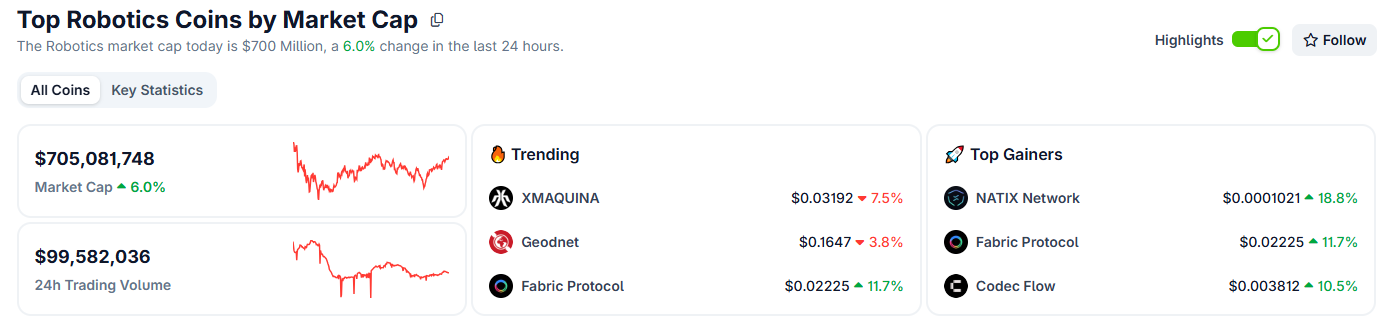
Source: https://www.coingecko.com/en/categories/robotics
Meanwhile, from the perspective of the capital market, the robot theme does not only exist within on-chain projects. The traditional stock market has continuously priced the robot industry chain through listed companies engaged in automated devices, humanoid robots, medical robots, warehousing logistics, and industrial software; the Web3 market is attempting to establish new financial expressions for machine identities, machine data, machine payments, and machine asset financing. Together, they form a complete trading map of the robot economy.
1. New Cycle of Robot and Cryptocurrency Integration
1.1 Macroeconomic Environment and Stages of Robot Development
The global robotics industry is currently undergoing a rapid transition from technical pilots to commercial deployments, with market size and installation data steadily growing to accelerate the industry. According to ABI Research, the global robotics market size is expected to grow from approximately $44.9 billion in 2024 to about $50 billion in 2025; from 2024 to 2030, the compound annual growth rate is projected to be around 13.8%, with the market expected to reach approximately $110.7 billion by 2030.
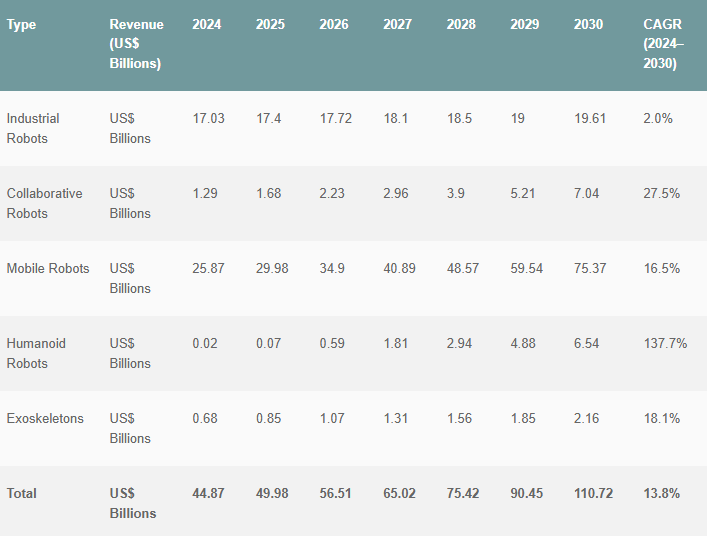
Source: https://www.abiresearch.com/blog/global-robotics-market-outlook
From the perspective of technology and cost trends, robots are moving from demonstrable to deployable capabilities. The fusion of large models, intelligent algorithms, and multi-modal perception technologies has equipped robots with stronger environmental understanding, planning, and autonomous decision-making capabilities. Meanwhile, the continual decrease in the costs of core hardware, such as sensors and actuators, as well as edge computing, along with standardized and modular designs, has improved manufacturing and maintenance efficiency, enabling robots to be commercially viable in more niche scenarios like warehousing, cleaning, security, and medical care.
On the demand and institutional level, macro factors like labor shortages, an aging population, and supply chain reconstructions are increasing reliance on automation, with more and more enterprises viewing robots as strategic investments to improve efficiency, ensure stability, and reduce long-term costs. At the same time, strengthened regulatory requirements, such as data traceability and security verification, are providing support for new collaborative frameworks and verifiable execution systems. The technological maturity, cost advantages, and increasing demand are jointly driving the robot sector into a new cycle.
1.2 Cryptocurrency as Underlying Infrastructure
Traditional internet and financial systems are largely built around human participatory transactions and collaboration scenarios, heavily relying on human authorization, centralized risk control, and post-event audits during operation. Such systems find it challenging to achieve low-cost, continuous operation and automatic scaling when faced with high-frequency and cross-organizational collaboration demands between machines. In contrast, the machine agent economy demands native digitization, strong automation, and high composability from its underlying infrastructure, and cryptographic technology holds advantages in these areas. As core capabilities in payments, identity, and services gradually improve at the protocol layer, machine agents are evolving from mere tools that passively execute commands to autonomous entities capable of collaborative operation, independent settlement, and participation in economic activities.
1.2.1 x402 Promoting Payment Layer Maturity
Payments are a primary condition for establishing a closed loop in the machine agent economy. Whether dealing with computing power, data, API services, or the delivery and settlement of execution results, machine agents must accomplish instant, low-cost, and programmable value exchanges without human intervention. Limitations in traditional payment systems regarding transaction costs, settlement delays, and automation capabilities hinder them from accommodating the significantly higher transaction frequencies in the machine economy.
The x402 protocol as a foundational payment mechanism for machine agents is gradually maturing. Currently, x402 has processed over 150 million transactions, with its latest version introducing wallet-based machine identity systems and automated API discovery capabilities at the protocol layer, allowing machine agents to complete payment negotiations and settlement execution while discovering services. As a result, payments are transforming from an external capability to an integral part of the collaborative process among machines. More importantly, x402 has been included in the machine agent payment protocol system promoted by Google and is being implemented in multi-organization environments as agent-to-agent payment extensions.
1.2.2 ERC-8004 Completing Trust and Collaboration Foundations
Meanwhile, in the machine agent economy, merely solving the ability to pay is insufficient to support complex collaborations. If machine agents cannot confirm each other's identities, assess their historical performance, or validate the reliability of execution results, collaborative relationships will only remain at the level of low-risk and low-complexity transactions, unable to accommodate cross-entity and cross-organization task divisions.
ERC-8004 addresses this core bottleneck by introducing a comprehensive trust and collaboration framework at the protocol layer. This standard establishes verifiable collaborative foundations for machine agents through three types of registration mechanisms. First, identity registration provides each machine agent with a chain verifiable identity and service description, facilitating their discovery, recognition, and citation; second, reputation registration standardizes execution records, payment proofs, and feedback signals, quantifying and comparably evaluating the historical behaviors of machine agents; finally, verification registration introduces independent verification methods such as zero-knowledge machine learning validation and trusted execution environments, allowing tasks of varying risk levels to match the corresponding validation intensity.
By unifying identity, reputation, and execution verification within the protocol layer, ERC-8004 ensures that collaboration among machine agents no longer relies on centralized endorsements but rather is founded on composable and scalable decentralized trust mechanisms. The establishment of this trust layer enables payments, execution, and collaboration to form a stable loop, consolidating the foundation for the transition of the machine agent economy from simple transactions to large-scale collaboration.
1.2.3 Machine Agent Discovery, Collaboration, and Execution Approaching Standardization
Beyond payments and trust mechanisms, the scalability of machine agents also depends on whether collaboration processes themselves have a standardized foundation. If the ability descriptions, task exchanges, and result returns among machine agents highly rely on customized interfaces, collaboration costs will increase linearly with the number of participating entities, and the system will struggle to scale. The standardization of discovery and collaboration mechanisms is a crucial prerequisite for machine agents to move from operational to scalable.
At this level, the Model Context Protocol (MCP) and Agent-to-Agent (A2A) protocols are gradually emerging as standards. MCP standardizes the interaction between machine agents and tools, data resources, enabling different agents to invoke external capabilities through consistent interfaces; A2A allows machine agents to discover each other directly, distribute tasks, and return results through standardized capability descriptions and task life cycles, thus reducing integration costs for cross-platform collaboration. Together, these promote a transition of machine agent collaboration from point-to-point integration to networked cooperation.
Overall, x402 addresses the payment issue, ERC-8004 establishes the trust foundation, while MCP and A2A complete the standardization of the discovery, collaboration, and execution layers. Meanwhile, as the scale of stablecoins expands and the regulatory framework becomes clearer, machine agents are already equipped with the conditions for operation in real environments. Cryptographic technology is evolving into the underlying infrastructure supporting machine agent autonomous operations. In the following sections, this report will further dissect the overall architecture of the current machine agent crypto ecosystem and its representative projects from a hierarchical structural perspective.
2. Hierarchical Structure of the Robot Cryptocurrency Ecosystem
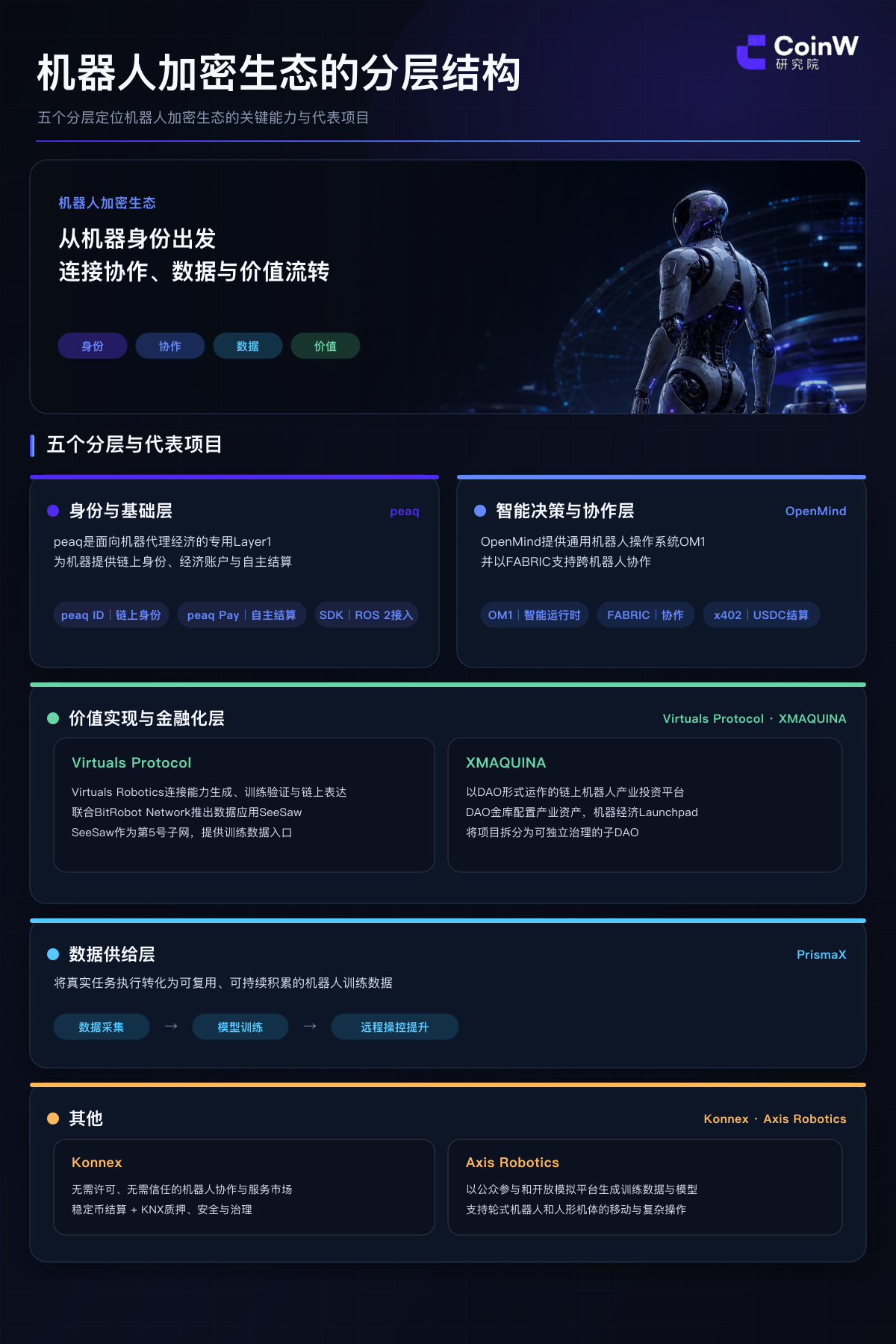
Before delving into specific explanations, it is essential to clarify the logic of the hierarchical structure of the robot crypto ecosystem. The hierarchy here is defined according to the capability chain that a robot must undergo to enter the open economic system: first, there must be physical devices and network connectivity; next, there must be verifiable on-chain states, identities, and settlement rules; then there are intelligent decision-making, task collaboration, data provisioning, and financial representation.
According to this logic, the base layer consists of robot hardware, sensors, internet, and IoT protocols, responsible for enabling machines to connect to the real world and generate data; above that is blockchain consensus, data availability, smart contracts, and Layer 1/Layer 2 execution environments, responsible for recording trustworthy states, carrying assets, and executing rules; above that, machine identities, wallets, payments, reputations, and verification protocols provide economic subject qualifications for machines; the operational systems, collaboration protocols, and data networks in the upper layer enable machines to have perception, reasoning, collaboration, and learning capabilities; finally, the top layer comprises DApps, DAOs, launchpads, robot assetization, and profit distribution targeted at users and capital markets. Therefore, this report divides the robot crypto ecosystem into identity and infrastructure layers, intelligent decision-making and collaboration layers, value realization and financialization layers, data provisioning layers, and other early exploration projects.
2.1 Identity and Infrastructure Layer
2.1.1 peaq
peaq is a dedicated Layer 1 built for the machine agent economy, aimed at providing on-chain identities, economic accounts, and executable economic rules for robots, devices, and automation systems. As robots transition from passive tools to autonomous agents, traditional centralized management models struggle to support the complex interactions among thousands of machines. The existence of peaq aims to resolve how machines can independently complete payments, contract signings, and service deliveries without relying on centralized platforms. It provides standardized survival protocols for machines, enabling them to seamlessly integrate into the open global economic system.
In contrast to general public chains that primarily service human transactions, peaq natively integrates identity, access control, and payment capabilities oriented towards machine scenarios at the protocol layer, thus creating an economic network that is inherently designed for machines. This determines peaq's positioning within the robot crypto ecosystem, serving as the infrastructure layer for identity and economic rules, providing a unified, scalable institutional foundation for various types of robots and devices.
On-Chain Machine Identity
In the machine agent economy, identity is the starting point for all autonomous interactions. peaq provides every device or robot with a unique, verifiable on-chain identity through peaq ID, allowing it to be recognized, authenticated, and authorized within the open network. This identity system does not rely on a single vendor or centralized platform but is safeguarded by blockchain and cryptographic mechanisms, thus mitigating issues of platform trust common in traditional IoT and robot systems.
Furthermore, the machine identity of peaq is not a static identifier but can be linked to behavioral records, permission rules, economic accounts, and smart contracts. This means that every action a robot performs on the chain has a clear and traceable identity background, providing foundational data structures for responsibility delineation, compliance auditing, and economic settlements. In scenarios involving multi-robot collaboration or cross-platform operations, robots from different sources can complete recognition and collaboration without prior trust.
Robot Autonomous Settlement
On top of identity, peaq equips robots with on-chain wallets and economic accounts, enabling them to participate directly in value transfers. This directly addresses one of the core constraints of the robot economy: if robots can only execute tasks but cannot autonomously settle costs and benefits, their economic actions will always require humans or centralized platforms for completion, hindering the formation of a genuinely autonomous machine network.
In the peaq network, robots can automatically perform various economic behaviors according to preset rules, such as paying for resource consumption like electricity, charging, bandwidth, or computing power calls, and directly receiving service income upon task completion. Furthermore, through smart contracts, robots can automatically distribute revenue based on contributions among various parties, such as equipment owners, maintenance providers, and data contributors, thereby reducing collaboration costs and minimizing human intervention. This mechanism transforms robots from passive execution tools into economically operational units. To support this capability, peaq has launched a modular machine payment system, peaq Pay, to facilitate peer-to-peer settlements between machines, providing infrastructure support for instantaneous payments in M2M scenarios.
Compatibility of Robot Systems
To avoid the complexity of blockchain becoming an obstacle to robot landing, peaq has simultaneously launched a developer-facing Robotics SDK, encapsulating complex logic such as identity generation, wallet creation, and on-chain communication at the bottom layer. Robot developers need not deeply understand cryptographic technology, enabling them to access the chain through standardized interfaces.
Design-wise, this SDK optimizes communication latency and permission management for robot scenarios, allowing on-chain rules to operate without affecting real-time control. Furthermore, the SDK natively supports ROS 2, lowering the migration costs of existing robot systems to the peaq network. Peaq also introduces a unified time standard to address time synchronization issues in multi-robot and multi-system collaborations, bringing it closer to the role of an operating system for the machine agent economy.
On-Chain Data
From the perspective of on-chain data, peaq has initially formed a machine economy network with scale effects. To date, it has processed over 196 million on-chain transactions, with the number of machine addresses exceeding 3.37 million and human wallets surpassing 2.7 million, processing approximately 70,000 machine-related transactions daily, demonstrating a certain usage foundation.
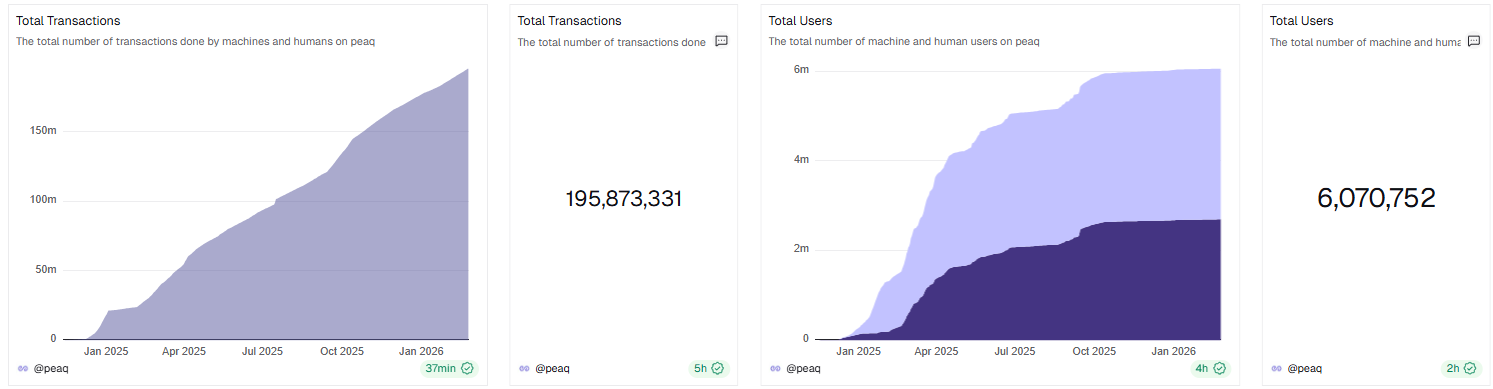
Source: https://dune.com/peaq/peaq-dashboard
In terms of financial infrastructure, peaq has launched the native decentralized exchange, MachineX, targeting the machine economy. Currently, MachineX is still in its early stages, with a TVL of around $700,000, a cumulative trading volume of approximately $70.01 million, and total transaction fees of about $540,000, with liquidity primarily concentrated in the PEAQ/USDT trading pool, which has a TVL of around $300,000.
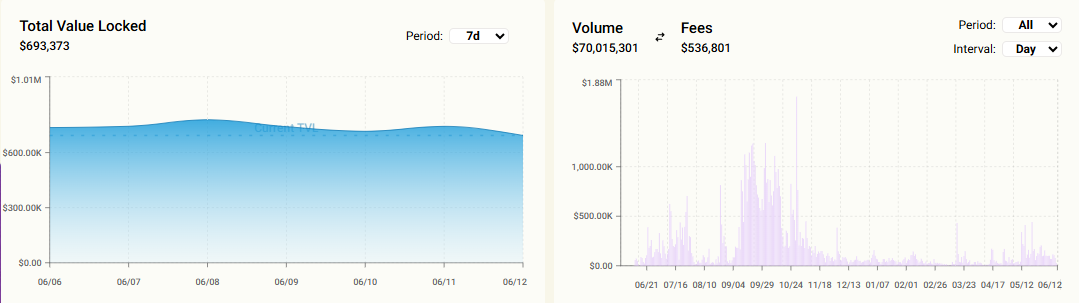
Source: https://app.machinex.xyz/analytics
The core value of peaq in the robot crypto ecosystem is embodied in its provision of identity and economic rule infrastructure. As robots gradually move towards scalable and autonomous operation, the lack of a unified identity, settlement, and rule execution system will become a systemic bottleneck, which peaq is attempting to fill.
However, it is worth noting that peaq was initially positioned in the DePIN track, with the core goal of providing universal identity and economic rule infrastructure for real-world devices and machine nodes, of which robots are only one application branch and currently still in a relatively early stage. Peaq's native token has been issued; as of now, its market valuation is approximately $48.16 million, while its historical peak market valuation once reached around $450 million. In terms of overall advancements, peaq is still in the early stages of transitioning from DePIN infrastructure to a more complex machine agent and robot application extension, with the maturity of its ecosystem and scalability requiring further verification.
2.2 Intelligent Decision-Making and Collaboration Layer
2.2.1 OpenMind
OpenMind is a robotics and intelligent infrastructure company founded in 2024, led by Stanford University bioengineering professor Jan Liphardt. The team includes engineers and experts from Microsoft and the field of robotics research. OpenMind's core mission is to build a universal foundation layer for intelligent and collaborative physical robots, solving the issues of fragmentation, interoperability, and insufficient collaboration in the current robotics ecosystem through open-source software and decentralized protocols.
Within the hierarchical structure of the robot crypto ecosystem, OpenMind is positioned in the intelligent decision-making and collaboration layer, with a core focus on enabling robots from different manufacturers and forms to share intelligent runtime environments and collaboration protocols, thereby overcoming the limitations imposed by traditional closed systems on collaboration, learning, and large scale deployment.
Core Technical Architecture
A. General Robot Operating System OM1
OM1 is the open-source, hardware-agnostic robot operating system released by OpenMind, designed with a concept similar to that of Android in the mobile field, aimed at providing a unified perception, reasoning, and execution runtime layer for intelligent robots. The OM1 system supports a variety of robot platforms through a modular architecture, such as quadrupeds, bipeds, humanoids, and drones, allowing developers to quickly build intelligent behaviors with environment sensing, language understanding, and spatial reasoning, thus lowering the barriers to fragmented development within the industry.
The open-source version of OM1 has been launched on GitHub and released under the MIT license, supporting cross-architecture deployment and adapting to real hardware and simulated environments. It natively supports capabilities such as natural language, vision, and navigation, offering advantages over traditional robot stacks in terms of intelligent expression and environmental adaptability. OM1 is seen as a universal AI-native operating system, enriching robot intrinsic capabilities and providing a basis for operation that more closely resembles human interaction and decision-making abilities.
B. FABRIC Collaboration Protocol
Above OM1, OpenMind has introduced FABRIC, a protocol that serves as a decentralized coordination layer among robots, providing features such as identity verification, collaborative state sharing, environmental context transmission, and event recording. FABRIC is not only an interactive layer protocol but also a hub for trustworthy cross-device collaboration, allowing robots to build consensus, share context, and coordinate task execution without a centralized controller. The design intention behind FABRIC is to construct a scalable collaborative infrastructure, providing data and institutional traceability for potential future robot economies, task transactions, and accountability.
C. x402 Payment Protocol Integration
From the economic and execution perspective, OpenMind incorporates payment capabilities as an essential component of machine autonomy, introducing native autonomous settlement mechanisms for machines through the integration of the x402 payment protocol. This solution was developed in collaboration with Circle, leveraging the USDC stablecoin to enable robots to complete resource payments, such as charging, electricity consumption, computing power calls, and network service fees, without human intervention.
In terms of specific architecture, USDC serves as a stable accounting unit and value carrier, performing cross-scenario settlement functions; the x402 protocol provides underlying payment and calling channels; and OpenMind’s intelligent system is responsible for dynamically deciding when, where, and how to trigger payment actions based on task status, environmental context, and collaborative rules, thus establishing a value settlement closed loop without human intervention.
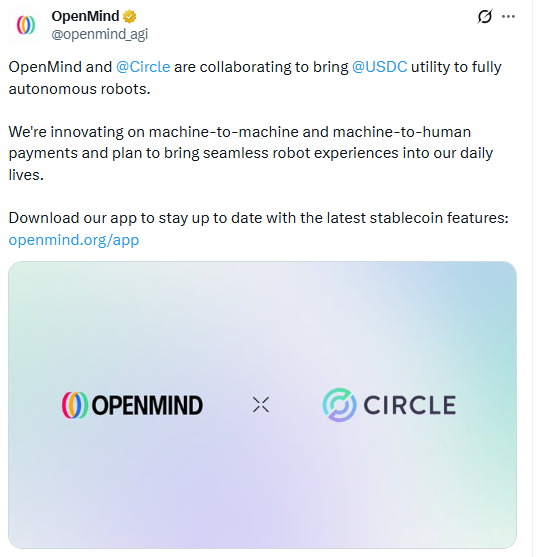
Source: https://x.com/openmind_agi/status/1995840403745231039
By embedding payment logic directly into robot operations and collaboration processes, x402 makes economic behaviors a native part of the machine execution link. In May 2025, OpenMind became one of the first launch partners for the Coinbase x402 protocol, marking its exploration in the direction of machines as economic entities starting to integrate with mainstream stablecoins and payment infrastructures.
Funding Background
In August 2025, OpenMind completed a $20 million funding round led by Pantera Capital, with participation from well-known institutions including Coinbase Ventures, Digital Currency Group, Ribbit Capital, and Sequoia China.
Product Progress
On the product side, OpenMind has transitioned from foundational system and protocol development to the production-level delivery phase of intelligent products. In November 2025, OpenMind launched and began pre-selling BrainPack, its first commercialized hardware product, which operates on OM1 and natively integrates the FABRIC collaboration protocol. BrainPack supports real-time 3D SLAM and semantic map construction, privacy-native facial detection and blurring processes, and automated recharging functionalities, facilitating decentralized identity verification and context sharing through FABRIC.
BrainPack is based on the NVIDIA Jetson Thor GPU but is positioned as a plug-and-play module, clearly compatible with Unitree Robotics' G1 humanoid robots and Go2 quadrupedal robot platforms. According to official information, BrainPack's pre-sale deposit is $999, with the first batch expected to be delivered in the first quarter of 2026.
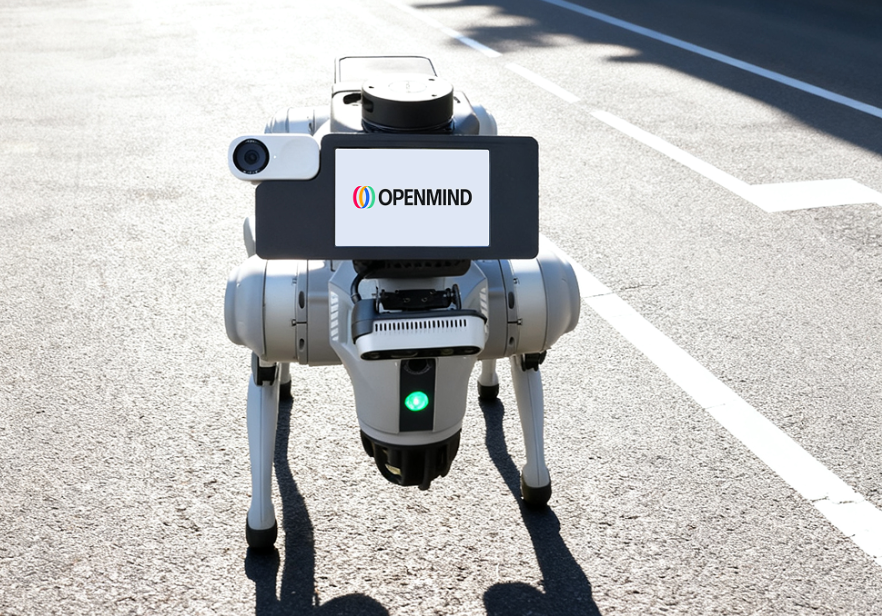
Source: https://openmind.org/store/purchase
OpenMind's Fabric Foundation has launched a public sale for the ROBO token, with a public valuation of $400 million, selling 0.5% of the total tokens. During the public sale, 40% of the tokens will be prioritized for allocation to the Fabric Foundation, Kaito, Virtuals, and Surf AI communities. Currently, the ROBO token is live, with a current market valuation of $29.95 million.
In summary, OpenMind is attempting to resolve the fragmentation issues in operational environments, context understanding, and collaborative execution among multi-vendor, multi-form robots using the open-source robot operating system OpenMind OM1 and the decentralized collaboration protocol FABRIC. On this foundation, OpenMind further integrates the x402 payment protocol, embedding autonomous payment mechanisms based on USDC into robot execution chains, enabling them to autonomously complete economic settlements during task and resource scheduling. OpenMind has moved from foundational protocol development to the verification stage in real robot scenarios, yet it still remains in the early exploration phase regarding large-scale deployment, long-term stable operation, and the maturity of economic incentive mechanisms, and future performance will depend on its technology stack's applicability to more robot platforms and actual usage scenarios.
2.3 Value Realization and Financialization Layer
2.3.1 Virtuals Protocol
Virtuals Robotics is an important extension of the Virtuals Protocol into the robotics direction, aiming to provide robots with a complete path from capability generation through training verification to on-chain expression and liquidity realization. Virtuals Robotics focuses on how robot intelligence can be standardized, priced, and incorporated into a tradable and combinable asset system after it is formed. Under this framework, robots with autonomous decision-making and execution abilities are no longer merely seen as technical systems but as economic units capable of generating continuous value, whose capability levels, collaboration relationships, and potential revenue expectations can be expressed through on-chain mechanisms.
Within the hierarchical structure of the robot cryptocurrency ecosystem, Virtuals Robotics aligns more closely with the middle layer of infrastructure between robotic intelligence and crypto finance. On one hand, it provides experimental and training environments for robots, supporting iterative capabilities for different types of agents; on the other hand, it introduces external capital and liquidity through issuance and trading mechanisms, allowing robot capabilities to move beyond being restricted to use within closed systems, instead enabling their valuation and allocation by the market, thus creating a positive cycle among robot capabilities, capital, and application scenarios.
Robot Training Data Provisioning
Currently, Virtuals Robotics is primarily focusing on the collection, validation, and incentive mechanisms for robot training data. In October 2025, Virtuals partnered with BitRobot Network to launch the data application SeeSaw, which 운영합니다.
免责声明:本文章仅代表作者个人观点,不代表本平台的立场和观点。本文章仅供信息分享,不构成对任何人的任何投资建议。用户与作者之间的任何争议,与本平台无关。如网页中刊载的文章或图片涉及侵权,请提供相关的权利证明和身份证明发送邮件到support@aicoin.com,本平台相关工作人员将会进行核查。