Author: Jae, PANews
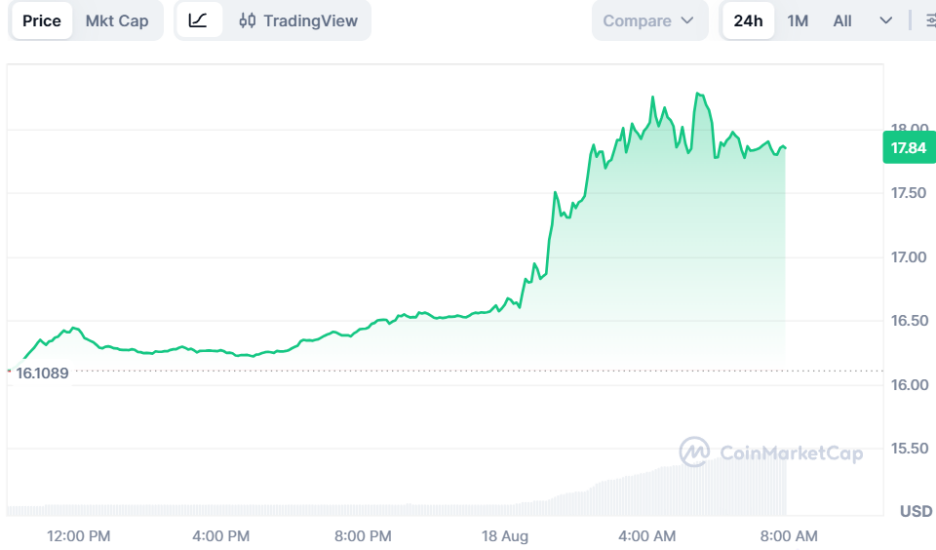
On the evening of August 17, the Compound DAO approved a record budget of $52 million, announcing a strategic focus shift towards the institutional DeFi market. As the news broke, its protocol token COMP briefly rose by over 10%.
The lending pioneer Compound, which kicked off the DeFi Summer feast, now stands at a crossroads of fate.
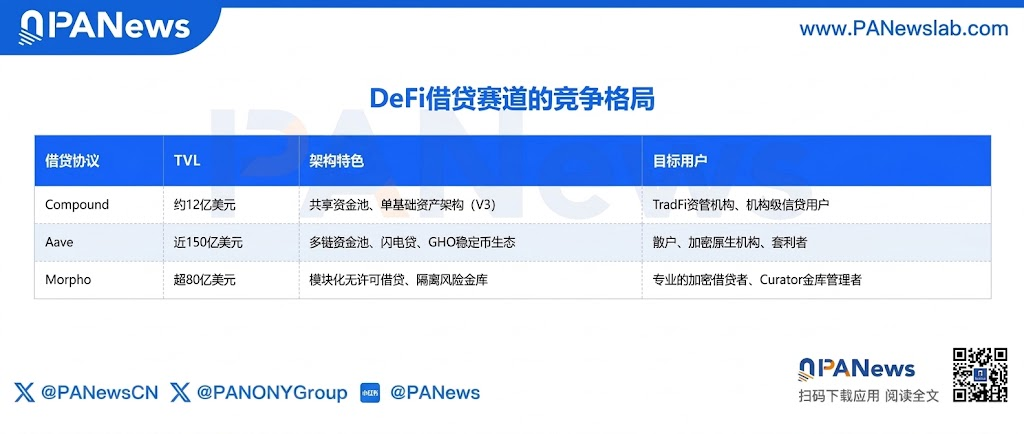
With a peak TVL of $12 billion and being the first in the industry to introduce "liquidity mining," these achievements are now history. After experiencing multiple bull and bear market cycles, Compound's current deposit size has shrunk to $1.2 billion, nearly 90% off its historical high, accounting for less than one-tenth of its competitor Aave during the same period.
For Compound, continuing to grab market share in the retail lending space has become increasingly difficult. Meanwhile, the institutional-level market remains an incremental avenue that DeFi has yet to truly tap into, perhaps offering a door of opportunity for further growth.
In May of this year, Compound DAO overwhelmingly approved a two-year budget proposal of $52 million with 1.88 million votes in favor and none against. Subsequently, the Compound Foundation announced a new management team comprised of veterans from Coinbase Custody, Anchorage Digital, NEAR Foundation, and Maple Finance.
This marks the largest survival gamble for Compound since its inception in 2018, as well as a self-revolution concerning the rebranding of the protocol.
Breaking Out of Retail Infighting, Traditional DeFi Protocols Eye Institutional Market
The plight of Compound reflects the overall situation of the traditional DeFi lending sector.
During the DeFi Summer of 2020, Compound rapidly gained traction thanks to its straightforward shared fund pool model and mining subsidies, briefly claiming the top spot in the lending space. However, due to early security and governance issues that undermined confidence, unsustainable liquidity mining, lagging product and multi-chain innovations against competitors, and the overall crypto bear market, this once-leading protocol began to fall behind in the competitive landscape. Particularly, inadequate capital efficiency, inability to isolate risks, and severe homogeneity in competition have made it increasingly difficult for the traditional DeFi lending model to meet the diverse risk appetite of funding, resulting in users and funds being continuously diverted to new protocols.
As a result, Compound has slipped out of the first tier and is struggling for survival in the crevices of the lending sector, while competitors display a different trajectory:
Aave: With a deposit scale of nearly $15 billion, maintaining its leading position through multi-chain deployment, flash loans, and the GHO stablecoin ecosystem;
Morpho: With deposits exceeding $8 billion, rapidly emerging as a competitive newcomer through modular permissionless lending and isolated market architecture.
In this competitive environment, it has become increasingly challenging for Compound to achieve rapid growth by relying on the retail market. Compound's chosen path for breaking the deadlock is to step out of the crypto-native limited competition and tackle the incremental market of traditional financial institutions.
It also happens to hold what institutions value the most: system stability since its launch in 2018, a widely reused open-source codebase across the industry, and a long record of zero bad debts.
For traditional financial institutions, yield is never the primary consideration; capital security, system robustness, and compliance controllability are prerequisites for entry. Characteristics that appeared insignificant in the retail market have now become Compound's competitive advantages in entering the institutional market.
DeFi Geeks Exit, "Regular Troops" Step In
The first step in the strategic shift is a change of leadership.
The new management team formed by the Compound Foundation is composed entirely of professionals from crypto-native platforms, compliant custody institutions, and traditional financial giants, each résumé aligning with the imperative for transformation.
Executive Director Aaron Schnarch: Former COO of Anchorage Digital and CEO of Coinbase Custody. He secured custody for 11 of the first 12 spot Bitcoin ETFs in the United States. This means that the new head of Compound is well-versed in how to make traditional financial institutions "trust" crypto assets.
COO Christopher Donovan: Former COO and General Counsel of NEAR Foundation, who facilitated over $20 billion in transaction volume through NEAR Intents, blending cross-chain operations and legal compliance experience to lead the protocol's compliance framework and cross-chain lending network expansion.
CPO Steven Liu: Former product expert at Maple Finance and HSBC, who grew Maple's institutional lending AUM from $500 million to $5 billion, will be responsible for the design of RWA collateral lending architecture, institutional permission vaults, and the Curator system.
CTO Leo Eikelman: With over 4 years of engineering leadership experience at Coinbase Institutional, previously led Prime Onchain wallet development, will spearhead the technical implementation of Compound V4 architecture and institutional SDK suite.
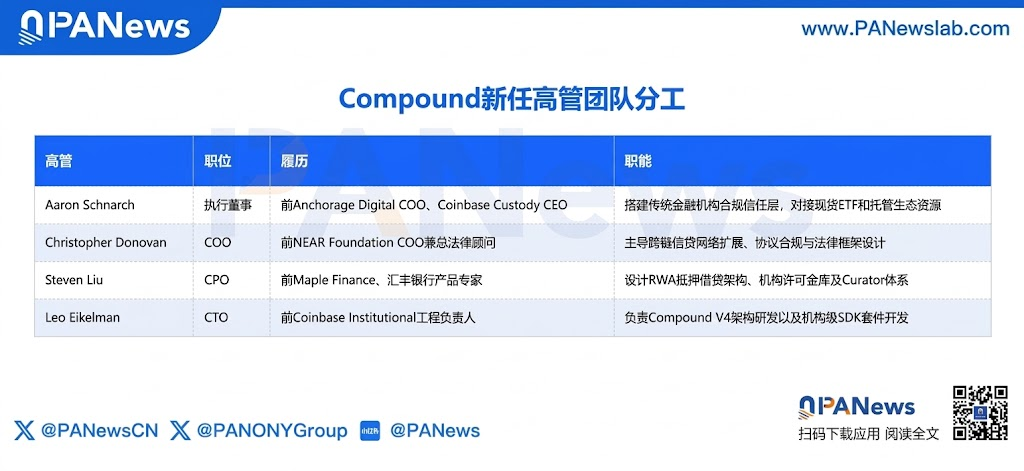
This new configuration of the team says goodbye to the early protocol model dominated by "tech geeks," shifting towards a comprehensive lineup of "resources + compliance + product + technology." The complete overhaul of the team also showcases Compound's determination to transform into an on-chain credit infrastructure provider serving traditional financial institutions.
The Largest Expansion Budget in History: Two Years, $52 Million
Implementing a strategy requires a substantial financial investment. The two-year budget of $52 million marks the largest development expansion budget in Compound's history.
Unlike a one-time budget allocation for management, this fund is not simply "disbursed." According to the rules, only $14 million of the initial funds will be allocated to the foundation's multisig wallet as starting capital. The remaining $38 million will be locked in the "project reserve," overseen by a treasury management committee consisting of 5-of-7 signers. The unlocking of funds will no longer depend on "promises," but will be strictly tied to technology and performance assessments for phased release:
Operating Budget: The next phase of funding can only be unlocked upon the delivery of a production-level V3 integration suite;
Growth Budget: Must onboard Tier-1 institution Curators and successfully launch the Compound V4 public testing network to activate funding.
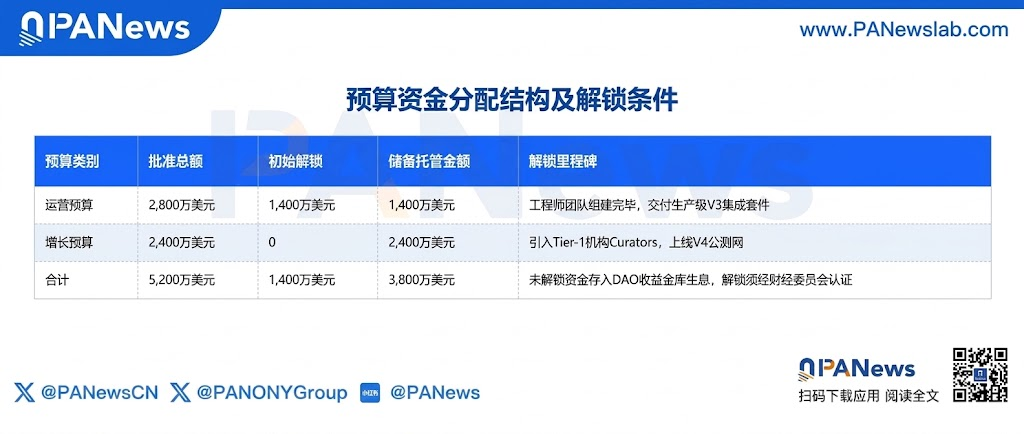
In simple terms, this business transformation is not about allocating budgets first and waiting for results, but rather setting goals initially and releasing funding support based on delivery outcomes.
Additionally, the DAO has unified assets previously scattered across various corners into a custody pool, consolidating over $57 million in liquidity as a buffer for institutional transformation.
For DAO governance, this is also a change worth observing. In the past, DeFi governance mainly revolved around parameter adjustments, incentive allocations, and protocol upgrades. However, as the protocol scales, how to manage the treasury, supervise the core team, and measure capital input-output ratios are becoming key components of DAO governance.
Nonetheless, this approach to fund management cannot eliminate transformation risks. In the context of slowing protocol revenues during bear markets, the $52 million burn rate over two years poses significant pressure for a DeFi protocol with decelerating revenue growth. The expansion of institutional business typically takes a long time and shows slow results; if capital inflows do not meet expectations, the entire protocol could be at risk of collapse.
V4 Launches Four Major Moves, Transitioning from DeFi Protocol to Institutional Credit Infrastructure
With the team and funds in place, the true test lies in the product.
Integrating traditional financial institutions into on-chain lending faces four unavoidable hurdles: difficulty in system integration, asset homogeneity, high compliance requirements, and mismatched risk control. Compound V4 aims to build a "modular credit infrastructure" addressing these four major pain points:
System Integration Layer: Develop Fintech integration suites to provide standard API/SDK for neobanks, brokers, and asset management institutions, allowing them to seamlessly integrate into the Compound lending pool as if connecting to traditional financial systems;
Asset Expansion Layer: Support tokenized stocks, government bonds, and other tokenized assets as acceptable collateral, allowing institutions to lend stablecoins using RWA, thereby bridging on-chain and off-chain balance sheets;
Compliance Isolation Layer: Launch permissioned vaults that natively embed KYC/AML compliance checks on-chain, catering to the credit matching needs of regulated institutions in isolated environments;
Risk Control Upgrade Layer: Introduce a portfolio-aware risk control engine that dynamically calibrates the loan-to-value (LTV) ratio based on asset correlation and market liquidity, while granting real-time intervention rights to third-party risk management institutions to further mitigate bad debt risks.
It can be said that this product combination is tailor-made for institutional clients: enabling traditional financial institutions to enjoy the efficiency advantages of on-chain credit within a compliance framework.
However, granting risk control authority to third-party institutions or emphasizing KYC/AML may alienate crypto-native users who previously valued the principles of "decentralization" and "permissionless." If the institutional business fails to take off and the retail base is lost, it could leave the organization in an awkward position of falling short on both fronts.
Moreover, it's worth noting that competition in the institutional market is equally fierce. Compound is a latecomer, while Aave, Morpho, and Maple Finance have already established positions in the institutional lending and compliance market.
From the groundbreaking "liquidity mining" initiative in 2020 to its institutional self-rescue in 2026, Compound's trajectory mirrors that of many established DeFi giants today: dominating the scene, facing a retreat in sentiment, cycle transitions, and seeking new paths.
The $52 million secured is not merely a ticket to the institutional market but also an opportunity for Compound to redefine its growth curve and reposition the protocol. For Compound, the ultimate challenge will be converting the imagination of the institutional market into real customers, assets, and income. The outcome of this bet will be revealed in the next two years.
免责声明:本文章仅代表作者个人观点,不代表本平台的立场和观点。本文章仅供信息分享,不构成对任何人的任何投资建议。用户与作者之间的任何争议,与本平台无关。如网页中刊载的文章或图片涉及侵权,请提供相关的权利证明和身份证明发送邮件到support@aicoin.com,本平台相关工作人员将会进行核查。


