On August 18, 2026, Hyperliquid Policy Center, in collaboration with trade[XYZ], submitted a comment letter to the SEC, formally proposing the IPOP (pre-IPO perpetual contracts) tool in response to Chairman Paul Atkins' CLL-16 initiative for modernizing the IPO process. This is not an ordinary policy lobbying effort; rather, Hyperliquid is proactively positioning itself as a “public price discovery infrastructure,” attempting to bridge on-chain trading with the key pathway of traditional U.S. capital markets.
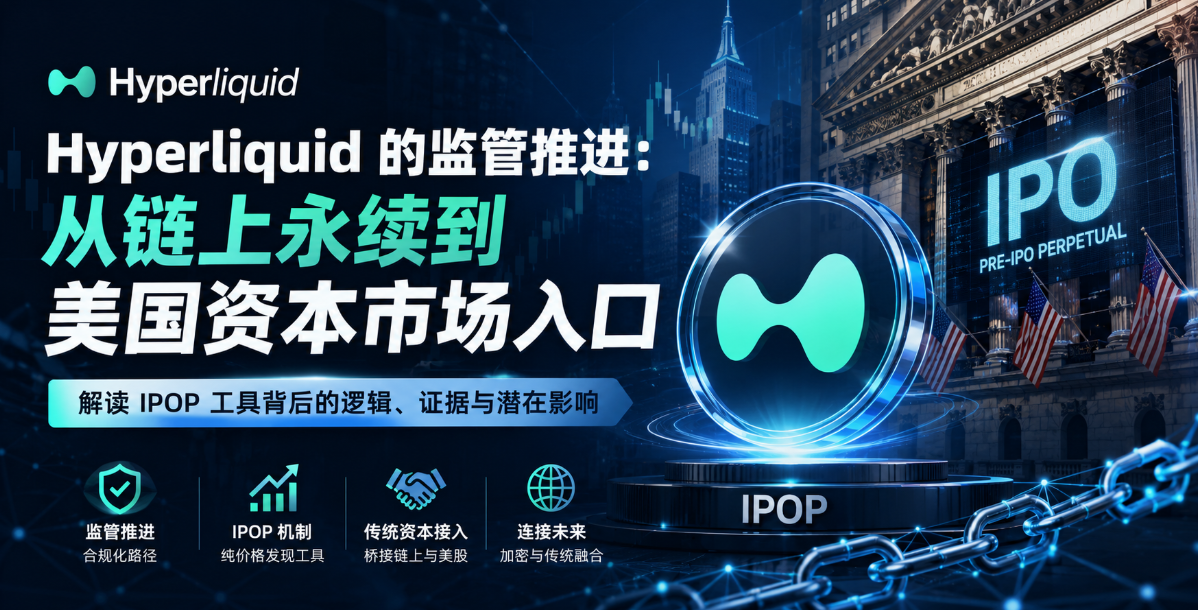
From the perspective of a deep analyst, the value of this event lies not in the short-term fantasy of “immediate SEC approval,” but in the clear demonstration of how Hyperliquid systematically addresses the structural flaws of traditional IPOs, while simultaneously constructing a threefold narrative of regulatory communication, traditional financial cooperation, and institutional capital access. The following dissects its logic, evidence, and potential impact.
1. The Real Pain Points of Traditional IPOs: Pricing Failure and Lack of Inclusivity
The current U.S. IPO market has two long-neglected systemic inefficiencies:
- Fewer Companies Going Public: Compared to the mid-1990s, the number of companies listed on U.S. exchanges has decreased by about 40%. The time companies spend in private markets has significantly lengthened, with growth dividends largely locked in by VCs, accredited investors, and institutions. Ordinary investors often only participate when “growth has ended,” and IPO allocations are typically prioritized for specific clients.
- Pricing Completed in a “Blind Spot”: Investment banks collect orders through private book-building, leading to a lack of transparent signals about actual demand for the issuer and the market before opening. Multiple cases in 2026 illustrate the costs: Cerebras was priced at $185, opened at $350 (a premium of about 89%); SpaceX was priced at $135, opened at $150; SK Hynix was priced at $149, opened at $170. The situation was more extreme for CXMT in Shanghai, which was priced at about $1.30, opened at about $7.30 (a premium of 472%). These “first-day gaps” did not flow to the issuer but rather to the allocation recipients.
Issuers are not the beneficiaries either. They are almost blindly pricing in their most critical “sale.” A moderate first-day increase helps subsequent demand, but such substantial undervaluation directly undermines the company’s capital-raising efficiency.
2. The Design Logic of IPOP: A Pure Price Discovery Tool, Not a Transfer of Ownership
The essence of IPOP is extremely simple: to provide a continuously tradable perpetual contract for several weeks before an expected listing, allowing the market to express directional views on the underlying equity and producing real-time public pricing signals. It does not grant any shares, allocation rights, voting rights, or claims on the issuer—only price exposure.
Compared to the private secondary market (restricted stock transfers), IPOP involves no transfer of ownership, no complex fees, and legal frictions, and is designed to automatically end or convert after the company's official listing, avoiding evolving into a permanent “private company synthetic market.” The first IPOP (Cerebras) operated for only 13 days.
The completed data from five trade[XYZ] IPOP cases provide direct evidence:
- In U.S. issuance cases, official pricing is generally 10.8%–38.4% lower than the price on the day before IPOP.
- CXMT's official pricing is even less than one-fifth of the IPOP market indicative price.
- IPOP prices correct themselves as the listing date approaches, and in multiple instances, they are closer to actual opening prices than traditional media’s pre-opening indications.
- All trading records are on-chain and can be publicly verified by any issuer, regulator, or researcher.
This exemplifies the “public good” characteristic of public price discovery: issuers and underwriters receive independent, continuous demand signals; direct listings (long limited by the lack of a pre-listing price formation mechanism) especially benefit. For investors, it provides a means to participate in price discovery while growth is still ongoing, rather than just being able to pick up shares afterward.
3. Regulatory Timeline and Business Signals: Systematic Advancement Rather Than Isolated Actions
The comment letter itself is merely a surface representation. What is more noteworthy is the synergistic actions behind it:
- Regulatory communication has been ongoing for several months: On May 26, 2026, SEC Chairman Atkins initiated CLL-16, publicly soliciting opinions on the modernization of IPOs, direct listings, etc. On July 14, HPC, trade[XYZ], and Sullivan & Cromwell officially met with the SEC Crypto Task Force to present the agreement, technology, and HIP-3 market. The IPOP letter on August 18 represents a further advancement in this line of communication.
- Access to Traditional Finance: On March 18, S&P Dow Jones Indices authorized trade[XYZ] to use the S&P 500 index to launch on-chain perpetual contracts (targeting eligible non-U.S. investors). While this is a commercial collaboration rather than regulatory approval, it marks the beginning of traditional indices and data systems opening up to Hyperliquid.
- Indirect Outlet for Institutional Capital: Nasdaq-listed company PURR, by holding HYPE, provides indirect exposure for U.S. and institutional investors. Q2 13F shows significant increases in holdings by institutions such as Duquesne, Renaissance, Citadel, Jane Street, Balyasny, and Nuveen. It should be emphasized that 13F only reflects net long positions at the end of the June 30 reporting period and does not disclose short positions, derivatives, or hedging structures, so it cannot be interpreted as “institutions have confirmed that the SEC will approve IPOP.” However, it at least proves that professional funds are seriously evaluating the long-term infrastructure value of Hyperliquid.
The combination of these three creates a clear picture: Hyperliquid is not waiting for regulatory “arrival” but is actively constructing a complete pathway of “policy lobbying + technological products + traditional financial cooperation + public market financing.”
4. The Practical Implications for All Parties and Boundaries That Need Calm Consideration
For U.S. investors and issuers:
IPOP is expected to allow all investors (including retail) to access pricing exposure close to the pre-growth of private companies within a compliant framework, while providing issuers with low-cost, independent demand signals. Direct listings may particularly benefit from a truly usable pre-price formation mechanism as a result.
For Hyperliquid and HYPE:
Successful implementation will significantly expand the application scenarios of HIP-3, extending from crypto perpetual contracts to equity price discovery, reinforcing the platform narrative of “unified accounts + high-performance order books + open deployment.” Institutional indirect participation through vehicles like PURR may also further reduce the recognition discount for “pure crypto assets.”
Boundaries that must be acknowledged:
- Classification issues (security futures vs. security-based swaps) will directly determine registration, trading venues, clearing, and margin requirements, requiring coordination between the SEC and CFTC.
- Disclosure, listing eligibility safeguards, and market integrity (oracles, settlement rules, deployer permissions, manipulation prevention) need to be clarified.
- Comprehensive access for U.S. users may be phased, with leverage and position limits likely unavoidable.
- Currently, IPOP primarily serves non-U.S. users, and U.S. investors can only “see the signals but cannot trade.”
The five specific suggestions proposed in the comment letter (classification, matching disclosures, listing safeguards, market integrity, phased onshore) demonstrate a pragmatic rather than idealistic stance.
5. Conclusion: This is a Key Step in Infrastructure-Level Narrative, Not a Short-Term Catalyst
Hyperliquid's recent action essentially answers a more fundamental question: Can on-chain markets become an effective complement to traditional capital markets, or even provide a better solution in certain areas (price discovery)?
There is already evidence indicating:
1. IPOP has provided valuable public pricing signals in actual operation;
2. Regulatory communication has entered a formal and ongoing phase;
3. Traditional index authorizations and institutional indirect holdings are progressing in parallel.
This does not mean “immediate comprehensive access for U.S. users” or “instant revaluation of HYPE.” It means Hyperliquid is seriously constructing a compliance pathway to the U.S. capital markets and moving itself from “high-revenue perpetual exchange” towards “trading infrastructure that can serve a wider range of financial products.”
The truly worthwhile indicators for future tracking are not short-term sentiment but rather:
- Whether the SEC officially publishes the CLL-16 comment records;
- Whether the Crypto Task Force continues to issue related meeting minutes;
- The pricing accuracy and liquidity performance of the upcoming IPOP market;
- Substantive progress in the U.S. investor access framework.
If these signals continue positively, Hyperliquid will not only be a leader in on-chain derivatives but may also become one of the key bridges connecting crypto and traditional capital markets. This is precisely where deep analysis should focus on the long-term value—solving genuine market failures with verifiable products and ongoing regulatory interaction.
AiCoin User Exclusive Benefits
👉 Enter the invitation code AICOIN88 when binding your Hyperliquid account to enjoy a 4% transaction fee rebate.
🔗 Exclusive registration link:
https://app.hyperliquid.xyz/join/AICOIN88
📖 Beginner's Tutorials:
- “AiCoin PC Hyperliquid Authorization Trading Tutorial”:
https://www.aicoin.com/zh-Hans/article/514197
- “AiCoin Mobile Hyperliquid Authorization Trading Tutorial”:
https://www.aicoin.com/zh-Hans/article/541383
- “Beginner's Entry! Super Detailed Tutorial for First Hyperliquid Transaction”:
https://www.aicoin.com/zh-Hans/article/510225
📖 Community Communication:
- Telegram:
https://t.me/AiCoinWhaleData
- Discord:
https://discord.gg/5XSXjXSpz
- AiCoin Chat Group:
https://www.aicoin.com/link/chat?cid=N6OVMor5g
The content of this article only represents the author's personal opinion and does not represent the platform's position. The views, conclusions, and suggestions contained in the article are for investors' reference only and do not constitute any investment advice related to this platform. Investing in U.S. stocks still requires individuals to bear market risks, regulatory risks, and compliance risks with local laws and regulations (especially foreign exchange controls, overseas investment reporting, etc.).
免责声明:本文章仅代表作者个人观点,不代表本平台的立场和观点。本文章仅供信息分享,不构成对任何人的任何投资建议。用户与作者之间的任何争议,与本平台无关。如网页中刊载的文章或图片涉及侵权,请提供相关的权利证明和身份证明发送邮件到support@aicoin.com,本平台相关工作人员将会进行核查。