In the past month, the security nerves of the crypto sphere have been tightened again.
First, Coldcard was exposed for a serious random number generation vulnerability, followed by Trezor and SafePal disclosing risks of user privacy data leaks one after another.
At first glance, the three incidents do not seem to have much in common, but if the timeline is extended a bit, it becomes evident that they all point to an increasingly important issue:
As AI begins to automate vulnerability discovery, attack development, and social engineering more and more, how many areas in a cryptocurrency wallet may still become the next weak link sought by attackers?
1. With AI, hacking attacks have shifted from "craftsmanship" to "industrialization"
Objectively speaking, these three incidents exposed completely different attack surfaces.
The issue with Coldcard lies in private key generation, which is a severe security problem; Trezor faced challenges with third-party logistics services, and SafePal had issues with order systems and plugin permissions, exposing risks associated with data leaks.
Although there is currently no evidence directly connecting the three incidents to AI, it must be acknowledged that, in the era of AI, hackers' "toolkits" are undergoing a significant transformation.
In the past, many sophisticated cyberattacks were limited by a very real constraint—human time.
Researching a large codebase, understanding the call relationships, and finding long-hidden logical vulnerabilities required experienced security researchers to invest a significant amount of time; gathering identity information for a specific user, studying their habits, and crafting a convincingly tailored phishing email might even take months to construct a complex social engineering script.
This led to a trade-off in past attacks: either highly automated but the methods were crude, casting a wide net for only a few users to bite; or meticulously designed for specific high-value targets, but difficult to scale.
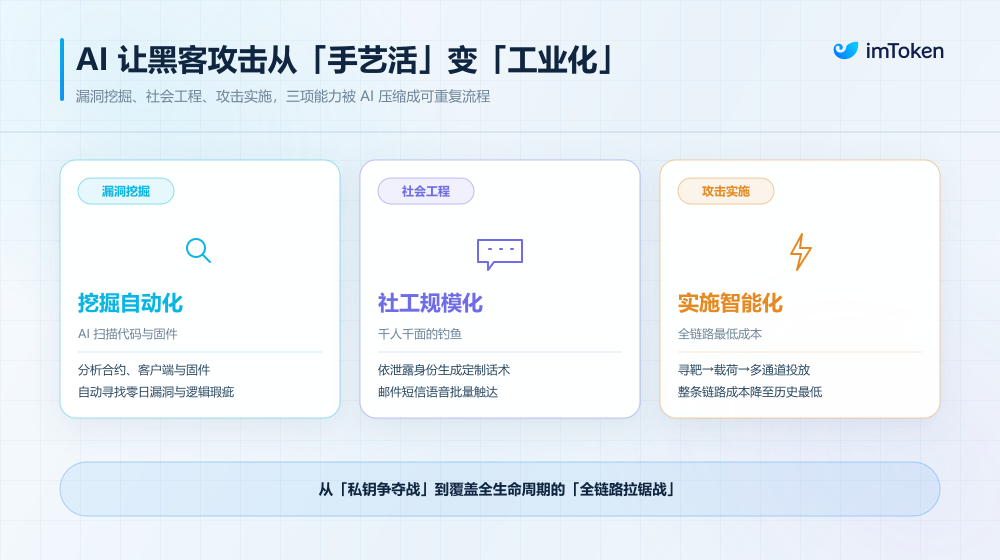
But today, with the rapid evolution of AI capabilities, hackers' toolkits have been significantly upgraded:
- Automated vulnerability digging: AI can assist attackers in quickly analyzing smart contracts, client code, and even firmware, automatically searching for zero-day vulnerabilities and logical flaws.
- Scaled social engineering: Phishing emails that once needed to be carefully crafted can now be automatically generated by AI based on leaked user identity data, producing highly customized and persuasive phishing content, messages, or even voice/video notifications (see reading: Spring Festival Asset Security Handbook: How to Protect Your Tokens While Visiting Family and Friends?);
- Intelligent attack implementation: From target selection to multi-channel concurrent deployment, the overall cost of the attack chain has dropped to a historic low;
It can be said that from target screening, vulnerability research, to malicious code generation, social engineering, and attack content delivery, capabilities that used to be dispersed among different attackers are gradually being compressed into a more automated workflow.
This is also the truly far-reaching impact of AI on cybersecurity.
It may not suddenly create an unprecedented attack method, but it is quickly reducing the costs of existing attack methods—finding a vulnerability has become cheaper, analyzing a target faster, and generating a thousand different versions of phishing emails is much easier than before.
In other words, the reason many systems have not been attacked in the past does not necessarily mean there are no vulnerabilities; sometimes it's just that the vulnerabilities were too difficult to find, the attack costs too high, and the cost-effectiveness of the target too low. Now, the invisible security boundary that relied on "attackers don't have that much time" is gradually thinning.
From this perspective, the security offense and defense of crypto assets are also transitioning from the relatively concentrated "private key contest" to a full-chain tug-of-war covering code, devices, supply chains, user identity, and daily interactions.
What AI has done is merely press the accelerator button further.
2. The real attack surface of wallets is more than just a string of mnemonic phrases
This is why the recent incidents appear particularly representative when viewed together.
They have successively hit different points in the wallet lifecycle, reminding us that the risks faced by wallets have long exceeded the single dimension of whether "the private key has been stolen," becoming embedded in every link of private key generation, hardware devices, logistics supply chains, and even user privacy information.
We can break this down simply.
Coldcard is the most typical example, with issues arising even before the user has truly started using the wallet.
The mnemonic phrases still appear as 12 or 24 normal words, and the device can also sign and transfer normally, making it very difficult for the user to notice any anomalies; however, the random number used to generate these mnemonic phrases was not random, meaning that even if your mnemonic phrases were not disclosed to anyone, they may still face risks.
Because the premise of "keeping the mnemonic phrases safe" is that the phrases themselves were generated in a sufficiently secure and unpredictable manner.
Then we have Trezor and SafePal.
Unlike Coldcard, their hardware itself has not been compromised, and the mnemonic phrases remain intact, but they leaked user purchase records—including names, phone numbers, email addresses, and even shipping addresses.
This is akin to having bought a top-tier explosion-proof safe, which remains unbroken, but the shipping slip from the logistics company has been lost, clearly stating what your name is, what your email is, what your phone number is, where you live, and that you purchased a hardware wallet specifically for storing crypto assets.
The attacker then receives a potential lead for high-value crypto users, can impersonate customer service to send notifications for "emergency firmware upgrades," can customize phishing pages based on the model purchased, can call claiming there is an issue with the order, and even further correlate the user's social media, public identity, and on-chain addresses.
This means that not being able to crack the cryptography does not imply there are no avenues for attack.
There is even an extreme saying that has circulated in the crypto community for many years—"the $5 wrench attack": no matter how strong the encryption algorithm, it cannot solve the issue of an attacker directly locating the asset holder.
This is not merely a theoretical risk. According to data provided by Chainalysis to the Financial Times, as of mid-August 2026, at least 46 violent attacks against crypto holders have been recorded this year, with over half being kidnappings, and over a third involving home invasions.
So, looking back at these three incidents, it becomes apparent that today's so-called "wallet security" has effectively transformed into a long chain:
From wallet code, random numbers, and key generation to chips, firmware, and devices, then to official websites, purchasing channels, supply chains, logistics, and order databases; once users truly start using the wallet, they will connect with RPC, DApps, browser plugins, and smart contracts, followed by authorizations, signatures, customer service, social media, and even AI agents.
Any weak link among these could potentially bypass the security defenses established by other links.
3. When attacks begin to automate, defenses must integrate AI
If AI continues to evolve at its current speed, the issues that have been exposed today may just be the beginning.
Because one of AI's strengths is continuing to find anomalies, repeated patterns, and weak points in a vast system.
Attackers can have an agent continuously scan open-source code, can perform bulk tests on web pages, APIs, and plugin permissions, and can automatically collect information from social media and public databases to filter potential high-value targets.
Even phishing itself might evolve from previously standard "Your wallet is about to expire, please enter your mnemonic phrases" to a real-time dialogue that truly knows who you are:
- If the attacker knows you just purchased a specific model of hardware wallet, they could generate a "firmware security notification" tailored to that model;
- If they know you recently participated in a specific DeFi protocol, they could disguise themselves as the project team and prompt you to migrate to a new protocol treasury;
- If they further obtain your social media account and public comments, they could even impersonate familiar team members, KOLs, or customer service representatives in communication;
From this perspective, a significant challenge for wallets in the future will be whether defenses can rely solely on static rules when attacks have transitioned from "fixed rules" to dynamic systems that can analyze, judge, and change.
After all, previous wallet security mechanisms were still relatively close to a "rulebook": if a certain address is marked as a phishing address, it shows a pop-up reminder; if a certain domain is blacklisted, access is prohibited; if a particular authorization model is deemed high-risk, an additional prompt is added.
These mechanisms remain important, but when faced with increasingly dynamic attacks, relying solely on past risks to identify the next risk is evidently insufficient.
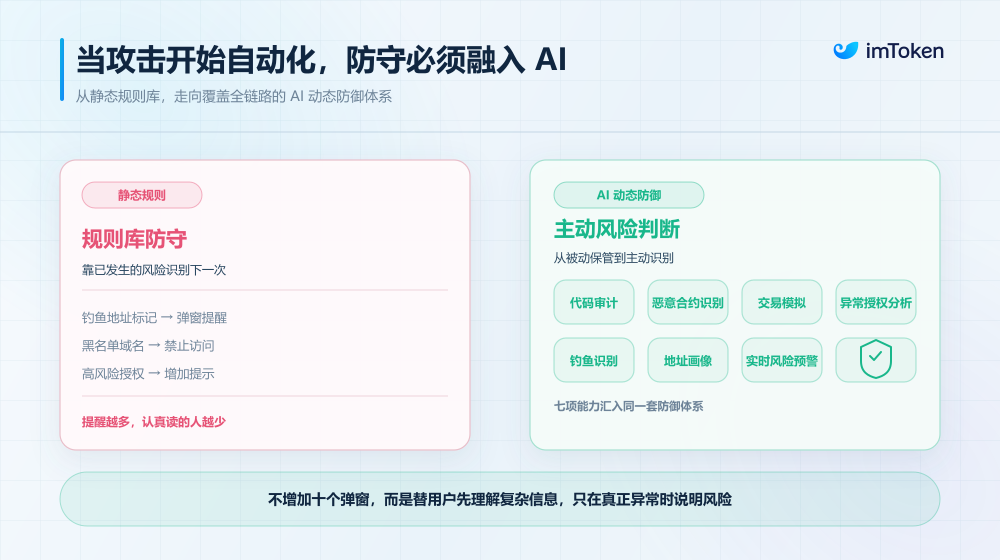
AI can indeed become a very important complement for defenses (see reading: When hackers use AI "more efficiently," how does the arms race of "spear and shield" upgrade in Web3?), and in fact, this is not suddenly emerging as a new proposition.
Previously, imToken discussed around "AI × Web3 Security" and suggested similar directions: the future security capabilities of wallets should not merely stop at address blacklists, risk labels, and fixed pop-ups, but rather leverage AI to further advance security judgments throughout the entire user transaction process.
For instance, AI could constantly review code dependencies, call paths, and abnormal logics before the code enters the production environment; when a user accesses a DApp, it can determine whether it is abnormal by combining domain history, frontend behavior, contract addresses, and on-chain associations; prior to signing, it could simulate the actual outcomes of executing the transaction rather than merely displaying a string of incomprehensible hexadecimal data.
Taking it a step further, wallets could gradually build dynamic security models for each user.
An account that has only conducted transfers of a few hundred dollars suddenly preparing to authorize all its assets to an unfamiliar contract deployed just two hours ago is itself an abnormal signal; an address the user has never interacted with suddenly requesting unlimited Approval should also trigger a higher priority risk alert; and an email claiming to be from the official wallet, requesting users to input their mnemonic phrases, regardless of how realistically written, should be directly deemed high risk.
Thus, the changes brought by AI may not merely be "automatically helping users judge whether an address is safe." Instead, it resembles allowing wallets to move from a relatively passive key management and signing tool to gradually possessing proactive risk judgment capabilities.
This also underscores the importance of another layer of security boundary that imToken has previously discussed, namely that AI can assist users in understanding and executing complex operations, but control over assets cannot be indefinitely relinquished. For key actions such as large transfers, authorizing new addresses, and interacting with sensitive contracts, it is essential to maintain AI's capabilities within clearly defined authorization boundaries through least privilege, human confirmation, pre-execution simulations, and clear explainability.
Especially in truly exceptional situations, clearly inform the user about "why it is risky," "what will happen after execution," and "where the risks lie."
In other words, the significance of AI defense lies in promoting wallets from being mere passive signing tools to gradually possessing the ability to proactively understand transactions, recognize anomalies, and constrain execution.
In conclusion
The recent series of wallet security incidents does not mean that self-custody models have lost their value, nor does it imply that users should return all control over their assets to centralized platforms.
What they truly remind us is that self-custody has never equated to natural security; it simply returns absolute control over assets to users.
However, protecting this control requires a security system that can evolve with the times and continuously upgrade, because security is not a one-time product delivery; it is a long-term dynamic evolution that requires the combined efforts of users, project teams, and wallet vendors.
Attackers can use AI to understand code, users, and environments; defenders can do the same.
This will be a protracted arms race of "spear and shield" upgrading.
免责声明:本文章仅代表作者个人观点,不代表本平台的立场和观点。本文章仅供信息分享,不构成对任何人的任何投资建议。用户与作者之间的任何争议,与本平台无关。如网页中刊载的文章或图片涉及侵权,请提供相关的权利证明和身份证明发送邮件到support@aicoin.com,本平台相关工作人员将会进行核查。


