Overview
The global embodied intelligence and quadrupedal robot unicorn Unitree Robotics has officially completed its initial public offering (IPO) and listed on the stock exchange. On the first day of trading, Unitree Robotics' stock (Unitree Robotics Stock) saw a massive influx of buy orders from the opening bell, with intraday gains at one point surpassing 600%, triggering multiple temporary trading halts. In the phase leading up to the public offering, retail investor subscription was over 8,000 times, setting a rare record of oversubscription for the hard technology sector in recent years. This trading frenzy, driven by the combination of artificial intelligence large models and physical entities, not only established Unitree Robotics as a core listed entity in the global humanoid robot market but also sparked in-depth discussions in the capital markets about the commercialization pace and valuation rationality of the embodied intelligence industry chain.
Key Points
Unitree Robotics' stock demonstrated extremely high liquidity premium on its first day of listing, opening significantly higher and reaching intraday gains of approximately 600%, with trading volume among the highest in its sector.
The retail subscription phase recorded an oversubscription of more than 8,000 times, reflecting the market's intense enthusiasm for the first stock in the humanoid robot sector.
The core product matrix includes quadrupedal robots (Unitree Go2, B2) and general-purpose humanoid robots (Unitree H1, G1), with the basic version of G1 bringing the price of humanoid robots into the $16,000 (approximately 99,000 RMB) range, breaking the industry's mass production price barrier.
Global AI giants are accelerating their layouts in the embodied intelligence field, including Tesla promoting the Optimus project and NVIDIA launching the GR00T foundational model platform, serving as key macro catalysts for this round of valuation explosion.
The company has achieved a high degree of full-stack self-research in core components such as motors, reducers, and controllers, with the cost advantage of self-researched hardware becoming a critical moat supporting its large-scale mass production.
Investors need to focus on the mass production delivery cycle, the order conversion rate from industrial and service scenarios, and the mean reversion risk of valuations after the first-day emotional tide recedes.
Market Frenzy Behind Unitree Robotics’ Surge on Its First Day of Listing
Retail Subscription of Over 8,000 Times and Trading Details of a 600% Surge
According to publicly disclosed subscription data from the stock exchange and underwriters, Unitree Robotics sparked fierce competition among global institutional funds and individual investors during the public offering phase. The initial effective subscription multiple of online offerings exceeded 8,000 times, reflecting the extreme demand for pure robot concept stocks in the primary and secondary markets. On the first day of trading, Unitree Robotics opened significantly higher, accompanied by large buy orders driving the stock price up by about 600% from the IPO issue price.
This surge in price reflects characteristics typical of high turnover and high volatility. As trading time progressed, both bullish and bearish sides engaged in fierce turnover, with the daily turnover rate rapidly climbing, and trading volume setting a record for similar technology hardware listed stocks. According to reports from Bloomberg and Reuters regarding the technology sector, this surge illustrates global liquidity seeking core hard technology assets with disruptive technological breakthroughs.
Why Capital Markets View Unitree as a Core Humanoid Robot Stock
The core reason that capital markets assign such high valuation premiums to Unitree Robotics lies in its scarce ability to commercialize and the progress of technology implementation. Compared to the vast majority of startup companies still in the laboratory research and development stage or reliant on external conceptual financing, Unitree Robotics has already established mature cash flow support in both consumer-level and industrial-level quadrupedal robot markets.
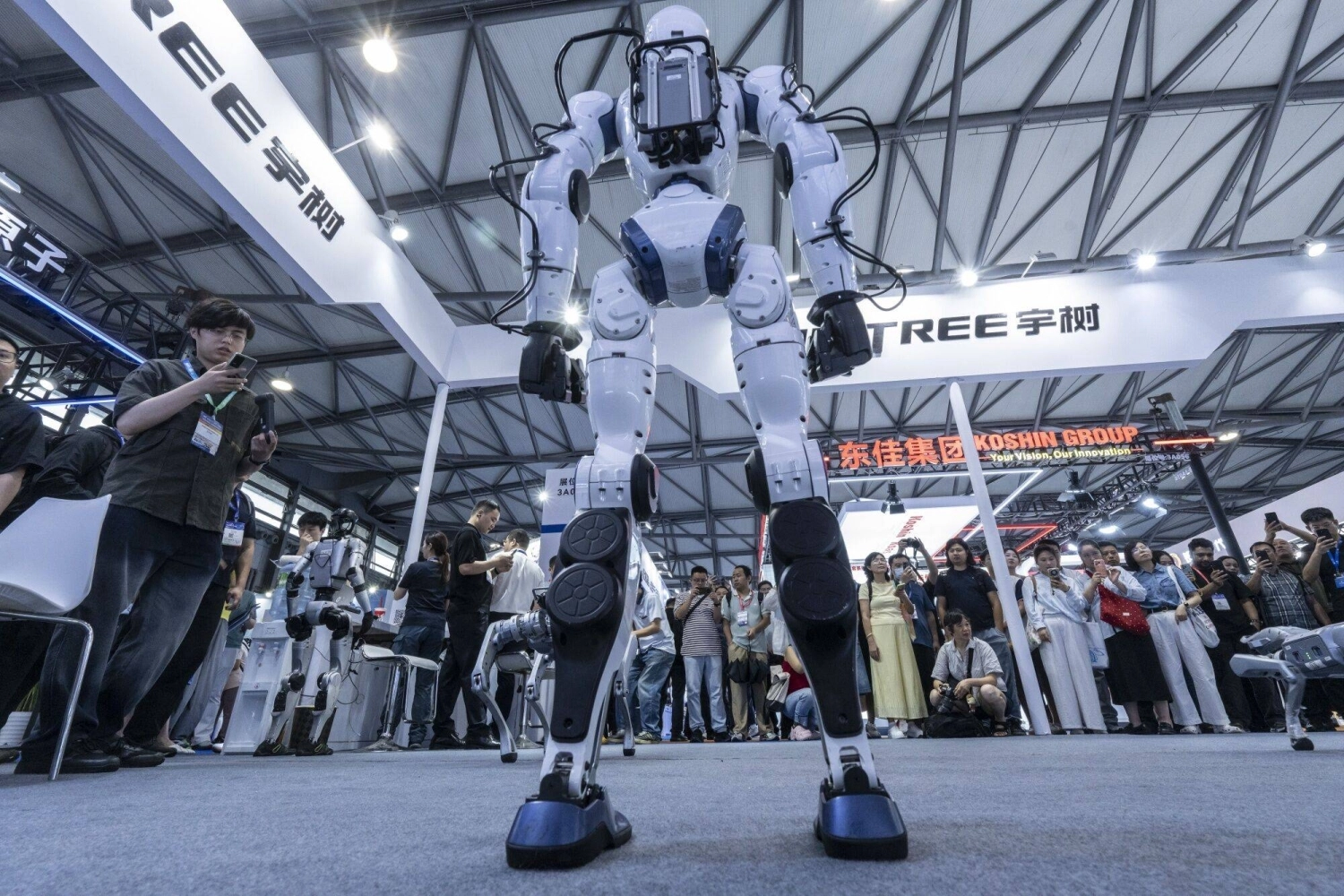
More importantly, Unitree Robotics has successfully transferred the dynamics control experience of quadrupedal robots seamlessly into the bipedal humanoid robot field. The company’s successive launches of the full-sized general-purpose humanoid robots H1 and mass-produced intelligent humanoid robot G1 not only possess high dynamic motion control capabilities such as running and backflipping but also have achieved a commercialized closed-loop in mechanical structure and perception algorithms. In the public capital market, Unitree Robotics has become one of the very few humanoid robot manufacturers with actual mass production shipping data.
Commercialization Critical Points in the Embodied Intelligence and Humanoid Robot Sector
From Quadrupedal Robot Dogs to Humanoid Robots G1 and H1 Product Matrix
The product evolution path of Unitree Robotics demonstrates a strong engineering implementation logic. According to the official technical documentation of Unitree Robotics, the company initially opened the global market with the Go1 and Go2 series of quadrupedal consumer robots, followed by the launch of the B2 industrial quadrupedal robot, which penetrated vertical scenarios like power inspection and firefighting rescue, capturing a leading share of global quadrupedal robot shipments.
On this basis, Unitree Robotics quickly entered the blue ocean of humanoid robots. The H1 humanoid robot set a world record for running speed among full-sized humanoid robots thanks to its advanced powertrain, while the new generation G1 humanoid agent further integrated multimodal large models and reinforcement learning algorithms. G1 features up to 23 to 43 degrees of joint freedom, capable of performing complex collaborative tasks with robotic arms and precise object manipulation, demonstrating its potential for evolving from single dynamics control to general labor replacement.
Hardware Cost Control and Global Supply Chain Advantages
The major pain point restricting the large-scale popularization of the global humanoid robot industry is the high manufacturing cost of hardware. The assembly cost of traditional industrial robots and some overseas high-end humanoid robots often reaches tens of thousands of dollars, severely limiting their penetration speed in factory assembly lines and home services.
Unitree Robotics has broken this deadlock through full-stack self-research of core power units. The company has independently developed high-torque density external rotor motors, precision planetary gears, high-performance magnetic encoders, and integrated drivers, significantly reducing the production cost of the core drive system. Relying on a comprehensive precision processing and consumer electronics supply chain network, Unitree Robotics has successfully reduced the starting price of the G1 to the 99,000 RMB range, making humanoid robots economically feasible for medium and small enterprises and high-tech consumer markets.
Global AI Giants’ Layout and Humanoid Robot Concept Stock Valuation Restructuring
Tesla's Optimus and NVIDIA's GR00T Ecosystem Technical Resonance
The explosive growth of humanoid robot concept stocks in the secondary market is inseparable from the coordinated boost of global tech giants towards the embodied intelligence ecosystem. Tesla CEO Elon Musk has repeatedly emphasized that the Optimus humanoid robot will constitute most of the company's long-term market value in the future and is accelerating on-site work testing in its automotive manufacturing super factory.
Meanwhile, semiconductor giant NVIDIA has launched the Project GR00T universal humanoid robot foundational model and provided a toolkit for synthetic data generation and model training based on the Isaac simulation platform, significantly shortening the development cycle from algorithm simulation to physical reality. This industry resonance from underlying computing power, foundational models to terminal hardware has led global capital to reassess the market space of physical AI.
Cross-Asset Liquidity and Valuation Differentiation in the Technology Hardware Sector
In the context of structural transformation in the macro economy, growth capital is globally seeking new narratives with trillion-dollar potential market space. The slowing growth of traditional consumer electronics and general software sectors has prompted risk-averse and growth capital to accelerate into cutting-edge fields represented by embodied intelligence.
For investors focusing on global technological innovation and asset rotation, the trend of cross-market liquidity migration is particularly crucial. Many traders, who focus on capturing the global technology cycle and the digital economy's spillover effects, usually monitor liquidity pricing mechanisms through mainstream digital asset trading platforms like MEXC, to timely seize trading opportunities arising from the fluctuations of frontier technology assets in a multi-asset environment.
Register on MEXC now to win up to 10,000 USDT in new user benefits!
Core Variables and Potential Risks for Investors to Closely Monitor Going Forward
Mass Production Delivery Capability and Gross Margin Stability
As the first-day IPO enthusiasm is gradually digested by the market, the long-term investment logic of Unitree Robotics will revert to its fundamental delivery capability. The primary variable to consider is the actual conversion speed of the order backlog. Although the low-price strategy is conducive to quickly capturing market share, the control of yield rates in large-scale batch assembly processes, post-sales maintenance costs, and the resilience of the components supply chain will directly determine whether its overall gross margin can remain at a healthy level.
Additionally, the operational stability of the robots in actual industrial manufacturing, warehousing logistics, and special operations scenarios, as well as the average time between failures (MTBF), will be decisive indicators of whether enterprise clients can continue to place repeat orders.
Valuation Rebound and Unlocking Pressure After Market Sentiment Recedes
Historical market patterns have shown that growth-tech stocks that experience extreme gains on their IPO day often face severe price volatility and valuation corrections shortly after listing. The over 8,000 times retail subscription and 600% first-day surge included a considerable proportion of short-term speculative funds and arbitrage transactions.
As the market sentiment gradually stabilizes in subsequent trading days, stock prices may converge towards their intrinsic fundamental values. Investors need to be particularly wary of the timelines for equity unlocking of early-stage venture capital firms and cornerstone investors, as well as the possible liquidity tightening impacts that overvalued growth stocks may experience in the context of macro interest rate fluctuations.
Potential Risks and Different Market Scenario Analyses
Commercialization Progress Falling Short of Expectations and Technical Iteration Risks
According to industry research institutions and The Financial Times industry observations, the technology route for humanoid robots has not yet fully converged. In terms of sensor solutions (pure vision versus lidar multimodal), joint drive solutions (electric drive versus hydraulics), and dexterous hand degrees of freedom design, the industry is still in a rapid evolution stage.
If downstream clients' calculations of return on investment (ROI) for humanoid robots do not meet expectations, leading to delayed procurement demand in the industry, or if competitors achieve breakthrough advances in end-to-end embodied intelligence algorithms, Unitree Robotics may face the dual challenges of adjusting its technology route and prolonging its commercialization cycle.
Valuation Evolution and Secondary Market Trend Scenario Simulation
Based on the current liquidity and risk appetite in the technology sector, the future trend of Unitree Robotics may present two main development scenarios:
In the baseline scenario, the company continues to win bulk orders in industrial manufacturing and research education sectors due to cost advantages, while the annual shipment of humanoid robots steadily rises, and quadrupedal robot overseas business maintains stable cash inflows. Under these circumstances, after experiencing a reasonable technical adjustment following the first-day surge, the stock price is expected to establish a central support point at core moving averages, forming a long-term upward channel matching growth fundamentals.
In the pessimistic scenario, the excessively leveraged valuation bubble on the first day prompts institutional funds to take profits, and the progress of industrial scene implementation lags behind market optimism, resulting in a slowing quarterly revenue growth rate. In this scenario, the stock price may face a prolonged period of fluctuating downward exploration, with valuation multiples converging towards traditional high-end equipment manufacturing companies.
Exclusive Insights from James Mitchell
Analyzed from the perspective of market microstructure and cross-asset cycles, the astonishing 600% rise recorded by Unitree Robotics on its first day of listing essentially reflects the global capital's frenzied pursuit of physical entities as monetization vehicles amid diminishing marginal effects faced by artificial intelligence software narratives.
The truly important core is not merely the emotional climax created by the 8,000 times subscription on the first day, but rather the fundamental shift in the robot hardware manufacturing paradigm. Unitree Robotics has successfully combined fully self-researched components with China's mature precision manufacturing supply chain to reduce the price of humanoid robots below 100,000 RMB. This price breakthrough is a decisive critical point that determines whether embodied intelligence can transition from laboratory research toys to universal production tools.
The market may partly overlook the challenges of soft and hardware co-evolution during its current frenzy. While the physical movement capabilities of humanoid robots are highly mature, the generalization and utility capabilities of the embodied intelligence brain and cerebellum are still in the early exploratory stages. The generalization boundaries of end-to-end reinforcement learning models determine the task success rate of robots in unstructured complex environments, which cannot be completely solved by merely reducing hardware costs in the short term.
This logic presents a high degree of isomorphism with the evolution of the blockchain ecosystem. Just as the Bitcoin network requires underlying computing network support to establish decentralized trust, and the prosperity of the Ethereum ecosystem relies on decentralized physical infrastructure (DePIN) and distributed execution layers, the ultimate form of physical AI also requires deep collaboration of decentralized data collection, edge computing, and physical hardware terminals. With the large-scale deployment of embodied intelligence devices globally, future micro-payment settlements based on smart contracts between machines and decentralized computing power collaboration will open new narrative dimensions for cross-asset fintech.
Investors should maintain rational restraint at this stage, avoiding blind chasing in extreme emotional highs, and instead focus on tracking mass production delivery rates, hardware gross margin fluctuations, and the efficiency of research and development spending transforming into actual commercial orders in subsequent quarterly reports.
Frequently Asked Questions
What type of robot company is Unitree Robotics?
Unitree Robotics is a globally renowned high-tech enterprise specializing in quadrupedal robots and embodied intelligence, focusing on the research, development, production, and sales of consumer and industrial quadrupedal robot dogs, general-purpose humanoid robots, and core power joint components.
Why did the stock of Unitree Robotics surge 600% on its first day of listing?
The surge was mainly driven by market funds’ enthusiasm for the rarity of the first stock in humanoid robots, the over 8,000 times retail subscription enthusiasm during the subscription phase, and the macro industry valuation restructuring brought about by global tech giants accelerating their layouts in the embodied intelligence track.
What is the core price of Unitree Robotics’ humanoid robots?
The official starting price of Unitree Robotics' mass-produced intelligent humanoid robot G1 base version is approximately 99,000 RMB (about $16,000), far lower than the industry counterparts which are often priced at several tens of thousands of dollars, significantly lowering the commercialization threshold for embodied intelligence robots.
What are Unitree Robotics' core competitive barriers in hardware manufacturing?
The company has achieved full-stack self-research and self-production of core transmission components such as motors, reducers, controllers, and encoders, combined with efficient supply chain integration capabilities, establishing deep barriers not only in motion control algorithms but also in controlling the overall material cost (BOM) of the complete machine.
What commercial challenges does the humanoid robot industry currently face?
Major challenges include the inadequacy of end-to-end large model generalization capabilities in unstructured complex scenarios, lengthy verification cycles for operational reliability and safety in industrial and home service scenarios, and managing yield rates and supply chain stability during the early mass production delivery process.
What does the over 8,000 times retail subscription imply for future trading?
Such a high subscription rate reflects significant market attention and involvement of short-term speculative funds. While this drove the stock price up on the first day, it also means there will be intense turnover of shares in the early listing stage, which could lead to higher volatility in the secondary market as initial emotions settle and unlocking periods approach.
What financial and operational indicators should investors focus on going forward?
Investors should closely monitor the actual delivery volumes of humanoid robots and quadrupedal robots in each quarter, the conversion rates of enterprise-level scenario commercial orders, the changes in overall gross margin of main business, and the actual output efficiency of R&D investments in software and hardware upgrades.
Disclaimer
The information provided in this article is for reference, learning, and academic exchange purposes only, and does not constitute any form of investment advice, financial analysis, legal opinions, tax consulting, or trading recommendations for any specific financial assets. The markets for stocks, initial public offerings (IPOs), cryptocurrency assets, and related derivatives carry high price volatility and investment risks, influenced by multiple factors such as macroeconomic trends, market supply and demand sentiment, industry regulatory policies, and changes in company fundamentals, which may lead to significant or total losses of invested capital.
Historical market data, subscription multiples, technical analysis indicators, and industry development forecasts do not constitute a guaranteed certainty of future returns. Investors should conduct thorough independent due diligence before participating in any financial market transactions and make prudent decisions based on their financial condition, risk preferences, and investment goals. The MEXC Crypto Pulse team and its affiliates bear no legal responsibility for any financial losses, trading decisions, or operational outcomes arising from direct or indirect reliance on the content contained herein.
免责声明:本文章仅代表作者个人观点,不代表本平台的立场和观点。本文章仅供信息分享,不构成对任何人的任何投资建议。用户与作者之间的任何争议,与本平台无关。如网页中刊载的文章或图片涉及侵权,请提供相关的权利证明和身份证明发送邮件到support@aicoin.com,本平台相关工作人员将会进行核查。


