Written by: Yang Xi, Feng Zitong, 21st Century Business Herald
Since the Bitcoin network officially went live in 2009, its price has experienced a complete three cycles of bull and bear markets.
From the characteristics observed, each bull market shows progressively diminishing gains, while bear market declines progressively converge; the duration of bull markets has extended from 742 days in the early stages to 1068 days in the third round; bear markets have lasted about 12 months since the second round, with a historical average duration of 383 days.
According to Coinglass data, on August 19, Bitcoin's price fluctuated around $64,400, having dropped about 50% from the historical peak of $126,198 on October 6, 2025.
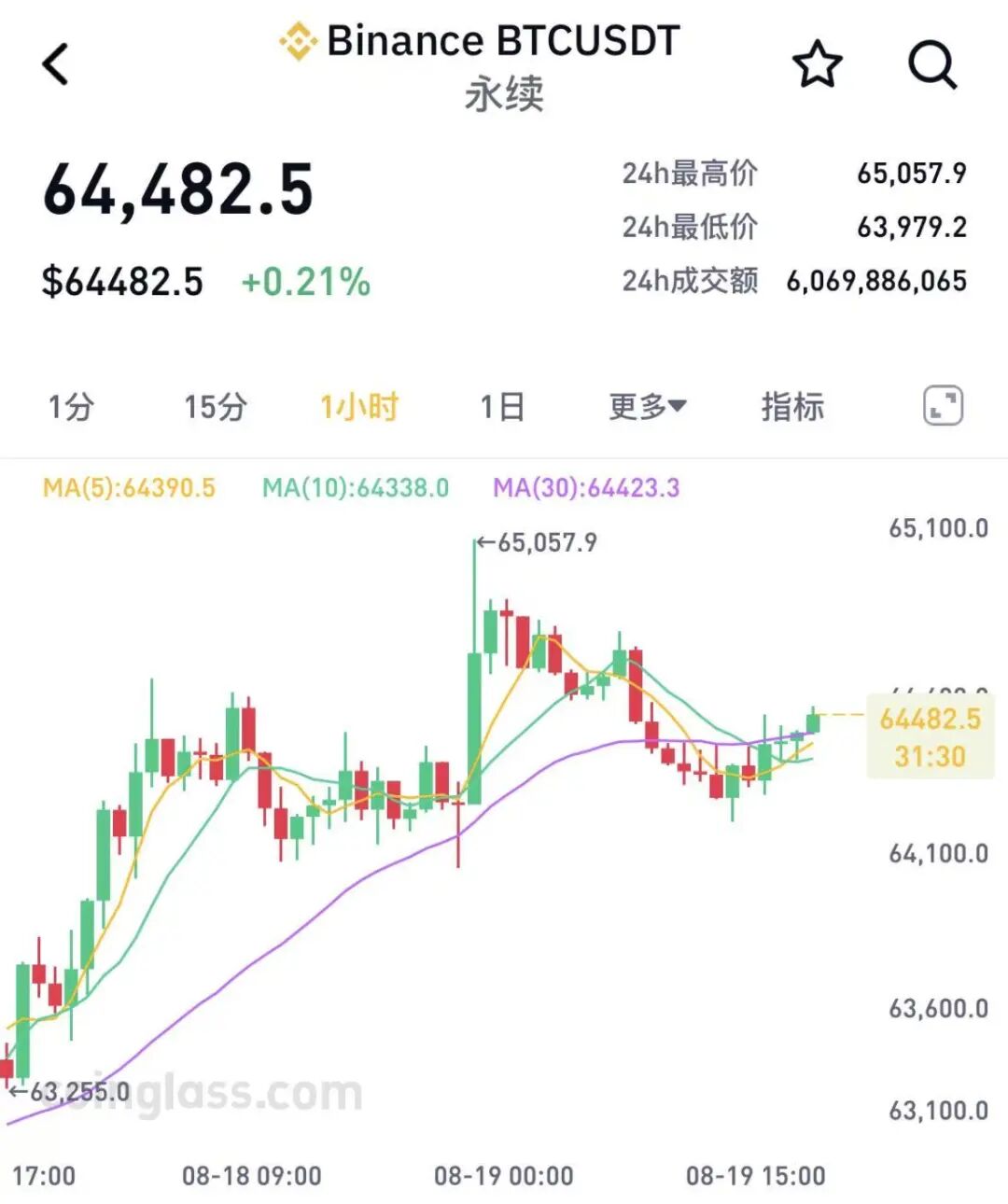
This is also the core basis for the current market's judgement that the bear market may be nearing its end. If we view the peak date as the starting point of this bear market, then this long downward cycle has lasted for 317 days. If history repeats itself, the turning point may be near.
This time window has been echoed by several institutions. Investment research firmBernsteinpointed out in a report that Bitcoin's price may find a bottom near the previous cycle's peak (around the $60,000 range).
Grayscale believes that the final bottom could form by the end of 2026, but there is also a possibility of hitting bottom sooner.
From a market technical perspective, some analysts have pointed out that the technical damage Bitcoin has suffered over the past few months may be nearing its end and that a rebound driven by ETF fund flows, a weakening dollar, and institutional buying may start from the end of 2026 to the beginning of 2027.
In 2025, there was a net inflow of $21.4 billion into U.S. spot Bitcoin ETFs, a decrease from $35.2 billion in 2024. However, as 2026 begins, the situation drastically worsened. From mid-May to early June, Bitcoin ETFs faced a continuous outflow of funds for 13 consecutive trading days, totaling about $4.4 billion.
However, in the first full week of August, the net inflow to U.S. spot Bitcoin ETFs reached $854 million, maintaining a net inflow for five consecutive trading days, with BlackRock's IBIT contributing $694 million. This is the largest consecutive buying record since April.
It is important to note that the sample size is limited, and historical experiences do not guarantee that the market will recreate past trends. At the same time, bearish factors in the market are still significant. The progress of U.S. cryptocurrency industry legislation is slow, and there is considerable uncertainty regarding regulatory policies; if inflation rebounds and the Federal Reserve continues high-interest rates, it will continue to suppress risk assets like cryptocurrencies. Even if a phase of rebound occurs, selling pressure from positions stuck at high levels will still constrain upward movement.
In addition, market analysis suggests that there is dual pressure from trapped chips and profit-taking when Bitcoin prices are around $65,000. Well-known Bitcoin critic and Euro Pacific Capital economist Peter Schiff warns that $65,000 is a good selling opportunity. Research firm Fundstrat points out that Bitcoin's volatility has reached a historical low, and there may be a significant fluctuation of 30% in the next 60 days. Using $64,000 as a baseline, the upward target is around $83,200, while the downward potential could reach $44,800.
(Disclaimer: The content of this article is for reference only and does not constitute investment advice. Investors operate at their own risk based on this information.)
免责声明:本文章仅代表作者个人观点,不代表本平台的立场和观点。本文章仅供信息分享,不构成对任何人的任何投资建议。用户与作者之间的任何争议,与本平台无关。如网页中刊载的文章或图片涉及侵权,请提供相关的权利证明和身份证明发送邮件到support@aicoin.com,本平台相关工作人员将会进行核查。


