
Author: Jae, PANews
The AI computing power competition has transcended the boundaries of chips and technology, evolving into a capital war sweeping the global credit market.
In the past, major cloud companies like Google, Microsoft, and Amazon were recognized in the market as "cash cows," with massive operating cash flows that were sufficient to cover all capital expenditures. However, as the funding needs for AI infrastructure have increased exponentially, this "self-sufficient" model has become increasingly difficult to independently bear the costs of computing power expansion. Debt financing has thus transitioned from a supplementary tool to the main engine supporting Silicon Valley's computing power expansion.
On August 17, Google’s parent company Alphabet preparing to issue its first Australian dollar bond is yet another signal of this trend. Meanwhile, the global debt related to AI has reached $489 billion, with the supply of U.S. investment-grade corporate bonds also hitting a historical high.
On the other side of the celebration, Wall Street's alarm bells have already sounded: Bank of America has listed "shorting AI bonds" as the current optimal hedge strategy, as the massive debt supply is quietly squeezing the liquidity of the global financial market due to interest rate shocks.
To supply "ammunition" for the AI war, Alphabet launches "kangaroo bonds"
As a leading player in the global cloud computing arena, Alphabet's financing actions are always a barometer for the industry. This time, it has extended its reach into the Australian credit market.
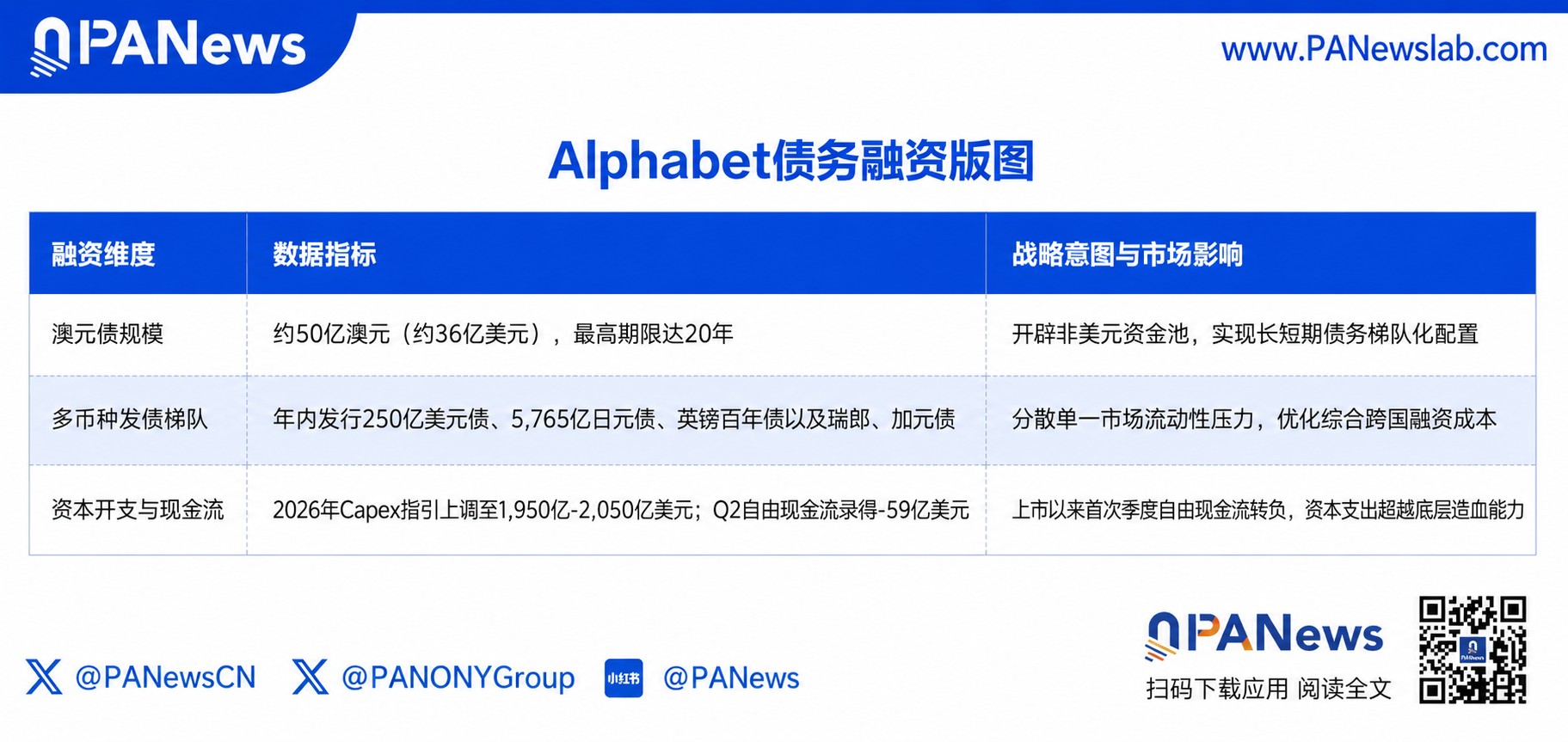
According to Bloomberg, Alphabet has hired underwriters such as ANZ Bank, Deutsche Bank, and Royal Bank of Canada to prepare for issuing its first Australian dollar bond, planning to raise about 5 billion Australian dollars (approximately 3.6 billion USD). The bonds cover four maturities: 3 years, 5 years, 10 years, and 20 years, providing a mix of fixed and floating rates at the short end and adopting a fixed rate structure at the long end. This is not only the cloud giant's first entry into the Australian bond market but also one of the largest foreign corporate bond projects in the country in nearly a decade.
The launch of "kangaroo bonds" is not an isolated action but a part of Alphabet's global debt financing strategy. Since 2026, it has successively issued $25 billion in bonds, 576.5 billion yen (approximately $3.6 billion) in bonds, and even launched a rare 100-year ultra-long bond in the UK market. With about $85 billion in equity financing, its fundraising scale has exceeded $100 billion this year.
Why has this tech giant, once sitting on hundreds of billions in cash and almost not relying on debt expansion, suddenly begun to strike out in the global bond market? The answer lies in its massive funding gap for computing power infrastructure.
In the second quarter of this year, Alphabet's quarterly free cash flow was -$5.9 billion, marking the first time it has reported negative quarterly free cash flow since its IPO. Meanwhile, the company significantly raised its capital expenditure guidance for the year to $195 billion to $205 billion, nearly six times higher than in 2022.
The iteration of AI models and the building of data centers require extremely high upfront investment, with long payback periods. When cash flow cannot cover capital expenditures, borrowing becomes an inevitable choice: locking in long-term liquidity through global multi-currency bonds, diluting short-term funding pressures, and preparing ammunition for the computing power competition that will last several years.
Alphabet’s pivot reflects a microcosm of the entire tech industry. When AI infrastructure transforms from "incremental investment" to "life-and-death competition," even deep-pocketed giants must bear debt leverage and join this cash-burning marathon.
From buying chips to competing on credit, the bond market has become the valve for computing power expansion
Alphabet's bond issuance is not an isolated case. In the context of rapidly expanding computing power, the global corporate bond market is being reshaped by tech giants.
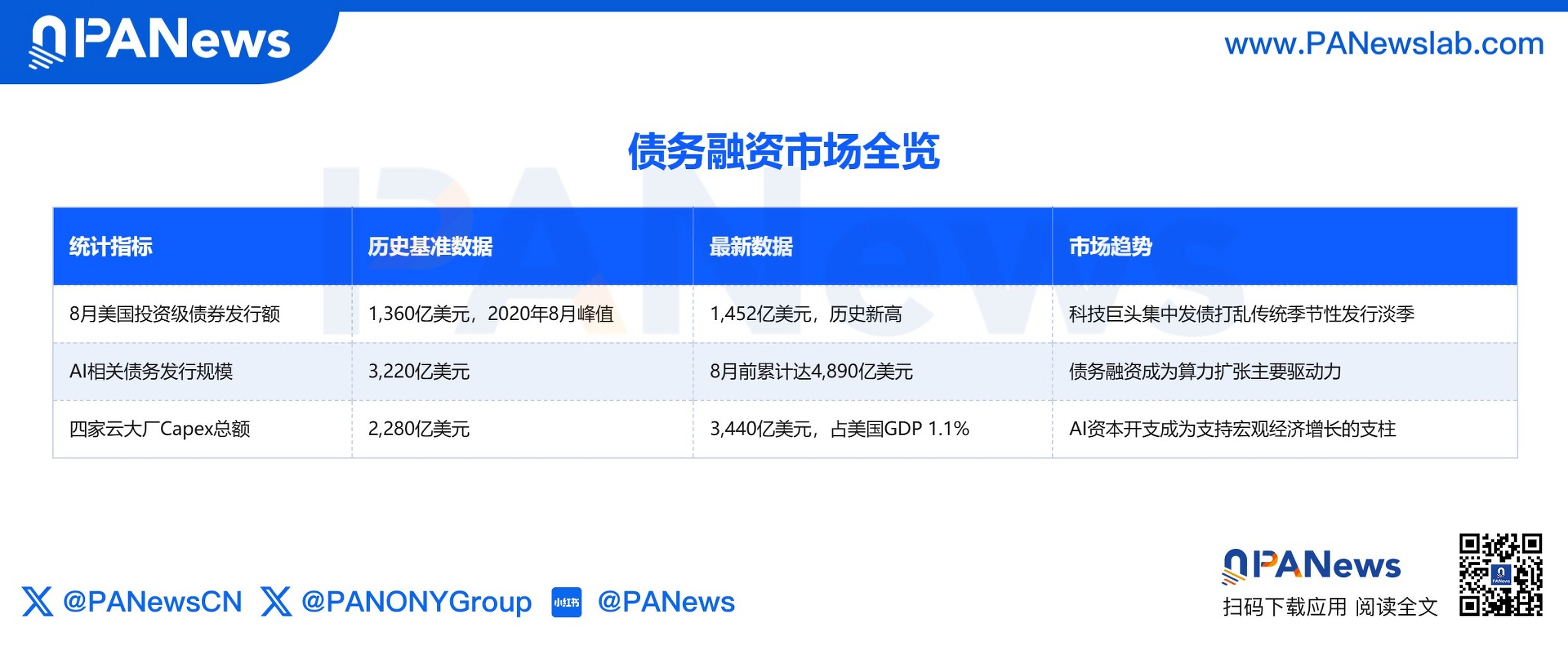
In August, strong demand for AI-related financing pushed the monthly supply of U.S. investment-grade corporate bonds to $145.2 billion, breaking the historical record of $136 billion set in August 2020. According to data from Nomura Securities, the total supply of U.S. corporate bonds has increased by 61% year-on-year this year. AI and data center related bonds and loans have reached 12 times the average annual level during the period from 2015 to 2024.
Goldman Sachs estimates that as of now, the scale of AI-related debt issued in the global market has reached $489 billion, far exceeding the total for the entire year of 2025. Correspondingly, the total capital expenditures of the four major cloud companies: Microsoft, Amazon, Alphabet, and Meta this year have reached $344 billion, equivalent to 1.1% of U.S. GDP, greatly up from $228 billion last year.
Behind the growth lies a continuously expanding funding gap. Morgan Stanley points out that by 2028, the cumulative investment demand for global data center construction (excluding power support) will reach $2.9 trillion, while the operating cash flow of cloud giants can only cover about $1.4 trillion, leaving a funding gap of $1.5 trillion. It is expected that by the end of this year, the annual issuance of publicly traded AI-related bonds will approach $570 billion.
The credit market is no longer just an auxiliary funding source for AI expansion; it has directly become the valve for computing power deployment. The interest rate spreads and liquidity tightness in the fixed-income market will determine the financing costs for cloud giants and subsequently impact the pace of global data center construction.
Bank of America calls for "shorting AI bonds," AI bond issuance backfires on global liquidity
The faster the accumulation of debt, the more worrisome the hidden risks beneath the surface become.
Michael Hartnett, Chief Investment Strategist at Bank of America Securities, suggested in his latest research report that in the macro environment of the spreading AI bubble, the optimal hedge strategy for investors is to buy leading AI tech stocks and oversold cyclical assets while shorting AI-related bonds.
The logic behind the strategy of shorting AI bonds directly points to the dual pressures of supply-demand imbalance and worsening cash flow.
In the coming years, the trillions of dollars in capital expenditure plans from cloud companies mean that the bond market will face a surge of issuance. In the context of negative free cash flow and unfulfilled earnings expectations, continuous bond issuance will continue to suppress the prices of existing bonds. Compared to the highly volatile AI stocks at high levels, shorting the oversupply and falling prices of AI bonds may offer a better risk-reward ratio to hedge against AI investment returns that fall short of expectations.
The far-reaching impact is the pressure on macro liquidity following the expansion of AI debt.
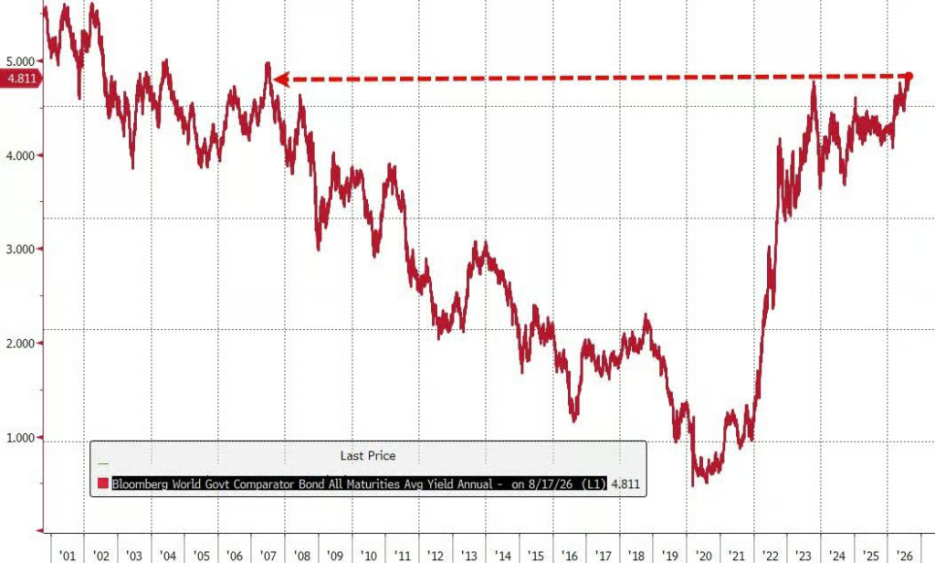
A special study by the Dallas Fed pointed out that AI debt financing is generating significant duration supply effects, which will create structural pressure on the yield curve. According to data compiled by Bloomberg, the average yield of investment-grade sovereign bond benchmarks has skyrocketed to about 4.5%, the highest level on record since 2015.
According to calculations from Bank of America and the Dallas Fed, the supply of AI investment-grade bonds this year has exceeded $300 billion, equivalent to injecting approximately $360 billion of 10-year Treasury bond duration equivalents into the interest rate market, accounting for about one-eighth of the annual duration supply of U.S. Treasuries.
The massive duration supply has directly squeezed the funding in the U.S. Treasury market.
Against the backdrop of high fiscal deficits and elevated Treasury issuance in the U.S., high-rated tech giants issuing corporate bonds at higher yields have substantially redirected funds that would have flowed into Treasury bonds. The influx of corporate bond supply has significantly lifted long-term interest rates and term premiums. On August 18, the yield on the U.S. 30-year Treasury bond briefly touched 5.33%, reaching its highest level since 2007; the yield on the 10-year Treasury bond approached 4.75%, hitting a high not seen since January 2025.
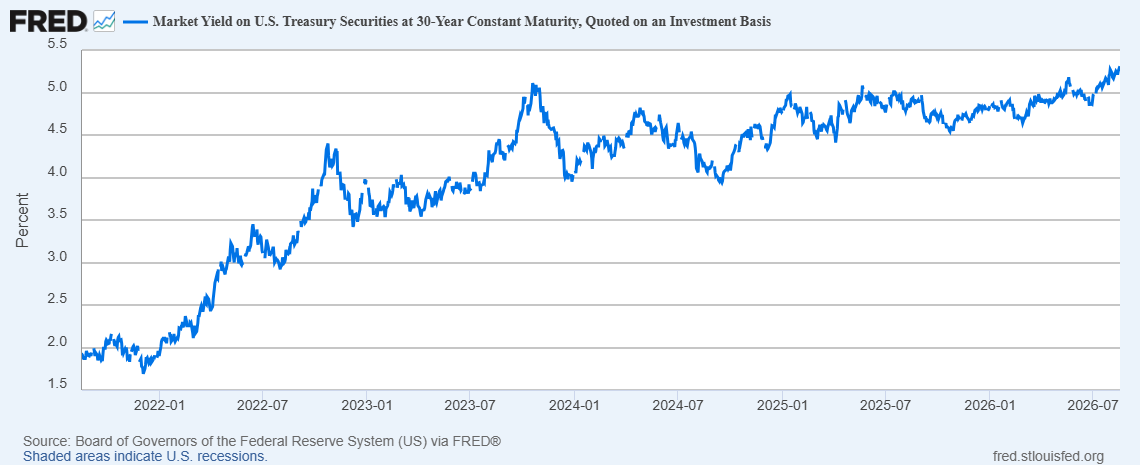
The yield on Treasury bonds is the pricing anchor for global assets. If the supply of AI debt pushes up long-term interest rates, this means that the refinancing costs for the entire macro economy will be passively elevated. The global financial market may enter a risk zone of "high debt, high yield, and high liquidity tightening."
Of course, AI bond issuance is not the sole reason for the rise in Treasury yields. However, the expansion of AI debt financing is becoming an increasingly difficult variable to ignore. The competition among tech giants has already shifted from technology, talent, and hardware battles to a capital war crossing the global credit market.
For the tech industry, debt financing is a double-edged sword. It frees computing power infrastructure from the constraints of self-generated cash flow, allowing for accelerated expansion and supporting the iteration of large models and industrial landing. At the same time, it also deeply binds the fate of the entire industry to interest rate cycles and liquidity environments. Once monetary policy shifts or the credit environment tightens, the computing power expansion based on debt financing will face huge funding pressures.
For the financial system, the impact of AI debt has already transcended the industrial scope. When the bond issuance scale of tech giants is large enough to influence Treasury yields and squeeze global liquidity, the costs of this AI feast are no longer just financial issues for tech companies, but may be collectively absorbed by the entire capital market.
The story of computing power remains appealing, and the expansion of debt continues, but every celebration comes with a cost. Whether the massive AI debt can be digested through future profitability and whether the tidal wave of supply will trigger liquidity tightening will ultimately become key variables in assessing the sustainability of this AI capital expenditure cycle.
免责声明:本文章仅代表作者个人观点,不代表本平台的立场和观点。本文章仅供信息分享,不构成对任何人的任何投资建议。用户与作者之间的任何争议,与本平台无关。如网页中刊载的文章或图片涉及侵权,请提供相关的权利证明和身份证明发送邮件到support@aicoin.com,本平台相关工作人员将会进行核查。


