Liquidity expectations drive up, but the macro environment has not really shifted towards easing
Yesterday, the market experienced a noticeable rise, but if you observe gold, bitcoin, and other assets alongside US stocks, you will find that this is not a situation where all risk assets rise together.

Assets like gold and bitcoin, which are more sensitive to liquidity expectations, saw significant increases, while the performance of US stocks was relatively limited.
This indicates that the core of the market trading is not a sudden improvement in economic fundamentals, but ratherchanges in liquidity expectations.
Recent information released by the US Treasury regarding bond buybacks has been interpreted by the market as a signal to alleviate pressure in the bond market. The market further deduces that if short-term liquidity pressures continue to increase, the Federal Reserve may have to resort to interest rate cuts in the future.
For this reason, gold and cryptocurrency assets have risen first.
But the problem is:
Expectations are expectations, and true liquidity easing is another matter.
If the macro environment has not fundamentally changed, then a rise based purely on rate cut expectations is unlikely to last long.
Why are US Treasury yields becoming increasingly important?
To understand this market, one must first grasp one of the core issues currently facing the US -the continued high level of US Treasury yields.
Currently, the yield on 30-year US Treasuries has surpassed 5.3%.
The continuous rise in long-term bond yields means that the market demands higher returns for holding US long-term debt.
Why?
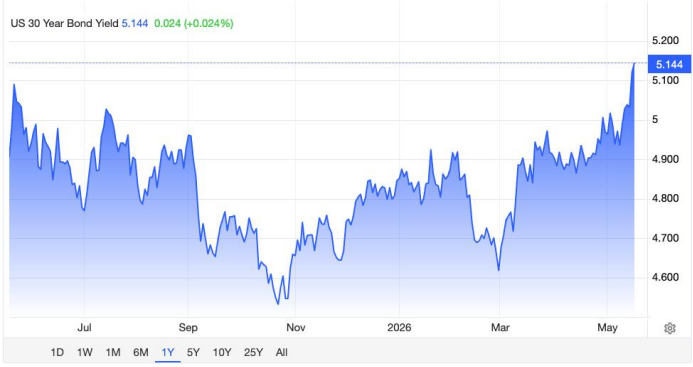
Because the longer investors hold bonds, the greater the uncertainty they undertake.
Future inflation, fiscal deficits, economic growth, dollar credit, and the scale of US debt can all affect the actual value of long-term bonds.
Therefore, as the market becomes increasingly cautious about the US's future fiscal condition, it will demand higher yields to compensate for risk.
What the US faces now is precisely:
increasing debt.
The US government itself needs a large amount of financing, and in recent years, technology giants have also borrowed heavily to maintain capital expenditures in the AI field.
As more and more funds need to enter the bond market, the market will naturally demand higher yields to absorb this new debt.
This is also why the issue of long-end US Treasury yields is increasingly worth paying attention to.
The Fed's balance sheet reduction complicates the issue
At the same time, the Federal Reserve has been continuously shrinking its balance sheet.
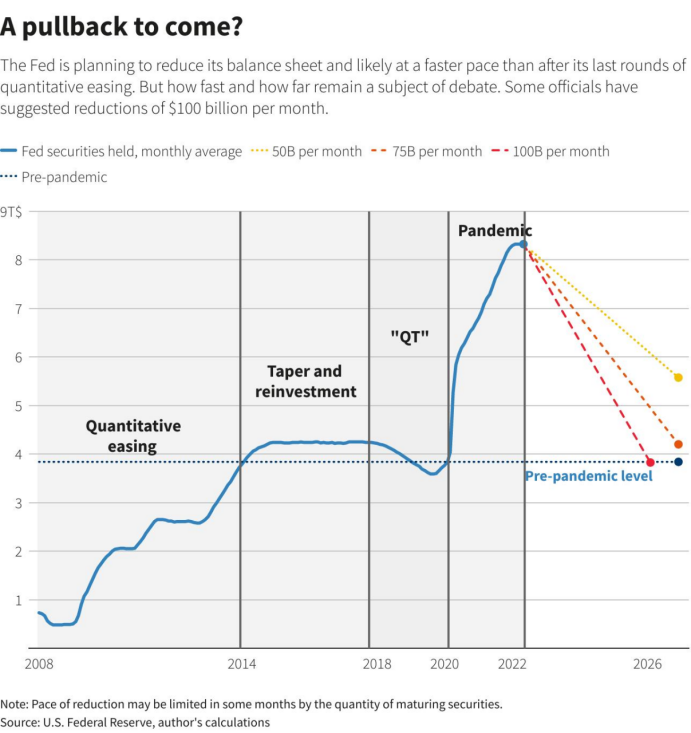
Since December of last year, the Fed has been further in a shrinking state, and the scale of its balance sheet has noticeably decreased.
This means that compared to the past environment of large-scale liquidity provision, the current financial market no longer has as ample dollar liquidity.
Thus, a rather contradictory situation has emerged:
On one hand, the US government needs to keep issuing debt;
On the other hand, the market demands higher yields to take on this debt;
At the same time, the Fed has not re-entered a state of large-scale balance sheet expansion or liquidity release.
Under these circumstances, long-term US Treasury yields are naturally likely to remain high.
Therefore,the real issue now is not whether there is news that can temporarily lower yields, but whether the US can fundamentally address the growing pressures from increasing debt and interest payments.
What does replacing long-term debt with short-term debt really mean?
This is also the key to understanding yesterday's market rise.
The US Treasury's increased efforts in short-term bond buybacks are essentially aimed at alleviating some long-end pressure by adjusting the debt structure.
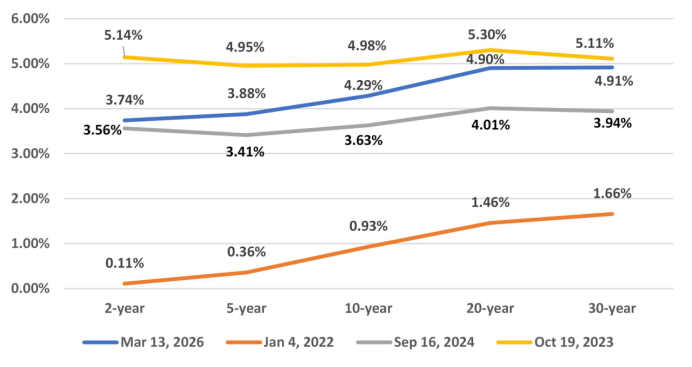
Simply understood, it is:
Replacing some long-term debt pressure with more short-term debt.
Doing so may indeed temporarily suppress long-term Treasury yields and also send a policy signal to the market.
But the problem is, it does not eliminate US debt.
The debt still exists; only the maturity structure has changed.
This means that the US might gain some breathing space in the short term, but over the next few years, it will face greater short-term financing and interest payment pressures.
Thus, from a macro liquidity perspective, this cannot simply be understood as genuine easing.
In fact, in some senses, it may lead to new short-term liquidity pressures.
Why, despite tight liquidity, are BTC and gold rising instead?
The answer actually lies in the two words "expectations."
Currently, the market logic is not:
We have already started cutting rates.
But rather:
If short-term liquidity pressures continue to increase, the Fed may eventually have to cut rates.
The market is trading on this expectation ahead of time.
So the noticeable rise in gold, bitcoin, and other assets last night is not surprising.
These assets are very sensitive to dollar liquidity and interest rate expectations.
As long as the market begins to believe that future monetary policy will turn towards easing, funds will preemptively enter assets like gold and bitcoin.
But there is a very important question here:
Will it really be possible to cut rates in the future?
If inflation does not decrease significantly, then the Fed's room for rate cuts will still be limited.
In other words, the current market rise is trading on "rate cut expectations," not "rate cut facts."
There is a significant difference between the two.
Daily sharing of real-time trading strategies, free position diagnostics, solution ideas, and practical market insights. Scan to follow the public account《比特西瓜》,Join the community for strategies!
The real key is whether the US can bring down inflation
If the US wants to truly open up rate cut space, it must ultimately return to the issue of inflation.
And one of the crucial influencing factors of inflation is oil prices.
Therefore, what the market truly needs to focus on next is not just when the Fed will cut rates, but more importantly:
Whether the US can reduce oil prices.
If oil prices decrease and inflationary pressures ease, the Fed will have greater policy space.
This is also why, in the near term, the US government is likely to continue various expectation management efforts.
Factors such as energy prices, the Middle East situation, and related geopolitical risks could all become significant variables affecting market expectations.
Especially in the Middle East, if there are favorable changes that help stabilize energy supply, then a downward trend in oil prices will further assist the US in alleviating inflationary pressure.
From this perspective, we may see more policy signals in the coming period focusing on "lowering oil prices, reducing inflation, and opening up rate cut space."
Daily sharing of real-time trading strategies, free position diagnostics, solutions ideas, and practical market insights. Scan to follow the public account《比特西瓜》,Join the community for strategies!
In the next two months, macro liquidity may still be tight
It is important to pay special attention to a time lag here.
Even if the US government begins managing expectations now, it does not mean that inflation data will change immediately.
A decline in oil prices takes time to transmit to inflation data, and inflation data also has to go through statistics and announcement.
Therefore, macro liquidity is likely to remain tight in the near future.
This means:
The market can trade on rate cut expectations in advance, but the macro environment itself has not changed immediately.
Thus, whether yesterday's rise can be sustained becomes a most concerning question.
If there is no real liquidity easing to support it later, then after the market digests this round of rate cut expectations, it may still revert to a state of fluctuation or even decline.
BTC's rise does not mean the bull market has restarted
Thus, for yesterday's rise in bitcoin, my judgment remains cautious.
The biggest mistake the market is likely to make now is to see the price rise and immediately define it as "the bull market is back."
However, to truly judge whether a rise can be sustained, one cannot simply look at the candlestick charts.
It is more important to assess:
Whether there is sustained capital support behind the rise.
If the rise mainly comes from short covering, news stimulation, and rate cut expectations, then it can be very strong.
But this type of rise does not necessarily have sustainability.
Because when the market again recognizes:
Rate cuts have not really happened;
Liquidity remains tight;
Inflation still requires time to resolve;
US Treasury yields remain high;
Then the logic that drove the price increase may gradually weaken.
Therefore, I tend to interpret this rise asa rebound driven by macro expectations, rather than an official start of a new bull market.
Daily sharing of real-time trading strategies, free position diagnostics, solution ideas, and practical market insights. Scan to follow the public account《比特西瓜》,Join the community for strategies!
Future market: more likely to be a downward adjustment than another sharp drop
Considering macro liquidity and the current price structure, my judgment for the future market is:
It is highly probable that we will enter a downward adjustment rather than immediately seeing a new round of significant sell-offs.
The reason is quite simple.
First, the market has already partially priced in the rate cut expectations, so it will not easily revert to an extreme pessimistic state in the short term.
Second, yesterday's rise has already consumed some short positions.
Third, if macro liquidity does not deteriorate further going forward, then the market is more likely to gradually repair this rise through a time-for-space approach.
Thus, what we need to be most cautious about next is not the sudden appearance of a massive bearish candlestick, but rather:
Prices oscillating repeatedly at high levels, market sentiment gradually cooling, and then slowly trending downwards.
The real big risks may still be far away
From a longer cycle perspective, the US debt problem has not been resolved by a single adjustment of debt structure.
On the contrary, as the debt scale continues to increase, the pressure from interest payments may continue to expand.
If US long-term Treasury yields break through 5.3% again in the future, or even approach 6%, then global financial markets may face a more pronounced asset repricing.
When that time comes, it will not just be bitcoin or gold affected, but possibly global stocks, bonds, real estate, and other risk assets.
Such a level of risk is likely to appear over a longer cycle rather than immediately.
So right now, the market seems more like a balanced state:
Short-term liquidity is tight, but the market is continuously trading expectations of potential rate cuts in the future.
These two forces have temporarily formed a game of balance.
Daily sharing of real-time trading strategies, free position diagnostics, solution ideas, and practical market insights. Scan to follow the public account《比特西瓜》,Join the community for strategies!
Final judgment
Summarizing the entire macro logic, it can actually be expressed in four sentences.
First,the current actions of the US Treasury resemble adjustments in debt structure and expectation management, without fundamentally changing the liquidity environment in the US.
Second,replacing long-term debt with short-term debt can temporarily alleviate some long-end pressure, but it does not solve the issues of long-term debt and interest expense in the US.
Third,the market is currently trading on future rate cut expectations, rather than actual monetary easing that has already occurred.
Fourth,As long as macro liquidity has not truly shifted towards easing, the sustainability of the rise in assets like gold and bitcoin, which rely on liquidity expectations, is in question.
Therefore, I do not currently believe that this rise signifies that the bull market has restarted.
The greater probability is that the market first completes this round of expected trading and then enters a phase of consolidation.
Ultimately, the direction of the next major market trend will still revert to several core variables:
oil prices, inflation, US Treasury yields, and the Federal Reserve's monetary policy.
Before these variables truly change, relying solely on a piece of news stimulus makes it difficult to define a new bull market.
Daily sharing of real-time trading strategies, free position diagnostics, solution ideas, and practical market insights. Scan to follow the public account《比特西瓜》,Join the community for strategies!

免责声明:本文章仅代表作者个人观点,不代表本平台的立场和观点。本文章仅供信息分享,不构成对任何人的任何投资建议。用户与作者之间的任何争议,与本平台无关。如网页中刊载的文章或图片涉及侵权,请提供相关的权利证明和身份证明发送邮件到support@aicoin.com,本平台相关工作人员将会进行核查。