Key Takeaways
- Bitcoin rose from about $62,653 to a $79,461 high, trading near $77,000 on Aug. 21.
- CME and Binance held about $20.37 billion of bitcoin futures open interest, amplifying market risk.
- Jackson Hole, Treasury yields and Aug. 22 bitcoin options expiry are the next key tests.
The session offered some breathing room after a bruising stretch in which rising long-term Treasury yields repeatedly hammered stocks lower. The Nasdaq Composite climbed 104.12 points, the NYSE Composite gained 194.68 points, the Dow Jones Industrial Average ripped 517.84 points higher, and the S&P 500 tacked on 32.83 points during Friday’s trading session.
Even with that bounce, the real pressure point remained the bond market. Long-term Treasury yields had climbed toward multi-year highs as investors wrestled with sticky inflation, relentless government borrowing, and the swelling interest bill attached to federal debt. Higher yields bite because they raise financing costs for households and companies, while simultaneously making future corporate profits worth less in today’s dollars.
Treasury Secretary Scott Bessent’s plan to expand purchases of outstanding longer-dated government bonds initially took some heat out of markets during the week. Those buybacks can lift bond prices and, in turn, push yields lower. But the relief proved thin because investors stayed locked on the forces driving yields higher, including massive deficits and oil-driven inflation risks tied to tensions involving Iran and the Strait of Hormuz. The U.S. 30-year Treasury bond yield stands at 5.273%.
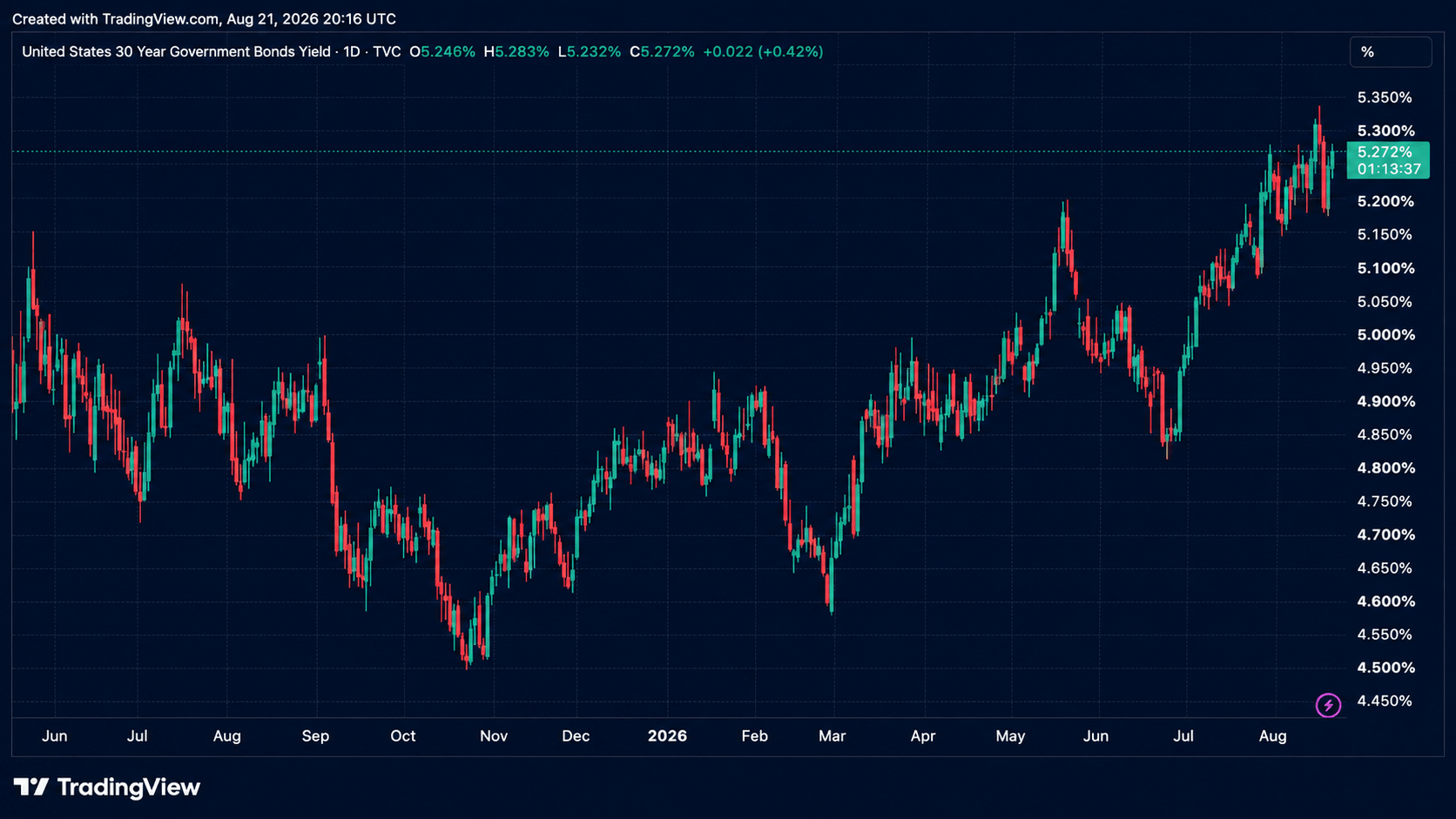
United States 30-Year Government Bond Yield via Tradingview on Aug. 21, 2026.
That pressure explains why Friday’s gains hardly erased the week’s nerves. Financial stocks powered parts of the advance, while Ross Stores climbed after delivering stronger-than-expected quarterly results. Crypto-linked shares, including Coinbase, also caught a bid from bitcoin’s explosive move higher. Technology stocks, however, remained hostage to the bond market because high-growth companies get hit particularly hard when long-term yields climb.
Bitcoin delivered the sharpest contrast with the guarded mood in equities. Bitstamp BTC/USD data over a four-hour timeframe shows the cryptocurrency ripping from a marked low near $62,653 to an intraday high near $79,461 before settling around $77,000. The run marked one of bitcoin’s strongest weeks since March 2023 and put the market’s swelling derivatives activity squarely under the microscope.
Bitcoin futures open interest, the value of outstanding futures contracts, climbed sharply alongside the price. Exchange stats collected from coinglass.com show Binance carrying about $10.92 billion in bitcoin open interest and CME with $9.45 billion. CME’s open interest jumped 11.34% over 24 hours, while Binance’s rose 4.64%, showing that activity accelerated across both major venues.
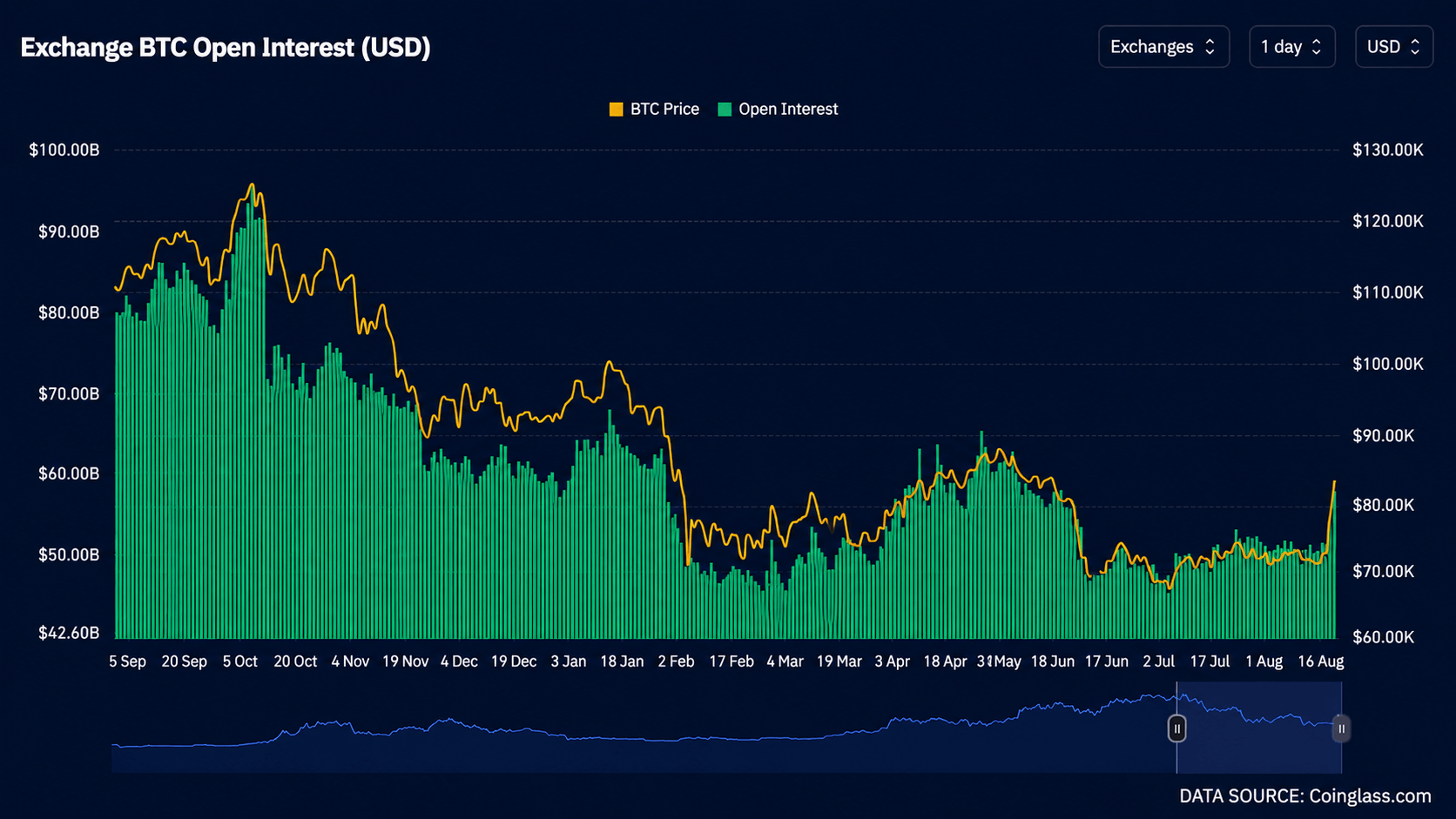
Bitcoin futures open interest (OI), according to stats collected from Coinglass.com on Aug. 21, 2026.
Open interest is not automatically a bullish or bearish signal. While it reveals how much money is tied up in open positions, it cannot tell whether traders are positioned for gains or declines. Here, the increase followed a blistering price advance that triggered massive liquidations of leveraged short positions, or bets that bitcoin would fall. That kind of short squeeze can turbocharge a rally.
The broader futures picture looked messier beneath the headline increase. Bybit, Gate, Kucoin, and Hyperliquid each recorded declines in open interest over the last 24 hours, while BingX logged a large percentage increase from a smaller base. That split shows the rally was not simply a leverage stampede across every venue. Instead, participation appeared concentrated in the biggest markets and in specific corners of the derivatives complex.
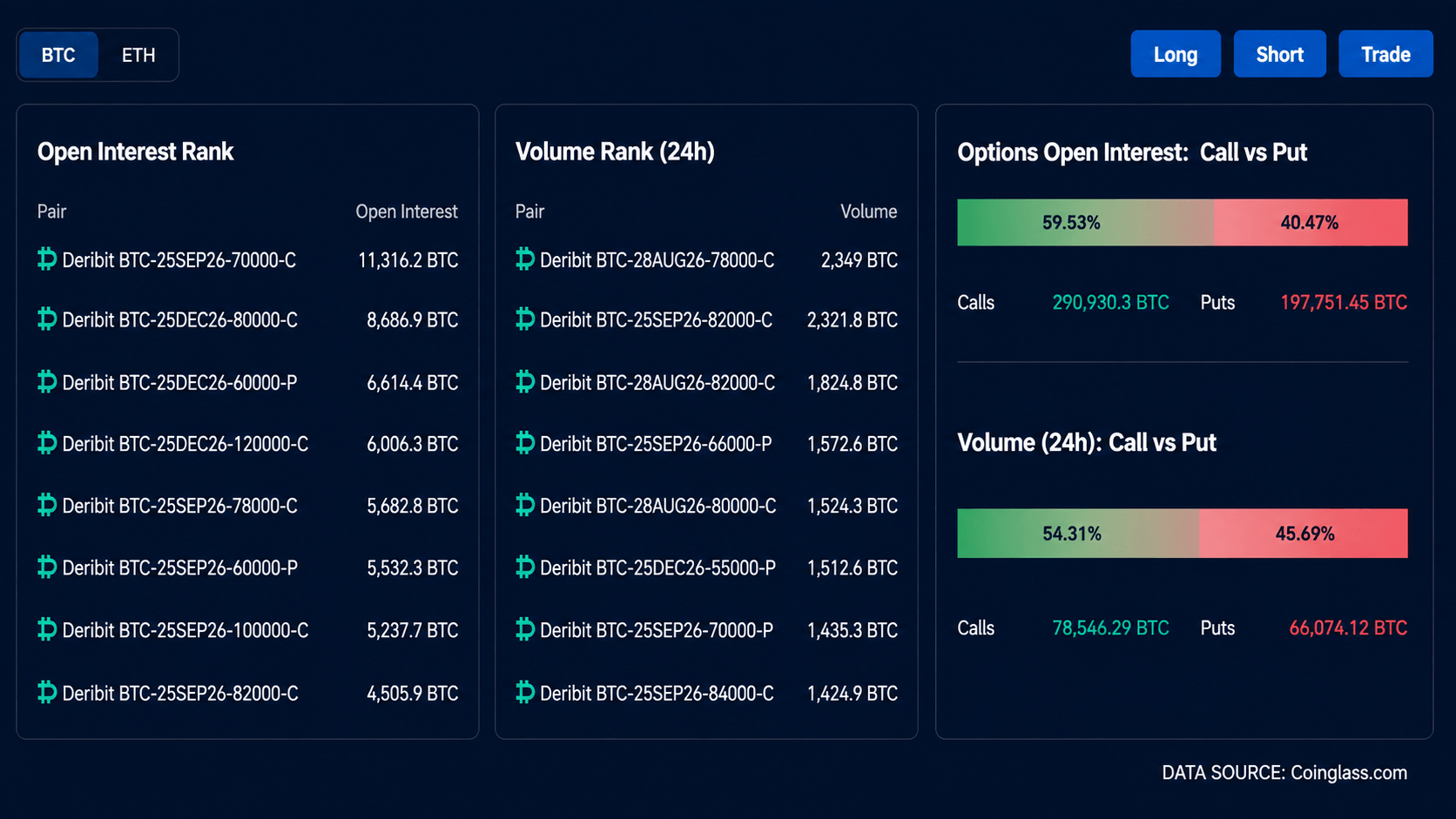
Bitcoin options calls and puts on Deribit, according to stats collected from Coinglass.com on Aug. 21, 2026.
On the other side of the derivatives map, options data showed a moderately bullish positioning tilt. Calls, which generally benefit when bitcoin climbs, represented 59.53% of bitcoin options open interest heading into the weekend, compared with 40.47% for puts. Calls also accounted for 54.31% of 24-hour options volume. The largest listed open-interest positions included December 2026 calls at $80,000 and $120,000, along with September calls at $70,000, $78,000, $82,000 and $100,000. Six figures is still firmly on the radar.
Those positions should not be mistaken for clean-cut price targets. Investors routinely buy calls for upside exposure while buying puts to protect a portfolio against a reversal. The appearance of large put positions at $60,000 and $66,000 shows that downside insurance remains important right now, even while traders loaded up on upside exposure.
The options market’s “max pain” measure, specifically from Deribit, also highlighted the gulf between bitcoin’s Friday price and several near-term strike concentrations. Max pain is the price where outstanding options would, theoretically, inflict the greatest aggregate losses on option buyers at expiration. Deribit’s data puts the Aug. 22 level near $74,000, followed by roughly $69,000 on Aug. 23 and $66,000 around Aug. 28.
Institutional demand supplied another major piece of the advance. U.S. spot bitcoin exchange-traded funds (ETFs) are on track for more than $1 billion in weekly inflows, their strongest pace since January. These funds give investors BTC exposure through a traditional brokerage account, making it easier for institutions and individuals to participate without directly holding or managing the cryptocurrency.
Bitcoin was hardly the only asset reacting to the shift in yields and the dollar. The precious metal gold traded at $4,617.50 per ounce on Friday at Wall Street’s close, up 2.15% on the day, while silver traded at $69.52, gaining 1.92%. Platinum climbed 2.85%, and palladium added 1.29%, according to spot-price data.
Gold and silver pay no interest, so they become relatively more attractive when yields retreat or when investors fear inflation and currency risks will eat into fixed-income returns. A weaker dollar also makes dollar-priced metals cheaper for buyers holding other currencies. The metals rally, therefore, captured both the temporary cooling in bond-market stress and the deeper anxiety surrounding debt, inflation, and geopolitical risk.
The next test is whether yields stay contained after the Treasury’s intervention and whether Federal Reserve boss Kevin Warsh delivers clearer signals at the Jackson Hole symposium. Investors will also track oil prices, developments around Iran and the Strait of Hormuz, bitcoin ETF flows, and whether the leading crypto asset can defend its gains without another aggressive build-up in leveraged futures positions.
免责声明:本文章仅代表作者个人观点,不代表本平台的立场和观点。本文章仅供信息分享,不构成对任何人的任何投资建议。用户与作者之间的任何争议,与本平台无关。如网页中刊载的文章或图片涉及侵权,请提供相关的权利证明和身份证明发送邮件到support@aicoin.com,本平台相关工作人员将会进行核查。


