Written by: Rita
The second quarter earnings season has come to a close, with the internet sector as a whole underperforming the S&P 500 (S&P rose 11%, the internet sector rose 9%). On August 25, Goldman Sachs released a review of the U.S. internet industry's second quarter EPS and a preview of the Communacopia technology conference, distilling three core topics that ran through the earnings season: the growth rate and return curve of AI spending, digital consumption resilience, and the balance of investment and profit. From September 8 to 11, Goldman Sachs will hold the Communacopia technology conference in San Francisco, featuring 40 listed companies and private enterprises, with the CFO of OpenAI leading, followed by executives from Google Cloud, SpaceX, Uber, and others.
Cloud vendors' AI capital expenditures show a continuous upward trend, supported by three aspects: upward revision of cloud/AI revenue, stable incremental profit margins, and strengthening pricing per gigawatt. The digital consumption sector overall remains strong, with e-commerce, online travel, and mobility sectors delivering exceptional results, while the trend of consumer differentiation is intensifying. High-income groups show no reduction in spending willingness, while low-income groups are more cautious regarding timing and amounts of spending. On the profit side, structural efficiency improvements and the tug-of-war of AI reinvestment are evident, and the market has begun to penalize companies with vague return cycle statements.
Digital Advertising: AI Advertising Tools Drive Share Concentration
AI-driven advertising automation is reshaping the digital advertising landscape. Google and Meta have achieved broad outperformance this quarter through deep integration of AI advertising tools. Pinterest, Reddit, and Unity continue to show growth momentum, with advertisers consistently reallocating budgets towards platforms where performance is measurable and user intent is clear. Demand for advertising in major verticals like retail, finance, and technology remains healthy, with short videos, AI-assisted discovery, creator content, and personalized recommendation engines becoming new growth points for user engagement.
The role of AI is evolving from a productivity tool to a core driver of product innovation and revenue growth. Meta emphasizes the ongoing adoption of Advantage+ and AI advertising solutions, while Google highlights the commercial potential of AI Overviews, AI Mode, Gemini, and AI search experiences. Both companies are increasing investments in infrastructure, talent, and model development, while investors still harbor doubts about the impact of return timelines and depreciation costs on profitability.
The market's highest concern is the sustainability of advertising budgets and the evolution of AI search. How advertisers allocate budgets amidst macro uncertainty, how AI changes the way consumers discover information, and whether AI investments can ultimately yield profits are core topics in the digital advertising sector at this conference.
E-commerce: Scale Effects and AI Empowerment Drive Resilient Growth
The e-commerce sector performed steadily in the second quarter, with consumer demand showing resilience amid macro uncertainty. Amazon continues to benefit from ecosystem synergy, Wayfair emphasizes accelerated market share gains and premium brand growth, and Etsy focuses on personalization and product innovation. StubHub has achieved share growth and margin expansion in the secondary ticketing market, while Pattern has realized growth through deepening brand relationships and market expansion.
The penetration of AI in e-commerce is accelerating. Management teams increasingly view AI as a dual engine driving customer experience and operational efficiency. The speed of deployment for smart recommendations, search optimization, advertising placements, and process automation is increasing, with agency-style e-commerce and AI-driven traffic acquisition reshaping transaction flows.
Investor focus is concentrated on three aspects: the sustainability of consumer demand, the quality of customer acquisition and retention, and the long-term impact of AI and agency-style e-commerce ecosystems on traffic costs and conversion rates.
Cloud Computing: Hundreds of Billions in Backlogged Orders Validate AI Demand Resilience
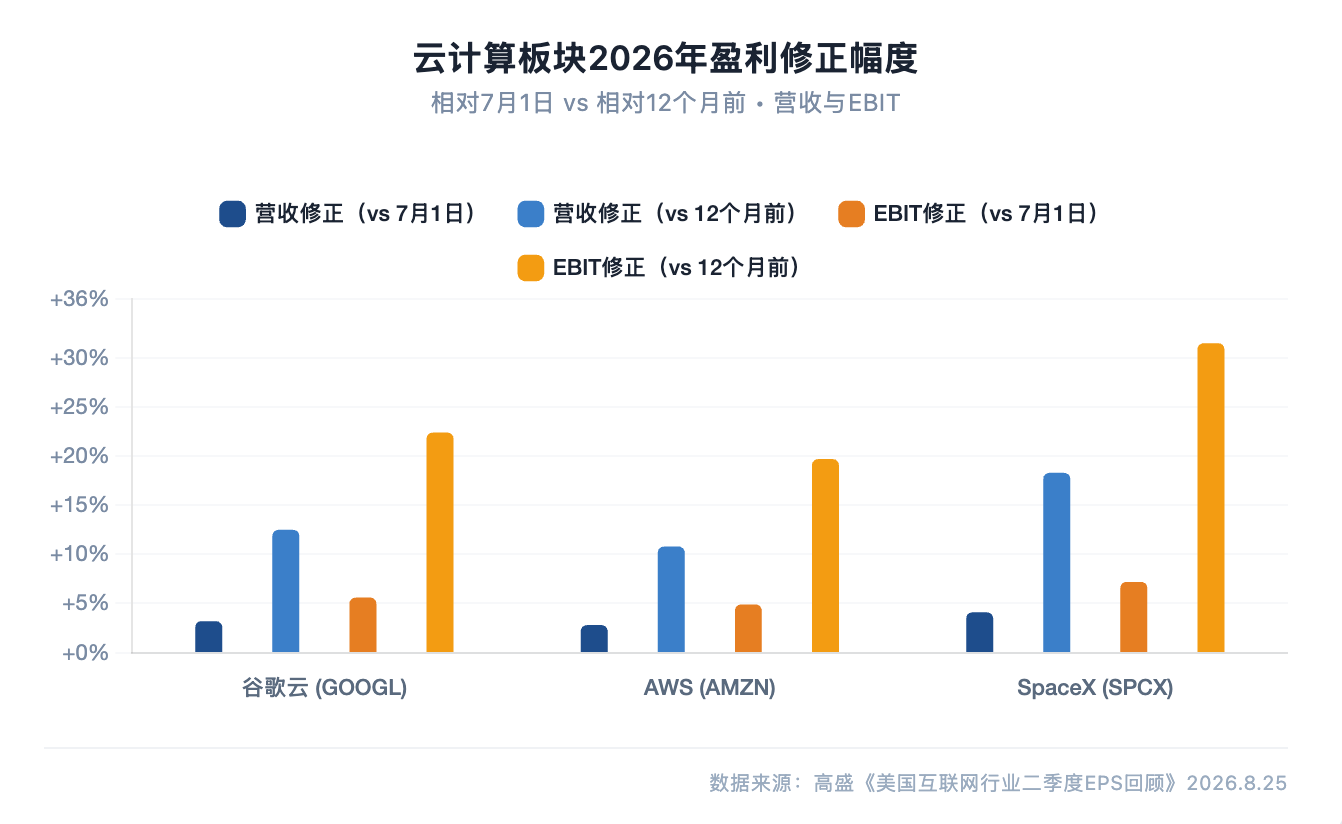
Google Cloud's revenue grew by 81% year-over-year in the second quarter, with backlog increasing to approximately $514 billion. AWS saw a 37% year-over-year acceleration in revenue, with backlog growing 154% year-over-year. Together, these two cloud vendors have a total backlog exceeding $1 trillion. Despite facing depreciation pressures, AWS still recorded about a 39% record operating profit margin.
The supply-demand conflict is intensifying. Both AWS and Google Cloud indicate limited capacity, particularly due to power and data center availability limiting the ability to serve AI demand. Clients have begun planning for 2028 workloads and capacity commitments, with AWS remaining in a supply-constrained state into 2026 and even 2027. SpaceX also emphasizes that AI infrastructure demand continues to exceed supply.
Custom chips and capital intensity are the main concerns for investors. Goldman Sachs expects management teams to engage in in-depth discussions during the conference regarding the sustainability of AI demand, the pace of infrastructure deployment, improvements in economics from custom chips, and the impact of depreciation on incremental profit margins.
Online Travel: AI Plays an Enabling Role
The online travel sector's second-quarter performance generally exceeded expectations. Following geopolitical fluctuations and macro uncertainty, booking trends improved in June, with summer travel demand described as “healthy” by management. High-end travel remains strong, while low-income groups are more selective about travel timing and spending amounts. Events like the World Cup and experiential travel demand have become significant catalysts.
The long-term impact of AI on online travel is the biggest concern for investors. This quarter, management broadly communicated a clear signal: scalable travel platforms that possess extensive supply aggregation, brand advantages, loyalty programs, and deep partnerships are more likely to engage in AI workflows and avoid disruption.
The core variables of market focus are: the normalization growth algorithm for online travel (most investors expect high single digits), share dynamics across different regions and categories, customer acquisition costs under the trend of de-marketing, the return cycle of non-marketing investments, and the ongoing scale of shareholder returns.
Mobility and Delivery: Autonomous Driving as a Total Addressable Market Expander
The mobility and delivery platforms showed steady demand in the second quarter. Uber continued to accelerate in the U.S. market, while Lyft performed strongly across North America. Both companies view autonomous driving as an opportunity to expand the total addressable market, with Uber reiterating plans to launch in 15 cities by the end of the year, while Lyft's Nashville vehicle hub is set to open in October. DoorDash continues to expand its local business landscape beyond core delivery, Instacart's enterprise services and advertising business are experiencing accelerated growth, and Lime's first financial report after going public showcases the growth logic of subscriptions and market expansion.
The pace of commercialization of autonomous driving and its role in the ecosystem are points of heated debate among investors. Whether ride-hailing platforms can become the primary demand aggregator for autonomous driving networks, and whether autonomous driving operators and OEMs will gain larger customer relationships and unit economics shares remain undecided.
Investors are also concerned about the balance between reinvestment and profit expansion. Uber and DoorDash continue to invest in autonomous driving, international expansion, local business, and AI platform opportunities, with the market evaluating whether these investments can support sustained revenue and profit growth in the long term.
Streaming and Gaming: Parallel AI Empowerment and Content Catalysts
Netflix and Spotify showed stable performance in the second quarter, though with significant differentiation. Netflix's total viewing time remained flat or slightly increased, emphasizing “high-quality viewing time”; Spotify's product innovation drove healthy growth in user engagement. Netflix's user growth is driven by international markets, and Spotify's paid user growth is robust, with an increase in ad loads in some regions impacting short-term monthly active growth.
The gaming sector focuses on three main catalysts: Roblox's ongoing investment in UGC platforms and AI development tools, Take-Two's upcoming GTA VI and its potential impact on industry growth and player time allocation, and the balance between platform investments and monetization returns.
Online Dating and Gambling: Product Improvements Drive User Trend Improvements
The online dating sector generally communicated optimistic signals about user trend improvements in the second quarter. Tinder's monthly active user decline has slowed, thanks to recommendations algorithm optimization and product innovation. Hinge's user growth remains in double digits. Bumble is still in the process of technology stack migration, with product features likely to roll out more in 2027 and beyond.
In online gambling, prediction markets have become a strategic priority for the industry, with traditional sports betting and data providers viewing them as a total addressable market expander and potential sources of incremental revenue. The regulatory environment and incremental returns of prediction markets are core topics at this conference.
Goldman Sachs' judgment is clear. The second quarter financial reports validate the triple narrative framework of AI spending, consumer resilience, and profit management, with market patience for AI returns narrowing. The San Francisco conference will be a focused test of management's communication capabilities; those who can clearly answer “when, how much, and what returns” regarding AI investments will gain an advantage in the current valuation differentiation.

Disclaimer
This article is an organization and interpretation by Chao Xiang Research of a third-party brokerage research report (Goldman Sachs, August 25, 2026), combined with the organization of public market information. The ratings, target prices, earnings forecasts, and related judgments cited in the text are the views of the brokerage's analysts and represent their respective institutions' positions, not the views of Chao Xiang Research, and do not constitute any investment advice.
The market carries risks, and decisions should be made independently. This article should not be taken as a basis for buying or selling any securities.
免责声明:本文章仅代表作者个人观点,不代表本平台的立场和观点。本文章仅供信息分享,不构成对任何人的任何投资建议。用户与作者之间的任何争议,与本平台无关。如网页中刊载的文章或图片涉及侵权,请提供相关的权利证明和身份证明发送邮件到support@aicoin.com,本平台相关工作人员将会进行核查。


