The circulation of WBTC and cbBTC is approximately 2911 times and 2465 times that of cirBTC, respectively.
Written by: Liam Akiba‑Wright
Translated by: Luffy, Foresight News
The circuit Bitcoin product cirBTC launched by Circle has strong institutional backing, but its market size is almost negligible.
Circle has provided cirBTC with isolated reserves, federal regulatory custodians, qualified enterprises for direct minting and redemption channels, as well as the mature distribution infrastructure behind USDC. However, approximately 11 weeks after its launch on Ethereum, Circle disclosed data indicating that the circulation of cirBTC is only 40.02450077 coins.
The same panel shows that the reserve pool holds 42.5114162 bitcoins, with a reserve coverage rate of about 106.2%, and retains a reserve buffer of 2.48691543 BTC in 14 disclosed Bitcoin addresses. With only 40 tokens in circulation, a tricky reality is exposed: Circle has built a highly credible institutional-grade Bitcoin wrapping solution but has hardly built a corresponding market ecosystem.
The current situation of cirBTC has become a reality test for Circle's grand narrative. Jeremy Allaire mentioned in Circle’s second-quarter financial report that Circle has built an "internet financial system platform." This statement points to Circle's entire business system, which includes trust licenses, USDC, and the upcoming Arc network. Now cirBTC needs to prove whether this infrastructure can generate sufficient liquidity and protocol integration, allowing wrapped Bitcoin to truly be used as collateral.
The market where 40 BTC is located is at the level of 100,000 coins
cirBTC is the tokenized version of Bitcoin issued by Circle on Ethereum. WBTC and Coinbase's cbBTC serve the same function, allowing Bitcoin assets to circulate in smart contract networks, but the scale of cirBTC is significantly different from the latter two.
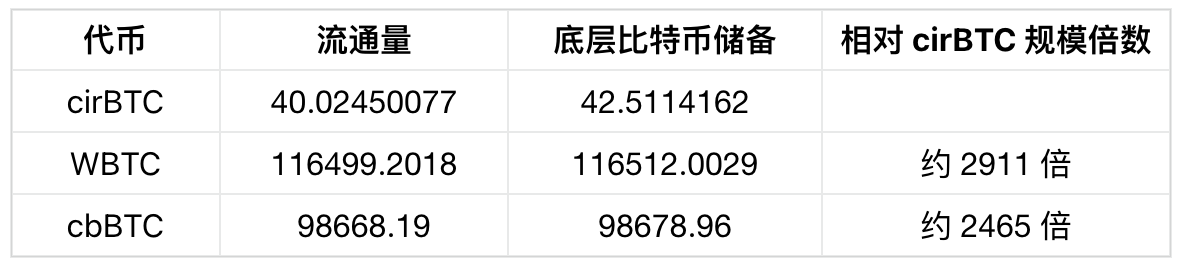
Data for cirBTC as of August 27, and transparency data for WBTC and cbBTC confirmed as of August 29. cbBTC statistics combine all issuance scales across Ethereum, Base, Solana, and Arbitrum multichain to avoid duplicate counts.
Circulation is just one measure of the utility of wrapped tokens, but it can also reflect the distribution capability of the tokens. Each circulating token corresponds to real demand for user minting, purchasing, or deploying. The circulation scale of primary competitors at the level of 100,000 coins provides a huge asset pool for exchanges and DeFi protocols, building trading and lending markets.
Public chain data further amplifies the scale gap. As of August 29, DefiLlama data shows that WBTC's historical maximum lending exposure reached $3.12 billion; cbBTC's historical maximum lending exposure was $2.817 billion. These values represent historical peaks recorded by DefiLlama, not real-time lending balances and market shares.
Data from CoinGecko indicates that cirBTC has no traceable 24-hour trading volume, liquidity, or on-chain transaction records. CoinGecko only counts publicly traceable activities, and private over-the-counter transactions are not included in the statistics. However, the complete blank in public market data sufficiently indicates that cirBTC has not yet formed visible liquidity in the mainstream public market.
The community has submitted a public proposal hoping to connect cirBTC to Aave. However, this proposal is still pending, and formal collateral support, lending demand, and risk parameters have not been established. For institutions, access to such agreements only has practical value if the market can open positions, finance, and close positions normally.
Circle's integrated architecture balances trust endorsement and platform control
The rollout of cirBTC itself carries a rigorous formal operational structure, and for this reason, its low adoption rate is particularly striking.
According to the cirBTC whitepaper, the issuing entity is Bermuda Circle International Limited, with the underlying Bitcoin being custodied by Circle National Trust, and Circle Internet Financial, LLC providing Circle Mint minting services and related distribution channels. On Ethereum, cirBTC is an 8-decimal ERC‑20 token, contract address: 0x72DFB2E44f59C5AD2bAFE84314E5b99a7cd5075E; this address can also be queried on Etherscan.
Circle National Trust received final license approval from the Office of the Comptroller of the Currency (OCC) in July. The license was granted to this national trust bank, and cirBTC itself has not received separate financial product approval. This license brings a highly valuable custody qualification: underlying Bitcoin is held by a federally-chartered trust bank, with the issuing party’s public reserve dashboard, and qualified clients can directly complete minting and redemption.
Circle Mint is open to qualified institutions; individual users cannot use it. Secondary market users can freely transfer this ERC‑20 token, but the rights to mint or redeem are restricted by institutional qualifications, jurisdiction, and Circle’s compliance processes.
This model will be favored by regulated funds and enterprises, which value clear redeemable counterparties. However, the entry threshold for the primary market is also higher. WBTC and cbBTC are already deeply embedded in existing exchange, wallet, and lending protocol networks. To leverage its trust advantage, cirBTC still requires dealers, market makers, various protocols, and custody platforms to complete integration.
Circle has rich experience in token distribution and is capable of meeting this challenge. Its second-quarter financial report shows that the circulation scale of USDC is $73.3 billion, with a quarterly total on-chain transaction scale of $14.8 trillion. The data proves that Circle has the ability to operate a large token network. Whether cirBTC can gain demand depends on whether major platforms and clients recognize the utility of this Bitcoin-derived token.
Circle proposes that wrapped Bitcoin should achieve "strategic neutrality." An official blog article points out that if the operator of wrapped assets also operates exchanges, decentralized exchanges, or lending protocols, it will lead to conflicts of interest. According to this definition, Circle can widely distribute cirBTC without steering users toward its affiliated trading or lending platforms.
But this neutrality belongs to the business level, not the architectural level. Key links in the issuance, custody, direct redemption, and distribution of cirBTC are all controlled by Circle-affiliated entities. USDC, as dollar liquidity, can be paired with cirBTC for trading, while Circle is building the Arc network, which may also become a potential operating vehicle for cirBTC in the future.
Thus, Circle can maintain commercial neutrality towards third-party platforms, but the entire business stack is highly integrated. Institutions will regard this centralized model as an advantage of clear responsibilities, but they will also worry about forming platform dependency. Ultimately, the market adoption results will determine which perspective prevails.
Current data indicates that mere trust endorsement is still insufficient to shake the network effects already formed by established projects. The reserve dashboard can only prove that the assets are sufficient; qualified collateral needs broad acceptability, lending demand, adequate trading depth, and low-cost redemption channels to jointly support.
The Arc network, a key assessment node for the future of cirBTC
The Arc network is expected to integrate Circle's custodial business, stablecoins, and the cirBTC wrapped Bitcoin into the same settlement environment. Circle states that the Arc mainnet will officially go live on September 16, having gathered over 100 builders, with a validator cohort that includes several large financial and payment institutions.
This report's data is as of August 29, earlier than the Arc planned launch date. The cirBTC documentation specifies support for the Arc testnet, but the status of official support for the mainnet has yet to be confirmed.
Therefore, Arc belongs to future assessment nodes, not current distribution results. When cirBTC is officially available on the Arc mainnet, complemented by USDC trading markets, institutional participants, and integrated lending transactions, it can then shorten the distance from cirBTC's minting to actual use. If cirBTC's circulation volume remains around 40 coins after the Arc launch, it would be difficult to explain Circle's infrastructure and actual user adoption gap as simply "initial phase post-launch."
As of now, Circle's reserve dashboard can deduce two facts simultaneously: the reserve Bitcoin of cirBTC exceeds the number of issued tokens; however, compared to mainstream competitors, there are almost no users minting and using it in practice.
Circle has already built institutional-level infrastructure. cirBTC still needs to prove that users, trading platforms, and DeFi protocols are willing to integrate into this system.
免责声明:本文章仅代表作者个人观点,不代表本平台的立场和观点。本文章仅供信息分享,不构成对任何人的任何投资建议。用户与作者之间的任何争议,与本平台无关。如网页中刊载的文章或图片涉及侵权,请提供相关的权利证明和身份证明发送邮件到support@aicoin.com,本平台相关工作人员将会进行核查。


